



The cryptocurrency market is currently witnessing a significant structural shift as Bitcoin, the world’s largest digital asset by market capitalization, struggles to maintain its upward momentum above critical technical thresholds. Market analyst Justcryptopays recently highlighted that Bitcoin’s breach below a primary ascending trendline could be the catalyst for a broader market transition, often referred to in trading circles as "altcoin season." This phase is characterized by a decrease in Bitcoin dominance and a surge in the valuation of alternative digital assets, ranging from established platforms like Ethereum and Solana to emerging sectors within Decentralized Finance (DeFi) and Web3.
As of early 2026, the digital asset landscape is grappling with the remnants of the bearish sentiment that dominated much of 2025. However, the recent price action suggests that the period of consolidation may be nearing its end. Bitcoin’s inability to decisively hold the psychological $90,000 level—currently fluctuating around the $90,525 mark—has introduced a layer of caution among institutional and retail investors alike. While $90,000 serves as a significant benchmark, the failure to establish it as a firm support floor has led many market participants to look toward altcoins for higher beta returns.
The Mechanics of Capital Rotation
Capital rotation is a well-documented phenomenon in the cryptocurrency markets. Typically, a bull cycle begins with Bitcoin leading the charge, absorbing the majority of new liquidity entering the space. Once Bitcoin reaches a level of perceived overvaluation or enters a period of sideways consolidation, investors often seek to "rotate" their profits into assets with lower market caps but higher growth potential. This rotation usually flows from Bitcoin into Ethereum, then into large-cap altcoins like Solana (SOL), Cardano (ADA), and XRP, eventually trickling down to mid-cap and small-cap tokens.
Binance Research has frequently pointed to these cycles as essential for the long-term health of the ecosystem. A market overly dependent on Bitcoin’s price performance is vulnerable to extreme volatility if the flagship asset falters. A transition toward a more balanced market, where altcoins gain prominence, suggests a maturing investor base that is beginning to value the underlying utility and technological propositions of diverse blockchain protocols rather than just the speculative value of the primary currency.
Technical Analysis and Trendline Breaches
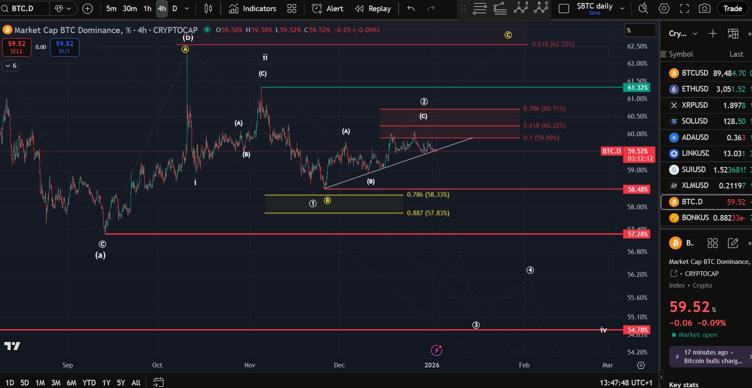
The observation by Justcryptopays regarding the break below a key trendline is grounded in classical technical analysis. For several months, Bitcoin had been supported by a diagonal trendline that guided its recovery from the lows of late 2025. The breach of this line indicates a loss of bullish momentum and suggests that the market may need to find a new equilibrium. When Bitcoin loses its "momentum lead," the Bitcoin Dominance Index (BTC.D) often begins to decline.
The Bitcoin Dominance Index measures Bitcoin’s market cap relative to the total market cap of all cryptocurrencies. During a full-blown altcoin season, this index typically drops significantly, sometimes falling from highs of 60% or 70% to below 40%. Analysts are closely watching this metric to confirm if the current trendline break is a temporary fluke or the start of a multi-month altcoin rally. If the dominance index continues to slip, it will provide the necessary "liquidity oxygen" for Ethereum and other altcoins to breathe and expand their market presence.

Chronology of the Current Market Cycle
To understand the current potential for an altcoin rally, it is necessary to examine the timeline of events leading into 2026. The year 2025 was marked by significant regulatory hurdles and macroeconomic uncertainty, which suppressed the appetite for riskier assets. High interest rates from the Federal Reserve and a stringent stance from the Securities and Exchange Commission (SEC) kept many altcoins in a state of prolonged accumulation.
By the fourth quarter of 2025, Bitcoin began a recovery phase, driven largely by institutional inflows into Spot Bitcoin ETFs. This rally culminated in the attempt to break and hold the $100,000 milestone, which ultimately proved unsuccessful, leading to the current consolidation around $90,000. As 2026 opened, the narrative shifted. With Bitcoin’s price discovery stalling, the market’s focus turned to the "Ethereum-Bitcoin" (ETH/BTC) pair, a classic indicator of altcoin health. The recent stabilization of this pair suggests that the worst of the altcoin bleed may be over, setting the stage for the resurgence currently being projected by Binance Research and independent analysts.
Spotlight on Leading Altcoins
In the event of a sustained capital rotation, several key assets are positioned to lead the charge. Ethereum remains the primary beneficiary of any altcoin-centric shift. Despite facing competition from faster Layer-1 blockchains, Ethereum’s recent network upgrades, focusing on scalability through Layer-2 solutions, have solidified its position as the foundational layer for DeFi.
Solana has also emerged as a formidable contender, frequently outperforming the broader market during short-term relief rallies. Its high throughput and low transaction costs have made it a favorite for retail traders and developers of decentralized applications (dApps). Similarly, XRP and Cardano continue to maintain strong community support and are often viewed as "laggards" that catch up rapidly once an altcoin season officially commences.
Beyond the established names, the market is seeing a resurgence in memecoins and niche sectors like Artificial Intelligence (AI) tokens and Real-World Asset (RWA) tokenization. While these assets carry higher risk, they are often the primary targets for speculative capital during periods of Bitcoin stagnation. The increased volatility in these sectors is a double-edged sword, offering significant upside for early movers while posing risks of rapid drawdowns.
Macroeconomic and Institutional Influences
The potential for an altcoin rally is not occurring in a vacuum. Broader economic factors play a crucial role in determining how capital is allocated. In early 2026, signals from central banks regarding a potential easing of monetary policy have provided a tailwind for risk-on assets. If inflation remains under control and interest rates begin a gradual descent, the resulting increase in global liquidity is likely to find its way into the crypto market.
Furthermore, the institutional landscape has evolved. The success of Bitcoin ETFs has paved the way for Ethereum ETFs, which have begun to see steady inflows. This institutional "stamp of approval" for Ethereum is vital, as it provides a regulated bridge for traditional finance (TradFi) to diversify away from Bitcoin. As more institutional products are developed for other altcoins like Solana or Chainlink, the barriers to entry for large-scale capital rotation will continue to diminish.
Challenges and Market Risks
Despite the optimistic outlook from some researchers, the path to a full altcoin season is fraught with challenges. The "bearish momentum of 2025" mentioned by Justcryptopays refers to the deep-seated resistance levels created during the previous year’s downtrend. Many altcoins are still trading 50% to 70% below their all-time highs, and breaking through these "overhead supply" zones requires immense buying pressure.
There is also the risk of a "fake-out," where Bitcoin breaks a trendline only to undergo a sharp correction that drags the entire market down with it. Historically, altcoins suffer more than Bitcoin during sharp market liquidations. Therefore, for a true altcoin season to occur, Bitcoin needs to remain relatively stable or move upward at a slow, controlled pace. Excessive volatility in Bitcoin—either to the upside or the downside—usually sucks the liquidity out of the altcoin market.
Analytical Implications for Investors
For investors and traders, the current market dynamic requires a strategic approach to portfolio rebalancing. The shift toward a more balanced market suggests that "maximalist" strategies—holding only Bitcoin—may underperform in the short to medium term compared to a diversified basket of high-quality altcoins. However, the transition also demands rigorous due diligence. Unlike the 2017 or 2021 cycles, the current market is highly fragmented, with thousands of tokens competing for limited attention.
The emphasis is now on "utility-driven" growth. Projects that demonstrate real-world usage, generate protocol revenue, and maintain active developer ecosystems are more likely to sustain their gains than those relying purely on hype. As capital rotates, the market is expected to become more discerning, rewarding innovation and adoption over mere speculation.
In summary, the breach of Bitcoin’s key trendline and its struggle to maintain the $90,000 level are more than just technical signals; they represent a potential pivot point in the 2026 market cycle. While Bitcoin remains the undisputed benchmark, the growing prominence of altcoins indicates a widening of the crypto economy. Whether this leads to a sustained "altcoin season" will depend on the market’s ability to overcome the psychological scars of 2025 and the continued evolution of institutional participation in the digital asset space. Vigilant monitoring of Bitcoin dominance, the ETH/BTC ratio, and macroeconomic indicators will be essential for those looking to capitalize on this emerging shift in market dynamics.














