The "Binance Listing Curse" in Crypto Markets
The phenomenon of a token experiencing a price downturn shortly after being listed on a major exchange like Binance is not new to the cryptocurrency landscape. This pattern, colloquially termed the "Binance listing curse," often arises from a confluence of factors. Primarily, a Binance listing provides unprecedented liquidity and accessibility to a token, attracting a wave of new retail investors. Simultaneously, it offers an ideal exit opportunity for early investors, venture capitalists, or large holders who may have accumulated significant positions at much lower prices. These large holders, often referred to as "whales," can leverage Binance’s deep order books to sell substantial blocks of tokens without significantly impacting the price on smaller, less liquid exchanges. The influx of selling pressure from these early participants, combined with potential profit-taking, can overwhelm the initial buying interest from new retail traders, leading to a temporary price dip or even a sustained correction. Binance itself acknowledges the inherent volatility of newly listed assets, often applying a "Seed Tag" to such tokens, which mandates a risk quiz for traders, signaling caution to its user base. This background context is crucial for understanding the immediate market reaction to HYPE’s Binance debut.
HYPE’s Anticipated Debut on Binance
Binance officially opened spot trading for HYPE on September 24, 2026, at 11:00 UTC. The exchange introduced three distinct trading pairs: HYPE/USDT, HYPE/USDC, and HYPE/TRY, with the latter specifically catering to verified Binance TR accounts. In a move that underscored its confidence in the asset while also acknowledging its potential volatility, Binance charged no listing fee for HYPE and affixed its "Seed Tag" to the token. This label serves as a cautionary indicator, reserved for assets that Binance identifies as unusually volatile or carrying higher investment risks, compelling users to complete a mandatory 90-day risk assessment before engaging in trading. The absence of a listing fee is often interpreted as a positive signal, suggesting Binance’s belief in the project’s organic merit rather than a transactional arrangement.
Immediate Market Reaction: A Price Correction Post-Listing

The timing of HYPE’s Binance listing proved particularly noteworthy. The token achieved its all-time high (ATH) of $97.96 on September 23, 2026, a mere day before its official listing went live on the global exchange. This pre-listing peak presented an almost perfect exit window for early investors and large holders, allowing them to capitalize on maximal gains just hours before a fresh wave of retail buyers was expected to enter the market. This specific sequence of events—an ATH immediately preceding a major exchange listing—alone laid fertile ground for the "listing curse" narrative, even before the first trade occurred on the new pairs.
Following the listing, HYPE did not experience the typical "listing pump" often anticipated by retail traders. Instead, the token’s price experienced an immediate correction, dropping approximately 4.5% to 6% on listing day itself. The price slid to around $90.50 as significant token blocks were moved through Binance’s considerably deeper order books. This pattern of selling pressure is much more efficiently executed on a larger exchange, where the liquidity can absorb substantial trades without causing drastic price swings, unlike on smaller, more nascent platforms such as Hyperliquid’s own. While there was a brief recovery attempt within the first week, pushing the price back toward $94 (a modest 6% increase from the post-listing low), this rebound proved unsustainable.
Unpacking the Selling Pressure: The Liquidity Event Hypothesis
As of recent market observations, HYPE has continued its downward trend, trading around $85.99. This represents a further decline of 1.82% on the day, with a 24-hour trading range between $84.87 and $89.08. Broader market data from CoinGecko corroborates this pressure, showing a 7-day decline of 7.8% for HYPE. This underperformance is particularly striking when juxtaposed against the global crypto market, which saw only a 2.4% decline over the same period. From its pre-listing all-time high of $97.96 to its current price near $86, HYPE has experienced a drawdown of approximately 12% in less than a week. This specific pattern of post-listing underperformance is precisely what proponents of the "Binance listing curse" narrative frequently highlight, suggesting that the initial hype surrounding a major listing often serves as a liquidity event for entrenched holders rather than a catalyst for immediate price appreciation.
This reaction is far from unique to HYPE; it is a recurring theme in the cryptocurrency market. A Binance listing routinely functions as a significant liquidity event, particularly for those who held the token before its widespread accessibility to retail investors. The expanded order books on such a large exchange empower substantial holders to execute significant sell orders without adversely moving the market against their own positions, a feat that would be considerably more challenging on smaller trading venues. This dynamic appears to have unfolded with HYPE in the hours and days immediately following its Binance debut. The prevailing market FUD (fear, uncertainty, and doubt) surrounding post-listing performance is, therefore, not baseless but rather rooted in a historical pattern observed across numerous tokens, cementing its status as a recurring crypto-market cliché.
A Divergent Narrative: Strong On-Chain Fundamentals and Treasury Activity

Despite the observable price depreciation on spot markets, the underlying data from Hyperliquid’s ecosystem presents a strikingly different and far more optimistic picture. This dichotomy reveals a fundamental strength that stands in stark contrast to the immediate market sentiment reflected in HYPE’s price action.
Hyperliquid Strategies: A Vote of Confidence from Within
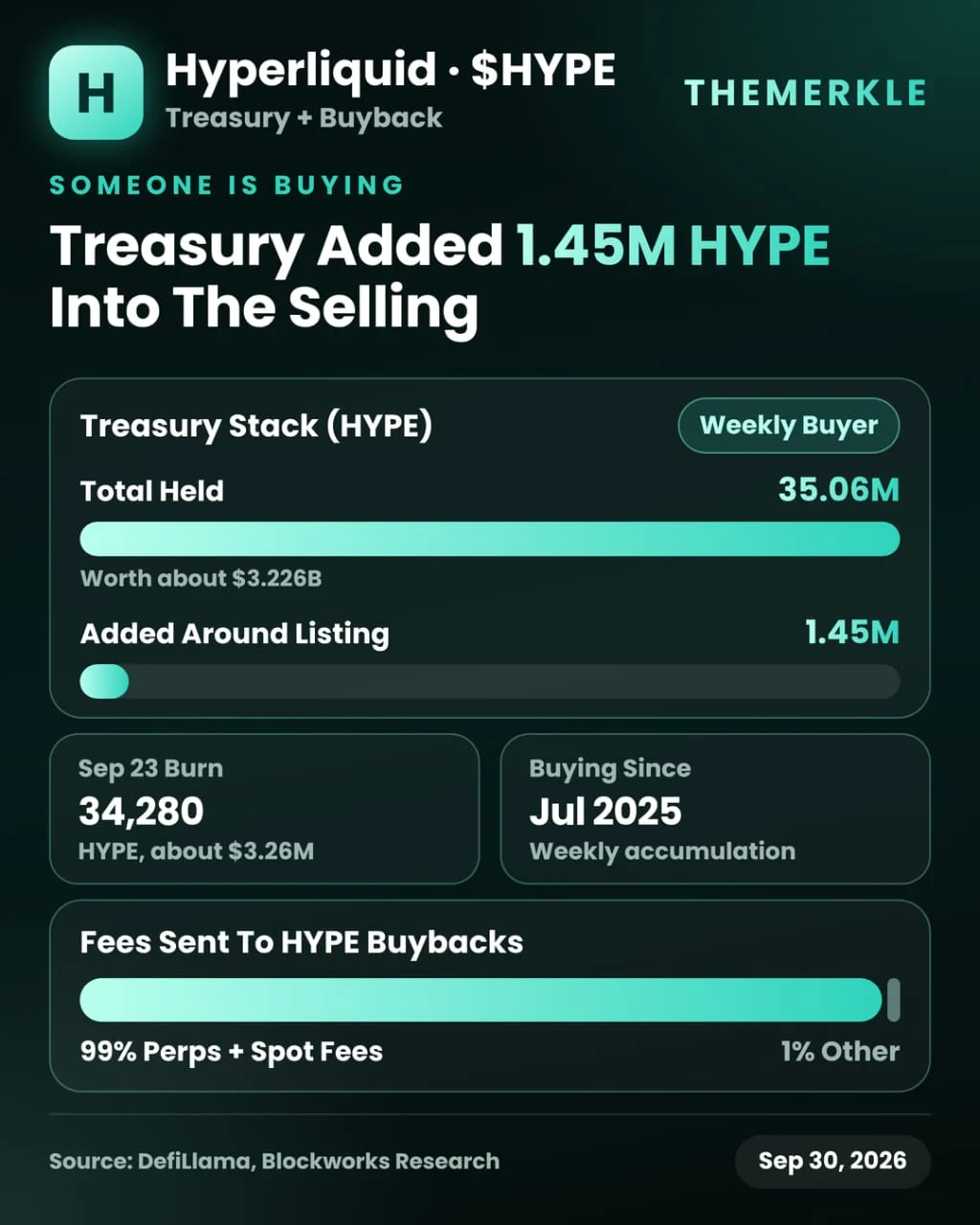
One of the most compelling counter-narratives emerges from the actions of Hyperliquid Strategies, the entity that holds HYPE as its primary treasury asset. According to its purchase history detailed on DefiLlama’s Hyperliquid Strategies treasury dashboard, the entity actively added 1.45 million HYPE to its position during the reporting period encompassing the Binance listing. This substantial accumulation directly coincided with the open market selling into Binance’s fresh liquidity.
Furthermore, the DefiLlama page illustrates a consistent pattern of weekly accumulation by Hyperliquid Strategies, a trend that dates back to the company’s inaugural announced purchase in July 2025. This sustained buying has resulted in total current holdings of approximately 35.06 million HYPE, valued at an impressive $3.226 billion. This position represents by far the largest corporate holding of the token. The behavior of a treasury actively adding to its stack at such a scale, precisely when the broader market is offloading tokens into new liquidity, strongly suggests a profound internal conviction in the token’s long-term value. This is decidedly not the action of an insider cashing out; rather, it is indicative of the opposite – a strategic strengthening of position.
The Protocol’s Deflationary Engine: Automated Buybacks and Burns
Beyond the treasury’s strategic accumulation, a significant structural buyback mechanism operates continuously in the background, a crucial detail often overlooked in immediate listing-day headlines. Hyperliquid maintains an Assistance Fund designed to automatically convert 99% of its perpetual futures fees and 99% of its spot trading fees into HYPE purchases. These purchased tokens are then immediately burned, permanently removing them from circulation. This inherent deflationary pressure works ceaselessly, independent of the token’s spot price fluctuations.

Data from Blockworks Research’s Hyperliquid AF Buyback Summary dashboard provides concrete evidence of this mechanism’s impact. On September 23, the day preceding the Binance listing, this automated system executed a substantial buyback and burn of 34,280 HYPE tokens, valued at approximately $3.26 million. This continuous, protocol-level buyback and burn initiative serves as a powerful testament to the project’s commitment to creating long-term value for HYPE holders, consistently reducing supply irrespective of short-term market sentiment.
Surging Usage Metrics: Beyond the Spot Price
The most direct indicators of a protocol’s health and utility are its usage statistics, and Hyperliquid’s figures paint a picture of burgeoning activity and robust growth. According to DefiLlama’s Hyperliquid dashboard, the protocol generated an impressive $72.66 million in fees over the past 30 days. Of this, $56.33 million was counted as protocol revenue, translating to an annualized rate of $911.46 million in fees and $687.95 million in revenue. These figures underscore the substantial economic activity occurring within the Hyperliquid ecosystem.
Its perpetual futures arm, a core component of the platform, processed an astonishing $190.782 billion in trading volume over the same 30-day window, as reported on DefiLlama’s Hyperliquid Perps page. Such immense trading volume not only highlights the platform’s liquidity and appeal to derivatives traders but also directly feeds into the automated buyback and burn mechanism, reinforcing HYPE’s deflationary tokenomics.
Further solidifying the narrative of underlying strength, Hyperliquid’s Total Value Locked (TVL) increased by 10% over the past 30 days. This growth in TVL indicates a continued inflow of capital into the ecosystem, signifying that users are actively depositing and utilizing assets within the protocol even as the HYPE token price experiences a short-term slide. This suggests a strong user base that values the protocol’s utility over immediate price movements.
External Validation: HYPE’s Dominance on Sunrise Protocol

Perhaps the clearest and most compelling evidence of HYPE’s intrinsic demand comes from an entirely separate platform. Sunrise, a Solana-based liquidity protocol, recorded its highest weekly trading volume ever during the week of September 21 to 27. Remarkably, HYPE emerged as the undisputed leader across this entire leaderboard, commanding $213.84 million in volume. This figure represents nearly 22% of Sunrise’s record $977.6 million weekly total, according to Blockworks Research’s Sunrise dashboard. A token does not casually lead a record-breaking week on an entirely distinct and prominent liquidity platform by accident. This exceptional performance on Sunrise unequivocally demonstrates a profound and active demand for HYPE, indicative of its utility and liquidity across the broader decentralized finance landscape.
Reconciling Two Truths: Price Volatility Versus Fundamental Strength
The Hyperliquid HYPE case study is genuinely interesting precisely because it compels observers to reconcile two seemingly contradictory truths simultaneously. On one hand, the price chart unequivocally supports the prevailing "Binance listing curse" narrative: HYPE’s listing occurred at arguably the least opportune moment, immediately following its all-time high, and has since endured an approximate 12% bleed, notably underperforming the broader cryptocurrency market. This aligns perfectly with the hypothesis that major exchange listings often trigger profit-taking from early investors leveraging enhanced liquidity.
On the other hand, the array of robust fundamental metrics paints a vastly different picture. The consistent and aggressive accumulation of HYPE by Hyperliquid Strategies, the relentless operation of the protocol’s automated buyback and burn mechanism (which, for example, removed $3.26 million worth of HYPE in a single day), the burgeoning fee revenue ($72.66 million in 30 days), the colossal perpetual futures trading volume ($190.782 billion in 30 days), and the sustained 10% growth in Total Value Locked (TVL) all collectively point to a protocol whose actual usage and underlying economic activity have not only remained robust but are actively expanding. Furthermore, HYPE’s dominance in trading volume on an entirely separate platform like Sunrise underscores a deep and organic demand that transcends its immediate spot price movements on centralized exchanges.
The Road Ahead: What to Watch
This stark divergence between market sentiment, as reflected in the token’s price, and the undeniable strength of its on-chain fundamentals creates a critical juncture for HYPE. Investors and market observers will be keenly watching to see which narrative ultimately prevails. Will the intrinsic value and growing utility, driven by surging fees, consistent treasury buying, and a powerful deflationary mechanism, eventually exert enough gravitational pull to lift the price back up? Or will the short-term selling pressure, exacerbated by the "Binance listing curse" phenomenon and large holder liquidations, continue to dictate the token’s trajectory in the immediate future? The resolution of this tension will not only be pivotal for HYPE but will also offer valuable insights into the complex interplay between market psychology, liquidity dynamics, and fundamental value in the volatile world of decentralized finance.

Disclosure: This is not trading or investment advice. Always do your research before buying any cryptocurrency or investing in any services.
Follow us on Twitter @themerklehash to stay updated with the latest Crypto, NFT, AI, Cybersecurity, and Metaverse news!