


The proliferation of deepfake technology has ushered in a new era of sophisticated fraud, particularly within the volatile cryptocurrency market. While initial perceptions might suggest that only those unfamiliar with digital security or the intricacies of crypto assets would fall prey to such schemes, evidence increasingly demonstrates the opposite. Highly educated and digitally literate individuals, including engineers and finance professionals who possess a nuanced understanding of blockchain technology, are consistently found among the victims. This phenomenon underscores a critical shift in the nature of online deception: scams are no longer solely designed to exploit ignorance but rather to manipulate the human element at moments of heightened emotional susceptibility or cognitive overload. The sophisticated orchestration of these scams transforms them from mere digital trickery into a profound challenge to digital trust and individual vigilance, operating at the intersection of advanced AI and classic psychological manipulation.
The Ascendance of Deepfake Fraud: A New Digital Frontier for Deception
Deepfake technology, initially a niche tool for entertainment or satire, has rapidly evolved into a potent instrument for financial fraud. Leveraging artificial intelligence, deepfakes can generate highly realistic video, audio, and images of individuals saying or doing things they never did. The accessibility and improving quality of these tools have lowered the barrier for entry for malicious actors, enabling them to create incredibly convincing impersonations of public figures, corporate executives, and even government officials. This technological leap has coincided with the booming cryptocurrency market, creating a fertile ground for scams that capitalize on both the allure of digital wealth and the perceived credibility of trusted personalities. The primary mechanism often involves promises of exorbitant returns on investment, typically structured as "giveaways" or "reward schemes" that demand an initial deposit of cryptocurrency with the false promise of a multiplied return.
Anatomy of Deception: A Chronology of High-Profile Impersonations
The operational blueprint for these deepfake crypto scams has become alarmingly consistent, relying on a combination of technological prowess and acute psychological insight. Several landmark cases illustrate this progression and reveal the common threads woven through successful deceptions.
June 2024: The Tesla-Musk Impersonation and its Viral Reach
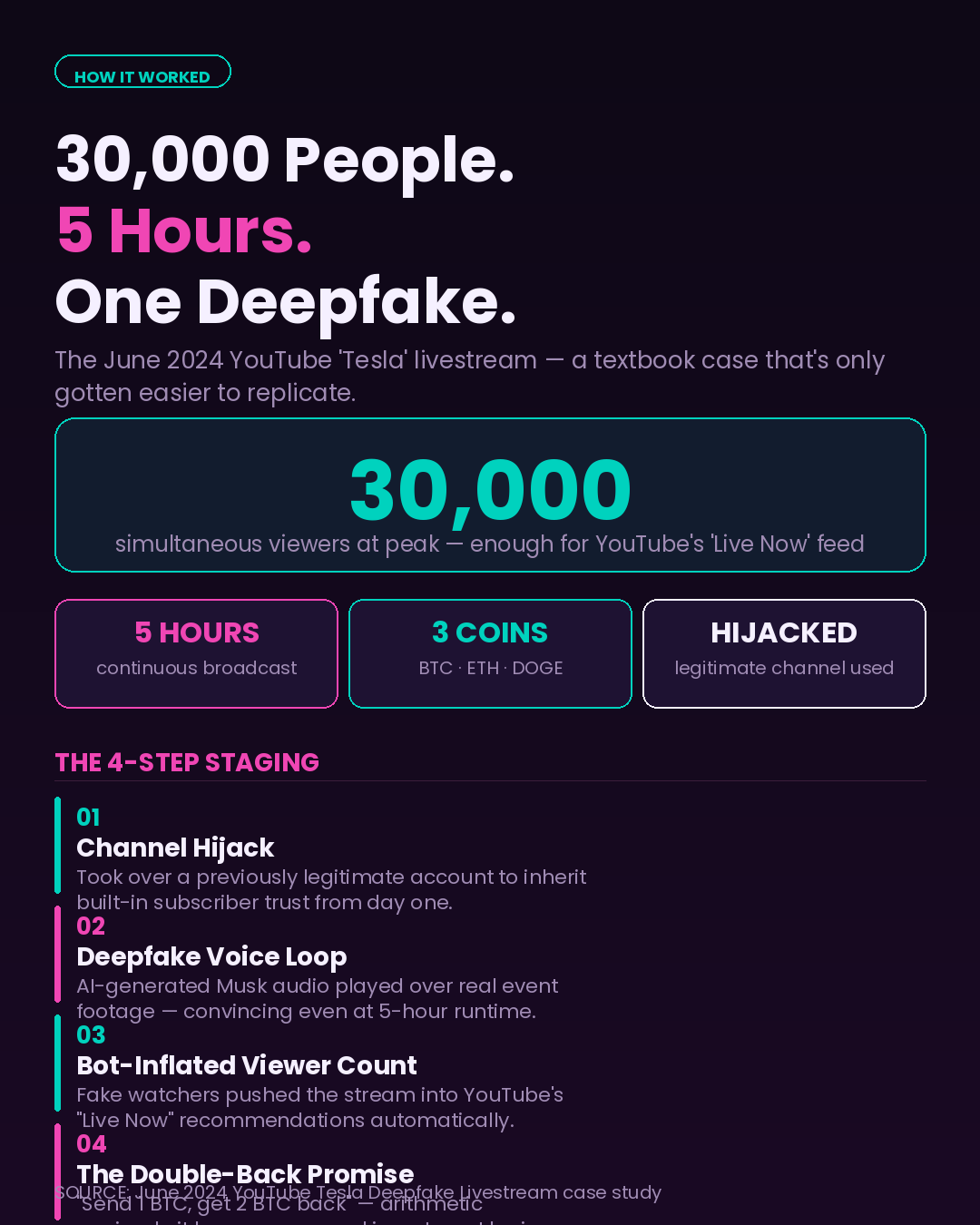
A pivotal case study emerged in June 2024, setting a precedent for the efficacy of deepfake livestream scams. A YouTube channel, deceptively branded as an official Tesla account, broadcast a five-hour livestream featuring a deepfake of Elon Musk. The AI-generated voice, meticulously synchronized with repurposed footage of Musk from various public appearances, delivered instructions to viewers. The core of the scam was a classic "send one, get two back" proposition: viewers were urged to send Bitcoin, Ethereum, or Dogecoin to a displayed wallet address, with the promise of receiving double the amount in return.

The meticulous staging of this event was critical to its success. Scammers did not merely create a deepfake; they orchestrated the entire environment to maximize credibility and reach. The stream was strategically timed to coincide with high-traffic periods, leveraging the digital noise to blend in. Crucially, the channel itself was not newly created but a previously legitimate account that had been hijacked. This tactic allowed the scammers to inherit a pre-existing subscriber base and, more importantly, the accumulated trust associated with the channel’s history. The viewer count, inflated by bots, soared to approximately 30,000 simultaneous watchers, a figure substantial enough to propel the stream into YouTube’s coveted "Live Now" recommendations. This algorithmic boost exponentially expanded the scam’s reach, exposing it to a vast audience beyond the hijacked channel’s original subscribers. The visual and auditory fidelity of the deepfake, combined with the context of a "trusted" source and massive "social proof," created an almost irresistible illusion of legitimacy, leading to significant financial losses for many participants.
July 2025: Ripple’s Brad Garlinghouse and the XRP Reward Scheme
The problem extended far beyond Elon Musk’s public persona. In July 2025, the cryptocurrency community witnessed another high-profile deepfake incident, this time targeting Ripple CEO Brad Garlinghouse. A video widely circulated depicted a deepfake of Garlinghouse endorsing an XRP "reward scheme," promising similar unrealistic returns. The quality of the deepfake was convincing enough to sow widespread confusion and prompt numerous individuals to consider participation. The gravity of the situation was underscored when Ripple’s Chief Technology Officer (CTO) was compelled to issue a public debunking, directly addressing the scam and clarifying that Garlinghouse had made no such endorsements. The necessity of such a high-level corporate response highlights the profound impact these deepfakes have on corporate reputation and investor confidence, forcing companies to actively combat disinformation campaigns that directly threaten their brand and user base.
Early 2026: The Musk Crypto Casino and News Cycle Exploitation
The pattern of exploiting current events continued into early 2026. Scammers fabricated a deepfake "pinned post" attributed to Elon Musk, promoting a crypto casino giveaway. This scam was deliberately timed to ride the news cycle following Musk’s real, unrelated court testimony concerning cryptocurrency. By synchronizing their fraudulent campaigns with genuine public interest surrounding a prominent figure and relevant topics, scammers amplify their reach and lend an additional layer of spurious authenticity to their schemes. This tactic leverages the public’s existing attention and association with real events, blurring the lines between verified news and malicious propaganda.
Across every documented instance, a clear modus operandi emerges: select a public figure who commands inherent trust and widespread recognition, connect their likeness to a current, relevant event, and then harness that borrowed credibility to persuade potential victims in a way the scam could never achieve on its own merits. This strategy effectively bypasses initial skepticism by leveraging pre-existing relationships of trust and attention.
The Staggering Scale of Deepfake-Enabled Fraud
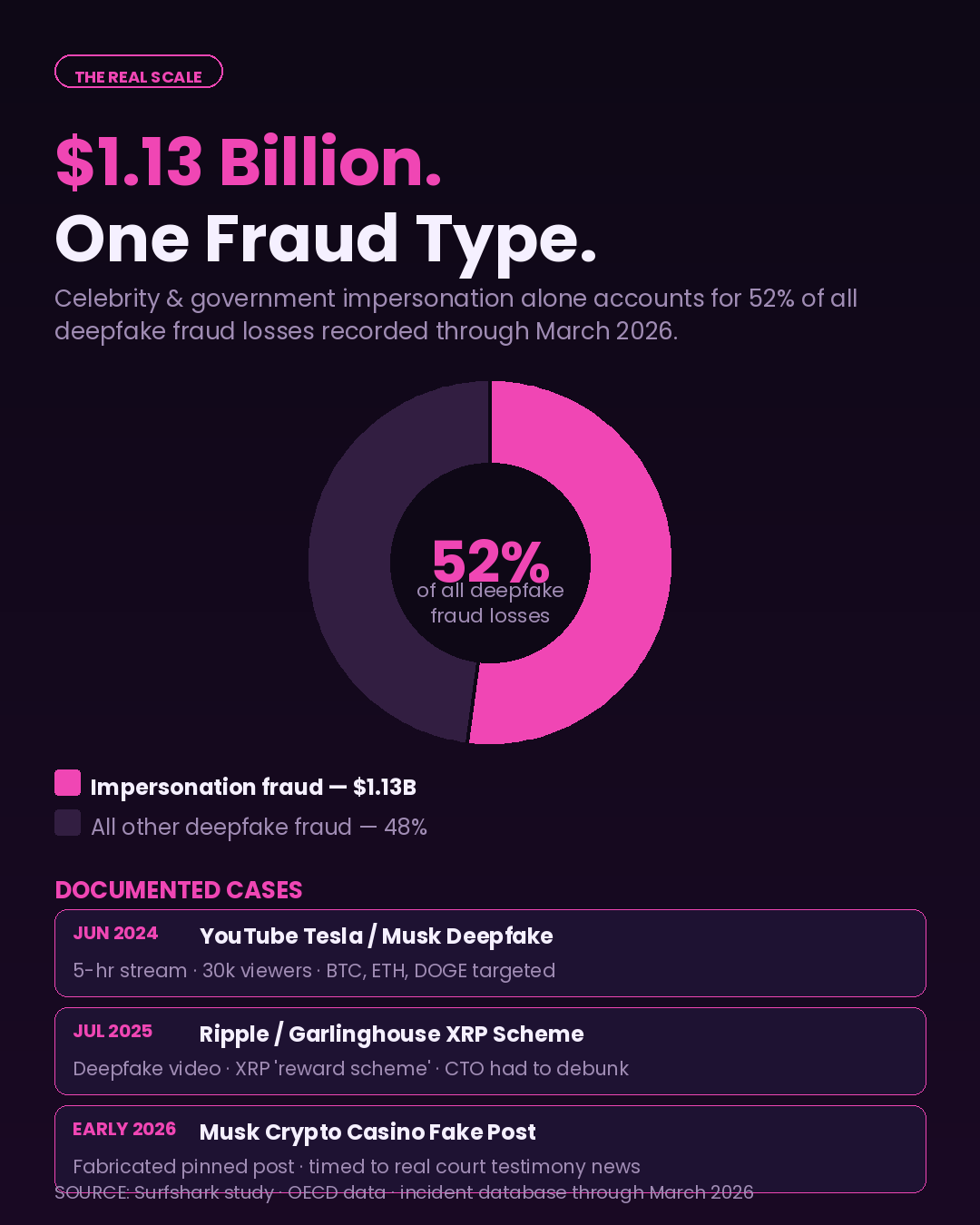
These incidents are not isolated anomalies but represent a significant and growing category of financial fraud. The scale of deepfake-related losses is alarming and underscores the urgency of addressing this evolving threat. A comprehensive study by Surfshark, drawing on incident-database and OECD data through March 2026, revealed that celebrity and government impersonation accounts for an astonishing $1.13 billion in deepfake-related losses. This figure represents close to 52% of all recorded deepfake fraud, positioning it as the single largest segment within this burgeoning category of cybercrime.
Beyond specific deepfake incidents, the broader landscape of crypto fraud paints an even grimmer picture. According to reports from the FBI’s Internet Crime Complaint Center (IC3) and blockchain analytics firms like Chainalysis, billions of dollars are lost annually to various cryptocurrency scams, including investment fraud, romance scams, and rug pulls. Deepfake impersonation significantly exacerbates this problem by adding a layer of sophisticated legitimacy that traditional phishing or scam tactics often lack. For instance, Chainalysis’s 2023 Crypto Crime Report highlighted that scams remained a significant component of illicit crypto activity, demonstrating the persistent vulnerability of investors. The integration of deepfake technology into these schemes makes detection harder, verification more complex, and recovery nearly impossible once funds are transferred. This staggering financial impact solidifies deepfake fraud as a dominant and deeply concerning phenomenon, built almost entirely on the calculated exploitation of borrowed faces and borrowed trust.
The Psychological Levers Doing the Actual Work
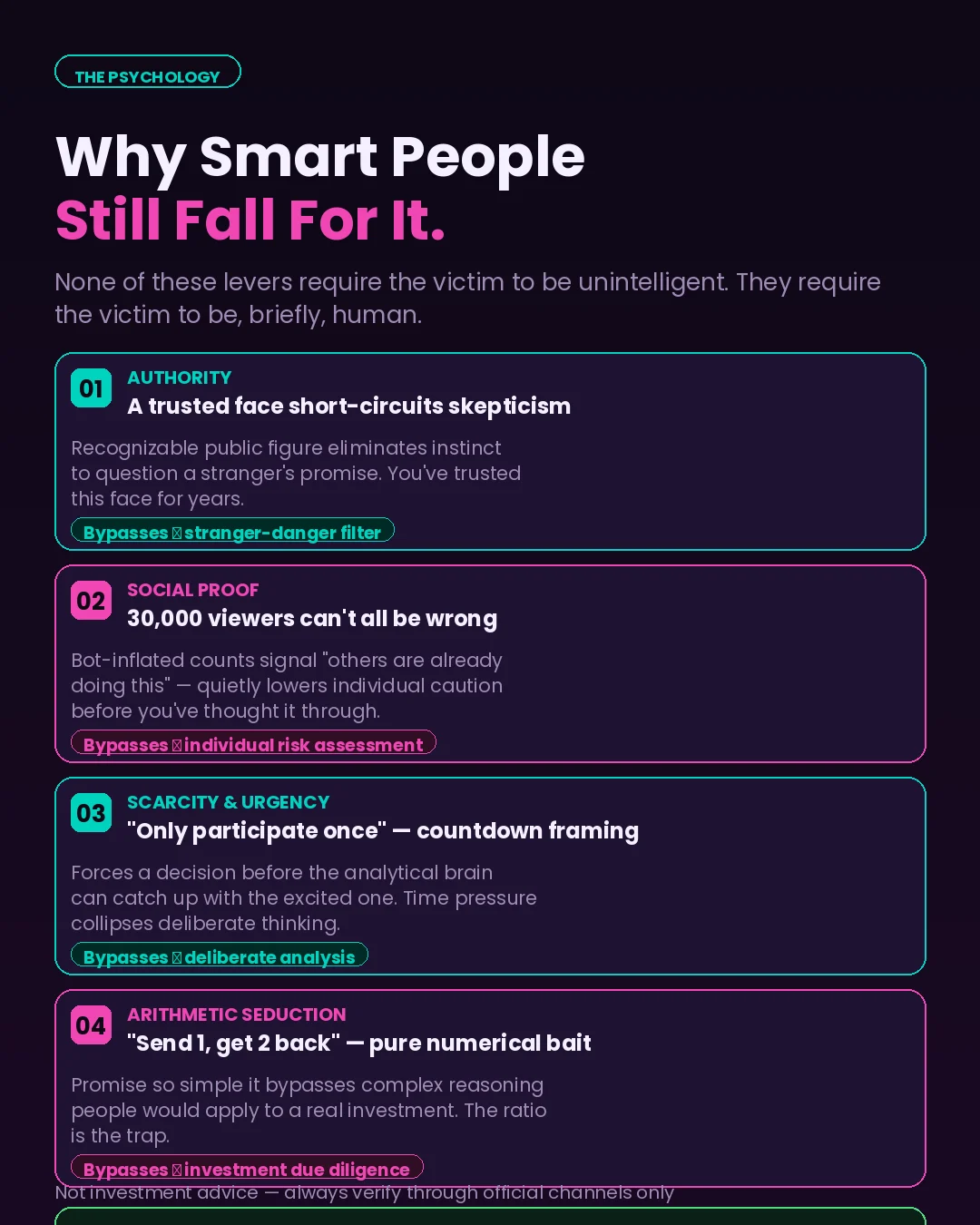
The persistent question of "how smart people fall for this" finds its answer not in technological flaws, which are increasingly imperceptible, but in the sophisticated manipulation of human psychology. These scams are meticulously engineered around a small, potent set of well-documented psychological pressure points, strategically layered to disarm even the most cautious individuals.
- Authority Bias: This is the primary lever. Humans are inherently predisposed to defer to authority figures. When a recognizable and trusted face—be it Elon Musk, Brad Garlinghouse, or another public figure—appears to endorse an offer, it immediately short-circuits the skepticism that individuals would typically apply to a stranger’s promise. The perceived authority lends an almost unquestionable legitimacy to the scheme, bypassing critical analysis.
- Social Proof: The presence of a massive, albeit artificially inflated, viewer count on a livestream acts as powerful social proof. The sight of tens of thousands of concurrent watchers signals, "other people are already doing this," or "if so many people are watching, it must be legitimate." This subtly lowers individual caution and triggers a herd mentality, making it harder for individuals to stand out by being skeptical. It validates the perceived authority and reduces the cognitive effort required to evaluate the offer independently.
- Scarcity and Urgency: Scammers expertly employ language designed to create a sense of scarcity and urgency. Phrases like "you can only participate once," "limited time offer," or countdown timers push potential victims to act impulsively. This pressure tactic bypasses the analytical, skeptical part of the brain, forcing decisions to be made quickly under emotional duress, often driven by fear of missing out (FOMO) or the perceived opportunity for rapid gain.
- Greed and the "Too Good to Be True" Fallacy: The simple arithmetic seduction of "send one, get two back" taps directly into a fundamental human desire for wealth and rapid returns. This promise, while objectively unrealistic, is often compelling enough to bypass the more complex reasoning people would typically apply to an investment decision. It preys on greed and the irrational hope for a shortcut to financial prosperity, clouding judgment and making individuals overlook obvious red flags.
None of these psychological levers require the victim to be unintelligent or technically illiterate. Instead, they demand that the viewer be, however briefly, human—excited by potential gains, time-pressured, and subconsciously pattern-matching against a face they have trusted or admired for years. This combination creates a perfect storm where critical faculties are temporarily suspended, allowing the scam to take hold.
The Digital Battlefield: Platform Responses and Regulatory Challenges
The proliferation of deepfake crypto scams presents significant challenges for both technology platforms and regulatory bodies. Platforms like YouTube, Twitch, and X (formerly Twitter) are often the primary conduits for these livestreams and posts, placing them at the forefront of the fight against this type of fraud.
Platform Accountability and AI Detection: Technology companies are under increasing pressure to implement more robust content moderation and AI-driven detection systems. While many platforms state they are investing heavily in AI to identify and remove deepfakes and fraudulent content, the rapid evolution of deepfake technology often outpaces detection capabilities. Scammers constantly adapt their methods, finding new ways to circumvent filters, hijack accounts, and amplify their content through bot networks. The sheer volume of content uploaded and livestreamed daily makes comprehensive, real-time human moderation impractical, creating an ongoing arms race between malicious actors and platform security teams. Furthermore, the global nature of these platforms means that content originating from one jurisdiction can quickly spread worldwide, complicating enforcement efforts.
Law Enforcement and Regulatory Efforts: Tracing cryptocurrency transactions, while often recorded on public ledgers, presents significant challenges for law enforcement dueance to the pseudonymous nature of wallets and the cross-border jurisdiction issues. Recovering stolen funds is notoriously difficult once they are laundered through mixers or quickly converted into other assets. Governments and international organizations are grappling with how to regulate deepfake technology and its malicious applications. Discussions around mandating disclosure for AI-generated content, increasing penalties for deepfake fraud, and fostering international cooperation to track and apprehend perpetrators are ongoing. However, legal frameworks often lag behind technological advancements, leaving a significant gap in effective deterrents and punitive measures. Financial regulators globally issue warnings about crypto scams, but the decentralized and borderless nature of cryptocurrency makes centralized oversight difficult.
Fortifying Defenses: Practical Strategies for Digital Resilience
While the technology behind deepfakes continues to improve, the most consistent and effective defense against these scams remains remarkably simple and has little to do with spotting visual glitches in the deepfake itself. These glitches are often too subtle or non-existent for the average viewer to catch in real-time.
- The Infallible Arithmetic Check: This is the single most crucial defense mechanism. No legitimate entity, whether a celebrity, a corporation, or a government body, will ever send back more cryptocurrency than it receives as part of a "giveaway" or "investment opportunity." The moment an offer promises to double, triple, or otherwise multiply your money simply for sending it first, the specific face on the screen becomes irrelevant. The offer itself is the definitive tell, not the video quality. This principle holds true universally: if it sounds too good to be true, it invariably is.
- Verify Through Official Channels: Never rely solely on a livestream link, a viral video, or an unsolicited message. Always verify claims through the company’s or individual’s official, established channels. This means visiting their official website (typing the URL directly, not clicking links), checking verified social media accounts (looking for blue checkmarks and consistent messaging), or consulting reputable financial news outlets that would report on legitimate initiatives. Any legitimate giveaway or announcement would be prominently featured on these official platforms, not exclusively through a fleeting livestream.
- Skepticism Towards Urgency and Scarcity: Be highly suspicious of any communication that pressures you to act immediately, without time for due diligence. Scammers thrive on urgency to prevent critical thinking. Legitimate opportunities rarely demand instantaneous decisions under duress.
- Enhance Digital Literacy and Critical Thinking: Cultivate a habit of critical evaluation for all online content, especially those involving financial transactions. Understand the basic principles of how cryptocurrencies work, including the irreversible nature of transactions. Be aware of common scam tactics and psychological manipulation techniques. Education is a powerful preventative tool.
- Secure Your Accounts: While not directly related to deepfake detection, maintaining strong cybersecurity practices, such as using unique, complex passwords, enabling two-factor authentication (2FA) on all crypto exchanges and digital wallets, and using hardware wallets for significant holdings, adds layers of protection against broader crypto-related threats that often accompany these scams.
The Future of Digital Trust
The rise of deepfake crypto scams poses a profound challenge to the future of digital trust. As AI-generated content becomes indistinguishable from reality, the ability to discern truth from fabrication will become increasingly difficult. This has far-reaching implications, not only for financial security but also for public discourse, political integrity, and the very fabric of online interaction. The ongoing arms race between scammers developing more sophisticated deepfakes and security experts creating better detection tools will continue. However, technology alone cannot solve this problem. A multi-faceted approach involving advanced AI detection, robust platform policies, proactive law enforcement, and, critically, a globally educated and vigilant user base is essential. The onus is increasingly on individuals to develop a heightened sense of digital resilience, understanding that what appears on screen may not always be what it seems, and that the most dangerous deceptions often target the mind, not just the wallet.














