This enduring pattern was once again demonstrated in real-time this week, as an address linked to the recent Triple-A exploiter commenced the movement of millions into Tornado Cash, one of the cryptocurrency industry’s most notorious laundering tools. This occurred despite years of concerted efforts by the U.S. government and international bodies to neutralize its effectiveness as a conduit for illicit funds. For seasoned observers of the digital asset space, the predictability of this sequence is no longer surprising, yet the sheer speed and methodical nature of the laundering process continue to underscore the persistent challenges faced by law enforcement and security professionals.
The Triple-A Breach: A Detailed Account of an $11.8 Million Exploit
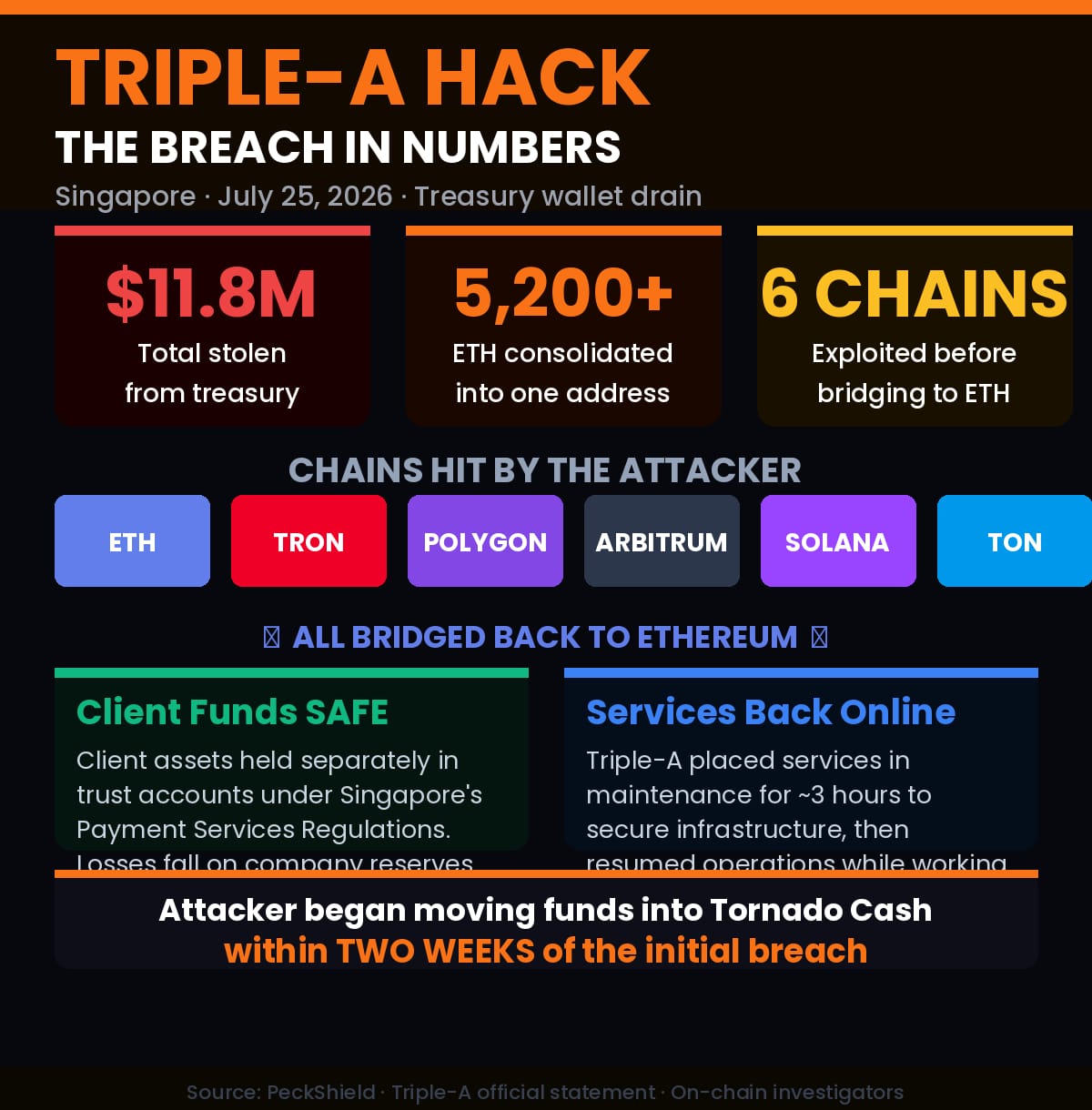
To fully grasp the significance of the funds’ movement, it is essential to understand the genesis of the exploit. Triple-A, a prominent Singapore-based fiat-to-crypto payment gateway, confirmed an unauthorized drain of its treasury wallets on July 25, 2026. Initially, reported losses stood around $9.3 million, but subsequent on-chain investigations revealed additional outflows, escalating the total misappropriated sum to approximately $11.8 million.
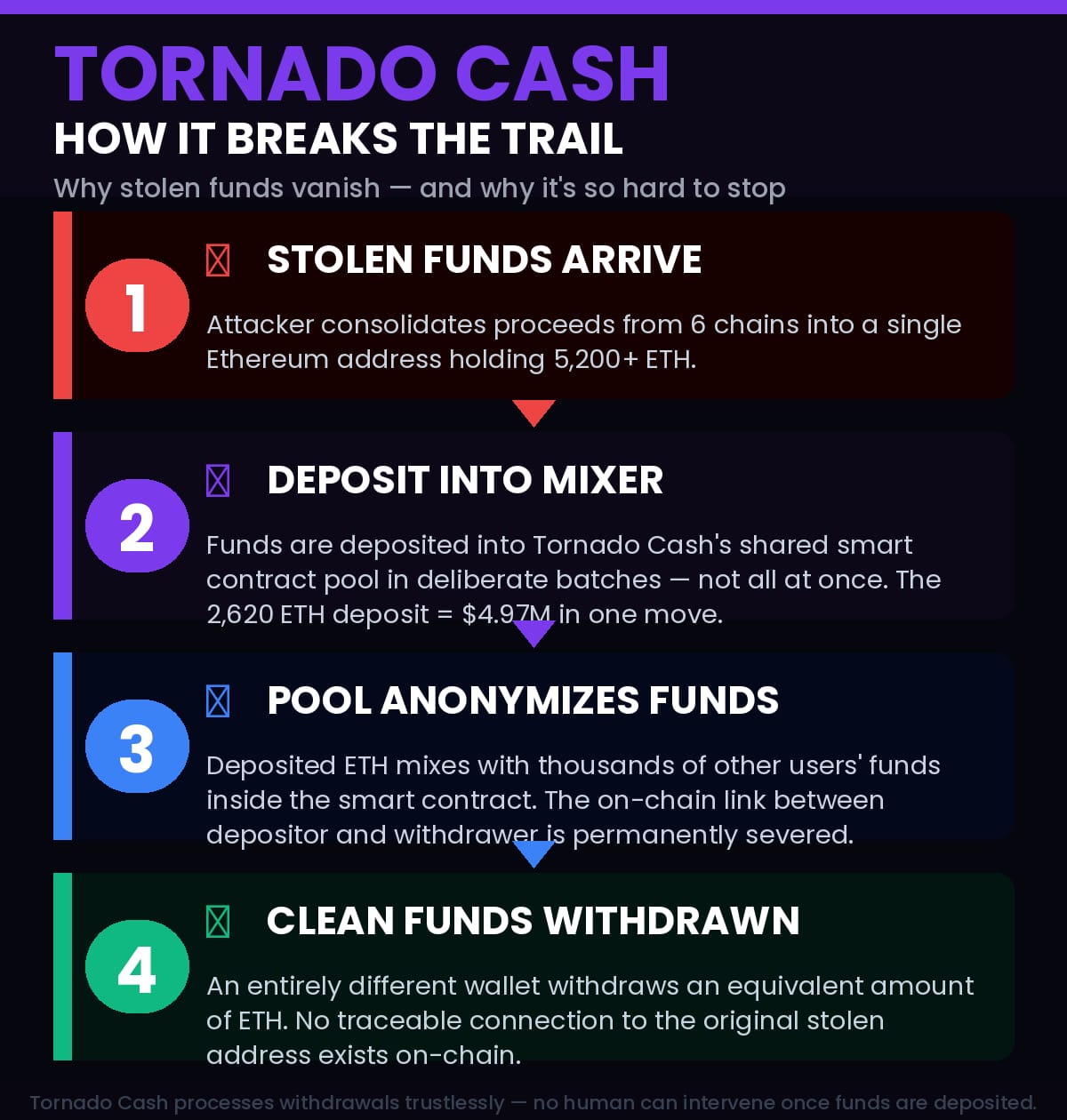
The attackers demonstrated a sophisticated understanding of cross-chain liquidity and asset consolidation. Funds were siphoned from a diverse array of blockchain networks, including Ethereum, TRON, Polygon, Arbitrum, Solana, and The Open Network (TON). This multi-chain attack strategy is indicative of an increasingly prevalent tactic employed by sophisticated threat actors, aiming to complicate forensic tracing and distribute risk across different ecosystems before consolidating the proceeds. Following the initial drain, the stolen assets were systematically bridged back to the Ethereum network, ultimately converging into a single address holding more than 5,200 ETH, preparing them for the next stage of the laundering process.
Triple-A swiftly issued a public statement via its newsroom, providing critical clarity regarding the incident. The company assured its clientele that user funds remained unaffected. This was attributed to Triple-A’s operational structure, which mandates the segregation of client assets into trust accounts held with independent custodians, in strict adherence to Singapore’s robust Payment Services Regulations. Consequently, the financial burden of the exploit falls entirely on the company’s own reserves, mitigating direct impact on individual users. The breach was specifically isolated to wallets operated by Triple A Technologies Pte. Ltd., their Singaporean entity, with no other Triple-A entities compromised. In the immediate aftermath, services were temporarily placed into maintenance mode for approximately three hours to secure infrastructure and prevent further unauthorized access. The company confirmed active collaboration with internal and external cybersecurity experts, leading blockchain forensics specialists, and the Singapore Police Force to trace and potentially recover the stolen assets. Such collaborative efforts are standard industry practice, though the success rate of recovery often hinges on the speed of tracing and the cooperation of various ecosystem participants.
A Fresh Deposit Reignites an Old Question: The Mechanics of a Mixer

The recent deposit into Tornado Cash was promptly flagged by blockchain security firm PeckShield. Their analysis revealed that the exploiter-labeled address tied to the Triple-A hack deposited 2,620 ETH, valued at approximately $4.97 million at the time of the transaction, directly into the mixer. This substantial sum represents a significant portion of the consolidated stolen funds.
What particularly drew the attention of analysts was not merely the volume of the deposit but its strategic timing and execution. Occurring barely two weeks after the initial breach, the attacker is not engaging in a single, panicked dump of all funds. Instead, the stolen ETH is being moved through Tornado Cash in batches. This calculated approach is characteristic of deliberate money laundering operations rather than a frantic attempt to dispose of assets. It suggests a pre-planned strategy aimed at maximizing anonymity and minimizing the risk of detection or seizure, indicating a professional and well-resourced adversary.
Understanding why Tornado Cash is consistently chosen by exploiters requires an appreciation of its fundamental mechanics. Unlike a centralized exchange or a specific wallet, Tornado Cash operates as a decentralized, non-custodial smart contract system. Users deposit cryptocurrency into a shared pool, which functions as a large, undifferentiated reservoir of funds. Subsequently, users can withdraw an equivalent amount of crypto from this pool to a completely different address, effectively severing the on-chain link between the original sender and the new recipient. This fundamental design feature is precisely what appeals to both privacy-conscious legitimate users and malicious actors seeking to obscure the origins of illicit funds. The protocol itself, being code-based and permissionless, does not discriminate between these user types, a neutrality that forms the core of its regulatory challenge.
For an individual or group in possession of newly acquired, illicit gains—such as the $11.8 million from the Triple-A hack—the advantages of a decentralized mixer like Tornado Cash are evident. Centralized exchanges are subject to Know Your Customer (KYC) and Anti-Money Laundering (AML) regulations, enabling them to freeze accounts, flag suspicious deposits, and cooperate directly with law enforcement agencies through subpoenas and data requests. A decentralized mixer, by contrast, operates autonomously. Its underlying smart contracts continue to execute across thousands of nodes in a distributed network, impervious to direct legal injunctions or the seizure of a single entity. This structural resilience against traditional regulatory and enforcement mechanisms is precisely why attackers have consistently relied upon such tools for years, and why the Triple-A exploiter appears to be following this well-established, albeit illicit, playbook.
A History of Controversy: Tornado Cash and Global Regulation
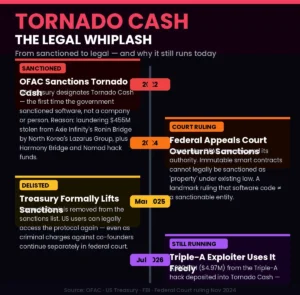
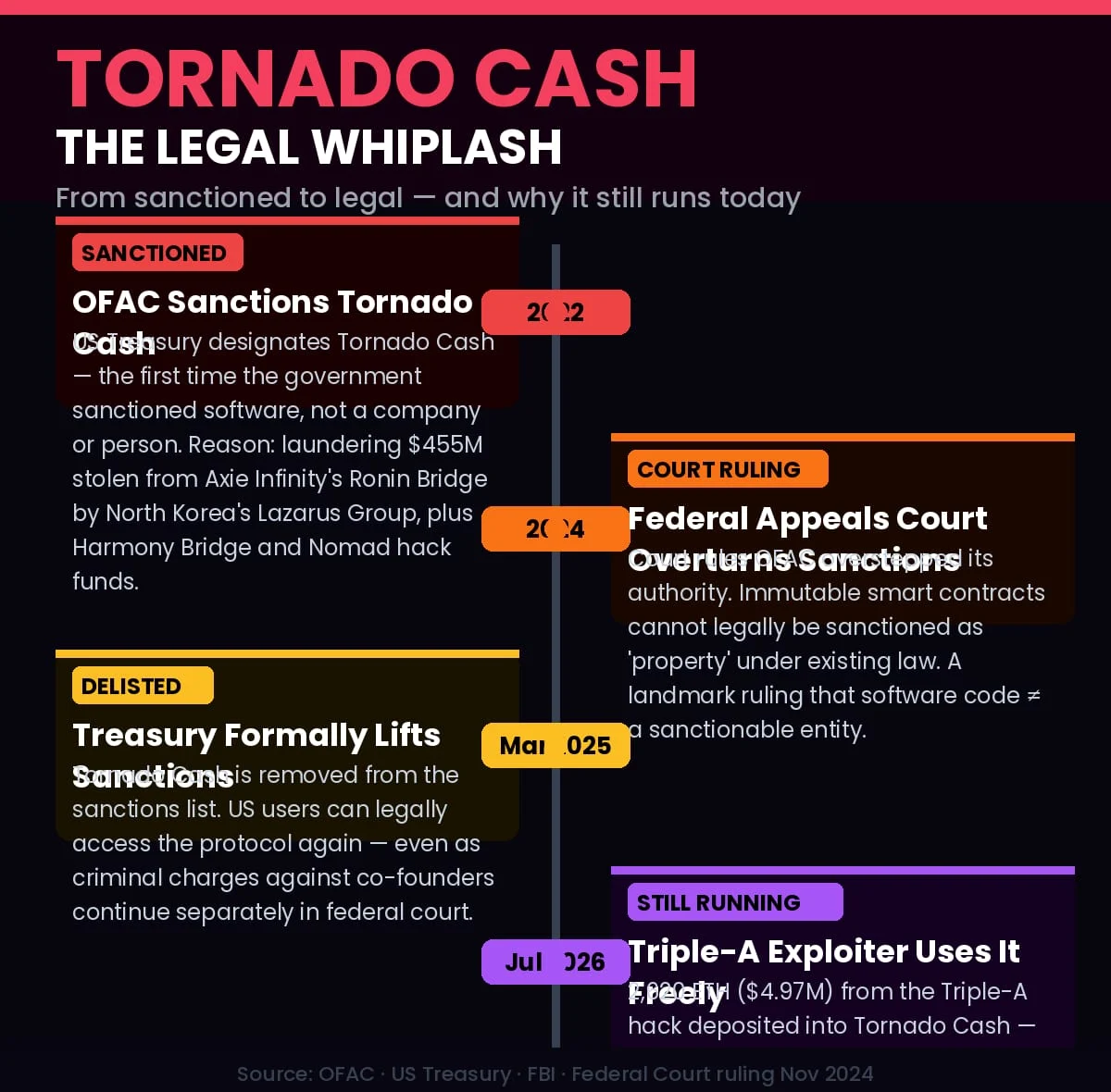
Tornado Cash’s journey through the regulatory landscape has been fraught with turbulence, a history that provides crucial context for its continued operational status and persistent use in illicit activities. The most significant regulatory action came in August 2022 when the U.S. Treasury’s Office of Foreign Assets Control (OFAC) sanctioned Tornado Cash. This unprecedented move was triggered by the mixer’s documented role in laundering over $455 million stolen from Axie Infinity’s Ronin Bridge by North Korea’s Lazarus Group, along with funds from other high-profile exploits such as the Harmony Bridge and Nomad hacks. This marked a historic moment: it was the first instance where the U.S. government sanctioned a piece of software—specifically, a decentralized protocol—rather than a traditional company or an individual. This regulatory precedent sparked intense debate about the scope of government authority over decentralized technologies.
However, OFAC’s sanction did not stand unchallenged. In November 2024, a federal appeals court delivered a significant ruling, determining that OFAC had exceeded its statutory authority in sanctioning the protocol. This legal setback for the Treasury Department paved the way for a formal reversal. In March 2025, OFAC officially lifted the sanctions on Tornado Cash, thereby restoring legal access to the protocol for U.S. users. It is crucial to note that this lifting of sanctions pertained specifically to the protocol’s legal accessibility, while separate criminal charges against its co-founders continued independently in federal court, highlighting the complex and multi-faceted nature of regulating decentralized autonomous organizations (DAOs) and their associated development teams. This legal "whiplash"—the imposition and subsequent removal of sanctions—is a critical factor explaining why Tornado Cash remains fully operational and accessible in 2026, serving as a conduit for anyone, including exploiters, seeking to anonymize stolen funds.
The Broader Landscape of Crypto Laundering and Forensic Efforts
The Triple-A hack and subsequent use of Tornado Cash are not isolated incidents but rather symptomatic of a larger, ongoing battle against illicit finance in the digital asset space. According to reports from leading blockchain analytics firms like Chainalysis and Elliptic, billions of dollars in cryptocurrency are laundered annually through various methods, with mixers consistently featuring as a primary tool for obfuscation. In 2023, for instance, Chainalysis reported that illicit addresses sent over $22.2 billion worth of cryptocurrency, with a significant portion passing through mixers. This volume underscores the scale of the challenge for law enforcement agencies globally.
Blockchain forensic specialists, often working in conjunction with law enforcement, employ sophisticated techniques to trace stolen funds. These techniques include cluster analysis, taint analysis, and the monitoring of known illicit addresses. While Tornado Cash is designed to break on-chain links, forensic experts often look for patterns in deposits and withdrawals, timing correlations, and subsequent movements to centralized exchanges where funds might eventually be cashed out, providing a potential choke point. However, the batching strategy employed by the Triple-A exploiter makes this task significantly more arduous, requiring sustained monitoring and analysis.
The global nature of cryptocurrency also complicates jurisdictional challenges. While Singaporean police are involved in the Triple-A case, the decentralized nature of the funds’ movement means that international cooperation among law enforcement agencies is paramount. Information sharing between countries, swift action from crypto exchanges, and robust regulatory frameworks are all crucial components in the fight against crypto crime.
Implications for Security, Regulation, and the Future of Decentralized Finance
The recurring pattern exemplified by the Triple-A hack and the subsequent use of Tornado Cash carries profound implications for the cryptocurrency ecosystem and its regulatory future.
Firstly, it highlights the persistent security vulnerabilities within the DeFi and Web3 landscape. Despite advancements in smart contract auditing and security protocols, sophisticated attackers continue to find exploits, often targeting bridges, payment gateways, or smart contract logic. The multi-chain nature of the Triple-A attack underscores the need for comprehensive security strategies that span across diverse blockchain environments.
Secondly, the situation intensifies the ongoing debate surrounding privacy versus transparency in decentralized finance. While privacy tools like mixers serve legitimate purposes for users seeking to protect their financial anonymity, their widespread misuse by criminals poses an existential threat to the broader adoption and regulatory acceptance of cryptocurrency. Regulators face the unenviable task of trying to curtail illicit activity without stifling innovation or infringing upon the privacy rights of law-abiding citizens. The legal saga of Tornado Cash vividly illustrates the difficulty of applying traditional legal frameworks to decentralized, code-based entities.
Thirdly, it underscores the limitations of current regulatory frameworks and the need for adaptive policy. The U.S. government’s initial sanctioning of Tornado Cash, followed by its reversal, reveals a regulatory landscape struggling to keep pace with technological evolution. Future regulatory approaches may need to focus more on the intermediaries that facilitate the on-ramps and off-ramps between crypto and traditional finance, as well as enhanced international cooperation to create a more unified front against crypto crime.
Finally, the incident serves as a stark reminder for both companies and individual users about the importance of robust security practices. For entities like Triple-A, this includes continuous security audits, multi-signature wallets, cold storage solutions for significant reserves, and comprehensive incident response plans. For users, it means exercising caution, understanding the risks associated with various protocols, and being aware of the ongoing threat landscape.
The cat-and-mouse game between exploiters and the forces of law and order in the crypto space shows no signs of abating. As long as decentralized tools like Tornado Cash remain accessible and structurally resistant to conventional regulatory pressure, they will likely continue to be the destination of choice for stolen crypto funds, presenting a formidable and evolving challenge for the industry and global governance alike. The Triple-A incident is not just another hack; it is a critical case study in the enduring struggle to secure the digital frontier.