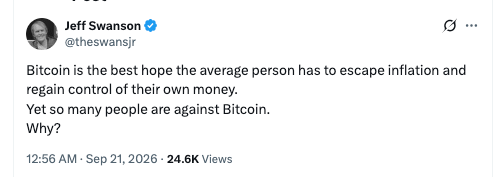
A prominent Bitcoin advocate, Jeff Swanson, has recently voiced his perspective on the persistent skepticism surrounding the premier cryptocurrency, asserting that it represents the most viable avenue for individuals seeking to safeguard their wealth against inflation and retain control over their financial assets. His commentary arrives at a time when Bitcoin (BTC) is demonstrating robust upward momentum, having surged past the $86,000 mark shortly before this report was filed. This resurgence in price underscores the ongoing relevance and potential of Bitcoin as an inflation hedge, a narrative Swanson has championed for years.
Swanson, a vocal proponent of Bitcoin for over a decade, shared his insights via a post on the social media platform X, formerly Twitter. His personal journey, which he attributes to the transformative power of cryptocurrency, saw him transition from the conventional 9-to-5 work structure to a life of financial freedom and early retirement for himself and numerous other early adopters. This profound personal experience fuels his bewilderment as to why, despite its demonstrable success and the significant value it has delivered to a considerable segment of the population, Bitcoin and the broader crypto economy continue to face substantial opposition.
"Bitcoin is the best hope for the average person to escape inflation and keep control of their money," Swanson stated in his recent tweet, echoing sentiments shared by many within the Bitcoin community. His perspective, however, is shaped by his direct experience, and to fully comprehend the persistent criticisms and the urgency for widespread adoption and understanding, a deeper examination of public perception and the underlying issues is necessary.
The "Get-Rich-Quick" Stigma: A Barrier to Adoption
One of the most significant hurdles to widespread acceptance and positive public perception of cryptocurrencies, including Bitcoin, stems from how the digital asset market has often been portrayed and marketed. For a considerable portion of the general public, the narrative surrounding crypto has been dominated by promises of rapid wealth accumulation, framing it as a "get-rich-quick scheme." This perception, while attractive to some, has unfortunately led to significant financial losses for many who were drawn into speculative ventures without a comprehensive understanding of the inherent risks.
While seasoned advocates like Swanson emphasize a strategic, long-term investment approach in Bitcoin, focusing on its fundamental value proposition as a store of wealth and a hedge against inflation, a parallel ecosystem of influencers and market participants has promoted a more volatile and high-risk strategy. This alternative vision often centers on highly speculative assets, including leveraged derivatives, meme coins, and other instruments characterized by extreme price swings. These ventures, while offering the allure of instant riches, carry an equally high probability of substantial and rapid losses.
The consequence of this bifurcated messaging is that many individuals have been misled into believing that quick, substantial profits are the norm in the crypto space. When these speculative bets inevitably fail, the resulting financial setbacks breed distrust and negativity towards cryptocurrencies as a whole. Ironically, this negative sentiment often solidifies even among individuals who have never actually invested in Bitcoin, a testament to the pervasive nature of the "get-rich-quick" narrative. One user, responding to Swanson’s observation, articulated this sentiment: "Most people think of crypto as a quick rich scheme because that’s how it’s been marketed. They see people flashing wealth and don’t understand the risks." This highlights a critical disconnect between the true potential of assets like Bitcoin and the sensationalized portrayal in popular media and certain online communities.
Bitcoin’s Unique Position in the Digital Asset Landscape
Distinguishing Bitcoin from the vast sea of other digital assets is crucial for understanding its distinct role and potential. As articulated by prominent figures such as Michael Saylor, CEO of MicroStrategy, and Jack Dorsey, co-founder of Twitter (now X) and Block, Bitcoin is not merely another cryptocurrency; it occupies a unique category. Its dominance in terms of market capitalization, consistently holding more than 50% of the total cryptocurrency market value, is a testament to its established position and perceived stability. Furthermore, Bitcoin boasts a track record of remarkable performance over many years, a stability that sets it apart from the more ephemeral altcoins that often emerge and fade.
This sustained performance and market leadership have begun to sway even the most entrenched skeptics. The recent approval and launch of Bitcoin Exchange-Traded Funds (ETFs) in the United States have been a watershed moment. These financial instruments, designed for institutional investors and traditional market participants, represent a significant validation of Bitcoin’s legitimacy and investment potential. Major financial institutions, many of whom were once vocal critics, now offer direct exposure to Bitcoin, a clear indication of a shifting landscape. This trend suggests that a growing number of sophisticated investors are recognizing the limitations of traditional, politically managed fiat currencies, which are susceptible to inflation and devaluation through monetary policy. They are actively seeking alternative assets that offer a more reliable store of value and a hedge against economic uncertainty.
The Evolution of Bitcoin’s Narrative: From Niche to Mainstream
The journey of Bitcoin from its inception in 2009 to its current standing has been marked by significant evolution. Initially conceived as a peer-to-peer electronic cash system, its early adoption was primarily by a cypherpunk community interested in decentralized technology and financial sovereignty. The narrative at this stage was often technical and philosophical, focusing on censorship resistance and disintermediation.
As Bitcoin’s price began to appreciate significantly in the early 2010s, media attention grew, often focusing on its use in illicit activities and its volatile price movements. This period cemented its reputation as a risky and speculative asset in the public consciousness. However, alongside this sensationalism, a more grounded narrative of Bitcoin as a "digital gold" – a scarce, decentralized store of value – began to emerge, championed by a growing number of investors and analysts.
The period between 2017 and 2021 saw major bull runs, followed by significant corrections, further amplifying both enthusiasm and skepticism. The introduction of blockchain technology and its potential applications beyond currency also broadened the understanding of the crypto space. However, the pervasive "get-rich-quick" mentality, fueled by the rise of meme coins and aggressive marketing campaigns, often overshadowed the fundamental principles of Bitcoin as a long-term investment.
The launch of Bitcoin ETFs in early 2024 marked a pivotal moment, signaling a maturation of the cryptocurrency market and a growing acceptance by mainstream financial institutions. This development has shifted the conversation from speculative trading to long-term investment, aligning more closely with Swanson’s long-held advocacy. The influx of institutional capital through ETFs provides a degree of stability and legitimacy that was previously lacking, potentially mitigating the extreme volatility associated with retail-driven markets.
Bitcoin’s Inflationary Hedge Potential: A Deep Dive
Bitcoin’s fixed supply of 21 million coins is a core tenet of its appeal as an inflation hedge. Unlike fiat currencies, which can be printed indefinitely by central banks, leading to a devaluation of their purchasing power, Bitcoin’s supply is algorithmically capped. This scarcity, coupled with increasing demand, theoretically drives up its value over time, preserving or even enhancing its purchasing power.
The halving events, which occur approximately every four years and reduce the rate at which new Bitcoins are created, further reinforce this scarcity narrative. The most recent halving, which took place in April 2024, reduced the block reward for miners from 6.25 BTC to 3.125 BTC. Historically, halving events have been followed by significant price increases, as the reduced supply meets continued or growing demand.

However, the effectiveness of Bitcoin as an inflation hedge is not without its critics. Some argue that its price is still too volatile to reliably serve as a stable store of value, especially in the short to medium term. Geopolitical events, regulatory crackdowns, and technological advancements can all trigger significant price fluctuations that can overshadow its scarcity-driven appreciation. Furthermore, the correlation between Bitcoin and other risk assets, such as technology stocks, has sometimes been observed, suggesting that it can behave more like a speculative growth asset than a traditional safe-haven asset during periods of market stress.
Despite these criticisms, the long-term trend of Bitcoin’s price appreciation, particularly when viewed over multi-year cycles, suggests a persistent upward trajectory that outpaces inflation for many fiat currencies. The increasing adoption by individuals and institutions seeking to diversify their portfolios and protect against currency debasement provides a growing demand base that underpins its potential as an inflation hedge.
The Future Outlook: Beyond Speculation
The future of Bitcoin hinges on its ability to transcend the "get-rich-quick" stigma and solidify its position as a reliable store of value and a tool for financial empowerment. The growing acceptance by institutional investors, the increasing availability of regulated investment vehicles like ETFs, and the ongoing development of the Bitcoin ecosystem are all positive indicators.
However, challenges remain. Regulatory clarity is still evolving globally, and potential government interventions could impact adoption and price. The environmental concerns associated with Bitcoin’s proof-of-work consensus mechanism, though increasingly addressed by renewable energy initiatives, continue to be a point of contention for some.
Ultimately, the success of Bitcoin in fulfilling its promise as a hedge against inflation and a means for individuals to control their wealth will depend on continued technological innovation, robust security, and a sustained effort to educate the public about its fundamental value proposition. As Jeff Swanson and other advocates continue to highlight, Bitcoin represents more than just an investment; it is a potential paradigm shift in how we conceive of money and financial sovereignty in an increasingly uncertain global economic landscape. The coming years will be critical in determining whether Bitcoin can fully realize this potential and become a cornerstone of personal finance for the average person.