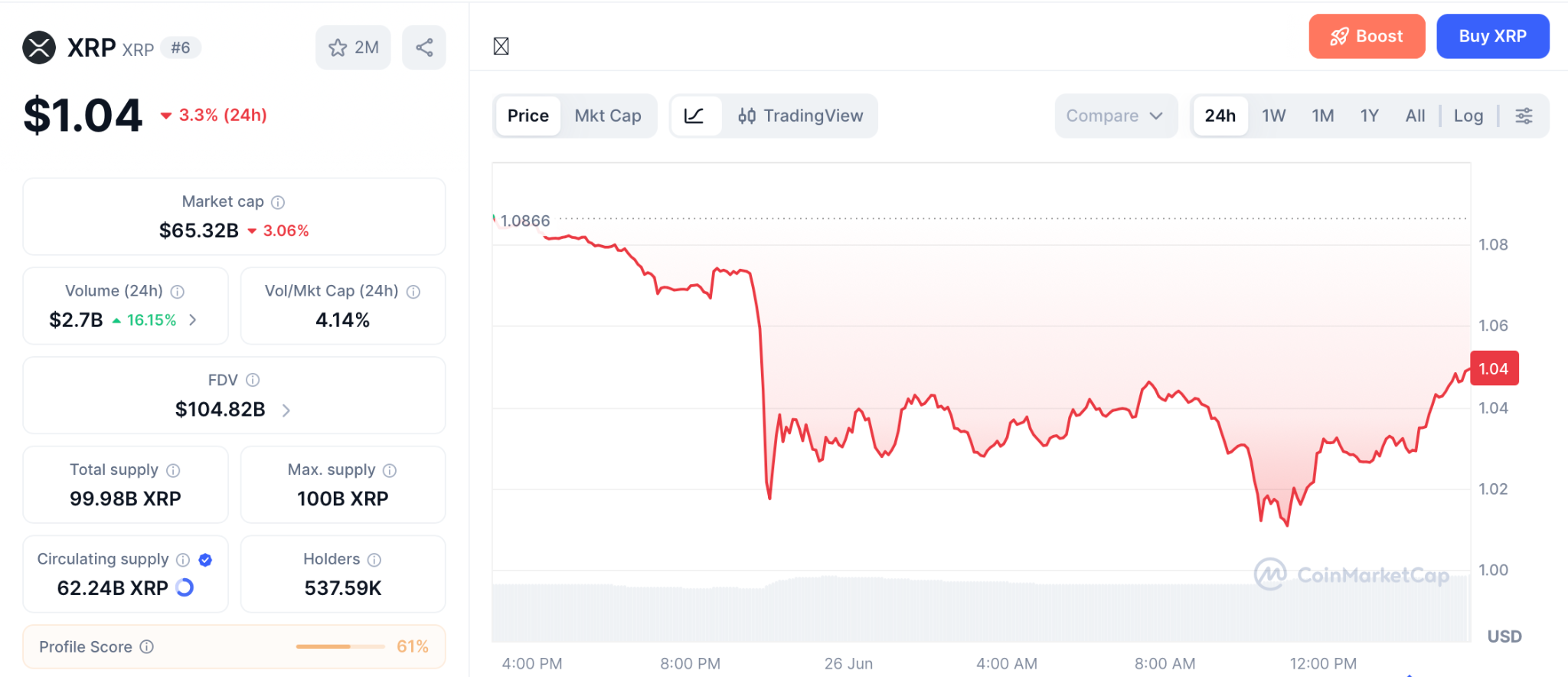
The cryptocurrency market experienced a notable shift in sentiment and price action on June 25, with XRP, the digital asset associated with Ripple, sliding to $1.04. This decline was compounded by a public call from prominent pro-XRP lawyer Bill Morgan, who urged Ripple to release a larger portion of its monthly 1 billion XRP unlock into the market rather than routinely returning it to escrow. This development, first reported by Benzinga, added another layer of complexity to XRP’s already intricate market dynamics, which are increasingly influenced by institutional engagement through new exchange-traded funds (ETFs) and the lingering shadow of regulatory uncertainty.
XRP’s Price Under Pressure Amidst Key Demands and Technical Challenges
On June 25, XRP’s price registered a 2.8% decline, settling at $1.04 and breaching the crucial $1.0850 support level. This placed the token at the lower end of its recent June trading range, prompting concern among investors. According to CoinDesk, market analysts are now closely watching for a potential rebound, with bulls needing to reclaim the $1.10 mark to reverse the prevailing bearish narrative. The technical landscape for XRP appears challenging, with multiple moving averages forming resistance between $1.13 and $1.19, effectively capping any significant upward momentum.
The catalyst for the renewed discussion around XRP’s supply mechanism stemmed from Bill Morgan’s public critique. Morgan, a well-known figure within the XRP community and a vocal proponent of Ripple, argued that Ripple’s current practice of re-escrowing unsold portions of its monthly 1 billion XRP release contributes to market uncertainty and potentially stifles price appreciation. Ripple established this programmatic escrow system in 2017 to provide predictability and transparency regarding the XRP supply, locking up 55 billion XRP in a series of smart contracts. Under this system, 1 billion XRP tokens are released from escrow each month, and any tokens not sold by Ripple during that period are returned to a new escrow account at the end of the month, effectively delaying their re-entry into circulation.
Morgan’s argument posits that by consistently returning unsold XRP to escrow, Ripple maintains a perceived overhang of future supply, even if not immediately liquid. He suggests that a more aggressive release strategy, perhaps by reducing the re-escrowed amount or accelerating distribution, could alleviate these concerns and signal greater confidence in XRP’s market absorption capacity. While Ripple has not issued an official response to Morgan’s specific demand, the company has historically defended its escrow strategy as a mechanism to manage supply responsibly and foster long-term stability for the asset. This ongoing debate highlights the delicate balance Ripple navigates between managing its treasury, supporting the XRP ecosystem, and addressing community expectations regarding tokenomics.
The Institutionalization of XRP: ETFs and Long-Term Projections
Despite the recent price dip and internal community debates, XRP continues to attract significant institutional interest, primarily evidenced by the emergence and rapid growth of U.S. spot XRP Exchange-Traded Funds. As of June 25, seven U.S. spot XRP ETFs collectively held over $1 billion in Assets Under Management (AUM) and custodied approximately 938.7 million XRP tokens. This burgeoning ETF activity mirrors the institutionalization seen earlier with Bitcoin and Ethereum, providing regulated investment vehicles for traditional investors to gain exposure to the cryptocurrency without directly holding the underlying asset. The convenience, liquidity, and regulatory oversight offered by ETFs are critical in drawing institutional capital, which often seeks compliant pathways into the digital asset space.
The influx of institutional money through ETFs is a significant factor in long-term price predictions for XRP. Benzinga maintains a bullish long-term target of $10, while Standard Chartered projects XRP could reach $8 by year-end. Coinpedia, another crypto analytics platform, maps a target range of $5 to $6 later in the current market cycle. These optimistic projections are largely predicated on sustained ETF inflows and increased regulatory clarity, particularly concerning the ongoing legal battle between Ripple and the U.S. Securities and Exchange Commission (SEC). A favorable resolution or continued legislative progress, such as the potential passage of the CLARITY Act, is widely expected to further legitimize XRP in the eyes of institutional investors and potentially unlock broader market participation.
However, analysts also caution that while institutional validation is crucial, the "early high-multiple window" for XRP, an asset with a substantial market capitalization of $67 billion, has likely closed. This concept suggests that assets already valued in the tens of billions of dollars require exponentially larger capital injections to achieve the kind of 100x or 1000x returns seen in earlier stages of nascent cryptocurrencies. Traders seeking such outsized gains are increasingly looking beyond established assets like XRP, where the current market battle is centered around maintaining a $1 floor, towards smaller, more speculative ventures.
Solana’s Performance Amidst Broader Market Cooling
Solana (SOL), another major altcoin, also experienced a downturn on June 25, trading at $69.25, a 0.52% decrease. This dip occurred against a backdrop of broader risk aversion across the cryptocurrency market, reflected in the cautious sentiment pervading the CD20 index, which tracks the performance of the top 20 digital assets. Like XRP, Solana has garnered significant institutional attention, with SOL ETFs continuing to attract incremental capital flows. These ETFs underscore Solana’s growing acceptance within traditional finance, recognizing its robust ecosystem, high transaction throughput, and low fees, which make it a popular platform for decentralized applications (dApps), NFTs, and gaming.
Technically, Solana finds strong support at the $65 level, with key resistance identified at $89. A failure to hold the $65 support could open the path to further declines towards $58. Similar to XRP, Solana’s impressive market capitalization, which has reached $40 billion, means that its period of hyper-growth and early high-multiple returns is considered by many analysts to be behind it. While SOL is expected to continue its upward trajectory over the long term, driven by ongoing ecosystem development and institutional adoption, its growth trajectory is likely to be more measured compared to its earlier explosive rallies. The current market environment, characterized by caution and profit-taking, suggests that both XRP and Solana are heavily reliant on sustained institutional flows to underpin their price stability and drive future appreciation.
The Search for the Next Breakout: High-Risk, High-Reward Altcoins
In a market where established cryptocurrencies like XRP and Solana are increasingly validated by institutions but offer more constrained growth prospects, a segment of the trading community remains focused on identifying the next generation of high-multiplier assets. This pursuit often leads to early-stage projects, particularly those in the presale phase, which present a significantly higher risk profile but also the potential for exponential returns.
One such project, Pepeto, has emerged as an example of this speculative trend. Positioned as an exchange token, Pepeto is currently in its presale stage, trading at an extremely low price of $0.0000001879. The project claims to be developing a live exchange infrastructure and has already raised over $10.3 million during a period when the broader market’s Fear and Greed Index indicated "Extreme Fear" (a reading of 12), suggesting a strong appetite for high-risk ventures even in bearish conditions.
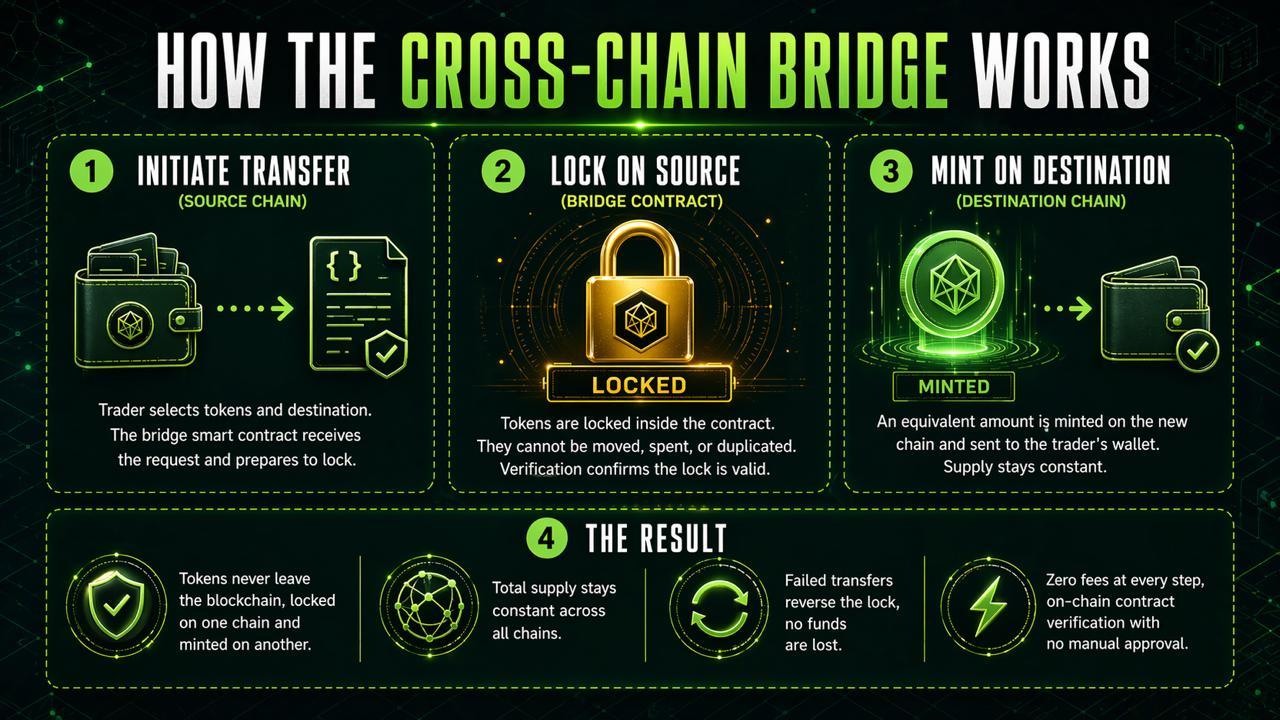
Pepeto differentiates itself by targeting the meme coin trading market, estimated to be worth over $45 billion, with a proposed zero-fee infrastructure spanning three distinct blockchain chains. The project highlights a SolidProof-reviewed contract, a common practice for new tokens to demonstrate a degree of security and legitimacy through external audits. Furthermore, Pepeto’s marketing emphasizes its connection to successful predecessors, claiming a co-founder was instrumental in Pepe’s rise to a $7 billion market capitalization, and that a former Binance executive is advising on its upcoming listing strategy.
The allure for investors in projects like Pepeto lies in the potential for significant returns from a fractional cent entry price. The project’s stated goal of achieving a "267x" return would require it to trade at a fraction of what the original Pepe token achieved, given a similar 420 trillion token supply. A major exchange listing, particularly on a platform like Binance, is often seen as a critical inflection point for such tokens, providing immense liquidity, exposure, and a potential catalyst for price surges. While XRP’s price prediction is seen to have a discernible ceiling, Pepeto, like many other early-stage altcoins, is presented as having an open-ended growth trajectory, with a Binance listing potentially transforming its market valuation.
However, it is crucial for investors to understand the substantial risks associated with such ventures. Presale tokens, especially those in the meme coin category, are highly speculative, lack established track records, and are prone to extreme volatility. The claims of association with past successes or high-profile executives, while enticing, should be independently verified, and the promised utility of an "exchange token" at such an early stage requires careful scrutiny. The potential for high returns is always accompanied by an equally high risk of capital loss.
Broader Market Context and Future Outlook
The current cryptocurrency landscape is a tale of two markets: one characterized by the gradual institutionalization of established assets like Bitcoin, Ethereum, XRP, and Solana, and another driven by retail speculation in nascent, high-risk altcoins. The overall market sentiment, as indicated by the Fear and Greed Index, oscillates between caution and opportunism. While institutional capital provides a stabilizing force and validates the long-term potential of major tokens, it also inherently limits the scope for exponential growth due to the law of large numbers.
Regulatory developments continue to be a dominant theme, particularly for Ripple and XRP. The outcome of the SEC lawsuit and the broader regulatory framework emerging in key jurisdictions will profoundly impact how digital assets are classified, traded, and adopted. For Solana, continued innovation in its ecosystem, coupled with its technical advantages, will be key to sustaining its growth momentum.
For investors seeking "the next breakout," the market presents a dichotomy. A $1,000 investment in XRP today, buying approximately 935 tokens at $1.04, could theoretically grow to around $9,000 if it reaches the bullish $10 target—a respectable 9x return over potentially several years. In stark contrast, a similar $1,000 investment in a speculative presale like Pepeto, securing 5.32 billion units at its current price, is marketed with the potential to yield between $100,000 and $150,000 if it mirrors the historical performance of tokens like Pepe at their all-time highs. This stark difference in potential returns, alongside a commensurate difference in risk, highlights the evolving strategies of crypto investors.
The June 25 price breakdown for XRP, losing the $1.0850 support, reinforces the notion that the period of easy, high-multiplier gains for both XRP and Solana is likely over. Both tokens are now firmly in a phase where institutional flows and fundamental developments will dictate their price action, with gains measured in percentages rather than multiples. The window for early, high-multiplier entry into projects like Pepeto, while inherently risky, is time-sensitive, often closing rapidly as demand hits presale targets or as tokens transition to public listings.

Conclusion
The cryptocurrency market continues its dynamic evolution, marked by increasing institutional integration for established assets and an enduring appetite for high-risk, high-reward ventures among retail investors. While Ripple and Solana navigate institutional flows and regulatory landscapes, with price movements becoming more measured, the speculative segment of the market remains vibrant, constantly seeking the next frontier of exponential growth. The critical takeaway for all market participants is the imperative for thorough due diligence and a clear understanding of the inherent risks associated with different asset classes within the digital economy.
FAQs
What is the current outlook for XRP’s price after Bill Morgan’s recent comments?
Following Bill Morgan’s call for Ripple to release more XRP from escrow, XRP’s price saw a decline to $1.04 on June 25. Long-term predictions from Benzinga suggest a $10 target, Standard Chartered projects $8 by year-end, and Coinpedia maps $5-$6 for the cycle, contingent on sustained ETF demand and regulatory clarity. However, its $67 billion market cap limits near-term upside to percentage gains rather than the high multiples seen in earlier-stage assets.
How do the potential returns of a presale token like Pepeto compare to holding established assets like XRP or SOL?
A $1,000 investment in Pepeto at its current presale price of $0.0000001879 could secure approximately 5.32 billion units. The project suggests this position could yield between $100,000 and $150,000 if it reaches market capitalization levels comparable to Pepe’s all-time high after listing. In contrast, $1,000 in XRP (at $1.04) would purchase 935 tokens, potentially growing to $9,000 at a bullish $10 target, representing a 9x return. XRP and Solana, with market caps of $67 billion and $40 billion respectively, cannot support 100x to 150x outcomes from their current valuations due to the immense capital required.
What are the implications of XRP losing key support on June 25 for XRP and Solana?
XRP’s breach of the $1.0850 support level on June 25 signifies that both XRP and Solana are increasingly reliant on institutional ETF flows for price support. This event, coupled with their significant market capitalizations, indicates that the "early high-multiplier window" for these tokens has likely closed. While they offer more stable, institutionally-driven growth, they do not present the same speculative upside potential as early-stage projects like Pepeto, which currently trades at $0.0000001879 ahead of a potential major exchange listing.