Recent on-chain data, primarily from June 18, indicates a significant and coordinated shift in XRP holder behavior, characterized by a substantial increase in withdrawals from major cryptocurrency exchanges such as Coinbase and Binance. This trend, signaling a move towards greater self-custody, coincides with sustained accumulation of XRP by institutional investors through U.S. spot Exchange-Traded Funds (ETFs), which now collectively hold over 1.4% of the token’s total circulating supply. The dual narrative of retail investors taking assets off exchanges and institutional entities absorbing supply presents a compelling picture of evolving market dynamics for the digital asset.
Contextualizing the Trend: Understanding Exchange Outflows
The metric of net depositing and withdrawing transactions provides crucial insights into investor sentiment and intent. A negative net reading, as observed across Coinbase and Binance, signifies that more XRP tokens are being moved off exchanges than onto them. This behavioral pattern is often interpreted as a bullish signal, as it suggests a reduced immediate intent to sell. Investors typically withdraw assets from centralized exchanges for several reasons: enhanced security through self-custody (e.g., hardware wallets), long-term holding strategies, participation in decentralized finance (DeFi) protocols, or simply to move assets to cold storage away from potential exchange-specific risks or regulatory uncertainties. Conversely, deposits usually precede trading activity, staking, or preparation for sale.
XRP, the digital asset associated with Ripple Labs, has a unique history marked by significant regulatory scrutiny, most notably the ongoing legal battle with the U.S. Securities and Exchange Commission (SEC). This regulatory backdrop has historically influenced investor behavior, with many opting for self-custody to mitigate perceived risks associated with holding assets on regulated platforms. The current surge in withdrawals, particularly from prominent U.S.-facing exchanges like Coinbase, could be partially attributable to this enduring sentiment, alongside a broader market trend towards increased investor control over digital assets.
Detailed Analysis of Exchange Movements: A Synchronized Shift
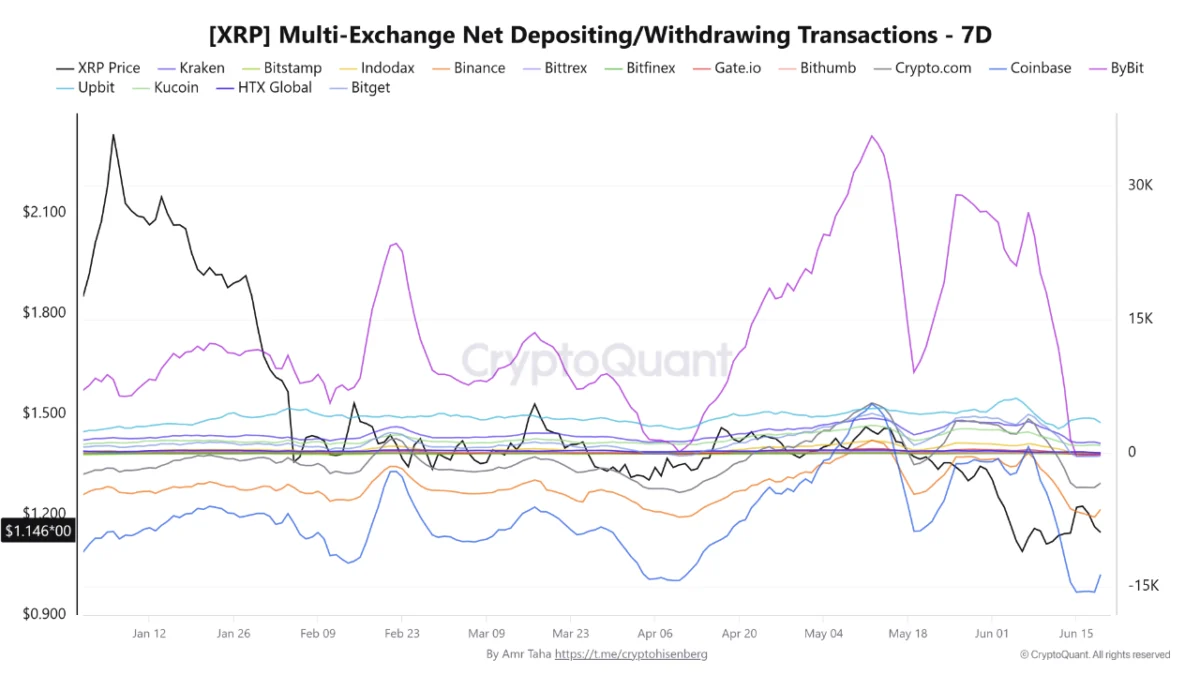
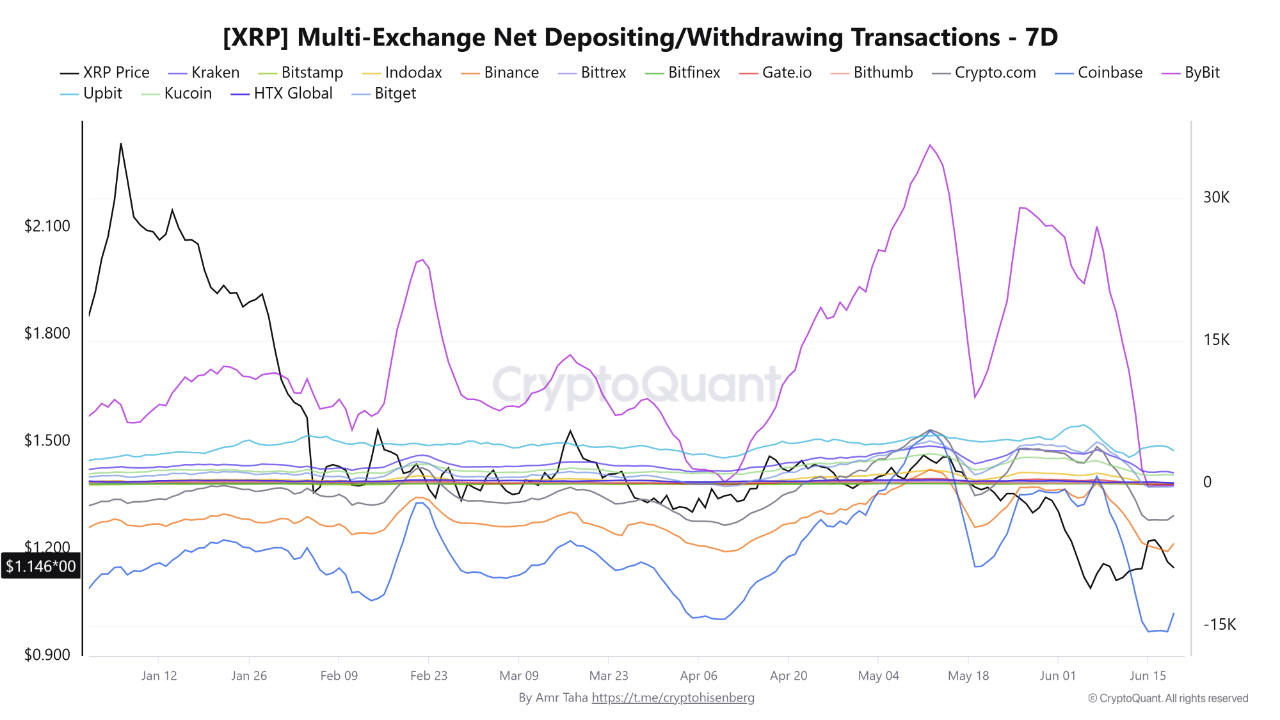
The data from June 18 reveals a stark picture of withdrawal dominance. Coinbase, one of the largest cryptocurrency exchanges globally, recorded a seven-day net depositing and withdrawing reading of -15,500. This figure not only represents a significant outflow but also surpasses previous notable peaks this year. For context, this reading fell below its April 9 level of -14,200 and its February 14 level of -12,300, indicating that the current rate of withdrawal dominance is more extreme than either of these prior episodes. Such elevated outflows suggest a strong conviction among Coinbase users to secure their XRP holdings off-exchange.
Mirroring Coinbase’s trend, Binance, another global giant in the crypto space, also registered a deeply negative reading on the same date. Binance’s net depositing and withdrawing figure dropped to -7,100, a level approaching its April figures and falling below the -5,200 recorded on February 14. The synchronized nature of these negative readings across two distinct and geographically diverse exchanges (Coinbase with a strong U.S. presence, Binance with a global footprint) is particularly noteworthy. This cross-exchange alignment strongly refutes any suggestion that the activity is localized or specific to a single platform; instead, it points to a broader, market-wide behavioral shift among XRP holders.
Adding another layer of complexity and confirming the widespread nature of this trend, Bybit, an exchange popular for derivatives trading, experienced a dramatic reversal in its net transaction readings. Earlier in June, specifically on June 7, Bybit had recorded an unusually concentrated deposit wave, pushing its net reading to approximately +27,000. This surge suggested a short-term influx of XRP, potentially for trading or specific promotional activities. However, within a mere 11 days, by June 18, this figure had plummeted to approximately -200, effectively erasing nearly all of the early-June movement. The speed and magnitude of this reversal at Bybit, coupled with the sustained outflows from Coinbase and Binance, underscore a coordinated and rapid shift in investor preference towards withdrawing XRP from exchanges across different platform types and geographical regions.
While the metric tracks the number of transactions rather than the total volume or dollar value of XRP transferred, its consistent and synchronized movement across major exchanges serves as a powerful behavioral indicator. It implies a collective decision by a significant portion of XRP holders to move their assets into self-custody, away from the immediate liquidity pools of centralized trading platforms.
Institutional Demand: The Ascendance of Spot XRP ETFs
In parallel with the retail-driven move towards self-custody, institutional interest in XRP continues to solidify through the burgeoning market for spot XRP Exchange-Traded Funds in the United States. These investment vehicles provide traditional investors with exposure to XRP without the complexities of direct ownership or self-custody. On June 15, spot XRP ETFs recorded net inflows of approximately $2.82 million, marking a continuation of a sustained accumulation trend.
Following this session, the suite of Ripple-linked ETF products now collectively holds 1.41% of XRP’s entire circulating supply. This figure is significant, demonstrating a growing institutional appetite for the digital asset. Since their inception in March, specifically from March 27, these spot XRP ETFs have registered net outflows on only five trading days. This remarkable streak of consistent inflows highlights robust and persistent institutional demand, contrasting sharply with the occasional, short-lived periods of profit-taking or reallocation. The preference for spot ETFs by institutional players reflects a desire for regulated, accessible, and often more liquid investment avenues compared to direct crypto market participation.
The emergence and rapid growth of spot XRP ETFs are intrinsically linked to the regulatory landscape surrounding Ripple and XRP. The partial victories achieved by Ripple against the SEC, particularly the court rulings classifying XRP as not inherently a security in programmatic sales, have significantly de-risked the asset for institutional adoption. These legal clarifications have paved the way for traditional financial institutions to offer XRP-related investment products, boosting confidence and broadening the investor base beyond the crypto-native community. The continued accumulation by ETFs serves as a strong vote of confidence from institutional capital, suggesting a long-term bullish outlook despite ongoing legal proceedings.
Broader Market Implications and Analyst Perspectives
The dual trends of increased retail withdrawals and sustained institutional accumulation carry profound implications for the XRP market.
Firstly, the surge in withdrawals from exchanges generally indicates a reduction in immediate selling pressure. When assets are moved off exchanges into cold storage or private wallets, they are less liquid and less likely to be traded in the short term. This reduction in the readily available supply on trading platforms could contribute to price stability or even upward pressure, assuming demand remains constant or increases. Market analysts often view prolonged periods of exchange outflows as a bullish indicator, suggesting that holders are accumulating for the long haul rather than preparing to sell.
Secondly, the growing trend of self-custody among individual investors signifies increasing maturity within the cryptocurrency ecosystem. As investors become more experienced, they often prioritize security and control over the convenience of exchange-held assets. This shift could be a defensive measure against potential security breaches on exchanges, a response to evolving regulatory landscapes, or simply a reflection of a deeper understanding of blockchain’s core ethos of decentralization and individual sovereignty over assets.
Thirdly, the consistent net inflows into spot XRP ETFs underscore the mainstreaming of cryptocurrency investments. Institutional involvement provides legitimacy and stability to the market, attracting a broader spectrum of traditional investors who might otherwise be hesitant to engage directly with digital assets. The accumulation of over 1.4% of XRP’s circulating supply by ETFs represents a substantial portion of the asset being locked away in institutional portfolios, further reducing the floating supply available for trading and potentially influencing market dynamics over time.
While no direct statements from Ripple Labs or specific exchange representatives were immediately available regarding these precise on-chain movements, market observers and financial analysts generally interpret such data as constructive for an asset’s long-term valuation. Industry experts often highlight that the combination of retail HODLing (holding on for dear life) behavior, as evidenced by withdrawals, and institutional buy-in via ETFs, paints a picture of robust underlying demand and confidence. This dynamic suggests a market that is consolidating its supply in stronger hands, both individual and institutional, thereby potentially laying the groundwork for future price appreciation as overall demand continues to grow and regulatory clarity improves.
Conclusion
The recent data from June, illustrating a significant surge in XRP withdrawals from major centralized exchanges like Coinbase and Binance, alongside a dramatic reversal on Bybit, points to a clear and synchronized shift towards self-custody among individual investors. This movement, reflecting a desire for greater security and long-term holding, is occurring concurrently with sustained and robust accumulation of XRP by U.S. spot ETFs, which now control a notable percentage of the asset’s circulating supply. These converging trends paint a compelling picture of evolving market dynamics for XRP: a growing conviction among retail holders to secure their assets off-exchange, coupled with unwavering institutional confidence channeled through regulated investment products. As the regulatory environment continues to evolve and the broader cryptocurrency market matures, these supply-side shifts could play a crucial role in shaping XRP’s trajectory, signaling a potentially bullish outlook for the digital asset as its supply becomes increasingly concentrated in long-term holdings.