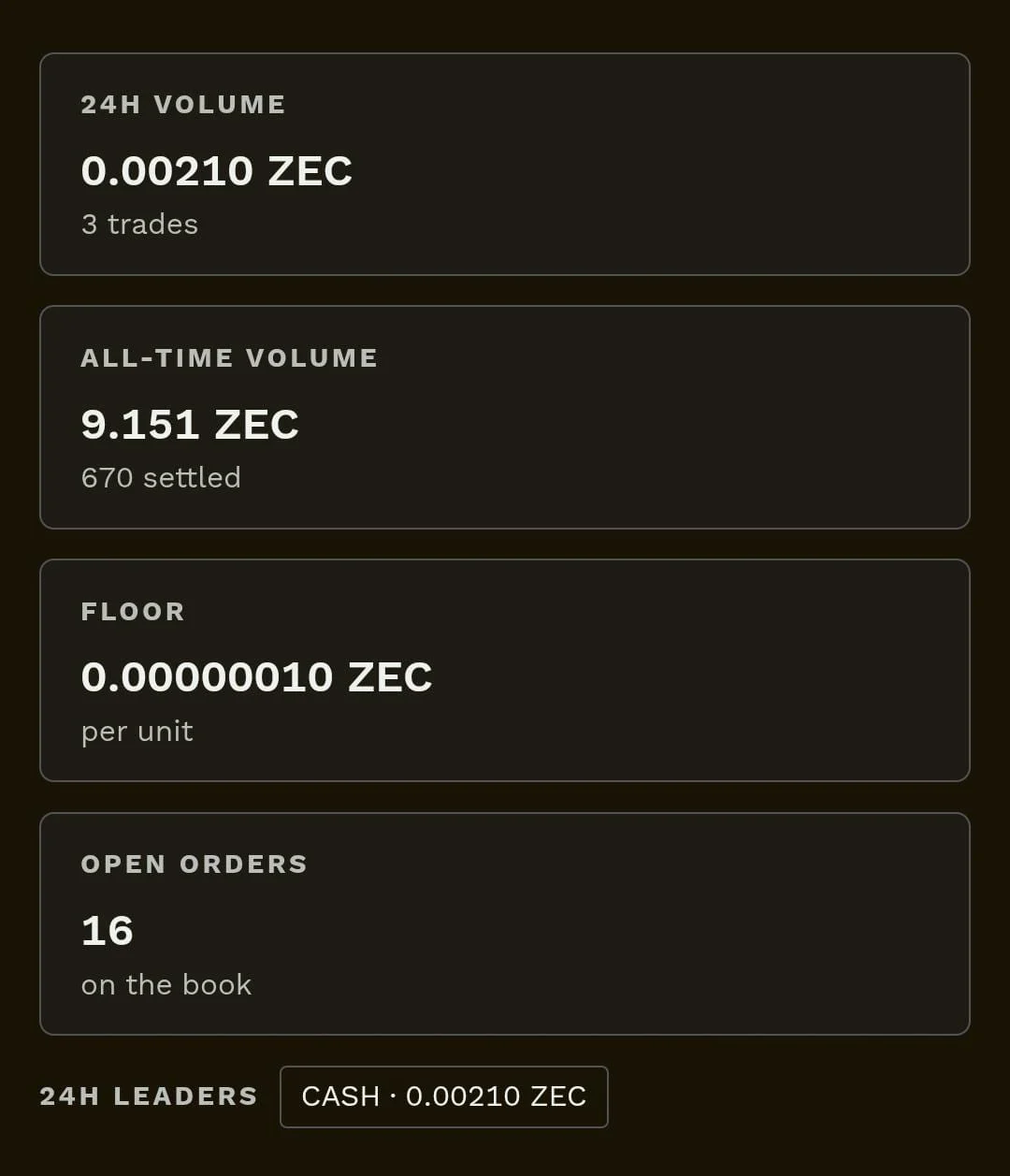
The ZRC-20 marketplace, an experimental platform designed to demonstrate the viability of a token economy built atop Zcash’s shielded network, recently reopened its doors, only to register a mere three trades within its first 24 hours of renewed operation. A direct examination of the live dashboard at zrc20.io/marketplace confirms this sparse activity, highlighting a significant disparity between the announcement of its return and the subsequent engagement from users. This quiet re-entry into the market warrants a detailed exploration of the ZRC-20 standard, its underlying technology, and the broader implications for privacy-centric blockchain ecosystems.
Understanding ZRC-20: A Privacy-Centric Inscription Standard on Zcash
ZRC-20 represents a fungible token standard specifically engineered for the Zcash blockchain. Its architectural design draws direct inspiration from BRC-20 tokens on Bitcoin, diverging significantly from traditional smart contract-based token standards like ERC-20 on Ethereum. Instead of relying on complex smart contract logic, ZRC-20 tokens manage their state through a system of JSON instructions—specifically "deploy," "mint," and "transfer"—that are inscribed directly into Zcash transactions. Wallets and indexers then process these instructions sequentially, in block order, to accurately determine token ownership and balances. This methodology ensures that every operation is transparently verifiable on-chain, yet without the need for a central custodian or a singular ledger.
The defining characteristic that sets ZRC-20 apart from its Bitcoin counterpart lies in its commitment to privacy, a core tenet of the Zcash protocol. While BRC-20 inscriptions are written into Bitcoin’s Taproot witness data, which becomes publicly visible upon transaction confirmation, ZRC-20 utilizes the memo field within a Zcash shielded note. This field is inherently encrypted, meaning its contents—including the token instruction data—are only accessible to parties possessing the correct viewing key. This privacy-by-design approach is a critical distinction, reflecting Zcash’s fundamental value proposition and attracting attention beyond the typical "inscription token" enthusiast crowd. It pushes the boundaries of how fungible tokens can be implemented while preserving user privacy at the protocol level.
The Genesis Token: $CASH and Its Symbolic Link
The inaugural token deployed under the ZRC-20 standard is dubbed $CASH. It features a hard cap of 21 million units, a figure that is intentionally resonant with Zcash’s own maximum supply. Ninety percent of the $CASH supply was initially distributed through a public, first-come, first-served minting process, which required a nominal fee of 0.005 ZEC per mint transaction. While the symbolic link to Zcash’s supply cap is clear, the project documentation has not explicitly detailed the deeper implications or strategic significance of this mirroring beyond its symbolic value. Such initial minting events, especially those that are low-cost or "free," often generate significant speculative interest and a surge of early activity, which can then naturally subside as the initial distribution phase concludes.
The ZRC-20 Marketplace: A Model of Trustless, Atomic Settlement

Perhaps the most innovative aspect of the ZRC-20 ecosystem is its native marketplace. Designed for true peer-to-peer exchange, the marketplace facilitates atomic settlement, meaning that the transfer of ZRC-20 tokens and the corresponding ZEC payment occur simultaneously within a single Zcash transaction. This eliminates the need for any intermediary escrow accounts or centralized custodians, thereby significantly reducing counterparty risk and enhancing the decentralized nature of the trading process. Every order and its settlement are verifiable through the Zcash explorer, reinforcing the marketplace’s pitch as a non-custodial trading venue.
For its services, the marketplace imposes a flat trading fee of 0.0003 ZEC, which is added on top of the standard Zcash network transaction fee. This minimal charge is generally considered too small to act as a significant deterrent to trading activity, suggesting that other factors are at play in the observed low volumes. The technical complexities involved in designing and implementing such an atomic swap mechanism within Zcash’s shielded transaction framework are substantial, requiring sophisticated cryptographic operations to ensure both privacy and transactional integrity.
Chronology and Official Stance
The emergence of ZRC-20 is best understood within the broader context of the "inscription token" phenomenon that gained significant traction in early 2023 with Bitcoin’s Ordinals protocol and BRC-20 tokens. This movement demonstrated a novel way to leverage the base layer of a blockchain for arbitrary data inscription and token state management, sparking widespread experimentation across various networks.
- Early 2023: Bitcoin Ordinals and BRC-20 tokens surge in popularity, driving high transaction volumes and fees on the Bitcoin network.
- Mid-2023: The concept of adapting inscription token standards to other blockchains, including Zcash, begins to materialize.
- Launch of ZRC-20 and $CASH: The ZRC-20 standard is introduced, followed by the public mint of its first token, $CASH. This initial launch generated a wave of speculative interest.
- Zcash Foundation’s Clarification: Following early reports that may have implied an official endorsement, the Zcash Foundation publicly clarified that ZRC-20 is not an official Zcash protocol or an endorsed feature. Their statement underscored that the Foundation focuses on core Zcash protocol development and does not officially support or manage third-party experimental projects.
- ZRC-20 Team’s Response: The ZRC-20 development team acknowledged the Zcash Foundation’s clarification, reiterating that the project is entirely experimental, independent, and carries no guarantee or promise of value. This transparent communication aimed to manage community expectations and emphasize the grassroots nature of their initiative.
- Marketplace Reopening: The ZRC-20 marketplace, after an undisclosed period of being offline or inactive, was announced to be back online, leading to the recent observation of minimal trading activity.
This sequence of events is crucial for understanding the current state of the ZRC-20 project. It underscores that ZRC-20 is a third-party experiment leveraging Zcash’s infrastructure, rather than a feature officially developed or endorsed by the Zcash core team or Foundation. This distinction is vital for potential participants, as it implies a higher degree of risk and a lack of official support or integration with the broader Zcash roadmap.
Analysis of Post-Reopening Trading Data
The current trading metrics for the ZRC-20 marketplace paint a clear picture of limited engagement. According to the live dashboard, the 24-hour volume stood at a mere 0.00210 ZEC, distributed across just three individual trades. To put this into perspective, if ZEC were trading at, for example, $20 per token, this daily volume would equate to approximately $0.042.
This recent performance stands in stark contrast to the platform’s cumulative activity since its initial launch. The marketplace has recorded all-time totals of 9.151 ZEC in cumulative volume across 670 settled trades. A comparison between the three trades in the most recent 24-hour window and the lifetime count of 670 trades highlights a steep and significant drop-off in activity from whatever pace established that earlier cumulative figure.

Further details from the dashboard reveal:
- Floor Price: The current floor price for ZRC-20 units reads 0.00000010 ZEC per unit.
- Open Orders: There are 16 open orders currently listed on the order book, indicating a willingness from sellers to list their tokens, but a clear lack of corresponding buyer demand at present.
- Active Tickers: The 24-hour leaderboard shows $CASH as the only active ticker trading, with the entire 0.00210 ZEC volume attributed to it. This suggests a complete absence of activity for any other ZRC-20 tokens within that period.
The recent activity feed further reinforces this trend. The three most recent $CASH trades are timestamped approximately 21 hours prior to the observation, with transaction values ranging from a negligible 0.00010 ZEC to 0.00100 ZEC. The activity log then jumps abruptly to five days prior, where a batch of older trades includes not only more $CASH activity but also transactions involving a "NEAR" ticker token. These older trades exhibit slightly larger sizes, with some reaching 0.00067 ZEC and one substantial $CASH trade worth 0.21 ZEC (representing 347,000 units). The distinct five-day gap in the activity log serves as compelling visual evidence of the prolonged period of dormancy or extremely thin trading leading up to and immediately following the marketplace’s announced reopening.
Factors Contributing to Muted Activity
Several interconnected factors likely contribute to the observed low trading volume on the ZRC-20 marketplace:
- Experimental and Unofficial Status: The explicit disclaimers from both the ZRC-20 team—stating the project is experimental and carries no promise of value—and the Zcash Foundation’s public distancing likely had a significant chilling effect on speculative interest. Investors and users are generally wary of projects without official endorsement, particularly in a market segment prone to high volatility and risk.
- Post-Mint Lull: The initial rush associated with a first-come, first-served public mint, especially for a new token standard, often generates a burst of activity fueled by early adopters and speculators. Once this initial distribution phase concludes, a natural lull typically follows as the initial hype dissipates and the market seeks a more stable valuation. The observed data is consistent with this pattern.
- Privacy-Related Challenges for Market Transparency: While ZRC-20’s privacy features are a core strength, they can inadvertently create hurdles for traditional market dynamics. The encrypted nature of shielded transactions makes public market analysis, on-chain liquidity tracking, and price discovery more challenging compared to transparent chains. For many traders, the inability to easily monitor large orders, analyze whale activity, or integrate with standard analytical tools can be a deterrent, even if the underlying privacy is desired for individual transactions.
- Limited Ecosystem and Tooling: As an independent and experimental project, ZRC-20 likely faces challenges in developing a comprehensive ecosystem of supporting wallets, explorers, and decentralized applications (dApps) that can seamlessly integrate with its shielded operations. The complexity of building on Zcash’s privacy features requires specialized expertise and significant development resources, which might not be readily available to an independent team.
- Market Awareness and Liquidity Depth: The ZRC-20 marketplace may suffer from a lack of broad awareness beyond a niche segment of the Zcash community. Without widespread visibility and a deeper pool of both buyers and sellers, achieving robust liquidity is difficult. The 16 open orders sitting unfilled suggest an imbalance, where sellers are present, but buyers are scarce.
- Broader Market Sentiment: While not the primary driver, general sentiment in the wider cryptocurrency market can also influence activity on smaller, experimental platforms. During periods of market consolidation or bearish trends, speculative interest in unproven assets often diminishes.
Implications for Zcash and Decentralized Privacy
Despite the current low trading volumes, the ZRC-20 experiment carries significant implications for Zcash and the broader landscape of decentralized privacy:
- Proof of Concept for Zcash’s Extensibility: ZRC-20 undeniably demonstrates Zcash’s technical capacity to support novel token standards and application layers, even with its highly sophisticated privacy features. It proves that Zcash’s shielded transactions are robust enough to carry complex data for asset issuance and transfer, extending its utility beyond simple value transfers. This technical validation is important for Zcash’s long-term vision as a platform for privacy-preserving dApps.
- Challenges of Building on Privacy Chains: The experience highlights the inherent trade-offs and challenges in building decentralized applications and marketplaces on privacy-focused blockchains. While privacy is paramount, it can complicate aspects like public market visibility, developer tooling, and user onboarding, which are often taken for granted on transparent chains. Overcoming these challenges will require innovative solutions for privacy-preserving analytics and user interfaces.
- Community-Driven Innovation: ZRC-20 exemplifies the power of independent developers to innovate within existing blockchain protocols. Such grassroots initiatives are crucial for exploring new use cases and pushing technological boundaries, even if they operate outside official endorsements. They act as vital testbeds for future potential.
- Future of Inscription Tokens on Privacy Chains: The ZRC-20 marketplace serves as an early indicator for the viability of inscription tokens on privacy networks. While the speculative frenzy seen on Bitcoin with BRC-20 has not translated here, the technical foundation has been laid. Future success may depend on increased developer interest, enhanced tooling, and a clearer value proposition beyond pure speculation.
- Balancing Experimentation with Mainstream Adoption: The careful delineation by the Zcash Foundation regarding ZRC-20’s experimental status is a necessary step in managing the ecosystem. It allows for independent innovation without tying the core protocol’s reputation to unproven ventures, while also reminding users of the inherent risks involved in participating in such experiments.
In conclusion, the ZRC-20 marketplace’s quiet reopening, marked by minimal trading activity, offers a nuanced snapshot of an ambitious experiment. While the technical accomplishment of building a trustless, atomically settled token marketplace on Zcash’s shielded network is significant, market adoption remains nascent. The journey of ZRC-20 will continue to be a crucial case study in the ongoing effort to balance the principles of decentralization and privacy with the practical demands of usability, liquidity, and broader market engagement in the evolving landscape of blockchain technology. The current silence, while not indicative of failure, certainly signals that the path to widespread adoption for privacy-centric token economies is one that demands patience, persistent development, and perhaps a re-evaluation of user incentives.
Disclosure: This is not trading or investment advice. Always conduct thorough research before engaging with any cryptocurrency or investment services.