The release of Collinear AI’s FrontierCUA benchmark on November 6 marks a significant development in the evaluation of autonomous AI agents designed for complex enterprise operations. This new benchmark aims to bridge a critical gap in existing evaluation frameworks by focusing on the high-volume, multi-application tasks that form the backbone of modern businesses. Initial results from testing 20 distinct computer-use agents reveal that even the leading model, GPT-6.1 Sol, achieves a pass rate of only 25%, underscor underscoring the nascent stage of agentic AI capabilities in this demanding domain. Critically, Collinear’s analysis highlights that the primary impediments to agent success are not errors in interface interaction—such as clicking the wrong button—but rather fundamental deficiencies in evidence gathering and logical reasoning, collectively accounting for 69% of lost points.
The Genesis of FrontierCUA: Addressing an Enterprise Automation Gap
For years, the burgeoning field of AI agents has seen evaluation benchmarks primarily concentrate on consumer-grade personal assistant tasks or specialized desktop software. Frameworks like OSWorld and its successors have largely focused on scenarios relevant to individual users, while benchmarks such as Agent’s Last Exam have targeted proficiency within single, specialized desktop applications. While valuable, these benchmarks have overlooked the intricate, multi-step, and multi-application workflows that characterize the operational core of enterprises. These "enterprise operations"—ranging from managing customer support tickets across various platforms to orchestrating site reliability engineering tasks—represent a vast and complex landscape where automation holds immense potential for efficiency gains.
Collinear AI identified this critical void, recognizing that the demands of enterprise environments far exceed the scope of previous benchmarks. Enterprise workflows are typically characterized by their multi-modal nature, requiring agents to navigate disparate systems, interpret varied data formats, and make context-dependent decisions across several applications simultaneously. The sheer volume and strategic importance of these tasks necessitate a robust evaluation method that accurately reflects real-world business challenges. Thus, FrontierCUA was conceived as a rigorous, industry-specific benchmark designed to push the boundaries of current AI agent capabilities and accelerate their development for enterprise adoption.
A New Paradigm for Agent Evaluation
FrontierCUA differentiates itself through several key design principles. Unlike benchmarks that rely on open-source applications or simplified environments, Collinear AI meticulously constructed functional clones of real-world enterprise software. This proprietary approach ensures a faithful reproduction of the user interfaces and operational logic of widely used products, including Zendesk, Shopify, HubSpot, GitHub, Jira, Cloudflare, Datadog, Notion, and Google Workspace. By using clones, Collinear safeguards against data contamination, where agents might have inadvertently been trained on the specific interfaces or data structures of live enterprise applications. This "held-out" and private nature of the benchmark’s 40 core tasks is paramount for maintaining evaluation integrity.
The benchmark spans 11 distinct enterprise functions and involves 30 different applications, with a particular emphasis on customer support and site reliability engineering (SRE) workflows. A defining characteristic of FrontierCUA tasks is their inherent complexity: every workflow necessitates interaction with at least two applications, and a significant 16 out of the 40 tasks require agents to navigate and synthesize information from four or five applications. This multi-application requirement is a direct reflection of the interconnected nature of modern enterprise IT ecosystems, where a single business process often touches various departmental tools.
Unpacking the FrontierCUA Methodology: Rigor in Simulation
The design of FrontierCUA tasks goes beyond simply requiring agents to interact with multiple applications; it establishes a demanding operational environment that mirrors the constraints and ambiguities of human-driven enterprise work. This rigorous methodology is crucial for generating actionable insights into the current state of AI agent capabilities.
Replicating Real-World Enterprise Environments
Each of the 40 enterprise workflows is presented to the agents with concise instructions, typically around 70 words in length. However, the apparent simplicity of these instructions belies the underlying complexity of the tasks. A "typical run" for an agent involves approximately 374 steps and an average duration of 36 minutes, all within a stipulated cap of two to three hours. This time constraint and step count emphasize the need for efficient and deliberate execution, penalizing agents that engage in extensive, undirected exploration.
Agents operate under strict conditions, mimicking human interaction with a computer: they receive only screenshots of the application interfaces and can execute actions solely through simulated mouse clicks or keyboard inputs. Crucially, they are granted no access to the underlying source code of the cloned applications, no direct API access, and no database privileges. Furthermore, the use of developer tools, export URLs, or any form of direct code interaction is strictly forbidden. This "human-like" interface interaction ensures that agents are tested on their ability to perceive, interpret, and act within a visual and interactive environment, rather than leveraging programmatic shortcuts. This approach forces agents to rely on visual cues and contextual understanding, much like a human operator would.
The Mechanics of Task Execution and Grading
The evaluation process within FrontierCUA is sophisticated and designed to account for the varied nature of correct task completion in enterprise settings. An "agentic judge"—itself an AI system—is responsible for grading the final state of each application involved in a workflow. This judge performs atomic yes-or-no rubric checks, with each check weighted by importance. This weighting acknowledges that not all aspects of a task hold equal significance; for instance, correctly updating a critical customer record might be weighted higher than sending a notification.
The judge also analyzes the "rollout"—the sequence of actions taken by the agent—to ascertain intent. This prevents agents from gaming the system by accidentally arriving at a correct final state without demonstrating the correct procedural understanding or by simply "guessing" completion evidence. A workflow is deemed a "pass" only if it achieves a reward score of 0.95 or higher, a high threshold that grants little credit for partial correctness. This stringent passing criterion reflects the real-world expectation in enterprise operations, where "mostly correct" often equates to "incorrect" when business processes are at stake.
To further ensure the integrity and solvability of the benchmark, Collinear AI implements rigorous quality checks across four dimensions for each task: the clarity and completeness of the instruction, the accuracy and comprehensiveness of the grading rubric, the consistency and realism of the "seeded world" (the initial state of the cloned applications), and the coherence of the rollout. Every task is also accompanied by a meticulously crafted reference solution that consistently scores a perfect 1.0, confirming that each task is inherently solvable as designed. This commitment to quality assurance bolsters the reliability and fairness of the benchmark results.

The Inaugural Leaderboard: Early Frontrunners and Surprising Trends
The live FrontierCUA leaderboard, publicly accessible as of November 9, presents a snapshot of current AI agent performance across three key metrics: pass@1 (the fraction of graded tasks passed), avg@1 (the average reward score), and cost (the estimated computational cost per run). All entries visible on the leaderboard at the time of analysis were run at the "high reasoning" setting, indicating an attempt by model developers to maximize performance.
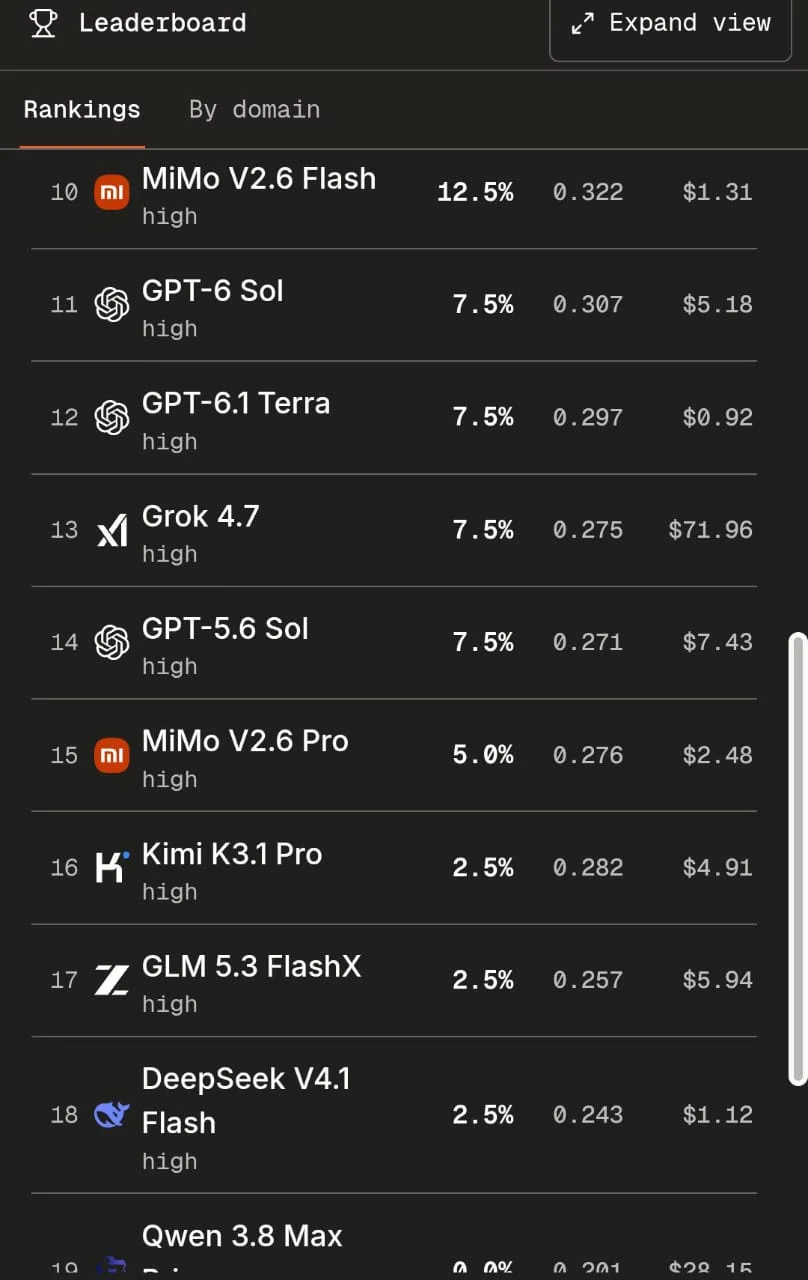
GPT-6.1 Sol currently occupies the top position, achieving a 25.0% pass rate, which translates to successfully completing 10 out of the 40 benchmark tasks. Its average reward score (avg@1) stands at 0.495, with an associated cost of $6.00 per run. Following GPT-6.1 Sol is GPT-6 Astra at 20.0%, then Opus 5 at 17.5%. Fable 5.1 and Fable 5 are tied at 15.0%. Muse Wonder follows at 12.8% (representing 5 out of 39 graded tasks, as per the unique calculation for this entry). A four-way tie at 12.5% includes Opus 5.5, Kimi K3, Sonnet 5, and MiMo V2.6 Flash.
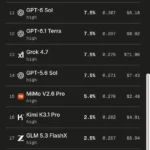
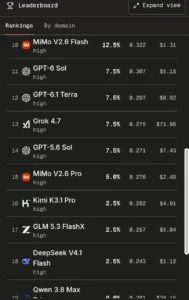
The leaderboard quickly thins out below these leading models. GPT-6 Sol, GPT-6.1 Terra, Grok 4.7, and GPT-5.6 Sol all sit at 7.5%. MiMo V2.6 Pro registers a 5.0% pass rate, while Kimi K3.1 Pro, GLM 5.3 FlashX, and DeepSeek V4.1 Flash are at 2.5%. Notably, models like Qwen 3.8 Max appear at 0.0%, indicating no successful task completions on the benchmark.
Dissecting Performance: Capability vs. Efficiency
Several significant observations emerge from the initial leaderboard data. Firstly, the performance gaps among the top-tier models, when viewed in terms of actual tasks, are remarkably small. The leader, GPT-6.1 Sol, surpasses GPT-6 Astra by only two tasks. Similarly, the cluster of models tied at 12.5% each completed five tasks. This suggests that while there is a clear leader, the competitive landscape among the upper-middle performers is tightly contested, and small improvements could significantly alter rankings. The current state suggests that even the most advanced agents are still grappling with the inherent complexity of enterprise workflows.
Secondly, the avg@1 metric often tells a different story than pass@1. For instance, Fable 5.1 ranks fourth in terms of pass rate but secures the second-highest average reward at 0.453, indicating that it frequently achieves substantial partial progress even when not meeting the stringent 0.95 pass threshold. Similarly, Opus 5.5 boasts a higher average reward (0.442) than Opus 5 (0.431), despite passing fewer tasks. This distinction highlights that "partial progress" and "full completion" are not necessarily indicative of the same underlying skill sets, suggesting some agents might be adept at making significant headway but struggle with the final, precise steps required for full success.
The Nuance of Partial Success and Cost Efficiency
Thirdly, and perhaps most strikingly for potential enterprise adopters, the computational cost per run varies dramatically across the models. GPT-6 Astra, for example, incurs a cost of $47.94, nearly eight times higher than GPT-6.1 Sol’s $6.00, despite achieving a lower score. Other models, such as Muse Wonder ($55.23) and Grok 4.7 ($71.96), demonstrate even higher costs for significantly lower pass rates. In stark contrast, models like MiMo V2.6 Flash, Sonnet 5, and Kimi K3 achieve a 12.5% pass rate for a mere $1.31 per run.
These cost discrepancies introduce a crucial economic dimension to agent evaluation. While Collinear does not officially report "cost per success," a rough estimation by dividing a rollout’s cost by its pass rate (ignoring retries) yields compelling insights. For GPT-6.1 Sol, the approximate cost per pass is $24. For GPT-6 Astra, it skyrockets to around $240 per pass. Meanwhile, models like MiMo V2.6 Flash and GPT-6.1 Terra might achieve a pass for an estimated $10 to $12. These rough estimates suggest that the "cheapest competent agent" could offer a more attractive economic proposition than the "most capable" one, even if the latter holds the top spot on raw pass rate. This cost-benefit analysis will be critical for enterprises considering the deployment of these agents at scale.
The Crucial Bottleneck: Reasoning, Not Clicking
Perhaps the most profound insight gleaned from the FrontierCUA benchmark concerns the nature of agent failures. Collinear AI meticulously categorized the lost rubric points for all 40 of GPT-6.1 Sol’s runs into five distinct causes, leveraging an analytical model to interpret each agent’s rollout and the judge’s reasoning. The findings challenge the long-held assumption that the primary hurdle for computer-use agents lies in accurate interface interaction or "grounding."
The analysis reveals that "evidence gathering" accounts for a substantial 39% of failures. This category encompasses scenarios where the agent acts prematurely without collecting all necessary facts, ceases its search for information too early, or fails to access a required data source altogether. Complementing this, "reasoning over evidence" contributes another 30% of failures. In these instances, the agent successfully gathers the relevant information but then draws an incorrect conclusion or makes an erroneous decision based on that information. Collectively, these two categories—evidence gathering and reasoning—constitute a staggering 69% of all lost points.
From Pixel-Perfect Actions to Strategic Decision-Making
This breakdown signifies a fundamental shift in the bottleneck for AI agent performance. For many years, advancements in computer-use automation were largely framed around "grounding"—the ability to accurately identify and interact with specific elements on a screen, essentially clicking the right pixel at the right time. The FrontierCUA results strongly suggest that this problem is largely, if not entirely, solved by current advanced agents. The challenge has unequivocally moved from mere "hands" (interface interaction) to "judgment" (cognitive processing).
Other failure modes, while present, are significantly less impactful. "Stopping before finishing" explains 24% of failures, where an agent prematurely declares completion, often with a significant portion of its allotted budget unused. Interface errors, including grounding mistakes like misclicking an element, account for a mere 5%. Arithmetic slips, such as calculation errors, represent an even smaller 2%. This distribution of failure causes is particularly stark on the 10 newest tasks added to the benchmark, where "reasoning over evidence" alone rises to 45%, further emphasizing the cognitive challenge.
Illustrative Failures: The Case of the CRM Task
Collinear AI provides a compelling worked example to illustrate these reasoning failures. In a simulated CRM task, an agent was instructed to route 44 inbound sales leads in HubSpot, referencing rules defined in Slack and existing records in Zendesk and Notion. A critical aspect of the task involved identifying two leads that, despite having different business names, shared a single USDOT number—a federal identifier that remains constant even if a carrier rebrands. These two leads, therefore, represented a single account. The agent, in this case, Claude Opus 5.5, successfully opened every necessary application page and accessed all relevant information. However, it failed to connect the shared USDOT number to correctly identify the leads as belonging to one account. This was a classic "reasoning miss," not a "navigation miss," demonstrating the agent’s inability to synthesize disparate pieces of information to form a correct conclusion.

This example underscores the core finding: agents can "see" and "access" information effectively, but their capacity to understand, correlate, and logically deduce insights from that information remains a significant hurdle. This points towards a need for future AI agent development to prioritize advanced cognitive architectures that can simulate human-like diligence, cross-referencing, and contextual understanding.
Interpreting the Results: Caveats and Considerations for Adoption
While the FrontierCUA benchmark offers invaluable insights, its headline numbers and methodology require careful interpretation by potential enterprise buyers and AI developers. The 25% pass rate, while seemingly low, must be understood within the context of the benchmark’s stringent criteria and its proprietary nature.
The high reward threshold of 0.95 for a "pass" means that agents receive no credit for workflows that are "mostly correct" but fail to achieve perfect completion. This all-or-nothing grading system, while mirroring real-world enterprise demands for accuracy, inherently suppresses overall pass rates compared to benchmarks that might award partial credit more generously.
Furthermore, the 40 tasks are "held out" and private, meaning external researchers or developers cannot directly access or rerun them. While this protects against training contamination and ensures the benchmark’s long-term validity, it also limits independent verification and experimentation. The fact that the functional clones of enterprise software are built by Collinear AI itself, and Collinear also offers evaluation and reinforcement-learning environments, necessitates a degree of independent replication as the benchmark gains prominence. Transparency around task specifics and access for research purposes could further strengthen the benchmark’s standing.
The Challenge of Cross-Model Comparison
Another critical factor in interpreting the results is the variation in "harnesses" used by different model providers. Anthropic models, for instance, utilize their native computer-use tool, while OpenAI models interact through the Codex agent via a desktop command-line interface. Open models, conversely, often rely on the OSWorld pyautogui agent. These differing integration layers and execution environments can introduce variability that complicates direct, apples-to-apples comparisons between models.
This can lead to seemingly counterintuitive results, such as Kimi K3 achieving a 12.5% pass rate while the newer Kimi K3.1 Pro only manages 2.5%. While internal model changes could be a factor, the influence of a generic or suboptimal open-model harness cannot be definitively ruled out as contributing to such discrepancies without further investigation. Understanding the impact of these harnesses is crucial for a nuanced interpretation of model performance.
Economic Viability: Beyond Raw Performance
The dramatic variations in cost per run, as discussed earlier, underscore that raw pass rate is only one dimension of an agent’s utility in an enterprise context. For businesses looking to deploy these agents at scale, the total cost of ownership, which includes computational expenses, will be a paramount consideration. An agent that consistently achieves a slightly lower pass rate but at a fraction of the cost might offer a superior return on investment for many enterprise use cases, especially where tasks are high-volume and tolerance for occasional human oversight is acceptable. The focus, therefore, shifts from pure capability to a balance of capability and cost-efficiency.
The Road Ahead: Evolving the Benchmark and Future of Enterprise AI
Collinear AI has indicated plans to expand the FrontierCUA benchmark. This expansion will involve adding more tasks within existing domains, thereby increasing the breadth and depth of evaluation in areas like customer support and site reliability engineering. Crucially, the benchmark will also incorporate longer, more complex workflows in emerging and critical enterprise functions, including MLOps (Machine Learning Operations), data engineering, IT and security operations, and finance operations. As the task set grows, each individual task will account for a smaller percentage of the overall score, which should contribute to more stable and less volatile rankings over time.
Strategic Implications for Enterprise AI Development
The clear message from FrontierCUA is that the future of enterprise AI agents hinges not on perfecting interface interaction, but on advancing cognitive capabilities. The bottleneck has shifted from "hands" to "judgment." This implies that research and development efforts in AI agents must increasingly focus on improving evidence gathering strategies, enhancing logical reasoning modules, and developing sophisticated planning capabilities that prevent premature task cessation. Agents need to learn habits that mimic human diligence: systematically exhausting all relevant data sources, cross-checking identifiers and facts, and resisting the urge to declare victory until all conditions are unequivocally met.
Recommendations for Enterprise Adoption
For enterprises currently evaluating or considering the adoption of AI agents for support, sales operations, IT work, or other critical functions, the FrontierCUA findings offer a crucial directive: do not solely rely on a leaderboard number. Instead, businesses should prioritize testing agents on their own proprietary data and workflows, specifically looking for behaviors that demonstrate diligence, thoroughness in evidence collection, and sound reasoning. Custom evaluations should be designed to probe an agent’s ability to handle ambiguity, integrate information from multiple disparate sources, and make complex, context-aware decisions. The "lesson here isn’t the 25%" pass rate; it’s the fundamental insight into where the failures cluster. A robust agent for enterprise use will be one that exhibits superior judgment, not just superior clicking.
The FrontierCUA benchmark represents a pivotal step in developing and evaluating AI agents that can truly transform enterprise operations. By illuminating the critical need for enhanced reasoning and evidence gathering, it sets a clear roadmap for the next generation of autonomous AI in business.