In a significant move signaling the increasing integration of digital assets into mainstream finance, Santander, one of the world’s largest banking groups, has officially launched cryptocurrency trading services for its clients in Switzerland. This development marks a bold step for the established financial institution, allowing account holders to buy and sell Bitcoin (BTC) and Ethereum (ETH) directly through their banking platform. The introduction of these services is poised to democratize access to the burgeoning digital asset market for a wider audience, potentially reshaping how traditional banking and cryptocurrency intersect.
The initiative, unveiled recently, enables Santander Swiss clients to engage in the trading of these two leading cryptocurrencies, offering them a regulated and potentially more secure avenue to participate in the volatile yet increasingly popular crypto space. This move by Santander is not merely a reactive measure to market trends but a strategic decision to cater to the evolving financial preferences of their customer base. As digital currencies gain broader acceptance and regulatory frameworks mature, traditional financial institutions are increasingly exploring ways to incorporate them into their offerings.
A Paradigm Shift in Traditional Banking
Santander’s foray into crypto trading is particularly noteworthy given its standing as a global financial powerhouse. Traditionally, large banks have approached cryptocurrencies with caution, often citing regulatory uncertainties and volatility concerns. However, the landscape has been shifting rapidly, with more institutions recognizing the potential of blockchain technology and digital assets. By offering Bitcoin and Ethereum trading, Santander is positioning itself at the forefront of this transformation within the Swiss market, a region known for its robust financial services sector and progressive approach to innovation.
The decision to focus on Bitcoin and Ethereum is strategic. These two cryptocurrencies represent the largest and most established digital assets by market capitalization and have seen significant adoption and development in recent years. Bitcoin, often referred to as digital gold, has garnered attention as a potential store of value, while Ethereum, with its smart contract capabilities, serves as the foundation for a vast ecosystem of decentralized applications (dApps), NFTs, and decentralized finance (DeFi) protocols. Offering trading for these two assets provides clients with access to the core of the current cryptocurrency market.
Implications for Swiss Financial Landscape
The introduction of crypto trading by a major bank like Santander is expected to have several implications for the Swiss financial ecosystem. Firstly, it enhances the legitimacy and accessibility of cryptocurrencies for retail investors. Many individuals who were previously hesitant to engage with crypto due to perceived complexity or lack of trust in unregulated platforms may now feel more comfortable venturing into the market through a familiar and reputable institution.
Secondly, it could spur further innovation and competition among other Swiss financial service providers. As Santander sets a precedent, other banks and financial institutions in Switzerland may feel compelled to follow suit to remain competitive and cater to the demands of their clients. This could lead to a more dynamic and developed cryptocurrency market within the country.
Thirdly, it underscores Switzerland’s commitment to fostering a regulated environment for digital assets. The country has already established itself as a hub for blockchain and cryptocurrency companies, and this move by Santander further solidifies its position as a leader in digital finance innovation. The regulatory clarity and established banking infrastructure in Switzerland provide a fertile ground for such initiatives.
Background and Chronology of Digital Asset Integration
While this direct trading offering is a recent development, Santander’s engagement with the digital asset space has been evolving. Banks globally have been exploring blockchain technology for various applications, including cross-border payments, trade finance, and digital identity. Santander, through its innovation arm, has previously invested in and explored blockchain solutions.
The timeline leading to this announcement likely involved extensive research, development, and regulatory consultation. The process would have included:
- Market Research and Demand Assessment: Analyzing client interest and the broader market trends in cryptocurrency adoption.
- Regulatory Compliance: Working closely with Swiss financial regulators, such as the Financial Market Supervisory Authority (FINMA), to ensure all trading activities comply with existing and emerging regulations. This is a crucial step for any traditional financial institution entering the crypto space.
- Technology Integration: Developing or integrating the necessary technological infrastructure to support secure and efficient crypto trading, including wallet management, order execution, and custody solutions.
- Risk Management Frameworks: Establishing robust risk management protocols to address the inherent volatility and security risks associated with cryptocurrencies.
- Partnerships: Potentially collaborating with specialized cryptocurrency exchanges or custodians to facilitate the trading and custody of digital assets.
The precise details of these preparatory phases are often proprietary, but the launch signifies the successful navigation of these complex challenges.
Broader Market Context and Whale Activity
This development at Santander occurs against a backdrop of continued interest and activity in the broader cryptocurrency market. While institutional adoption is on the rise, the market remains dynamic, with significant movements driven by both retail and large-scale investors, often referred to as "whales."
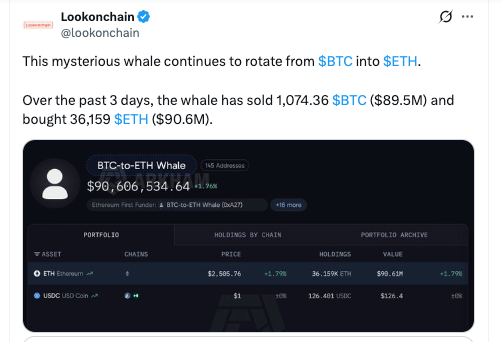
Recent on-chain analysis has highlighted intriguing shifts in whale behavior. One such instance, reported by on-chain analytics platform Lookonchain, revealed a substantial Bitcoin sell-off by a crypto whale, with the proceeds being immediately reinvested into Ethereum. Over a period of three to four days, this whale reportedly divested approximately 1,074.36 BTC, valued at around $89 million at the time of the transactions.
Instead of holding onto fiat currency or diversifying into other traditional assets, the whale then acquired over 36,159 ETH at an average price of $2,500-$2,530 per ETH. This strategic reallocation from Bitcoin to Ethereum, the second-largest cryptocurrency, suggests a deliberate pivot in investment strategy. While such rotations are not entirely unprecedented, they often signal a belief in Ethereum’s future growth prospects, potentially driven by its expanding ecosystem and upcoming technological upgrades, such as the continued development of its scaling solutions and the ongoing transition towards more energy-efficient consensus mechanisms.
This specific whale activity, though a single event, is indicative of a growing sentiment among some sophisticated investors to move beyond Bitcoin as the sole dominant force in the crypto market and explore the potential of other major digital assets. The fact that this large-scale transaction occurred amidst a period of broader market consolidation, where both Bitcoin and Ethereum have been trading within relatively narrow ranges, adds another layer of intrigue. Analysts continue to assess whether such whale movements are precursors to larger market trends or isolated strategic plays.
Analysis of Implications
The implications of Santander’s move into crypto trading are multifaceted:
- Increased Retail Participation: By offering crypto trading through a trusted banking interface, Santander is lowering the barrier to entry for a significant segment of the population. This could lead to a broader adoption of cryptocurrencies beyond the early adopter demographic.
- Regulatory Evolution: The success of such initiatives could encourage regulators globally to refine and strengthen frameworks for digital asset trading within traditional financial institutions. This, in turn, could foster greater investor protection and market stability.
- Competitive Landscape: Other banks, particularly in financial centers like Switzerland, will likely face increased pressure to offer similar services. This could lead to a more competitive and innovative environment for digital asset services within the traditional finance sector.
- DeFi and TradFi Convergence: Santander’s move represents a significant step towards the convergence of Decentralized Finance (DeFi) and Traditional Finance (TradFi). As more traditional institutions integrate digital assets, the lines between these two worlds will continue to blur.
- Security and Custody: The offering by a regulated bank implies that clients will likely benefit from enhanced security measures and potentially insured custody solutions, which are critical concerns for many potential crypto investors.
Future Outlook
The cryptocurrency market is in a constant state of evolution. While Bitcoin and Ethereum remain the dominant players, the emergence of new technologies and use cases continues to shape the digital asset landscape. The strategic decisions of large financial institutions like Santander will play a crucial role in determining the future trajectory of cryptocurrency adoption and integration into the global financial system.
The long-term impact of this move by Santander will depend on several factors, including client uptake, regulatory developments, and the continued evolution of the cryptocurrency market itself. However, its immediate effect is clear: it signifies a growing acceptance and integration of digital assets within the traditional banking sector, paving the way for a future where cryptocurrencies are an increasingly common component of investment portfolios and financial services. The continued observation of whale movements, coupled with institutional adoption, will be key indicators of where the digital asset market is headed.