


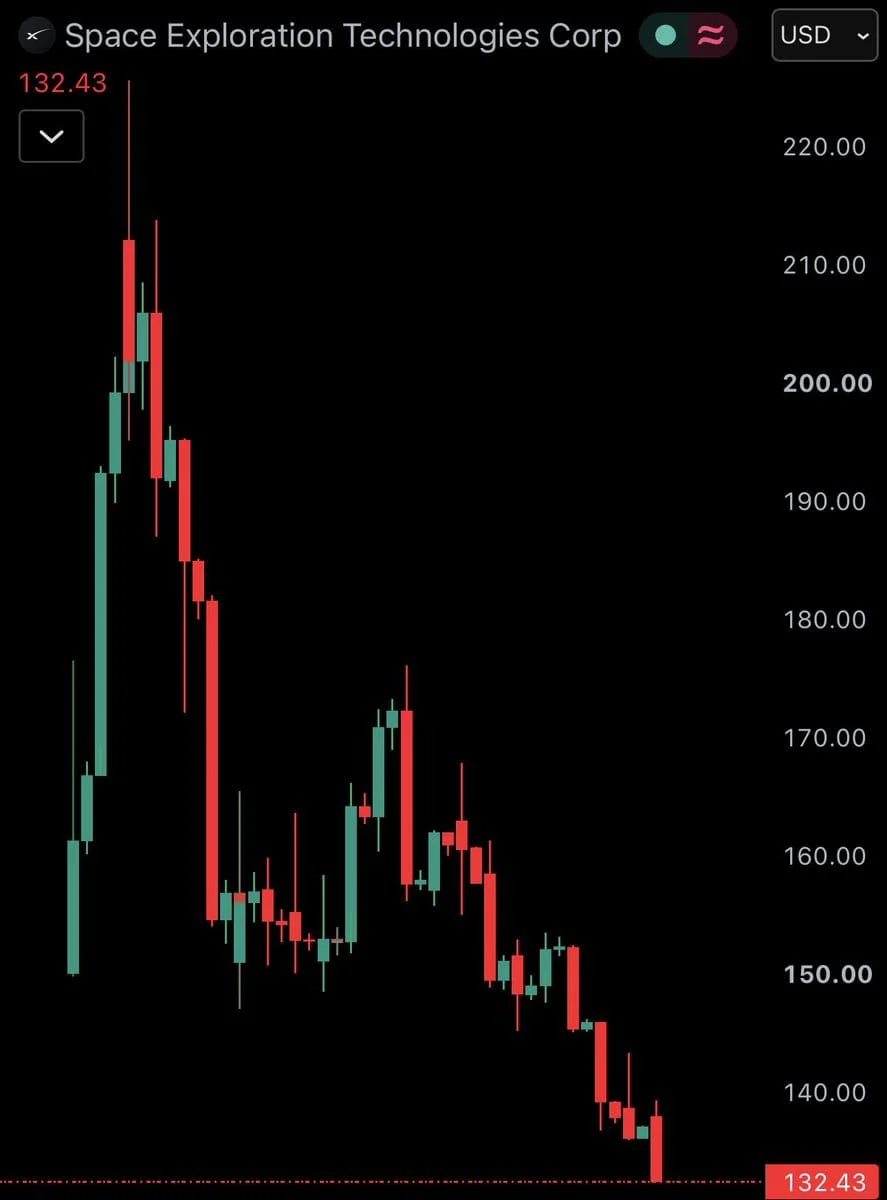
SpaceX, widely recognized as one of the most valuable private companies globally, is exhibiting stock price behavior more akin to a volatile small-cap meme stock than a behemoth valued in the hundreds of billions of dollars. This perplexing paradox, where a company spearheading space exploration and satellite internet infrastructure experiences dramatic swings, can be largely attributed to a fundamental market mechanic: the "float trap." This phenomenon arises when a minuscule fraction of a company’s total shares is available for public trading, creating an environment where even modest buying or selling activity can trigger outsized price movements, irrespective of underlying business fundamentals.
Recently, the implied valuation of SpaceX shares, often traded on secondary markets, has experienced a significant downturn, falling below its $135 IPO reference price. This decline represents a substantial 41.5% drop from its all-time high, an adjustment that, when extrapolated across its total share count, suggests a staggering $1.25 trillion erasure from its peak market capitalization. For investors who participated at or near the IPO reference price, this downturn translates into considerable paper losses. The crucial insight, often obscured by sensational headlines, lies not in the company’s rocket technology or Starlink constellation, but in the intricate dynamics of its share float.
Understanding the "Float Trap" in Detail
At its core, the float trap describes a situation where the free float – the number of shares actively available for trading in the open market – is extremely limited. In SpaceX’s case, a substantial majority of its shares remain tightly held by insiders, including founder Elon Musk, early venture capital investors, and long-term employees. Unlike publicly traded entities such as Apple or Microsoft, which have billions of shares freely circulating, SpaceX’s structure restricts liquidity. When only a small percentage of a company’s total equity is truly "liquid," meaning it can be bought and sold by the general public, the fundamental laws of supply and demand are dramatically amplified.
Consider a hypothetical scenario: if a company has 100 million shares outstanding but only 1 million of those shares are publicly traded, any significant order to buy or sell even a few hundred thousand shares can dramatically shift the price. The depth of the order book is shallow, making it prone to large fluctuations. For a company like SpaceX, which has achieved an estimated private valuation exceeding $175 billion (and at times, reportedly closer to $200 billion through secondary market transactions), this low float creates a cognitive dissonance for investors. They are observing a valuation typically associated with global industrial giants, yet the day-to-day trading characteristics mimic those of a nascent, highly speculative startup. This mismatch between institutional-level valuation and retail-like trading behavior is the central narrative driving SpaceX’s perceived volatility.
SpaceX’s Journey and Valuation Trajectory
SpaceX’s ascent to its current valuation is a testament to its groundbreaking achievements and audacious vision. Founded by Elon Musk in 2002 with the ambitious goal of making life multi-planetary, the company has revolutionized the space industry. Key milestones include the development of reusable rocket technology (Falcon 9, Falcon Heavy), the Dragon spacecraft for cargo and crew transport to the International Space Station, and the rapid deployment of the Starlink satellite internet constellation. More recently, the Starship program, designed for lunar and Martian missions, has captured global attention, promising to redefine human spaceflight.
These technological triumphs and aggressive expansion plans have consistently attracted significant private investment, pushing SpaceX’s valuation skyward through numerous funding rounds. Early investors and employees have seen their stakes appreciate exponentially, creating a pool of wealth that, until recently, largely remained illiquid. The "IPO reference price" of $135 often cited refers to a benchmark used in these private secondary market transactions, providing a quasi-public trading indicator for what is fundamentally a private company. This unique market structure, where shares change hands among accredited investors and institutional funds rather than on a major public exchange, contributes significantly to the limited float. Without a formal public offering, the vast majority of shares remain inaccessible to the broader public, intensifying the float trap’s effects.

Chronology of Volatility and Market Scrutiny
SpaceX’s valuation journey has been characterized by periods of rapid ascent, particularly following successful Starlink deployments, Starship test flights, and major government contracts. The "Elon Musk premium" played a substantial role, with investors often valuing the company not just on its current financials, but on Musk’s visionary leadership and a perceived inevitability of future success across his ventures. This narrative-driven valuation propelled the company’s implied market capitalization to unprecedented levels for a private entity.
However, the recent period has seen a reversal of fortunes. The decline below the $135 reference price marks a significant psychological and financial threshold. While specific dates for peak valuation are fluid due to the private nature of trades, the downturn has been noticeable over the past year. Factors contributing to this shift include a broader market reassessment of growth stocks amid rising interest rates, increased scrutiny over profitability for capital-intensive ventures, and a general cooling of speculative fervor that once buoyed "future-tech" companies. The market is now reacting with heightened sensitivity to news, whether it’s a Starship test anomaly, a Starlink subscriber update, or broader macroeconomic concerns, illustrating how thin the trading volume is.
The Role of Pre-IPO Hedging
An additional layer of complexity that exacerbated the downward pressure on SpaceX’s implied valuation and the broader space sector was the phenomenon of pre-IPO hedging. Many early SpaceX shareholders, holding illiquid, locked-up shares, sought to mitigate their exposure to potential future price drops. Unable to sell their actual SpaceX stock directly, these sophisticated investors often employed hedging strategies by shorting a basket of publicly traded space-related equities. This tactic allowed them to profit if the overall space sector declined, offsetting potential losses in their private SpaceX holdings.
This hedging activity had a disproportionate impact because of the very float trap it sought to protect against. With so few actual SpaceX shares available, the indirect pressure on related public companies served as a proxy for negative sentiment towards SpaceX. Publicly traded companies in the space sector, such as Rocket Lab, Astra Space, or Virgin Galactic (though not directly comparable in scale), experienced downward pressure as a result of these strategic short positions.
The recent breach of the $135 IPO reference price for SpaceX shares suggests that a meaningful portion of this hedge pressure may have run its course. Once the original price levels that triggered the hedging strategies are broken, the incentive to maintain or add to those short positions diminishes. This potential unwind of short positions could, paradoxically, create a cleaner and more stable environment for the broader space equity market going forward, even if SpaceX’s own implied valuation continues to search for a definitive floor.
The Erosion of the "Elon Musk Premium"
For years, SpaceX’s valuation seemed to operate on a different plane, largely detached from traditional financial metrics like quarterly earnings, debt-to-equity ratios, or immediate profitability. This premium was largely a function of the "Elon Musk trillionaire narrative"—the pervasive belief that Musk’s visionary leadership, combined with his track record of disrupting industries (PayPal, Tesla), virtually guaranteed SpaceX’s unparalleled success. His involvement alone, many argued, justified a valuation disconnected from conventional revenue, existing debt, or near-term execution risks.
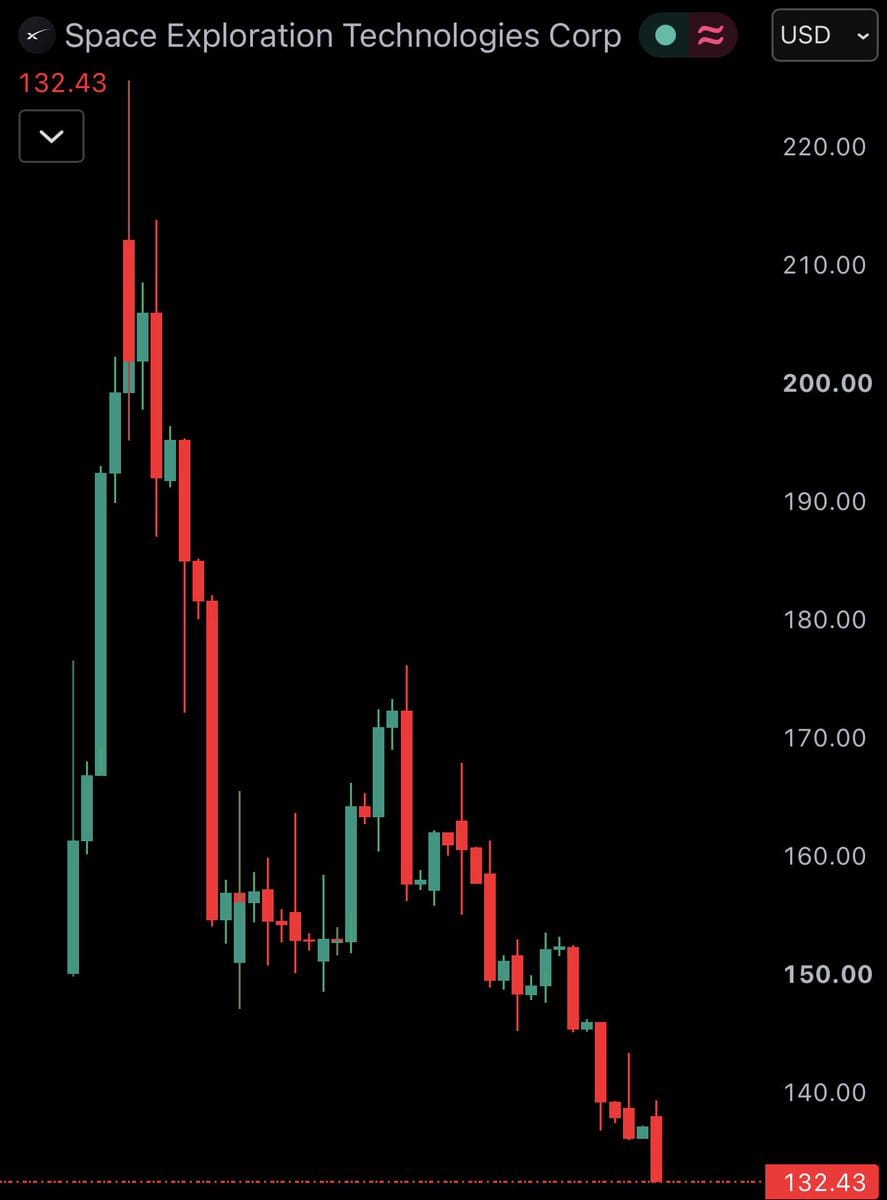
However, this era of narrative-driven valuation appears to be drawing to a close. The market, in its current state, is demonstrating a renewed appetite for fundamentals. Investors are increasingly asking harder, more concrete questions: What is SpaceX’s true debt burden, particularly given the massive capital expenditures required for Starlink deployment and Starship development? How quickly and profitably will the Starship program translate into tangible revenue streams from satellite launches, lunar missions, or even future Mars endeavors? Furthermore, Musk’s increasing emphasis on integrating artificial intelligence into his various ventures, including SpaceX, is prompting scrutiny: Is the capital allocated to this AI bet justified, and what are the clear, measurable returns on this investment? These are no longer rhetorical questions but critical inquiries that the market is actively pricing into the company’s implied valuation. This pivot from speculative optimism to demanding tangible financial performance represents a profound shift in investor sentiment, far more significant than any single day’s percentage move.
Low Float Amplifies Headline Impact
One of the most underestimated consequences of the float trap for retail investors is how dramatically it amplifies the impact of news and sentiment. In a stock with a thin, illiquid float, external factors exert disproportionate influence. A single negative headline, perhaps detailing a minor technical setback, a skeptical analyst’s report questioning future profitability, or even a large institutional investor’s decision to unwind a position, can trigger double-digit price swings in a single trading session.
It is crucial to understand that such volatile movements do not necessarily reflect an overnight deterioration of SpaceX’s underlying business. The company’s operations, its launch cadence, Starlink subscriber growth, and Starship development continue on their trajectory. Instead, the dramatic price action is a direct reflection of how little room the constrained float leaves for absorbing shocks. Without a deep and liquid market, there are simply not enough buyers or sellers to cushion the impact of sudden shifts in sentiment or trading activity. This structural setup, combining a low float with an astronomical valuation, produces the same kind of exaggerated, sentiment-driven price swings commonly associated with much smaller, far more speculative "meme stocks." The comparison, while initially jarring for a company of SpaceX’s stature, is structurally sound.
Broader Implications and the Path Forward
For current and prospective investors, the decline of $SPCX below its $135 reference point should not be interpreted as a sign that SpaceX’s rockets are failing or that its technological ambitions are collapsing. Instead, it signifies a fundamental recalibration: the public market, even in its secondary trading form, is finally beginning to treat Elon Musk less like an infallible visionary and more like a traditional CEO. This means a heightened expectation for balancing the books, servicing existing debt, justifying capital allocation (such as the burgeoning AI bet), and demonstrating clear pathways to sustainable profitability. The "Musk premium," once a powerful driver of valuation, has officially evaporated. Now, the real work of delivering financial performance commensurate with its technological prowess begins.
This shift, while undoubtedly a rough ride for many investors, is not necessarily a negative development for the long-term health of SpaceX or the broader space industry. A market that values a company based on its fundamentals—its revenue growth, profit margins, operational efficiency, and responsible debt management—rather than solely on an overarching narrative or the charisma of its leader, generally fosters a more sustainable and healthier investment environment.
Looking ahead, several key factors will dictate SpaceX’s trajectory and investor sentiment. Whether the company can tangibly prove the value and profitability of its AI initiatives, whether its share float eventually loosens up through future liquidity events (like a traditional IPO), and crucially, whether the market consistently rewards actual execution and financial discipline over past mythology, will define the next chapter. The journey from narrative-driven valuation to fundamental assessment is a critical evolution, and all eyes will be on SpaceX as it navigates this demanding new landscape.














