


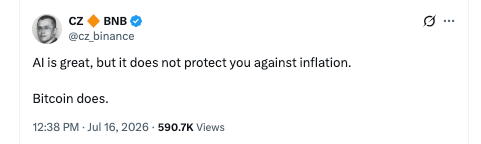
Binance founder Changpeng Zhao, widely recognized in the cryptocurrency sphere as "CZ," has recently ignited a discussion regarding the economic implications of artificial intelligence (AI) and its perceived limitations in combating inflation, contrasting it with the potential of Bitcoin. In a series of public statements, including a notable tweet, Zhao articulated his perspective that while AI is a transformative technology with profound societal impacts, it falls short in addressing the persistent issue of rampant inflation, a role he believes Bitcoin is better positioned to fulfill. This assertion has sparked considerable debate among industry leaders, financial analysts, and cryptocurrency enthusiasts, highlighting the ongoing divergence in views on the role and efficacy of these distinct, yet increasingly intertwined, economic forces.
The comparison, though seemingly disparate – pitting a cutting-edge technological frontier against a decentralized digital monetary system – arises from the significant economic ripples both are generating. Both AI and Bitcoin represent areas of intense technological innovation and substantial investment, capturing the attention of global markets and policymakers. Zhao’s comments underscore a growing sentiment that while AI is poised to revolutionize industries and enhance productivity, its immediate economic consequences, particularly concerning inflationary pressures, warrant careful consideration.
The Economic Engine of Artificial Intelligence and its Inflationary Undercurrents
The rapid advancement and widespread integration of AI technologies are undeniably reshaping the global economy. This technological revolution is not without its economic costs. The infrastructure required to power AI – massive data centers, sophisticated memory chips, and substantial energy resources – demands colossal investments. Reports from financial institutions corroborate this trend. For instance, a recent analysis by Goldman Sachs indicated that the surge in capital expenditure and infrastructure development dedicated to AI is contributing to elevated inflation for consumers.
The United States, in particular, has been identified as a region significantly impacted by these developments. The Goldman Sachs report suggested that AI-related investments added approximately 20 basis points to the annual core Personal Consumption Expenditures (PCE) inflation rate, with projections indicating this figure could potentially double by the end of 2026. This phenomenon is largely attributed to the increased demand for specialized hardware and energy, which drives up prices across various sectors.
While the long-term outlook for AI might point towards deflationary benefits, such as reduced labor costs and enhanced operational efficiencies, the immediate future presents a more complex picture. The energy-intensive nature of AI’s current deployment means that inflationary pressures are likely to persist and potentially intensify before the technology’s full productivity gains can offset these costs. This presents a significant challenge for central banks and policymakers aiming to maintain price stability in an increasingly AI-driven economy.
Bitcoin’s Historical Performance as an Inflation Hedge
In stark contrast to the immediate inflationary pressures associated with AI infrastructure, Bitcoin has historically demonstrated characteristics of an inflation hedge. While often criticized for its inherent volatility and susceptibility to price fluctuations, empirical data suggests a consistent pattern of recovery and robust long-term returns.
During the decade spanning 2015 to 2025, the premier cryptocurrency experienced an extraordinary surge of approximately 38,000%. This performance outpaced traditional safe-haven assets like gold, as well as the stock market and real estate, even after accounting for inflation. While it is true that Bitcoin’s progress has experienced periods of stagnation in recent years, a point frequently highlighted by its critics, its fundamental properties of scarcity and decentralized peer-to-peer utility continue to position it as a valuable hedge against the erosion of purchasing power.
The finite supply of Bitcoin, capped at 21 million coins, creates a built-in scarcity that can protect its value against the inflationary policies of fiat currencies. Furthermore, its decentralized nature and global accessibility allow for cross-border transactions and wealth preservation independent of traditional financial intermediaries. This makes it an attractive option for individuals and institutions seeking to diversify their portfolios and safeguard their assets against macroeconomic uncertainties.
Zhao’s consistent emphasis on Bitcoin, specifically its long-term potential, suggests a strategic focus on assets that possess intrinsic value and a demonstrable track record of preserving wealth over extended periods. This perspective often differentiates Bitcoin from other cryptocurrencies, many of which are viewed as more speculative and less established as long-term investment vehicles.
A Chronology of Commentary and Market Dynamics
The discourse surrounding Bitcoin and inflation is not new. For years, proponents have argued that its decentralized nature and limited supply make it a superior store of value compared to fiat currencies, which are susceptible to inflation through quantitative easing and monetary expansion. Skeptics, however, often point to Bitcoin’s extreme price volatility as a disqualifier for its use as a reliable inflation hedge.
Early 2010s: Bitcoin emerged as a nascent digital currency, largely seen as a niche technology with limited practical application. Early adopters were primarily tech enthusiasts and those interested in exploring alternative financial systems.
Mid-2010s: As Bitcoin gained traction, discussions about its potential as "digital gold" and a hedge against inflation began to surface. Its price experienced significant rallies and corrections, drawing both fervent support and sharp criticism.
Late 2010s to Early 2020s: The mainstreaming of cryptocurrency, coupled with periods of global economic uncertainty and unprecedented monetary stimulus, amplified the debate. Major financial institutions began to take notice, and institutional investors started exploring Bitcoin as a potential asset class. This period saw Bitcoin’s price reach new all-time highs, further fueling the inflation hedge narrative.
Recent Developments (2023-2024): The rise of sophisticated AI technologies has introduced a new dimension to economic discussions. The significant capital inflows into AI infrastructure have raised concerns about their impact on inflation, prompting comparisons with assets like Bitcoin. Changpeng Zhao’s recent statements align with this evolving economic landscape, positioning Bitcoin as a more reliable solution for inflation concerns than the immediate economic outputs of AI.
Broader Implications and Future Outlook
Changpeng Zhao’s perspective, while coming from a prominent figure in the crypto industry, touches upon a fundamental question about the future of value preservation in an era of rapid technological change and evolving monetary policies. The implications of his statements are multifaceted:
- Strategic Investment Advice: Zhao’s commentary can be interpreted as strategic guidance for long-term investors. He appears to advocate for assets with proven scarcity and decentralized characteristics as bulwarks against inflation, suggesting that the immediate economic disruptions caused by AI, while significant, do not negate Bitcoin’s fundamental value proposition.
- The Role of Technology in Inflation: The dichotomy presented between AI and Bitcoin highlights the complex relationship between technological advancement and economic stability. While AI promises increased efficiency and productivity, its immediate inflationary effects underscore the need for careful management of technological integration.
- Bitcoin’s Enduring Appeal: The continued focus on Bitcoin as a primary hedge, even amidst the hype surrounding AI, suggests its growing maturity as an asset class. Its scarcity, decentralization, and historical performance continue to resonate with investors seeking alternatives to traditional financial systems.
- Future of Monetary Policy: The debate also implicitly raises questions about the future of monetary policy. As digital assets and advanced technologies continue to evolve, central banks and governments will need to adapt their strategies to manage inflation and ensure financial stability in an increasingly complex global economy.
In conclusion, Changpeng Zhao’s assertion that Bitcoin offers a more robust hedge against inflation than the immediate economic consequences of AI reflects a growing sentiment among cryptocurrency advocates. While AI is poised to revolutionize industries and create immense value, its current inflationary impact is a significant consideration. Bitcoin, with its inherent scarcity and proven track record, continues to be viewed by many as a more reliable store of value in the face of persistent inflation. The ongoing interplay between technological innovation and economic stability will undoubtedly continue to shape these discussions and investment strategies in the years to come.














