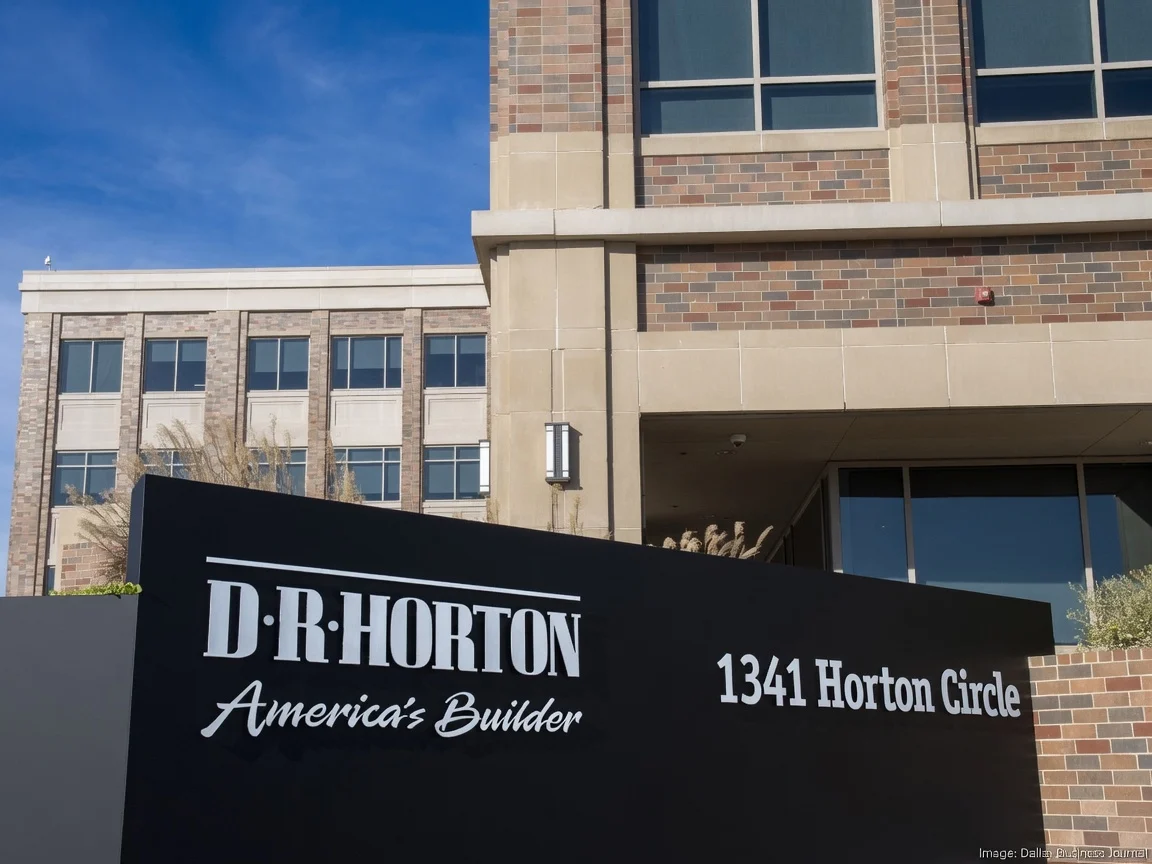
D.R. Horton, America’s largest homebuilder by volume, experienced a slight dip in its stock price during pre-market trading Tuesday, declining approximately 0.4% to $144.25. This downturn followed the company’s announcement of a revised, lower annual revenue forecast, overshadowing its stronger-than-anticipated third-quarter profit results. The revision reflects persistent headwinds in the housing market, primarily driven by affordability constraints and cautious consumer sentiment, even as the company demonstrated operational resilience in its recent financial performance.
For the fiscal quarter ending June 30, D.R. Horton reported diluted earnings per share (EPS) of $3.20 on quarterly revenue of $9.2 billion. These figures comfortably surpassed Wall Street’s consensus estimates, which, based on FactSet data, had projected EPS of $2.97 per share and sales of $9.1 billion. The company’s home sales gross margin also exceeded expectations, registering 20.7% against a projected 19.9%. However, this positive deviation from forecasts did not fully mask a year-over-year contraction in profitability, as the gross margin for the comparable quarter last year stood at 21.8%. This 1.1 percentage point decline underscores the increasing pressure on homebuilders to maintain profitability amidst rising costs and heightened buyer incentives.
Despite this quarterly outperformance, the management’s forward-looking statements tempered market enthusiasm. D.R. Horton revised its fiscal year consolidated revenue projection downwards to a range of $32.5 billion to $33.0 billion. This marks a notable reduction from its prior guidance, which had estimated revenues between $33.5 billion and $34.5 billion. Concurrently, the company also lowered its forecast for homes closed in the fiscal year, now expecting 83,800 to 84,300 units, down from the previous range of 86,000 to 87,500. Analysts, according to LSEG, had anticipated full-year revenues closer to $33.67 billion, indicating that the revised guidance fell short of market expectations.
Management’s Strategic Response to Market Headwinds
Executive Chairman David Auld provided critical insight into the company’s outlook, acknowledging the challenging marketplace for prospective homebuyers. "Affordability constraints and cautious consumer sentiment continue to impact new home demand," Auld stated. This observation highlights the dual challenge faced by the industry: rising home prices, exacerbated by high interest rates, are making homeownership less accessible, while broader economic uncertainties are leading potential buyers to defer large purchasing decisions.
In response to these market conditions, D.R. Horton has proactively implemented a multi-pronged strategy. The company has ramped up its offerings of mortgage rate buydown programs, which involve paying a portion of the interest upfront to temporarily or permanently lower a buyer’s mortgage rate. These incentives are crucial in making monthly payments more manageable for buyers grappling with elevated interest rates. Furthermore, D.R. Horton has strategically pivoted its product mix, increasingly focusing on more compact, budget-friendly homes. This shift aims to cater to a larger segment of the market where affordability is a primary concern, potentially capturing demand from first-time homebuyers or those seeking more economical options. Auld explicitly indicated that incentive spending is projected to remain high throughout the fourth fiscal quarter, underscoring the company’s commitment to stimulating demand in a competitive environment.
Chronology of Economic and Housing Market Shifts
The current landscape for homebuilders is a culmination of several interconnected economic developments over the past few years. The period immediately following the COVID-19 pandemic saw a surge in housing demand, fueled by low interest rates, remote work trends, and a desire for more living space. This demand, coupled with supply chain disruptions and labor shortages, led to a rapid escalation in home prices and building material costs.
However, the tide began to turn in early 2022 when the Federal Reserve initiated an aggressive campaign of interest rate hikes to combat surging inflation. Between March 2022 and July 2023, the Federal Funds Rate saw multiple increases, pushing mortgage rates to their highest levels in over two decades. For instance, the average 30-year fixed mortgage rate, which hovered around 3% in early 2022, climbed past 7% by late 2022 and has largely remained elevated since. This dramatic increase in borrowing costs significantly eroded buyer purchasing power, with a mortgage payment on a median-priced home often doubling compared to pre-hike levels.
Simultaneously, the existing home market experienced a sharp decline in activity. Homeowners, many of whom locked in historically low mortgage rates, became reluctant to sell, leading to a severe shortage of available inventory. While this might theoretically benefit new home construction by reducing competition, the overarching issue of affordability has proved a more formidable barrier. D.R. Horton’s recent guidance revision directly reflects these evolving market dynamics, signaling that even the largest players are adjusting to a new normal of moderated demand and increased cost pressures.
Profitability Challenges Mount Amidst Inflation and Tariffs
The decline in D.R. Horton’s gross margin from 21.8% to 20.7% year-over-year is emblematic of broader profitability challenges confronting the homebuilding sector. Several factors contribute to this margin compression. Tariffs imposed on various building materials, such as Canadian lumber, steel, and aluminum, have systematically increased input costs for homebuilders nationwide. While some of these tariffs have fluctuated, their presence adds an unpredictable layer of expense. Beyond tariffs, ongoing inflationary trends across a wide spectrum of goods and services continue to drive up the cost of raw materials, transportation, and labor.
The National Association of Home Builders (NAHB) has consistently highlighted the impact of these rising costs, noting that the price of many key building materials has surged significantly since the pandemic began. For instance, lumber prices, while volatile, have seen periods of extreme spikes, directly impacting construction budgets. Labor shortages in skilled trades have also pushed up wages, further contributing to overall construction expenses. When these escalating costs are combined with the necessity of offering enhanced buyer incentives – such as mortgage rate buydowns or price reductions – the cumulative effect is a substantial squeeze on profit margins.
The decline in D.R. Horton’s earnings per share from $3.36 in the prior-year period to $3.20 this quarter further underscores these sustained headwinds. Executive Chairman David Auld reiterated that the company anticipates "sales incentives to remain elevated during the fourth quarter, with incentive levels dependent on demand, mortgage rates and other market conditions." This statement signals that the current market environment necessitates a continued emphasis on incentives to drive sales volume, which in turn will likely keep pressure on profitability for the foreseeable future.
Comparative Performance and Mid-Tier Builders’ Strength
Year-to-date, DHI shares have climbed approximately 3.7%. While this performance has outpaced the broader iShares U.S. Home Construction ETF (ITB), which serves as a benchmark for the sector, it significantly trails the robust gains observed among some smaller and mid-tier competitors. For example, LGI Homes and Hovnanian Enterprises have surged 36% and 35% respectively during the same timeframe, demonstrating a distinct shift in investor focus and perceived value within the industry.
The strong momentum in smaller-cap homebuilders has been particularly pronounced following news of Berkshire Hathaway’s strategic acquisition of a stake in mid-market builder Taylor Morrison. This high-profile investment by Warren Buffett’s conglomerate prompted investors to explore more attractively valued opportunities within the homebuilding segment, especially among companies that might offer higher growth potential or operate in specific market niches.
Several other mid-tier builders have also exhibited impressive stock performance. Beazer Homes has rallied over 60% year-to-date, reflecting investor confidence in its operational strategies and market positioning. Analysts are also taking note: Alex Rygiel, an analyst at Texas Capital Securities, maintains "Buy" recommendations on Century Communities and LGI Homes, specifically highlighting that both companies trade beneath their book value. This valuation metric often indicates that a company’s stock price is lower than the value of its assets, suggesting potential undervaluation and room for growth.
In contrast, while D.R. Horton remains the United States’ largest homebuilder by market capitalization, its sheer size and broad market exposure mean it may be more susceptible to broad economic slowdowns and affordability challenges that impact a wider range of buyers. Nonetheless, D.R. Horton continues to attract positive analyst sentiment. BTIG analyst Ryan Gilbert, for instance, assigns a "Buy" rating to D.R. Horton with a $188 price objective. Gilbert’s optimism stems from the potential for recent momentum in the existing home market – if supply were to loosen – to translate into improved new home pricing power, which could subsequently support margin expansion for large builders like DHI.
Broader Industry Implications and Future Outlook
D.R. Horton’s earnings report and revised guidance offer a critical barometer for the health of the U.S. housing market. As the industry leader, its performance and outlook often set the tone for the entire sector. The ongoing tension between robust demand (driven by demographic shifts and a long-term housing shortage) and severe affordability constraints (due to high interest rates and elevated home prices) remains the central challenge.
The company’s strategic pivot towards smaller, more budget-friendly homes, coupled with aggressive incentive programs, reflects a pragmatic adjustment to current market realities. This approach, if successful, could allow D.R. Horton to maintain sales volume, albeit at potentially tighter margins. The effectiveness of these strategies will be closely watched by competitors and investors alike.
Further insights into the industry’s trajectory for the second half of the year are anticipated with PulteGroup’s upcoming earnings report, expected later this week. As another major player in the homebuilding sector, PulteGroup’s financial results and forward guidance will provide additional data points to either confirm or challenge the trends observed in D.R. Horton’s report. Analysts will be scrutinizing these reports for clues regarding the sustainability of current demand, the effectiveness of builder incentives, and the potential for any shifts in interest rate policies that could alleviate affordability pressures.
Ultimately, the trajectory of the housing market, and thus the performance of homebuilders like D.R. Horton, remains intricately linked to broader macroeconomic conditions. Any future adjustments in Federal Reserve monetary policy, particularly regarding interest rates, will play a pivotal role in shaping consumer purchasing power and, consequently, the demand for new homes. Until a more favorable environment emerges, homebuilders are likely to continue navigating a landscape characterized by strategic concessions and a relentless focus on efficiency to maintain market share and profitability.