


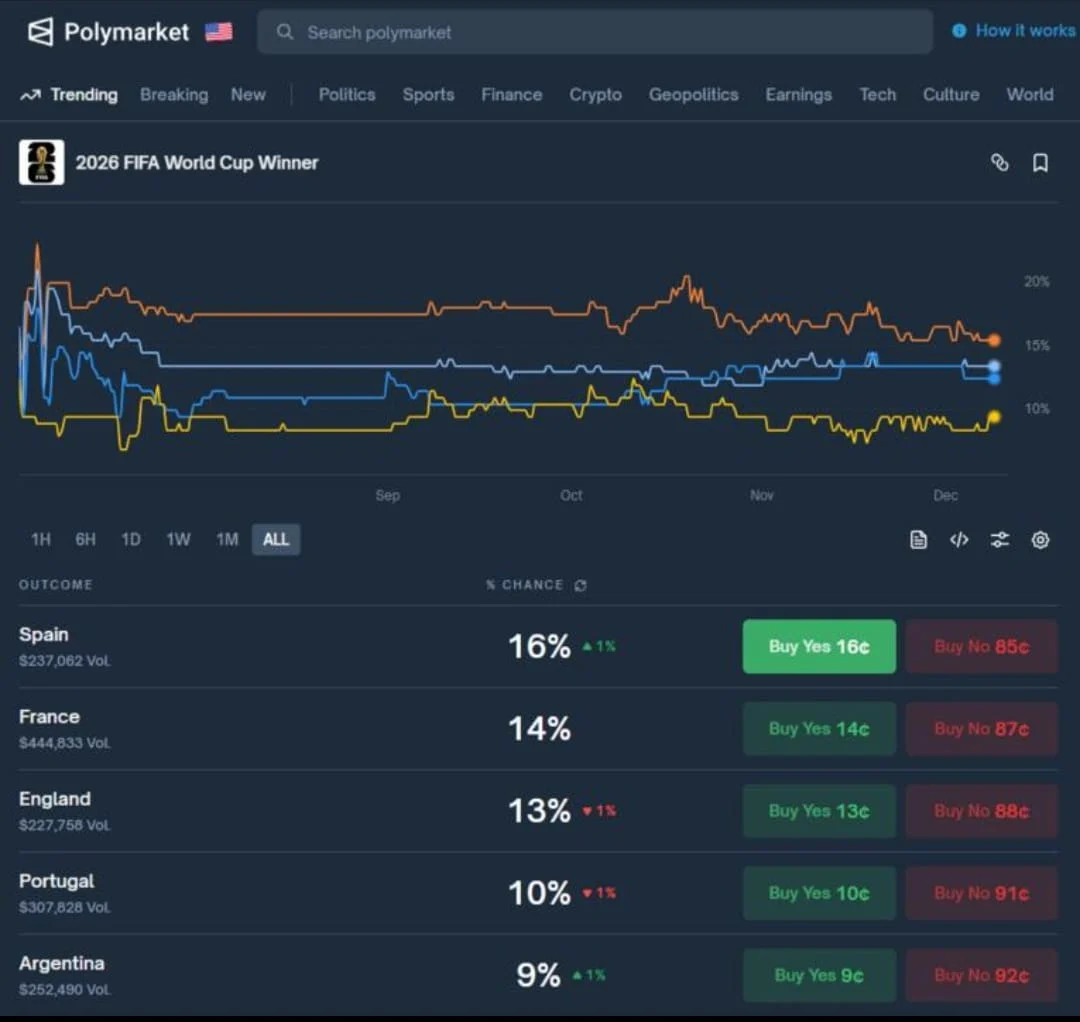
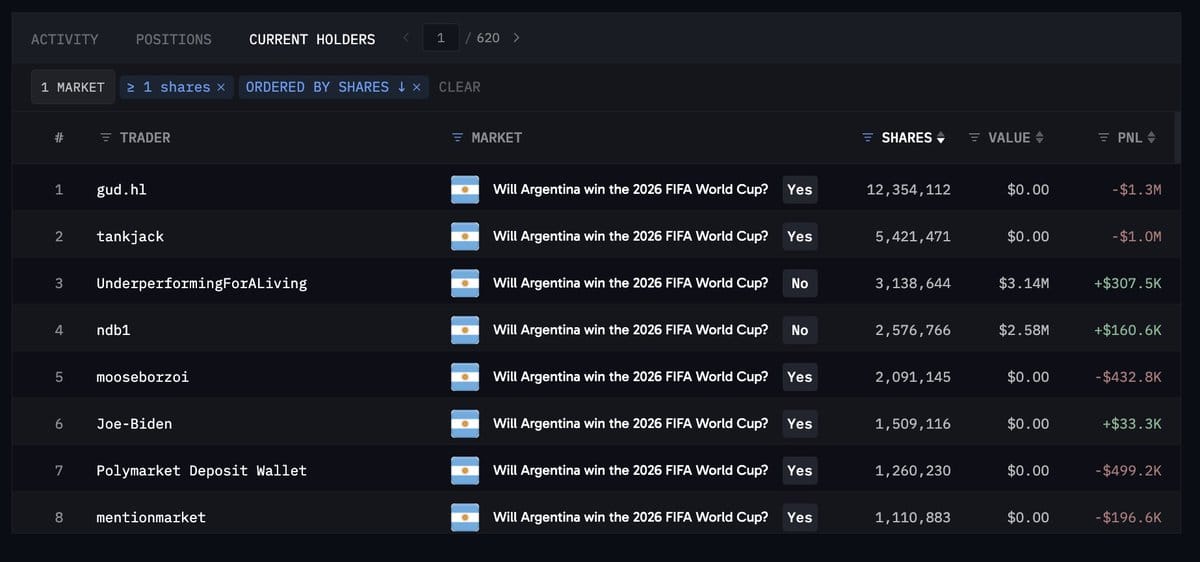
The global sporting spectacle of the 2026 FIFA World Cup culminated in a dramatic final, seeing Spain clinch the coveted trophy with a narrow 1-0 extra-time victory over Argentina. While millions celebrated or commiserated worldwide, the final whistle signaled not only the end of a thrilling tournament but also a significant financial reckoning for one particular cryptocurrency trader. Operating under the pseudonym gud.hl, the individual reportedly lost their entire $5.2 million position, which had been staked on an Argentine triumph, highlighting the volatile intersection of high-stakes sports betting and decentralized finance.
The Dramatic Final and the Immediate Fallout
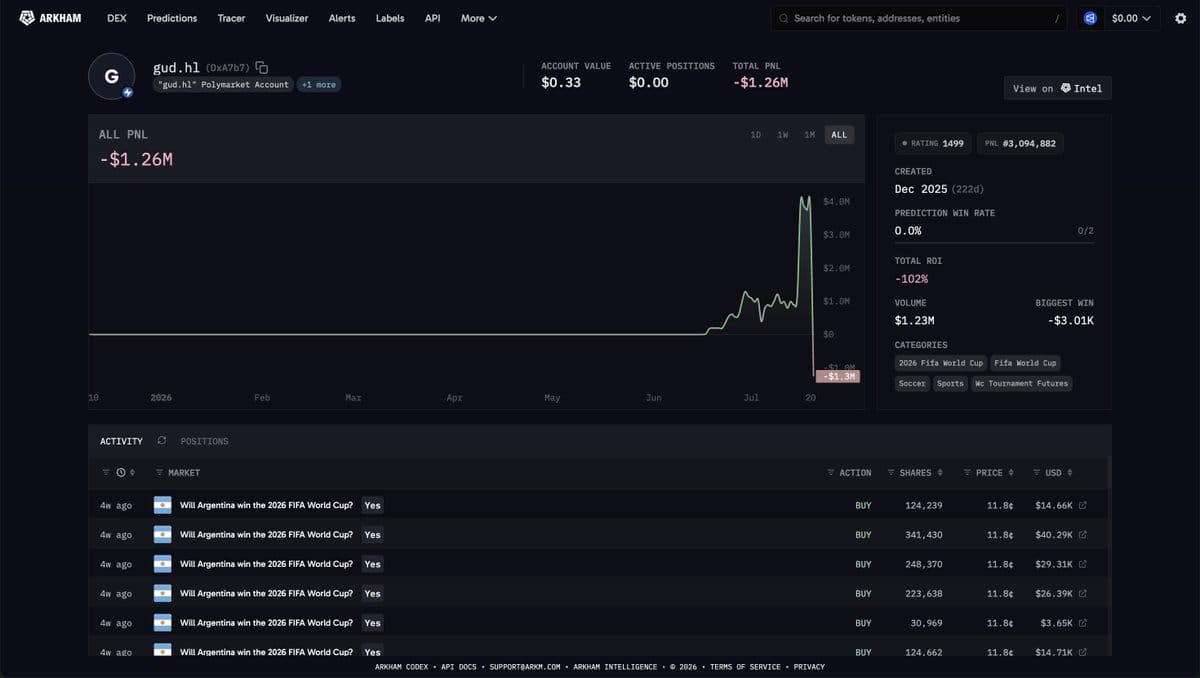
The 2026 World Cup final was a contest of nerves and skill, stretching into extra time after a fiercely fought 90 minutes. Spain’s decisive goal, scored in the additional period, shattered the hopes of Argentine fans and, more acutely, the financial prospects of gud.hl. According to tracking data from Arkham, a blockchain analytics firm, the trader’s substantial crypto position was liquidated instantaneously upon the match’s conclusion. This event serves as a stark reminder of the inherent risks in highly leveraged positions, particularly when tied to binary outcomes of unpredictable sporting events.
What makes gud.hl’s loss particularly poignant is the source of the capital. Reports indicate that the $5.2 million represented almost the entirety of their accumulated profits and losses (PnL) from trading on Hyperliquid, a decentralized perpetual exchange. This was not a casual side bet with disposable income but a significant allocation of hard-earned trading capital, converted into a single, high-conviction wager on a football match. The immediate evaporation of such a substantial sum underscores the brutal efficiency of smart contracts in executing predetermined outcomes, leaving no room for negotiation or reprieve once conditions are met.
A Tournament That Redefined Crypto Betting

While gud.hl’s personal loss captures immediate attention, it occurred within a much larger narrative of unprecedented activity in the crypto prediction market sector throughout the 2026 World Cup. The tournament itself was a financial behemoth for FIFA, reportedly generating over $9 billion, making it the most lucrative sporting event in history by revenue measures. However, the parallel surge in decentralized prediction markets represented a distinct and equally monumental financial story, illustrating the growing appetite for blockchain-based betting.
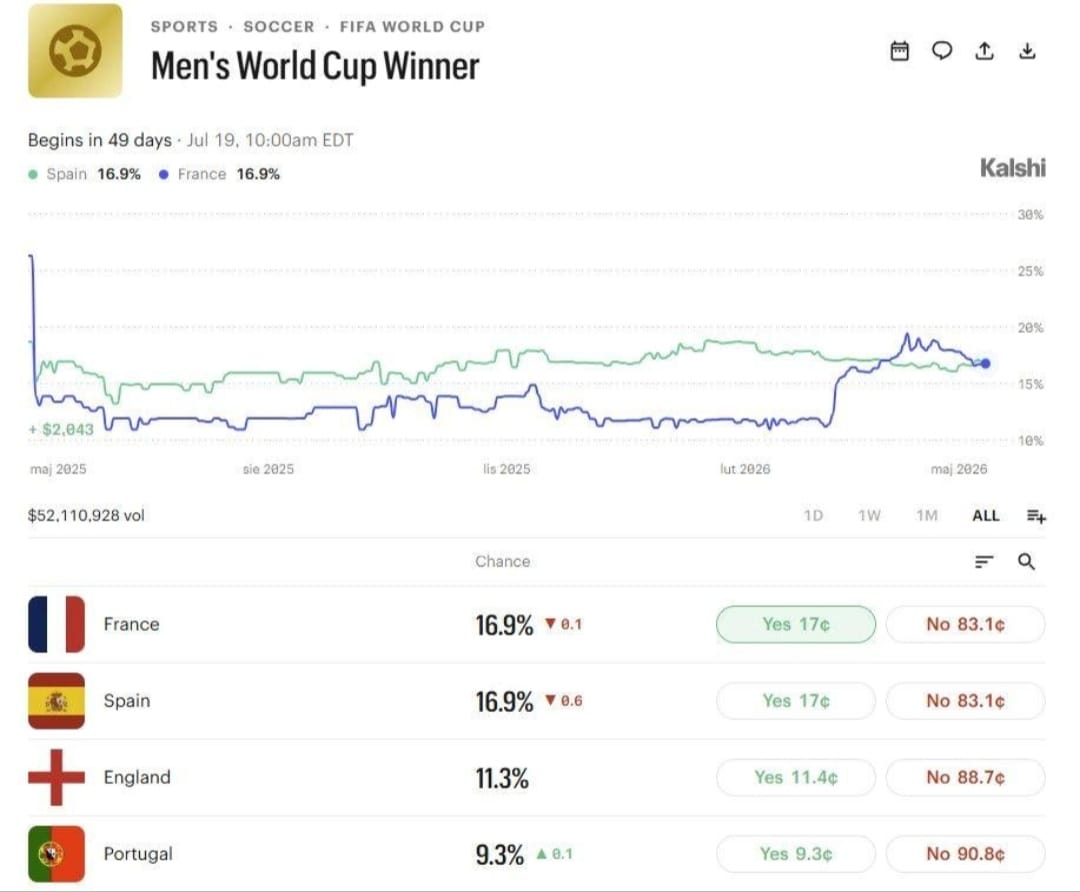
Prediction platforms witnessed a staggering influx of capital and users over the five weeks the tournament ran. Polymarket, a leading decentralized prediction market, recorded more than $4 billion in trading volume specifically on its World Cup winner market. This figure stands as an all-time record for the platform, dwarfing any previous market activity. Similarly, Kalshi, another prominent event-based market, saw its winner market cross $1.2 billion, also setting a new benchmark for its operations.
The cumulative effect of this engagement propelled monthly prediction market volume across the sector to an astonishing peak of over $50 billion. This figure is particularly significant when considering the relatively nascent stage of decentralized prediction markets compared to traditional sportsbooks. Conventional betting giants have spent decades building the necessary infrastructure, establishing brand trust, and cultivating vast user bases to achieve such monumental trading volumes. Prediction markets, leveraging the efficiency and transparency of blockchain technology, managed to reach comparable scales in a mere five weeks, signaling a paradigm shift in how global events can be monetized and interacted with by a global audience.
Unprecedented User Onboarding and Market Penetration
The financial volumes were matched by equally remarkable user growth. Kalshi, for instance, reported adding three million new users during the World Cup window alone. To put this into perspective, a single sporting event effectively onboarded more new users onto a decentralized platform than many entire blockchain networks have managed to attract throughout their entire existence. This demonstrates the immense pull a universally appealing event like the FIFA World Cup can exert when combined with accessible, real-money betting mechanisms and clear, verifiable outcomes.
Industry analysts suggest that the simplicity and finality of a World Cup result — a clear winner and loser — make it an ideal catalyst for prediction market engagement. Unlike complex financial derivatives or abstract blockchain protocols, the outcome of a football match is universally understood, removing significant barriers to entry for new users. This accessibility, coupled with the potential for substantial financial returns (or losses), proved to be a powerful magnet for millions, many of whom may have been introduced to decentralized finance for the first time through these platforms. The ability to participate in a global phenomenon with real financial stakes, underpinned by transparent blockchain technology, appears to be a compelling proposition that transcends traditional crypto demographics.
The High-Stakes Arena: A Spectrum of Wins and Losses
gud.hl’s $5.2 million loss, while dramatic, was just one story amidst a broader tapestry of fortunes won and lost during the tournament. The highly liquid and active markets created by the World Cup provided fertile ground for both spectacular successes and equally crushing failures.
One notable example, detailed in a post tracking the trade, involved a trader who courageously took a $4 million position against Spain earlier in the tournament. As Spain progressed, defying some expectations, this trader’s position grew, eventually culminating in a $9 million payout by correctly "fading" the eventual champion at a critical juncture. This strategic contrarian bet exemplifies the potential for outsized returns when market sentiment can be accurately anticipated or countered.
Conversely, the tournament also produced tales of significant financial distress beyond gud.hl. Another trader reportedly lost a staggering $11.6 million over a mere ten-day period by consistently betting on the wrong outcomes as the tournament unfolded. Such a rapid depletion of capital underscores the relentless nature of high-frequency, high-stakes betting and the compounding effect of incorrect predictions.
These contrasting outcomes — immense wins and devastating losses — paint a more complete picture of the prediction market landscape during the World Cup. For every gud.hl facing a multi-million-dollar loss, there were others who realized equally substantial gains by taking the opposite side of the trade. This dynamic is intrinsic to any liquid market of this scale, but its manifestation around a universally understood cultural event like the World Cup final makes the financial stakes feel profoundly more visceral and relatable than a typical crypto trading narrative. The emotional investment in the sport itself, combined with the financial exposure, amplifies the human drama of each outcome.
Why the World Cup Became a Crypto Phenomenon
The convergence of a global football tournament and a massive cryptocurrency liquidity event was not accidental. Prediction markets inherently thrive on clear, verifiable, and binary outcomes. A FIFA World Cup final provides an almost perfect illustration of these conditions:
- Clear Outcome: There is no ambiguity about who wins and who loses.
- Fixed Date and Time: The event has a globally recognized schedule, allowing for precise market closure.
- Global Attention: Billions tune in, generating immense public interest and speculative energy.
- High Stakes: Both in sporting terms and, as demonstrated, in financial terms.
Every ingredient necessary for a prediction market to function optimally was present, and critically, at a scale that most other events simply cannot replicate. The inherent simplicity of "who will win the World Cup?" translates easily into a market proposition, lowering the cognitive load for potential participants and enabling broad adoption.
Moreover, the infrastructure supporting these decentralized markets proved remarkably robust. Handling $50 billion in monthly volume at peak activity is a testament to the significant advancements in blockchain technology and decentralized application (dApp) development. Platforms like Polymarket and Kalshi processed record-breaking volumes without experiencing the widespread outages or platform failures that have sometimes plagued smaller markets or even centralized exchanges during periods of extreme traffic. This stability suggests a maturation of the underlying decentralized finance (DeFi) infrastructure, demonstrating its capacity to absorb massive demand and execute complex financial logic reliably under pressure.
Looking Ahead: Implications for the Future of Prediction Markets and Crypto
The real story emerging from the 2026 World Cup transcends gud.hl’s personal financial setback, however tragic it may be. It is the undeniable proof, delivered at massive scale, that prediction markets are capable of attracting and absorbing the kind of volume and user growth previously considered the exclusive domain of traditional sportsbooks and major financial exchanges. Three million new users and $50 billion in monthly volume generated by a single tournament is not a statistical anomaly; it is a clear signal.
This unprecedented engagement strongly indicates that future major global sporting events — from the Olympics to other international championships — are likely to see even greater capital flows through these decentralized platforms. The World Cup has served as a powerful stress test and a massive marketing campaign, validating the utility and scalability of prediction markets. It has effectively showcased how blockchain technology can facilitate transparent, efficient, and globally accessible betting markets that can rival, and in some aspects surpass, their traditional counterparts.
For the broader cryptocurrency ecosystem, the World Cup’s impact on prediction markets represents a significant stride in mainstream adoption. It illustrates a compelling use case that resonates with a global audience, potentially serving as a gateway for millions into understanding and interacting with decentralized applications. The success of these platforms during such a high-profile event lends credibility to the underlying technology and its potential to disrupt established industries.
As for gud.hl, the immediate future is uncertain and deeply personal. The question remains whether a Hyperliquid PnL, painstakingly built through skill and time, can be rebuilt after being wiped out by a single, albeit massive, bet. Markets like these, with their inherent volatility and rapid price movements, offer the potential for fortunes to turn quickly in either direction. Whether this particular saga becomes a comeback story, a cautionary tale for future traders, or simply a footnote in the history of crypto betting, only the unfolding months and subsequent market movements will tell. The 2026 World Cup has cemented its place not just in football history, but also as a pivotal moment in the evolution of decentralized finance and its increasingly intertwined relationship with global cultural phenomena.














