



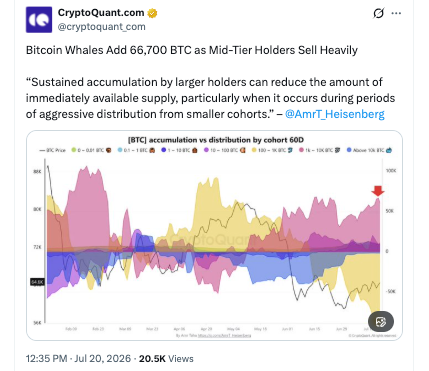
In a significant shift in Bitcoin market dynamics, substantial outflows of the cryptocurrency from exchanges have been observed, coinciding with aggressive accumulation by large-scale holders, commonly referred to as "whales." Over the past 60 days, these whales have reportedly augmented their Bitcoin holdings by more than $4.3 billion, while smaller investors have divested assets valued at over $5 billion. This contrasting behavior, as detailed by the prominent cryptocurrency analytics platform CryptoQuant, suggests a bifurcating market sentiment and potential strategic repositioning among different investor classes.
The data, shared by CryptoQuant via its official X (formerly Twitter) account, highlights a stark divergence in trading patterns. "Fish," defined as wallets holding between 100 and 1,000 BTC, have been net sellers during June and July. Conversely, "whales," holding upwards of 10,000 BTC, along with an intermediate category known as "dolphins" (1,000 to 10,000 BTC), have been actively acquiring Bitcoin. This trend implies that while smaller players are reducing their exposure, larger, more established entities are consolidating their positions, a pattern that could signal a potential floor for the cryptocurrency’s price.
Divergent Investor Strategies: Whales Accumulate, Fish Divest
CryptoQuant’s analysis, visualized in a compelling chart, indicates that the smaller investors’ selling spree has followed a period of significant buying activity during the first and second quarters of the year. This suggests a potential realization of limited profits or a change in strategy after an initial period of anticipation for a swift return to bull market conditions. The current price of Bitcoin, trading well below the $70,000 mark, may not offer substantial short-term gains for these smaller holders, prompting them to exit their positions.
"The smaller players appear to be looking to offload their Bitcoin at these prices after engaging in a major buying spree during the first and second quarters," stated a representative from CryptoQuant, as conveyed through their social media channels. "It is yet unclear why they are doing this as the cryptocurrency is struggling well below $70k and there cannot be much profit to be made here. A simple explanation would be that these players bought crypto anticipating a quick return to the bull market but that hasn’t happened and the premier cryptocurrency continues to be lacklustre."
The "dolphins," a demographic exhibiting even more aggressive buying behavior than whales in recent months, present an intriguing parallel. Their strong accumulation, mirroring that of the whales, could be interpreted as a significant signal for the market, potentially indicating that the long-term bottom for Bitcoin has been established. This sustained buying pressure from larger entities, despite the general market stagnation, often precedes significant price movements.
Broader Market Context: Institutional Interest and Retail’s Role
This internal market activity by large Bitcoin holders is unfolding against a backdrop of renewed institutional interest, primarily driven by the sustained inflows into U.S. spot Bitcoin Exchange-Traded Funds (ETFs). July has witnessed multiple days of positive net inflows for prominent ETFs, including BlackRock’s iShares Bitcoin Trust (IBIT). On July 20th alone, these exchange-traded products collectively added approximately $227 million in Bitcoin, with a five-day tally exceeding $700 million. This institutional demand provides a crucial layer of support and validation for Bitcoin as an asset class.
However, a critical component of the Bitcoin market that remains conspicuously absent from this surge in activity is the retail investor. While institutional inflows demonstrate a growing acceptance and demand from traditional financial players, the broader participation of individual investors is essential for sustained upward momentum. Without a significant return of retail buyers, Bitcoin’s price may continue to experience volatility and struggle to break through key resistance levels.

Bitcoin’s Price Trajectory and Market Performance
Bitcoin has recently managed to stabilize above the crucial $60,000 support level, trading within a range of approximately $63,000 to $66,000. This comes after earlier tests of lower support zones near $58,000 to $60,000 during the summer months. The cryptocurrency’s performance over the last three quarters has been somewhat lackluster, compelling short-term speculators to explore alternative investment opportunities, particularly in the booming stock and equities markets.
The performance of the broader cryptocurrency market has been closely tied to Bitcoin’s price action. While the "altcoin season" that many anticipated has not fully materialized, there have been pockets of significant growth in specific digital assets. However, the overall sentiment remains cautious, with investors closely monitoring macroeconomic indicators and regulatory developments alongside on-chain data.
Implications of Whale Accumulation
The sustained accumulation by Bitcoin whales and dolphins carries several potential implications for the market:
- Price Floor Formation: Aggressive buying by large holders can create a strong support level, making it difficult for prices to fall significantly. This can lead to a consolidation phase before a potential upward trend.
- Reduced Exchange Supply: As Bitcoin moves from exchanges to private wallets held by these large investors, the readily available supply on exchanges diminishes. This reduction in sellable inventory, coupled with sustained demand, can exert upward pressure on prices.
- Market Confidence Indicator: The actions of whales are often viewed as a proxy for market confidence. Their willingness to acquire large sums of Bitcoin suggests a belief in its long-term value proposition, which can influence the sentiment of other market participants.
- Potential for Future Price Appreciation: Historically, periods of significant whale accumulation have often preceded substantial price rallies. While not a guarantee, this pattern suggests that these large investors may be positioning themselves for future growth.
The Role of Exchange Outflows
The observation of over $3.45 billion worth of Bitcoin exiting crypto exchanges is a direct reflection of the accumulation trend by these larger players. Exchanges serve as primary venues for both buying and selling. When large amounts of Bitcoin are withdrawn, it typically signifies a move from speculative trading accounts to long-term holding strategies, often referred to as "hodling." This reduces the immediate sell pressure on the market and indicates a belief in the asset’s future appreciation.
The Net Exchange Flow metric, which CryptoQuant monitors, is a key indicator of this trend. A consistent negative net flow (more outflows than inflows) generally points to accumulation and potential bullish sentiment among significant holders.
Historical Context and Market Cycles
Understanding the current market dynamics requires looking at historical Bitcoin cycles. The cryptocurrency has a well-documented history of boom-and-bust cycles, often driven by speculative fervor, technological advancements, and macroeconomic factors. The current phase, occurring after a period of significant price appreciation in 2021 and a subsequent sharp correction in 2022, appears to be characterized by a more measured accumulation by sophisticated investors.
The halving events, which reduce the rate at which new Bitcoins are mined, have historically been catalysts for bull markets. The most recent halving occurred in April 2024, and while the immediate impact was not as dramatic as in previous cycles, the reduction in supply is a fundamental factor that could contribute to price appreciation in the medium to long term. The current whale accumulation could be a strategic move to capitalize on the reduced supply dynamics post-halving.
The Missing Piece: Retail Investor Engagement
The absence of robust retail participation remains a significant question mark for the future trajectory of Bitcoin. Retail investors, often driven by FOMO (fear of missing out) and media attention, can amplify price movements significantly. Their current subdued activity could be attributed to several factors:
- Market Volatility: The previous sharp downturn may have deterred smaller investors, making them more risk-averse.
- Competition from Other Assets: The strong performance of traditional markets, such as equities and bonds, may be drawing capital away from cryptocurrencies.
- Regulatory Uncertainty: Ongoing discussions and potential regulatory changes surrounding cryptocurrencies in various jurisdictions can create apprehension among retail investors.
- Learning Curve: For many new retail investors, navigating the complexities of the crypto market, including self-custody and security, can be daunting.
For Bitcoin to embark on a sustained bull run, a renewed influx of retail capital would likely be necessary. This could be triggered by a significant price breakout, positive regulatory developments, or a broader economic shift that favors alternative asset classes.
Looking Ahead: The Path Forward for Bitcoin
The current market scenario presents a complex interplay of forces. On one hand, the strategic accumulation by large holders and the steady inflows into spot Bitcoin ETFs signal a growing institutional acceptance and underlying demand. On the other hand, the cautious sentiment among smaller investors and the lack of widespread retail participation create headwinds.
The coming months will be crucial in determining Bitcoin’s short-to-medium term direction. Key factors to monitor include:
- Sustained Institutional Inflows: Continued positive net flows into spot Bitcoin ETFs will provide ongoing validation and demand.
- Macroeconomic Environment: Interest rate decisions by central banks and inflation data will influence the broader investment landscape.
- Regulatory Clarity: Clearer regulatory frameworks in major economies could boost investor confidence.
- Retail Investor Return: Any signs of renewed interest and participation from individual investors would be a significant bullish indicator.
- On-Chain Metrics: Continued whale accumulation and reduced exchange balances will be closely watched as indicators of strong underlying support.
The divergence in behavior between large and small Bitcoin holders, coupled with the increasing institutional embrace, paints a picture of a maturing market. While challenges remain, particularly in galvanizing retail participation, the strategic positioning of significant capital suggests a potential for future upside, provided the broader market conditions remain favorable. The narrative of Bitcoin as a store of value and a hedge against inflation continues to be tested, and the actions of its largest holders provide a critical lens through which to interpret its ongoing evolution.














