Moonshot AI has launched Kimi K3, a formidable 2.8-trillion-parameter open-weight model, decisively challenging prevailing narratives surrounding artificial intelligence development. This release is backed by impressive third-party benchmark data, marking a significant inflection point as a Chinese model actively compels the global AI industry to re-evaluate the true location of the technological frontier. Unveiled yesterday, Kimi K3 boasts performance metrics that Moonshot AI claims are comparable to leading Western models such as Anthropic’s Claude Fable 5 and OpenAI’s GPT-5.6. The model operates on a Mixture-of-Experts (MoE) architecture, making it the largest open-weight model released to date by a substantial margin. Furthermore, it incorporates a groundbreaking 1 million-token context window, enabling it to process vast amounts of information—ranging from entire codebases and extensive literary works to comprehensive research papers—within a single prompt. This unparalleled capacity positions Kimi K3 as a critical contender in the high-stakes global AI race, demonstrating substantial advancements in several key performance areas while also revealing strategic commercial positioning.
The Rise of Moonshot AI and the Kimi Lineage
Moonshot AI, founded by former Google and Meta AI researchers, has rapidly emerged as a prominent player in China’s burgeoning artificial intelligence sector. The company has been at the forefront of developing large language models (LLMs) tailored for various applications, with its Kimi series gaining increasing recognition. Prior to K3, the Kimi K2.6 model had already established a presence, demonstrating the company’s iterative approach to improving model capabilities and scaling. The release of Kimi K3 is not merely an incremental update but a generational leap, reflecting significant investment in research, computational resources, and architectural innovation. This trajectory underscores China’s strategic commitment to achieving self-sufficiency and leadership in advanced AI, a goal that has intensified amidst global technological competition. The development of such large-scale, high-performing models is a testament to the nation’s growing expertise and capacity to rival established Silicon Valley giants.
Kimi K3 Dominates Frontend Code Generation
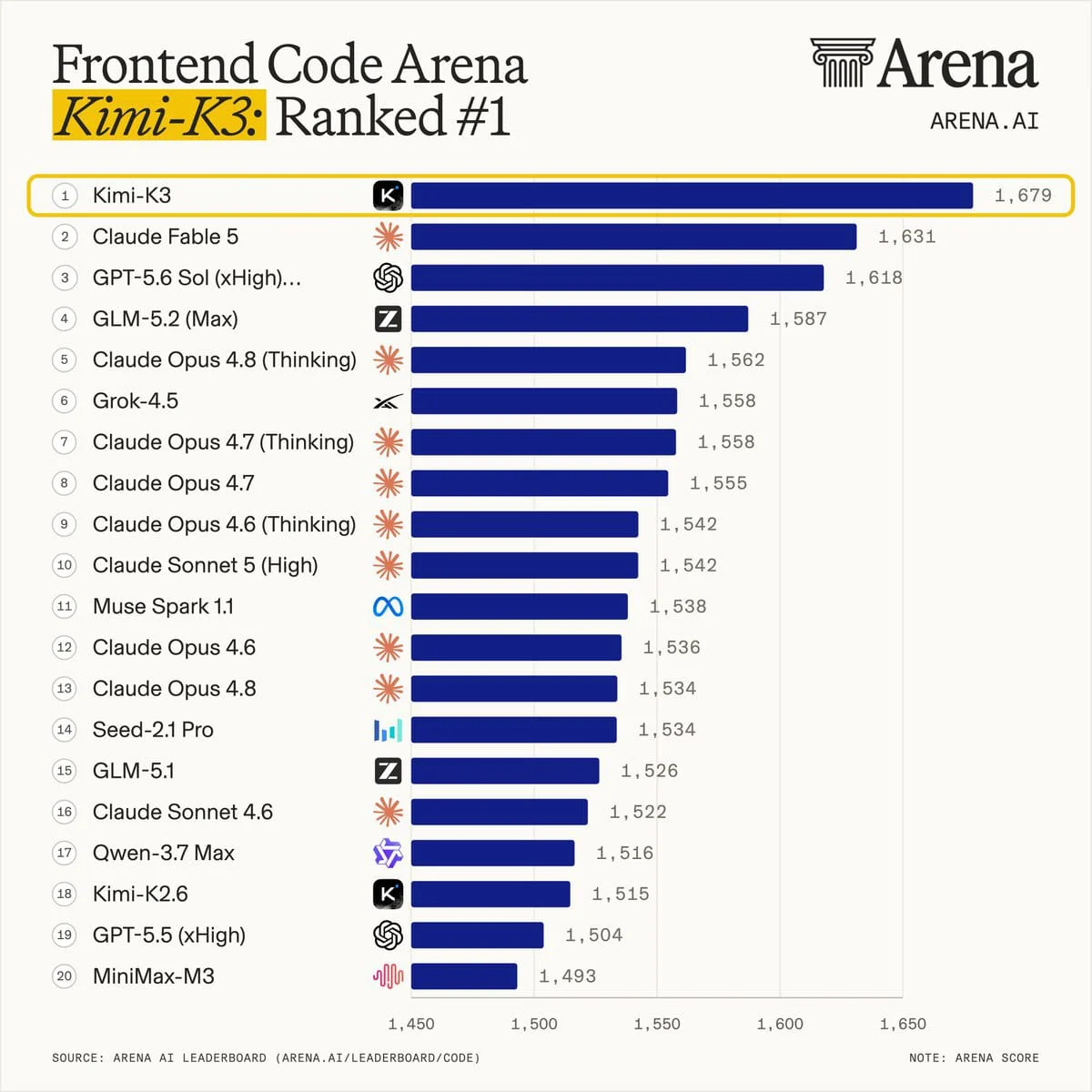
One of the most striking results from Kimi K3’s evaluation is its commanding performance on the Frontend Code Arena. The model secured the number one position with an impressive score of 1679 points. This represents a monumental leap of 17 places from its predecessor, Kimi K2.6, which previously held the 18th spot. The significance of this achievement extends beyond mere numerical superiority; Kimi K3 did not just narrowly surpass its rivals. It achieved first place in six out of seven critical frontend domains. These categories span a wide range of practical applications, including brand and marketing collateral generation, reference-based design implementation, data and analytics visualization, consumer product interface development, intricate simulations, and comprehensive content creation tools. Its only second-place finish was in the specialized domain of gaming, where it trailed behind Anthropic’s Fable 5.
Industry analysts widely regard frontend code generation as a crucial proxy for real-world utility and developer productivity. The ability of an AI model to accurately and efficiently translate design specifications into functional user interfaces is a direct indicator of its potential impact on software development cycles and the broader digital economy. Kimi K3’s near-complete dominance in this arena suggests a profound understanding of user experience principles, programming paradigms, and the nuances of various web technologies. This capability is particularly valuable in an era where digital presence and user interaction are paramount for businesses across all sectors. The model’s proficiency could significantly accelerate the development of web applications, mobile interfaces, and interactive digital experiences, potentially democratizing access to high-quality code generation for a broader spectrum of developers and enterprises.
Advanced Agentic Performance Narrows the Gap
Beyond coding prowess, Kimi K3 demonstrated substantial improvements in agentic performance, a critical area for autonomous AI systems capable of executing complex, multi-step tasks. On the GDPval v2 agentic benchmark, Kimi K3 achieved an Elo rating of 1668. This marks a sharp increase from K2.6’s 1190, showcasing a significant advancement in its ability to perform sophisticated knowledge work. This score allowed K3 to surpass several established models, including GLM-5.2 (1514), OpenAI’s GPT-5.5 (1494), and Anthropic’s Claude Opus 4.8 (1600). While Kimi K3 still trails Fable 5’s leading score of 1760, the gap has considerably narrowed, indicating that Moonshot AI is rapidly closing in on the absolute frontier of agentic capabilities.
Further reinforcing its agentic strength, Kimi K3 placed second on AA-Briefcase, a proprietary evaluation designed to assess long-horizon agentic knowledge work. Here, K3 posted an overall Elo of 1547, a remarkable 732-point improvement over K2.6, again positioning it directly behind Fable 5. Detailed analysis of its performance indicates that K3’s rubric scoring and analytical quality are closely aligned with Fable 5’s numbers. However, GPT-5.6 Sol retains a lead specifically in presentation quality. The implications of this enhanced agentic performance are vast. Agentic AI models are designed to understand, plan, and execute complex workflows, from data analysis and strategic planning to content creation and automated decision-making. Kimi K3’s progress in this domain signifies its potential to act as a powerful digital assistant or autonomous agent, capable of tackling intricate challenges that traditionally require human cognitive effort. This brings it to a competitive tier where the functional difference from the current leader is becoming increasingly subtle rather than categorical.
Strategic Pricing and Commercial Implications
Moonshot AI has positioned Kimi K3 with a pricing strategy that makes a compelling commercial case, particularly for high-volume enterprise applications. At an estimated cost of $0.94 per task, Kimi K3 is competitively priced, sitting closely to OpenAI’s GPT-5.6 Sol at $1.04 per task. Crucially, it is approximately half the price of Anthropic’s Claude Opus 4.8, which is priced at $1.80 per task. This significant cost advantage could be a decisive factor for businesses and developers running extensive agentic workloads or requiring large-scale code generation, offering a more economically viable option without sacrificing frontier-level performance.
However, it is important to note that Moonshot AI has also implemented a notable price adjustment compared to its previous iteration. The output token pricing for K3 has increased significantly to $15 per million tokens, up from $4 per million for K2.6. The first-party API pricing further clarifies this structure: input tokens are $3.00 per million, and output tokens are $15.00 per million. A 90% discount on cached input tokens brings the effective input cost down to $0.30 per million. While Kimi K3 demonstrably undercuts the largest U.S. labs in overall task cost, its per-token pricing places it in a different league compared to some open-weight peers. For instance, GLM-5.2 is priced at $0.32 per task, and DeepSeek V4 Pro is as low as $0.04 per task. This suggests that Moonshot AI is strategically positioning Kimi K3 as a premium, frontier-tier offering, competing on capability and cost-effectiveness against other top-tier proprietary models, rather than on a budget-friendly open-source model pricing structure, even before its own weights become public. This strategy indicates confidence in its value proposition and a clear intent to capture a segment of the market seeking high performance at a more accessible price point than current Western leaders.
Efficiency Gains and Future Enhancements
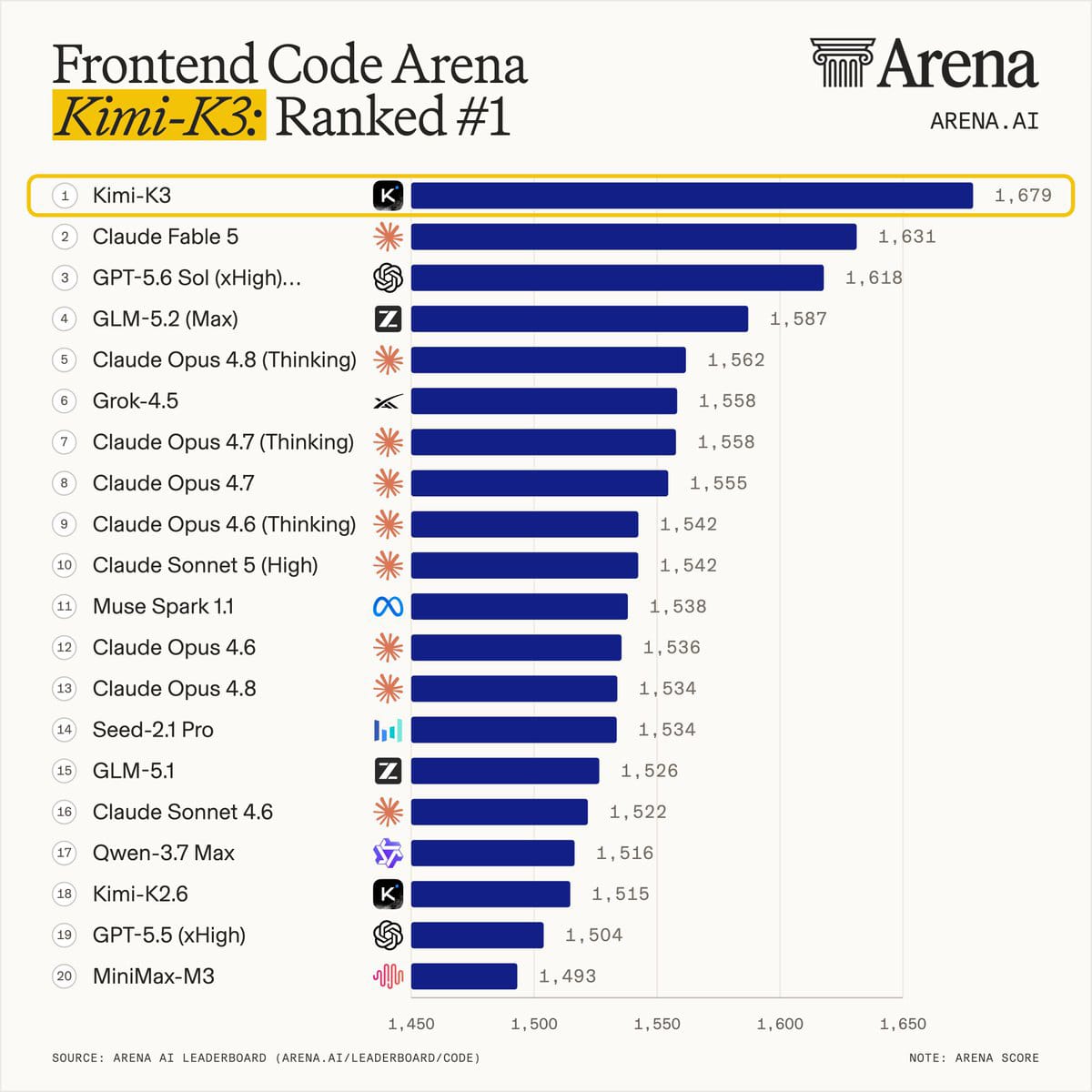
Beyond raw performance and pricing, Kimi K3 demonstrates notable advancements in operational efficiency. One often-understated detail in the initial coverage is its token efficiency. Kimi K3 utilized approximately 132 million output tokens to complete all nine evaluations on the Artificial Analysis Intelligence Index. This represents a significant 21% reduction in token consumption compared to K2.6, which required about 166 million output tokens for the same evaluations, all while K3 achieved superior scores across the board. This improvement in token efficiency is critical, as it directly translates into lower operational costs for users, faster inference times, and a reduced computational footprint, making the model more sustainable and scalable for widespread deployment.
Furthermore, Kimi K3 is equipped with native multimodal input capabilities, allowing it to process both text and images. While its output currently remains text-only, this multimodal input foundation lays the groundwork for future advancements. Moonshot AI has confirmed ambitious plans to release the full 2.8 trillion parameter weights of Kimi K3 by July 27. Should this materialize, Kimi K3 would become the preeminent open-weight model globally by a considerable margin, significantly surpassing existing open-weight giants like GLM-5.2 (753 billion parameters) and DeepSeek V4 Pro (1.6 trillion parameters). The release of such a massive and capable model as open-weight would have profound implications for the entire AI ecosystem, fostering accelerated research, enabling broader access for developers, and potentially catalyzing an explosion of innovation within the open-source community.
Market Repercussions and Geopolitical Dynamics
The launch of Kimi K3 has sent ripples through the Chinese AI market, underscoring its immediate and perceived competitive threat. Following the announcement, share prices for rival Chinese AI companies experienced significant declines. Zhipu, another prominent player in the Chinese AI landscape, saw its valuation crash by 28%, while MiniMax experienced a 16% fall. This sharp market reaction is highly indicative; it suggests that investors and market observers are not viewing Kimi K3 as merely another marketing exercise or incremental update, but rather as a genuine and formidable competitor capable of reshaping the domestic AI competitive landscape. When a single model launch results in such substantial value erosion for competitors, it signals a fundamental shift in market expectations and competitive positioning.
On a broader geopolitical scale, Kimi K3’s emergence marks a significant moment in the US-China AI race. For the first time, a Chinese model has achieved the top spot on a respected benchmark like the Frontend Code Arena, while simultaneously demonstrating near-frontier performance across multiple other critical evaluations. This is not an isolated incident but a clear inflection point, demonstrating China’s growing capacity to innovate at the cutting edge of AI. The prevailing narrative in some circles suggests that while Chinese firms like Moonshot are rapidly deploying frontier-competitive models on aggressive timelines, American policymakers are increasingly focused on imposing regulatory frameworks and potentially restricting access to critical resources like advanced data centers.
This framing highlights a fundamental tension: the drive for rapid technological advancement versus the imperative for safety, ethics, and responsible development. While the argument for "guardrails" is robust, citing the asymmetric stakes of AI safety at scale compared to the early internet, Kimi K3’s concrete results remain undeniable. The debate over whether the optimal response involves fewer regulatory burdens to accelerate innovation or smarter, more adaptive regulations to ensure safety and ethical deployment is intensifying. Kimi K3’s success does not resolve this complex policy argument, but it undeniably adds significant weight to the discussions surrounding national AI strategies, technological sovereignty, and the future trajectory of global AI development. The competitive pressure exerted by Kimi K3 will likely compel both governments and corporations worldwide to reassess their own AI roadmaps, investment strategies, and regulatory approaches in light of this new and powerful contender.