Bitcoin (BTC) is demonstrating remarkable resilience, consolidating its position above a critical macro support zone that market analysts suggest could be instrumental in dictating the trajectory of the ongoing bull market. While the immediate focus for some traders remains on navigating short-term resistance and support levels, a broader technical perspective indicates the potential for significant price appreciation in the coming months.
Ascending Channel and Long-Term Price Targets
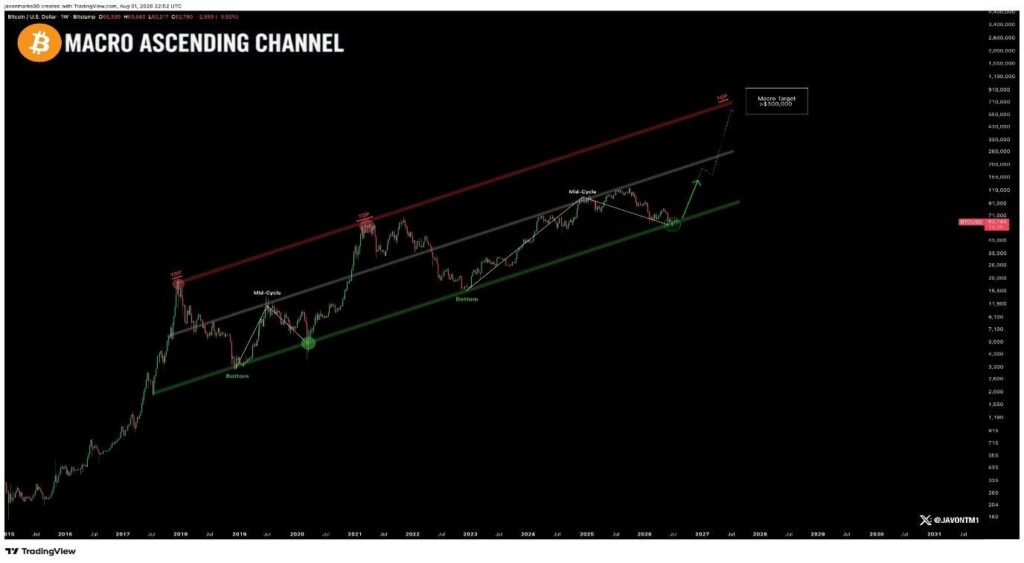
Javon Marks, a prominent market analyst, has highlighted Bitcoin’s sustained hold on a significant ascending channel support level on its macro chart. Marks posits that if this technical structure continues to remain intact, the current all-time high of approximately $126,000 may only represent the midpoint of the current market cycle, rather than its ultimate peak. He drew a parallel to Bitcoin’s market behavior in 2019, where a successful retest of support preceded the most robust phase of that cycle.
Marks’ analysis further suggests that continued support within this ascending channel could catalyze a parabolic advance, potentially driving Bitcoin’s price towards the upper boundary of the channel. This scenario could project long-term price targets well beyond the $300,000 mark. The visual representation of such a pattern, often depicted on logarithmic charts, illustrates a gradual but accelerating upward trend, where periods of consolidation are followed by significant price discovery.
The historical performance of Bitcoin has often been characterized by such cyclical patterns. Following halving events, which reduce the rate at which new bitcoins are created, demand has historically outstripped supply, leading to price surges. The current cycle, following the April 2024 halving, is being scrutinized for similar patterns, with analysts attempting to map its progression against historical data. The concept of an "ascending channel" in technical analysis refers to a pattern where an asset’s price moves between two parallel upward-sloping trendlines, indicating a sustained uptrend. Breaking out of such a channel to the upside can signal the continuation or acceleration of the trend.
Short-Term Technical Levels and Investor Sentiment
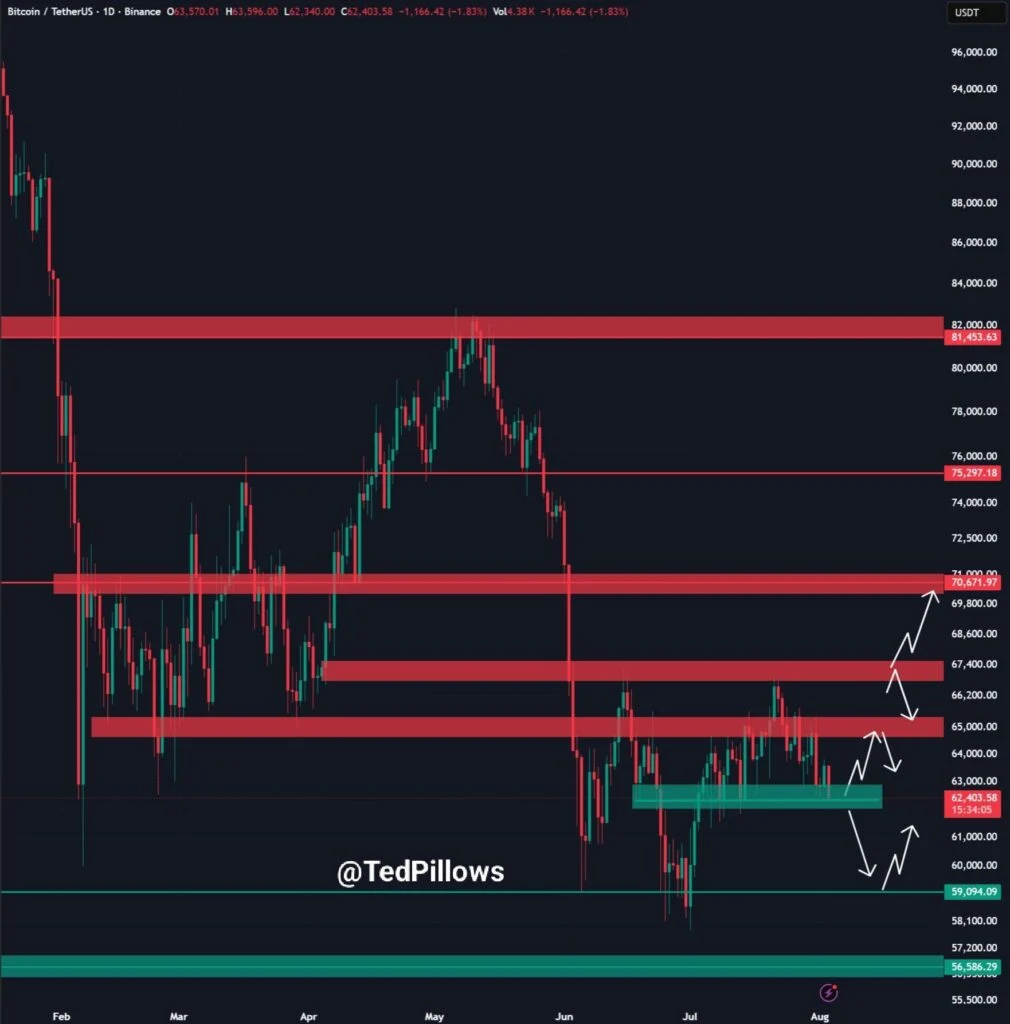
In the shorter term, analyst Ted, identified by his handle @TedPillows on social media, has pinpointed a crucial support region between $62,000 and $62,500. According to his assessment, maintaining this level could pave the way for a rally towards $65,000. Conversely, a breach below this threshold could trigger a decline, potentially testing the $60,000 level.
The cryptocurrency market, and Bitcoin in particular, often exhibits sensitivity to such defined technical levels. Traders and algorithmic trading systems frequently monitor these price points, leading to increased activity and potential volatility when they are approached or breached. The $60,000 to $65,000 range has been a significant area of contention for Bitcoin in recent months, with multiple attempts to break decisively above it being met with profit-taking or increased selling pressure.
Despite these short-term fluctuations, a significant portion of the investor base views the recent consolidation as a temporary pause rather than the inception of a deeper correction. This sentiment is often underpinned by fundamental factors and a belief in the long-term value proposition of Bitcoin as a store of value and a potential hedge against inflation.
Market Performance and Regulatory Landscape
As of Monday, the world’s largest cryptocurrency by market capitalization was trading in the mid-$60,000 range, having registered an increase of nearly 2% over the preceding week. This steady performance, despite a period of consolidation, underscores the underlying demand and stability in the market.
The evolving regulatory landscape in the United States has also been a significant influencer of market sentiment. The recent advancement of the CLARITY Act, a legislative proposal aimed at establishing a more defined framework for digital assets, has been largely interpreted by investors as a positive development for the cryptocurrency industry. While this legislation has not yet directly triggered a significant market breakout, proponents argue that greater regulatory clarity is essential for fostering institutional confidence and facilitating broader adoption. Clearer rules could make it easier for large financial institutions to engage with Bitcoin and other digital assets, potentially unlocking substantial capital inflows into the market.
The history of cryptocurrency regulation has been a complex and often uncertain one. Early regulatory approaches were largely reactive, with governments grappling to understand and categorize digital assets. The introduction of more proactive legislation, such as the CLARITY Act, signals a shift towards a more mature and supportive regulatory environment, which is crucial for the long-term sustainability and growth of the industry.
On-Chain Data and Holder Behavior
Crucially, on-chain data has remained robust, providing further evidence of the market’s underlying strength, even amidst recent price consolidation. Analysis of exchange balances indicates a stable trend, suggesting a lack of significant selling pressure from a large number of investors. Furthermore, long-term holders, often referred to as "HODLers," continue to control a substantial portion of Bitcoin’s circulating supply. This behavior is generally interpreted as a sign of conviction in the asset’s future value, as these holders are less likely to be swayed by short-term market fluctuations.
The stability of exchange balances is a key indicator of selling pressure. When large amounts of cryptocurrency are deposited onto exchanges, it can signal an intention to sell. Conversely, when balances remain stable or decrease, it suggests that fewer investors are looking to liquidate their holdings. The steadfastness of long-term holders is a fundamental pillar of Bitcoin’s market structure. These individuals or entities have demonstrated a commitment to holding their assets through various market cycles, often accumulating during periods of lower prices. Their continued participation provides a stable base for the market and reduces the likelihood of sharp, sustained downturns driven by panic selling.
At the time of this report, Bitcoin was trading at approximately $63,683, reflecting a modest gain of 0.30% over the preceding 24-hour period. This price point situates the asset within the critical range being closely watched by analysts and investors alike, poised for potential upward movement should key resistance levels be decisively broken.
Historical Context of Elon Musk’s Influence
While the article’s core focuses on Bitcoin’s technical and fundamental strengths, it is worth noting the broader context of public figures’ influence on cryptocurrency markets. Elon Musk, the CEO of Tesla and SpaceX, has previously demonstrated a significant ability to move cryptocurrency prices with his public statements. His tweets and pronouncements have, at times, caused considerable volatility in Bitcoin and other digital assets.

For instance, in early 2021, Musk’s announcement that Tesla would accept Bitcoin as payment, coupled with a substantial investment by the company in BTC, sent the price soaring. Conversely, his subsequent concerns regarding Bitcoin’s environmental impact, particularly its energy consumption, led to a sharp price correction. The tweet referenced in the initial article, "Bitcoin Is Not My Safe Word," is a nuanced statement that suggests a deliberate distancing from the cryptocurrency, perhaps to manage expectations or to avoid further direct influence on its price movements.
The fact that Bitcoin has remained "unmoved" or shown resilience following such a statement from a prominent figure like Musk is itself a noteworthy development. It could indicate a maturing market that is becoming less susceptible to the whims of individual influencers, or it could suggest that the underlying market fundamentals are strong enough to absorb such commentary. This resilience points towards a growing independence of Bitcoin’s price action from the pronouncements of even the most influential public figures. The market’s ability to shrug off such comments suggests a growing confidence in Bitcoin’s intrinsic value and long-term potential, driven by a broader base of investors and a more sophisticated understanding of its underlying technology and economic principles. The days of a single tweet dictating the fate of Bitcoin may be gradually receding as the asset class gains wider acceptance and its price discovery becomes influenced by a more diverse set of factors.
Broader Implications for the Crypto Market
The current price action and analyst outlook for Bitcoin have significant implications for the broader cryptocurrency market. As the market leader, Bitcoin’s performance often sets the tone for altcoins. A sustained upward trend for Bitcoin, driven by the technical factors and positive regulatory developments discussed, could lead to increased investor confidence and capital flows into other digital assets.
The potential for a parabolic advance towards $300,000 or higher, if the ascending channel holds, would represent a significant expansion of Bitcoin’s market capitalization. This would not only benefit Bitcoin holders but could also trickle down to the wider altcoin market, potentially fueling new bull runs for other cryptocurrencies. The CLARITY Act and similar regulatory efforts worldwide are crucial for this broader adoption. As the regulatory framework becomes clearer, institutional investors, who manage vast sums of capital, are more likely to allocate a portion of their portfolios to digital assets. This influx of institutional money could provide the necessary fuel for sustained growth and innovation across the entire crypto ecosystem.
The development of robust infrastructure, including regulated exchanges, secure custody solutions, and well-defined legal guidelines, is essential for this maturation process. The cryptocurrency market has evolved from a niche interest for early adopters to a significant and increasingly integrated part of the global financial landscape. The current period of consolidation and the focus on key technical levels, combined with positive regulatory signals, suggest that the market is building a strong foundation for its next phase of growth. The resilience shown by Bitcoin in the face of influential commentary and short-term market pressures underscores its growing maturity and its potential to continue its upward trajectory.