The global cryptocurrency mining landscape has entered a period of unprecedented volatility and economic distress following the successful execution of the Ethereum Merge. As the second-largest blockchain network transitioned from Proof-of-Work (PoW) to Proof-of-Stake (PoS) on September 15, 2022, an estimated $19 billion worth of mining hardware was effectively rendered obsolete for its primary purpose overnight. This transition, which eliminated the need for miners to secure the Ethereum network using graphics processing units (GPUs), has triggered a massive migration of computational power toward alternative PoW blockchains. However, the sheer volume of this "hashrate migration" has led to a catastrophic collapse in mining profitability, with nearly every major GPU-minable coin now yielding negative returns for the average operator.
The Great Migration: From Ethereum to Smaller Altcoins
For years, Ethereum was the backbone of the GPU mining industry. Its Ethash algorithm was highly profitable, supporting a vast ecosystem of industrial-scale mining farms and hobbyist "home miners." At its peak, the Ethereum network commanded a hashrate exceeding 900 Terahashes per second (TH/s). When the Merge occurred, this massive wave of computational energy had to go somewhere.
In the days following the Merge, alternative Proof-of-Work networks experienced a surge in hashrate that their ecosystems were ill-equipped to handle. Ethereum Classic (ETC), the most direct beneficiary of the migration, saw its hashrate skyrocket from approximately 50 TH/s to over 200 TH/s within 48 hours. Other networks, such as Ravencoin (RVN), Ergo (ERG), and Flux, witnessed similar exponential growth. While a higher hashrate generally implies greater network security, the economic consequences for the miners themselves have been devastating.
The fundamental issue lies in the relationship between hashrate and mining difficulty. Every PoW blockchain employs a difficulty adjustment algorithm designed to ensure that blocks are produced at a steady interval. When a massive influx of new miners joins a network, the competition for the fixed amount of block rewards intensifies. The network responds by increasing the mining difficulty, making it harder for any individual miner to solve a block. Because the market capitalization and daily issuance value of coins like ETC or RVN are a mere fraction of what Ethereum’s used to be, the rewards are spread so thin that they no longer cover the operational costs of the hardware.
Quantifying the Collapse: Data from the Field
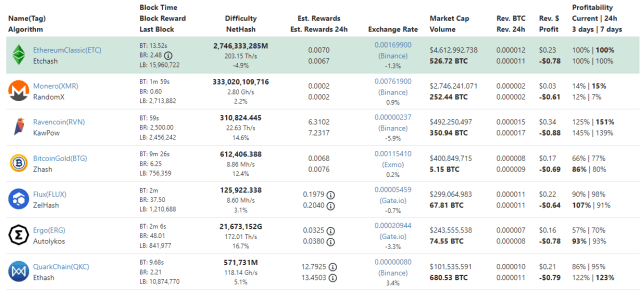
Current data from mining profitability calculators, such as WhatToMine, paints a grim picture for the industry. Under current market conditions, mining Ethereum Classic—the most popular alternative—results in a net loss for almost all hardware configurations. Using a standard electricity cost of $0.10 per kilowatt-hour (kWh), a miner utilizing three AMD Radeon RX 480 graphics cards can expect a daily profit of -$0.78 per hour. This means that for every hour the machine runs, the owner is losing nearly eighty cents in electricity and maintenance costs above the value of the crypto earned.

Even high-end, top-tier hardware is not immune to this trend. The NVIDIA GeForce RTX 3090 Ti, one of the most powerful consumer GPUs available, is currently mining ETC at an estimated loss of $0.50 per hour. When factoring in the initial capital expenditure for these cards—which often retailed for over $1,500 during the height of the mining boom—the "return on investment" (ROI) has shifted from months to an indefinite timeframe.
The profitability of other coins is equally dismal:
- Ravencoin (RVN): Currently yielding negative returns across most GPU tiers due to its energy-intensive KawPow algorithm.
- Ergo (ERG): Once considered a "haven" for miners due to its efficiency, its profitability has cratered as the hashrate increased by over 300% post-Merge.
- Beam and Flux: These smaller-cap coins have seen their difficulty levels rise so high that only those with near-zero electricity costs can hope to remain "in the black."
The Mechanics of the "Difficulty Bomb" and Reward Dilution
To understand why the profits have vanished, one must look at the total "daily reward pie." Before the Merge, Ethereum distributed roughly 13,000 ETH per day to miners. At a price of $1,500 per ETH, that represented nearly $20 million in daily revenue available to the mining community.
In contrast, Ethereum Classic distributes roughly 28,000 ETC per day. At a price of $30 per ETC, the total daily revenue available is only about $840,000. When the miners who were previously fighting for a $20 million daily pot suddenly move to a network with an $840,000 daily pot, the individual share for each miner drops by more than 95%. This dilution is the primary driver of the current "mining winter."
Furthermore, the "difficulty bomb" of incoming hashrate has pushed many networks to their limits. The suddenness of the influx meant that many miners were operating at a loss from the very first minute of the post-Merge era, hoping that the price of the alternative coins would pump to compensate for the difficulty. That price surge has yet to materialize.
Hardware Market Saturation and the Secondary Market
The collapse in profitability has triggered a secondary crisis: the flooding of the used GPU market. For the past two years, gamers and professional creators struggled to find graphics cards at MSRP due to relentless demand from miners. Now, the tide has turned.

Platforms like eBay, Craigslist, and Facebook Marketplace are seeing a surge in listings for "lightly used" mining rigs and bulk GPUs. Large-scale mining operations, facing mounting debt and high electricity bills, are being forced to liquidate their assets to stay solvent. This has led to a sharp decline in GPU prices, with many cards now selling for 50% less than their retail value from just six months ago.
However, prospective buyers remain cautious. Mining GPUs are often run 24/7 at high temperatures, leading to concerns about the longevity of the hardware, particularly the cooling fans and video memory (VRAM). This skepticism has further suppressed prices, leaving miners in a "double bind" where they cannot mine profitably and cannot sell their equipment for a significant portion of their initial investment.
Official Responses and Community Sentiment
The Ethereum Merge was a highly choreographed event, years in the making. Vitalik Buterin, the co-founder of Ethereum, has long advocated for the move to Proof-of-Stake, citing a 99.9% reduction in the network’s energy consumption. While Buterin acknowledged that miners would need to find other pursuits, his stance remained that the environmental and scalability benefits of PoS outweighed the interests of the mining industry.
In the months leading up to the Merge, some miners attempted to organize a "hard fork" of the Ethereum network to maintain a PoW version, known as ETHW (EthereumPoW). Led by prominent Chinese miner Chandler Guo, the ETHW project aimed to preserve the revenue stream for GPU miners. However, since its launch, ETHW has struggled with technical issues, lack of widespread exchange support, and a rapidly declining token price, failing to provide the "lifeboat" many miners had hoped for.
Industry analysts suggest that the current state of GPU mining is a "purge" that will eventually force inefficient operators out of the market. Only those with access to industrial-scale renewable energy or subsidized electricity (under $0.03/kWh) are expected to survive this transition period.
Broader Implications for the Crypto Ecosystem
The death of profitable GPU mining marks a fundamental shift in the decentralization of hardware. For a decade, the ability for an individual to secure a network with a home computer was a cornerstone of the "crypto ethos." With Ethereum moving to PoS and other PoW coins becoming unprofitable, mining is increasingly becoming the domain of specialized ASIC (Application-Specific Integrated Circuit) machines, which are used for Bitcoin.
ASIC mining is highly centralized, requiring massive capital and specialized hardware that cannot be easily repurposed for other tasks. The loss of GPU mining means that the "entry barrier" for participating in network security has shifted from owning hardware to owning capital (staking).
There is also a significant environmental implication. While Ethereum’s energy usage has plummeted, the displaced miners are still consuming electricity as they test alternative coins. If these coins remain unprofitable, the total global energy consumption of the crypto sector will eventually drop as rigs are powered down permanently. However, in the short term, the "Great Migration" has simply moved the carbon footprint from one ledger to another.
Conclusion: Is GPU Mining Dead?
As of late 2022, the outlook for GPU mining is the bleakest it has been in the history of the industry. With Ethereum’s price currently hovering around $1,400—down significantly from its all-time highs—and alternative coins failing to gain the market cap necessary to support the massive hashrate, the "mining gold rush" appears to be over.
For GPU mining to become viable again, one of two things must happen: either a massive percentage of the current hashrate must permanently disconnect (lowering difficulty), or the price of alternative PoW coins like Ethereum Classic, Ravencoin, or Ergo must increase by several hundred percent. Until then, the machines that once printed digital gold are more likely to be found gathering dust or listed for sale on the secondary market. The Merge has successfully upgraded Ethereum, but it has left a trail of economic obsolescence in its wake, signaling the end of an era for the global mining community.