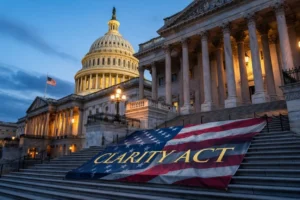
The United States Senate is entering what legislative analysts describe as the final viable window for passing the Clarity Act in 2026, a landmark piece of legislation intended to provide a comprehensive federal framework for the digital asset industry. Advocates and Hill staffers expect a heavily revised draft of the bill to emerge as soon as next week, representing a high-stakes attempt to reconcile competing jurisdictional interests and partisan priorities before the legislative calendar is overtaken by the fall midterm election cycle. This updated text is expected to merge the distinct efforts of the Senate Banking and Agriculture committees, effectively consolidating the two primary tracks that have defined the chamber’s approach to cryptocurrency regulation for the past two years.
The timing of the release is critical. Senate backers are reportedly aiming for potential floor action during the week of July 20. However, the window for success is narrow. With the summer recess approaching and the political gravity of the 2026 midterms beginning to pull at every legislative move, the Senate has only a few weeks to deliberate, amend, and vote on a package that currently spans hundreds of pages. The process of moving such a complex bill through the Senate floor typically requires several days of procedural maneuvering, leaving virtually no margin for delay or unforeseen legislative hurdles.
A Unified Framework for a Fragmented Market
The Clarity Act is designed to address the long-standing ambiguity regarding the oversight of digital assets in the United States. Since the inception of Bitcoin and the subsequent explosion of the altcoin market, the industry has operated under a patchwork of enforcement actions and conflicting guidance from various regulators. The new bill seeks to codify a federal framework that clearly delineates authority between the Securities and Exchange Commission (SEC) and the Commodity Futures Trading Commission (CFTC).
Historically, the SEC has asserted broad jurisdiction over many digital assets, arguing that they function as investment contracts under the decades-old Howey Test. Conversely, the CFTC has maintained that many cryptocurrencies, including Bitcoin and Ethereum, are digital commodities. The lack of a statutory definition has led to what industry participants call "regulation by enforcement," a practice they claim stifles innovation and drives domestic firms to offshore jurisdictions.
The House of Representatives successfully passed its version of market structure legislation in 2025 with notable bipartisan support. That bill, which focused heavily on empowering the CFTC to oversee spot markets for digital commodities, provided a blueprint for the Senate’s current efforts. However, the Senate version has proven more difficult to finalize, as lawmakers attempt to balance the House’s industry-friendly approach with more stringent consumer protections and oversight mechanisms favored by the Senate Banking Committee.
The Evolution of the Senate Draft
The Senate Banking Committee released its initial version of the bill in May 2026. At the time, the draft was positioned as a vehicle to resolve perennial disputes over decentralized finance (DeFi) and the treatment of yield-bearing stablecoins. The latest iteration, which merges the Banking and Agriculture versions, is reportedly not a simple cut-and-paste job. Instead, the updated text is said to include more than 70 pages of new material, much of it dedicated to bolstering consumer protections in the wake of several high-profile platform failures in previous years.
The merged draft is also expected to revisit the contentious issue of federal preemption. This determines the extent to which federal law would override existing state-level regulations, such as New York’s BitLicense or Wyoming’s specialized banking laws. While industry advocates generally favor a single federal standard to simplify compliance, state regulators have lobbied fiercely to maintain their oversight powers, arguing that states are better equipped to respond to local consumer grievances and emerging fraud trends.
Political Obstacles and the 60-Vote Threshold
Despite the momentum behind the new draft, the Clarity Act faces a steep uphill climb in the Senate. Under current rules, the bill will require 60 votes to overcome a potential filibuster. Given the narrow margins in the chamber, Republicans must secure a significant number of Democratic votes to move the package forward. As of this week, that coalition remains unconfirmed.
The most significant roadblock is a proposed ethics provision sought by a group of influential Democratic senators. This demand would impose strict limitations on senior government officials, including the President and Cabinet members, prohibiting them from maintaining business ties or personal investments in the crypto sector. Proponents of the ethics clause argue that given the volatility of the market and the potential for regulatory decisions to move prices, such safeguards are essential to maintain public trust. Opponents, however, view the provision as an overreach that singles out the crypto industry while ignoring similar conflicts of interest in traditional finance or energy.
Several Democratic lawmakers have publicly stated that they cannot support the final bill without a compromise on these limits. This dispute has become one of the clearest political risks for the legislation, threatening to derail the bipartisan cooperation that characterized the House passage a year prior.
Regulatory Staffing and Agency Vacancies
Compounding the legislative friction is a simmering dispute over the staffing of the very agencies that would be tasked with enforcing the Clarity Act. The White House has consistently pressed Senate leadership regarding Democratic nominees for minority seats at both the SEC and the CFTC. Simultaneously, Democratic senators have criticized both the administration and Senate Republican leadership for the slow pace of filling vacancies at independent agencies.
The "staffing war" has direct implications for the bill’s implementation. If the Clarity Act passes, both the SEC and the CFTC will require a massive influx of resources, personnel, and technical expertise to manage their expanded mandates. Without a full complement of commissioners and a clear budgetary path, the agencies may struggle to issue the necessary rules and guidance required by the new law.
The Role of DeFi and the Blockchain Regulatory Certainty Act
The decentralized finance (DeFi) sector is also watching the proceedings with intense scrutiny. A key point of interest is the inclusion of the Blockchain Regulatory Certainty Act, a provision that would protect developers and non-custodial service providers from being classified as money transmitters. Under current interpretations by some law enforcement agencies, developers who write code for decentralized protocols could theoretically be held liable for the transactions that occur on those protocols, even if they do not control the assets involved.
Advocates for the DeFi industry received a boost this week when Senator Ron Wyden expressed support for the language, signaling that some high-ranking Democrats are open to protecting technical innovation from overly broad financial regulations. However, law enforcement agencies remain concerned that such protections could create "regulatory dark pools" that might be exploited by bad actors for money laundering or sanctions evasion. The final draft is expected to include a compromise that offers some clarity for developers while maintaining robust anti-money laundering (AML) and "Know Your Customer" (KYC) requirements for centralized intermediaries.
Market Implications and Institutional Reaction
The financial markets have reacted with cautious optimism to the news of the merged draft. Institutional investors have long cited the lack of a clear regulatory framework as the primary barrier to large-scale entry into the digital asset space. The passage of the Clarity Act would likely trigger a new wave of institutional products, including more sophisticated derivatives and regulated custody solutions.
"The industry is at a point where it is no longer asking ‘if’ it will be regulated, but ‘how,’" said a senior policy analyst at a leading digital asset trade association. "The Clarity Act represents the first real opportunity to move past the era of uncertainty and establish the U.S. as a leader in financial technology for the next decade."
Conversely, if the bill fails to move before the August recess, many analysts believe the window for federal crypto legislation will close until at least 2027. This would leave the industry in a state of limbo, potentially allowing international competitors in Europe and Asia—where frameworks like the Markets in Crypto-Assets (MiCA) regulation are already in effect—to pull ahead in the race for global market share.
Chronology of the Clarity Act
To understand the current urgency, it is necessary to look at the timeline of events that led to this moment:
- June 2024: Following a series of court rulings that challenged the SEC’s authority over certain tokens, the House Financial Services Committee began drafting a comprehensive market structure bill.
- May 2025: The House of Representatives passed the initial version of the market structure bill with a bipartisan vote of 279-136, sending the legislation to the Senate.
- January 2026: Senate Banking and Agriculture committees began a series of joint hearings to reconcile the House bill with Senate priorities.
- May 2026: The Senate Banking Committee released its own "Clarity Act" draft, focusing on stablecoins and DeFi.
- June 2026: Negotiations stalled over the ethics provision and law enforcement concerns regarding DeFi developer protections.
- July 2026 (Present): Senate leadership announces a merged draft expected next week, with a goal of floor action by July 20.
Analysis: The Path Forward
The success or failure of the Clarity Act hinges on the ability of Senate leadership to find a middle ground on three distinct fronts: the ethics provision, the division of power between the SEC and CFTC, and the technical definitions surrounding DeFi.
The White House’s role remains a wild card. While President Donald Trump has expressed a general desire to maintain American dominance in financial technology, the administration has not yet officially signed off on the merged Senate text. Furthermore, the report indicates that the White House has not participated in the latest round of high-level talks, suggesting a potential disconnect between the executive branch and Senate negotiators.
Even in the best-case scenario where the bill clears the Senate with 60 votes, it must return to the House for approval of the revised version. Given the significant changes—including the 70 pages of new consumer protection material—there is no guarantee that the House will accept the Senate’s modifications without further negotiation.
With the clock ticking toward the July 20 target, the crypto industry, regulators, and lawmakers find themselves in a high-stakes sprint. The Clarity Act represents more than just a set of rules; it is a test of whether the U.S. political system can adapt to the rapid pace of technological change or if the digital asset market will remain a permanent fixture of legal and political contention. If the bill fails to materialize next week, the "clarity" the industry seeks may remain elusive for years to come.