
Bitcoin embarked on a dramatic ascent Wednesday, tearing through the $69,000 mark and reaching an intraday high of $69,749. This significant surge, representing an 8.7% climb in a single day, stands as the steepest one-day move recorded since March 4 and marks the highest price point Bitcoin has touched since June 1. The cryptocurrency market, particularly its leading asset, had not witnessed such a pronounced "green candle" in over five months, signaling a powerful shift in market dynamics and sentiment that caught many traders and prediction markets off guard. The rapid appreciation liquidated over a billion dollars in short positions across the crypto market, fueling a rally that reverberated through crypto-linked equities.
The Anatomy of a Sudden Surge: Macroeconomic Tailwinds and Regulatory Glimmers
The catalyst for this robust rally was not singular but a confluence of pivotal events, primarily stemming from macroeconomic policy shifts in the United States, coupled with promising developments on the regulatory front for digital assets. The most immediate and impactful trigger appeared to be the U.S. Treasury’s unexpected announcement on Wednesday that it would double its long-bond buybacks, escalating from $2 billion to $4 billion per operation, commencing September 9. This strategic move by the Treasury Department immediately sent long-end yields tumbling and instigated a weakening of the U.S. dollar.
Historically, such loosening of financial conditions tends to create a favorable environment for risk assets, a category in which cryptocurrencies like Bitcoin are increasingly positioned. Lower bond yields reduce the opportunity cost associated with holding non-yielding assets, making Bitcoin a more attractive proposition for investors seeking higher returns. Simultaneously, a weaker dollar makes dollar-denominated assets, including Bitcoin, more accessible and cheaper for foreign buyers, a dynamic that market analysts have affectionately dubbed ‘QE Lite’ – a nod to quantitative easing policies that inject liquidity into the financial system. The financial news outlet ZeroHedge succinctly captured the market’s reaction, reporting, "Here Comes QE Lite: Yields, Dollar Tumble, Gold Spikes After Treasury Unexpectedly Doubles Size Of Long-End Treasury Buybacks."
Adding to this macroeconomic impetus, two significant crypto-native developments coincided with the Treasury’s announcement, creating what market participants described as a "perfect storm" for crypto bulls. First, a high-profile White House meeting brought together crypto executives and regulators, signaling a potential for more constructive dialogue and future policy clarity. While details of the meeting were not immediately public, the mere occurrence of such a gathering often instills a sense of legitimacy and optimism within the digital asset community. Second, the Securities and Exchange Commission (SEC) unveiled a fresh proposal aimed at easing registration rules for certain digital-asset offerings. This move, if enacted, could streamline the process for legitimate crypto projects to operate within regulatory frameworks, potentially paving the way for greater institutional participation and broader market acceptance. The convergence of these macro-financial and regulatory factors created an intensely bullish environment, causing the market to overextend rapidly.
Market Reaction: A Billion-Dollar Short Squeeze and Surging Equities
The swift and dramatic upward price movement of Bitcoin precipitated a massive liquidation event across the cryptocurrency derivatives market. Data from CoinGlass’s liquidation panel revealed a staggering $1.14 billion in short positions wiped out across various cryptocurrencies in just a single hour. Bitcoin alone accounted for a substantial portion of this, with $677.64 million in Bitcoin shorts being liquidated. A "short squeeze" occurs when a rapidly rising price forces traders who have bet against an asset (by short-selling) to buy it back to limit their losses. This forced buying further accelerates the price increase, creating a cascading effect that amplifies the initial rally. The magnitude of this squeeze underscores the prevailing bearish sentiment that had characterized the market in the preceding months, leaving a significant number of traders vulnerable to a sudden upward price shock.

The positive momentum was not confined to Bitcoin itself; crypto-linked stocks mirrored the rally, demonstrating the increasing interconnectedness between the digital asset space and traditional financial markets. MicroStrategy (MSTR), a software firm known for its substantial Bitcoin holdings, saw its stock price climb by nearly 12%. Coinbase (COIN), the largest cryptocurrency exchange in the U.S., surged by 9%. Other industry players such as Circle and BitMine also recorded impressive gains, both rising approximately 9-10% on the day. These movements highlight how Bitcoin’s performance can act as a bellwether for companies whose business models are directly tied to the health and growth of the cryptocurrency ecosystem, further indicating a broad-based positive market reaction to the confluence of events.
Prediction Markets Scramble to Recalibrate: A Shift from Bearish to Coin Flip
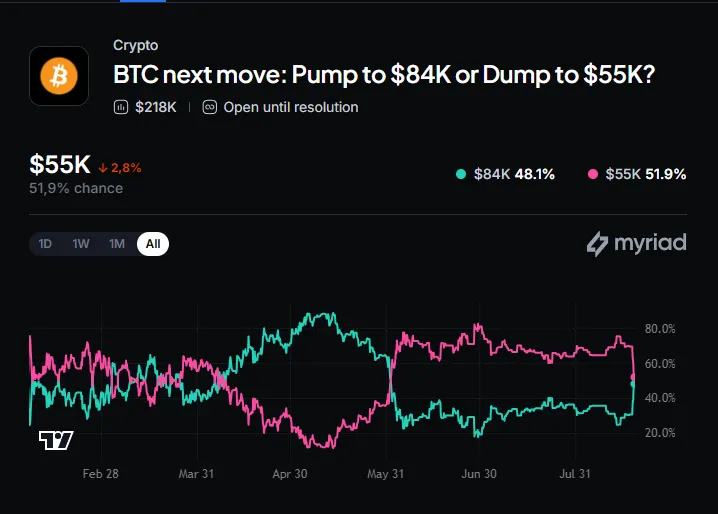
The ferocity and speed of Bitcoin’s rally left prediction markets, often seen as a barometer of collective market sentiment, in a state of rapid recalibration. Just days before the surge, traders on Myriad – a prediction market operated by Decrypt‘s parent company – had been predominantly bearish. Their "BTC next move" market, which pitted a potential pump to $84,000 against a dump to $55,000, saw approximately 70% of participants leaning towards the downside. However, the events of Wednesday completely upended this outlook. By Wednesday afternoon, the odds had dramatically shifted to a near coin flip: 51.9% favored a dump to $55,000, while 48.1% now anticipated a pump to $84,000. This stark reversal within a mere 24-hour period illustrates the profound impact of the unexpected market movement.
The sentiment swing was not an isolated incident at Myriad. Polymarket, another prominent prediction market, had been pricing a 56% chance that Bitcoin would touch $55,000 before year-end as of last week, with only a 51% chance of a run to $75,000. Similarly, on Kalshi, traders exhibited even greater caution, assigning Bitcoin a 54% probability of clearing $67,500 in August and a mere 31% chance of hitting $70,000. Both $67,500 and $70,000 were thresholds that Bitcoin swiftly blew past on Wednesday, underscoring how deeply entrenched the bearish sentiment was prior to the rally.
The significant divergence between pre-rally predictions and the actual market outcome reveals a critical aspect of prediction markets in highly volatile environments. While they often reflect collective wisdom, they can also be caught flat-footed by sudden, externally driven shifts. The original article notes that "prediction markets have been setting volume records as more traders hedge real positions with them," suggesting that the Myriad flip was less a predictive forecast and more a real-time reflection of market participants scrambling to adjust their positions and hedge against the rapid changes, essentially serving as a "recap of who got squeezed." This reactive nature, particularly in the short-term markets, highlights the difficulty of forecasting sudden macro-driven shifts in highly leveraged environments.
Expert Insights and Forward-Looking Technical Analysis
Market analysts and economists have begun to weigh in on the implications of the Treasury’s actions, interpreting them as a subtle yet significant shift in the broader financial landscape. "The Treasury’s increased buybacks signal a subtle easing of liquidity, which, while not a full-blown quantitative easing, certainly reduces pressure on longer-term rates," commented Dr. Eleanor Vance, a senior economist at Global Macro Advisors. "This directly benefits assets like Bitcoin that thrive in environments of abundant liquidity and lower interest rates, where the opportunity cost of holding non-yielding assets diminishes." This perspective reinforces the idea that Bitcoin’s recent surge is deeply intertwined with traditional financial market dynamics rather than being purely crypto-native.
On the regulatory front, industry proponents view the White House meeting and the SEC’s proposed rule easing as potentially transformative. "A clearer regulatory pathway and open dialogue with policymakers are crucial for the long-term maturation of the crypto industry," stated a spokesperson for a leading crypto advocacy group, preferring to remain unnamed due to ongoing discussions. "These developments, even if incremental, signal a willingness from authorities to engage constructively rather than solely through enforcement, which could unlock significant institutional capital."
From a technical analysis perspective, traders are now closely watching key price levels to gauge Bitcoin’s immediate trajectory. The next significant line in the sand sits at $70,284, which represents the lower edge of a critical resistance band on Bitcoin’s chart. A sustained daily close above this level would be a strong bullish signal, potentially opening the door for further upward movement towards $73,245. Conversely, a failure to hold above $68,000 would be a cause for concern, potentially dragging Bitcoin back inside the trading range that has constrained its price action since June, indicating a possible exhaustion of the current rally. The speed at which these levels are tested and either breached or respected will provide crucial insights into the sustainability of this newfound bullish momentum.
Broader Impact and Future Implications
The recent surge has undeniably altered the prevailing market sentiment, shifting from a period of "pain" and uncertainty to one of renewed optimism and cautious bullishness. This rally could serve as a psychological boost for investors who have endured a prolonged period of consolidation and downside pressure. For long-term holders, it reinforces confidence in Bitcoin’s resilience, while for day traders, it highlights the extreme volatility and profit potential that characterize the asset.
The confluence of macroeconomic easing and regulatory overtures also carries significant long-term implications for the broader adoption and integration of digital assets. Should the trend of lower yields and a weaker dollar persist, and if regulatory clarity continues to improve, it could pave the way for increased institutional investment and wider mainstream acceptance of cryptocurrencies. The SEC’s proposed easing of registration rules, in particular, could de-risk certain digital asset offerings, making them more attractive to traditional investors and potentially fostering innovation within a more defined legal framework.
Looking ahead, market participants will be closely monitoring several key factors. Further announcements from the U.S. Treasury regarding bond buybacks and broader monetary policy signals from the Federal Reserve will continue to influence liquidity conditions and investor appetite for risk assets. Regulatory developments, including the outcomes of White House discussions and the finalization of SEC proposals, will also be critical in shaping the operating environment for crypto businesses. Additionally, the impending Bitcoin halving event, a programmed reduction in the supply of new Bitcoin, typically occurring every four years, often creates a long-term bullish narrative that could underpin future price appreciation, though its immediate impact is not always predictable.
In conclusion, Bitcoin’s dramatic ascent past $69,000 was a multifaceted event, ignited by a potent combination of macroeconomic policy shifts and promising regulatory developments. This "perfect storm" not only liquidated billions in short positions and boosted crypto-linked equities but also triggered a significant recalibration in market sentiment, as reflected in the scramble of prediction markets. While technical resistance levels loom, the rally has injected a powerful dose of optimism into the digital asset space, underscoring the dynamic interplay between traditional finance and the evolving world of cryptocurrencies. The immediate future will hinge on the market’s ability to consolidate these gains and respond to ongoing macroeconomic and regulatory signals, setting the stage for what could be a pivotal period for Bitcoin and the broader crypto ecosystem.