


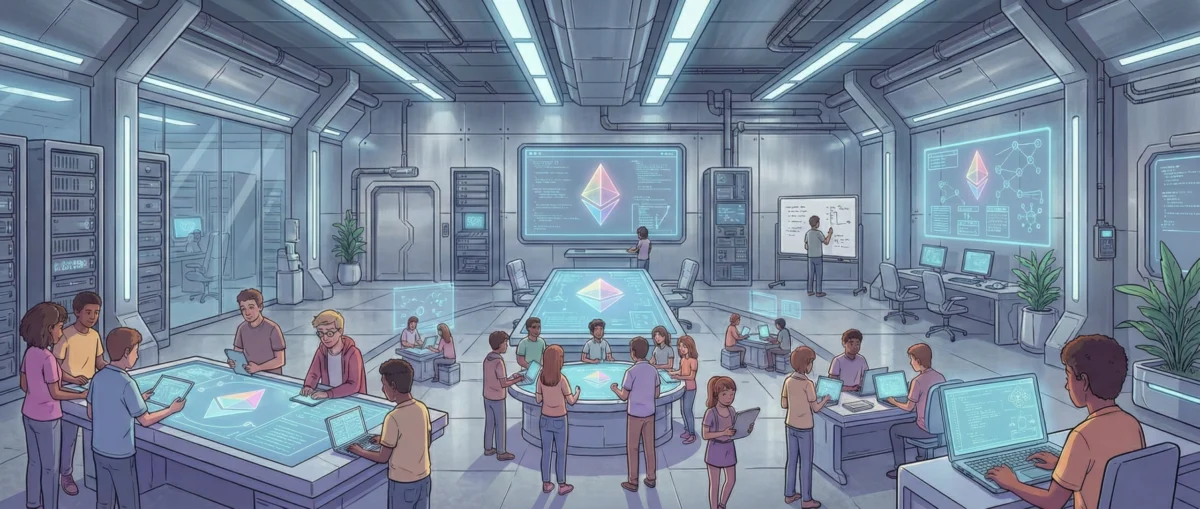
Ethereum Protocol Studies (EPS) is set to launch its 2026 program, promising a deeper dive into the intricacies of the Ethereum network with newly introduced content tracks focusing on cryptography, lean consensus mechanisms, and zkEVM technology. Building upon its established reputation as a premier educational resource for understanding Ethereum’s core protocol, EPS 2026 will also feature a novel self-paced learning platform, enhancing accessibility and offering a more flexible educational experience. The program officially commences on February 23rd, with all registration and introductory materials available at epf.wiki.
Since its inception as a 10-week study group preceding Ethereum’s Devcon 5, EPS has evolved into a critical educational pathway for individuals seeking a comprehensive understanding of Ethereum’s foundational architecture. The program has demonstrably empowered hundreds of participants, guiding them from a general familiarity with Ethereum to a sophisticated level of comprehension, enabling them to engage with technical specifications, navigate complex client codebases, and actively contribute to protocol development. This progression underscores EPS’s efficacy in translating complex blockchain concepts into actionable knowledge for a diverse audience.
The 2026 iteration signifies a notable expansion in both the depth of its curriculum and the modalities of its delivery. The introduction of two new content tracks addresses areas of paramount importance to Ethereum’s future roadmap, reflecting the network’s ongoing evolution and its commitment to innovation. Concurrently, the launch of a self-paced learning platform ensures that the valuable curriculum remains accessible to a global audience throughout the year, transcending the limitations of scheduled live sessions and catering to varied learning preferences and schedules.
What’s New in 2026: A Deeper Dive into Protocol Evolution
The 2026 program is structured to provide participants with an unparalleled understanding of Ethereum’s technical underpinnings and its strategic direction. The expanded curriculum is designed to equip learners with the knowledge necessary to engage with the most pressing challenges and exciting opportunities in blockchain technology.
Cryptography: The Mathematical Backbone of Ethereum
A significant new focus for EPS 2026 is the "Cryptography" track. This module is dedicated to exploring the fundamental mathematical principles and cryptographic techniques that underpin the security and functionality of the Ethereum protocol. Participants with a foundational understanding of mathematics will be guided through complex concepts such as elliptic curve pairings, Zero-Knowledge Succinct Non-Interactive Argument of Knowledge (zk-SNARKs) and Zero-Knowledge Bulletproofs (zk-STARKs) cryptography, KZG commitments, and advanced hash function constructions. This track is particularly crucial as Ethereum continues to explore and implement zero-knowledge proof systems for scaling solutions and privacy enhancements. Furthermore, it will delve into the emerging landscape of post-quantum cryptography, preparing participants for the potential future threats to current cryptographic standards posed by quantum computing. This foresight is vital for ensuring the long-term security and resilience of decentralized networks.
The emphasis on cryptography is timely, given the increasing integration of sophisticated cryptographic primitives within blockchain technology. As Ethereum transitions towards greater scalability and privacy, a deep understanding of these underlying mathematical tools becomes indispensable for developers, researchers, and protocol architects. The ability to grasp concepts like verifiable computation and secure multi-party computation will be a key differentiator for those looking to contribute meaningfully to the ecosystem.
Lean Consensus and zkEVM: The Future of Execution and Scalability
The second prominent addition to the 2026 curriculum is the "Lean Consensus and zkEVM" track. This area of study directly addresses the forefront of Ethereum’s scaling initiatives. With the rapid advancements and increasing adoption of zkEVM implementations, this track will provide participants with a comprehensive understanding of how these technologies function. The curriculum will explore the mechanisms by which zkEVMs prove the correctness of off-chain computations, a critical component for enabling high-throughput transaction processing.
Moreover, this track will illuminate the direct connection between zkEVM development and Ethereum’s broader objectives of achieving massive scalability and "SNARKifying" the protocol. This involves understanding how zero-knowledge proofs can be leveraged to compress and verify vast amounts of transaction data, thereby reducing the computational burden on the main chain. The exploration of "lean consensus" within this context refers to efforts aimed at optimizing consensus mechanisms to be more efficient and less resource-intensive, often in conjunction with zero-knowledge proofs. This focus positions EPS 2026 at the cutting edge of blockchain research and development, preparing participants to contribute to the next generation of decentralized infrastructure.
The implications of zkEVM technology for Ethereum are profound. By enabling the efficient verification of off-chain computations, zkEVMs offer a pathway to significantly increase transaction throughput without compromising on security or decentralization. This could lead to a more accessible and usable Ethereum for a wider range of applications, from decentralized finance (DeFi) to gaming and beyond. Understanding the nuances of these technologies is thus becoming an essential skill for anyone involved in the Ethereum ecosystem.
A New Learning Platform: Democratizing Access to Protocol Knowledge
In a significant enhancement to the program’s delivery, EPS 2026 introduces a dedicated self-paced learning platform. This new digital environment is built upon Moodle, a widely recognized Free and Open Source Software (FOSS) learning management system, ensuring robust functionality and accessibility.
Previously, EPS relied on a combination of live sessions, active Discord community engagement, and the EPF Wiki as its primary educational interfaces. While these components remain integral to the EPS experience, the new platform offers a structured and asynchronous learning path. It hosts the entirety of the existing EPS curriculum, meticulously organized into modules. Each module thoughtfully integrates video content derived from past study group sessions with interactive comprehension checks embedded directly within the lecture recordings. This innovative approach allows participants to engage with the material at their own pace, receive immediate feedback on their understanding, and track their progress through clearly defined learning objectives for each section.
This self-paced platform serves as a powerful complement to the live program, rather than a replacement. Participants in the cohort-based study groups will continue to benefit from the invaluable experience of direct interaction with protocol engineers, real-time question-and-answer sessions, and collaborative problem-solving facilitated through the EPF Wiki and Discord channels. The learning platform’s primary aim is to lower the barrier to entry, enabling individuals to acquire foundational knowledge and solidify their understanding at their own convenience, thereby maximizing their preparedness for the more interactive and advanced aspects of the live program. This dual approach ensures that EPS remains both a rigorous academic pursuit and an accessible gateway for aspiring Ethereum protocol enthusiasts.
The introduction of a dedicated learning management system marks a maturation of the EPS program. By leveraging established educational technology, EPS can now offer a more scalable and personalized learning journey. This is particularly important in the rapidly evolving field of blockchain, where continuous learning and the ability to revisit complex topics are crucial for staying abreast of developments. The platform’s design, with its emphasis on interactive assessments and progress tracking, is likely to enhance knowledge retention and provide a more engaging learning experience for a broader spectrum of participants.
What to Expect in 2026: A Comprehensive Educational Journey
Participants embarking on the Ethereum Protocol Studies 2026 program can anticipate a multifaceted and enriching educational experience designed to foster a deep and practical understanding of the Ethereum network. The program is meticulously crafted to cater to a diverse range of learners, from those new to blockchain technology to seasoned developers seeking to deepen their expertise.
Key components of the 2026 program include:
- Structured Curriculum: The program offers a meticulously designed curriculum that progresses from fundamental concepts to advanced topics. This ensures that all participants, regardless of their prior knowledge, can build a solid foundation.
- Expert Instruction: Learners will benefit from insights and guidance provided by experienced protocol engineers and researchers who are actively contributing to Ethereum’s development. This direct access to expertise is a hallmark of the EPS program.
- Interactive Learning: Beyond passive consumption of information, EPS emphasizes active participation through discussions, Q&A sessions, and collaborative projects. The new self-paced platform further enhances this interactivity with embedded assessments.
- Community Engagement: The program fosters a vibrant learning community through dedicated Discord channels, encouraging peer-to-peer learning, knowledge sharing, and networking opportunities with like-minded individuals from around the globe.
- Practical Application: The curriculum is designed not just for theoretical understanding but also for practical application. Participants are encouraged to engage with client codebases, explore specifications, and potentially contribute to protocol development.
- Cutting-Edge Topics: With the inclusion of cryptography and zkEVMs, EPS 2026 ensures participants are at the forefront of blockchain innovation, learning about technologies that will shape the future of decentralized systems.
- Continuous Learning Resources: The EPF Wiki serves as a living knowledge base, constantly updated and expanded by the community, providing an invaluable resource for ongoing learning and reference.
The overarching goal of EPS 2026 is to demystify the complexities of the Ethereum protocol and empower individuals to become informed contributors and innovators within the ecosystem. The program’s evolution reflects the dynamic nature of Ethereum itself, constantly adapting to new challenges and opportunities.
The EPF Wiki: A Living Knowledge Base for Protocol Development
The Ethereum Protocol Foundation (EPF) Wiki, accessible at epf.wiki, continues to stand as a cornerstone of the Ethereum protocol education landscape. This comprehensive, community-maintained knowledge repository is an indispensable resource for anyone seeking to understand Ethereum’s inner workings. Its scope is vast, encompassing detailed documentation on execution layer and consensus layer specifications, intricate client architecture designs, the methodologies of testing infrastructure, and explorations into active research areas.
The contributions of EPS participants have been instrumental in shaping the EPF Wiki into its current state of comprehensiveness and currency. The ongoing collaborative effort is vital for ensuring that the wiki remains an accurate and up-to-date reflection of the protocol’s evolution. The program actively encourages all participants to contribute to its expansion and refinement, fostering a culture of shared ownership and collective advancement of knowledge. This open and collaborative approach to documentation is a testament to the decentralized ethos that underpins the Ethereum ecosystem.
The EPF Wiki’s role extends beyond mere documentation; it serves as a living testament to the collaborative spirit of the Ethereum community. By providing a centralized and accessible platform for information, it accelerates the learning curve for new developers and researchers, while also serving as a valuable reference for experienced contributors. The continuous updates and additions ensure that the wiki remains relevant even as the protocol undergoes rapid development.
Get Involved: Charting Your Path in Protocol Development
The Ethereum Protocol Studies program is designed to be an inclusive initiative, welcoming anyone with a genuine interest in understanding the technical foundations of Ethereum. Whether an individual is a burgeoning developer aiming to make core contributions, a researcher diligently following the protocol’s roadmap, or simply a curious mind seeking to unravel the system’s internal mechanisms, EPS offers a structured and supportive pathway. The program effectively bridges the gap from foundational concepts to the most advanced frontiers of protocol innovation.
For those ready to embark on this educational journey, the first step is to explore the wealth of information available at epf.wiki. This will provide an excellent overview of the program’s scope and resources. Subsequently, joining the official Discord server is highly recommended. This vibrant community platform serves as the central hub for discussions, Q&A, and networking, offering real-time interaction with fellow participants and program facilitators. The combination of the wiki’s comprehensive knowledge base and the Discord community’s dynamic engagement creates an unparalleled learning environment. The program’s official kickoff on February 23rd marks an opportune moment to join and contribute to the ongoing advancement of the Ethereum protocol.














