For years, the bedrock of cryptocurrency wallet security was distilled into a single, immutable rule: safeguard your seed phrase above all else. This foundational advice, while critically important, has inadvertently fostered a dangerous blind spot, leaving countless users vulnerable to a new generation of sophisticated attacks that bypass the need for direct access to private keys or recovery phrases. The most significant thefts in crypto history are increasingly originating not from brute-force hacks or stolen passwords, but from seemingly innocuous signature requests, token approvals, and permission clicks that, on the surface, appear routine. This shift underscores a fundamental change in the threat landscape, revealing that attackers are no longer breaking into wallets; they are being granted access by users who unknowingly authorize their own financial demise, one subtle interaction at a time.
Beyond the Seed Phrase: Understanding the New Attack Surface
The prevailing narrative surrounding crypto security has long centered on the "seed phrase" or "recovery phrase" – a series of words that represents the ultimate key to a wallet. Guarding this phrase is paramount, as its compromise grants an attacker full, irreversible control over all associated assets. However, this singular focus has overshadowed other critical vulnerabilities inherent in the design of decentralized applications (dApps) and blockchain interaction models. Modern crypto ecosystems thrive on user interaction with smart contracts, which requires granting specific permissions to dApps. These permissions, ranging from allowing a decentralized exchange (DEX) to swap tokens to enabling a lending protocol to manage collateral, are integral to the functionality of Web3.
The danger arises when these legitimate permission systems are weaponized. Attackers exploit the trust users place in familiar interfaces and the complexity of blockchain transactions to trick individuals into signing authorizations that appear innocuous but, in reality, grant malicious actors the power to move funds. This paradigm shift means that even a perfectly secure seed phrase, stored offline in a vault, offers no protection if a user is duped into signing a malicious transaction or granting broad token approvals. The threat vector has moved from credential theft to permission abuse, requiring a more nuanced and vigilant approach to digital asset security.
Case Study 1: Malicious Token Approvals and the BadgerDAO Heist
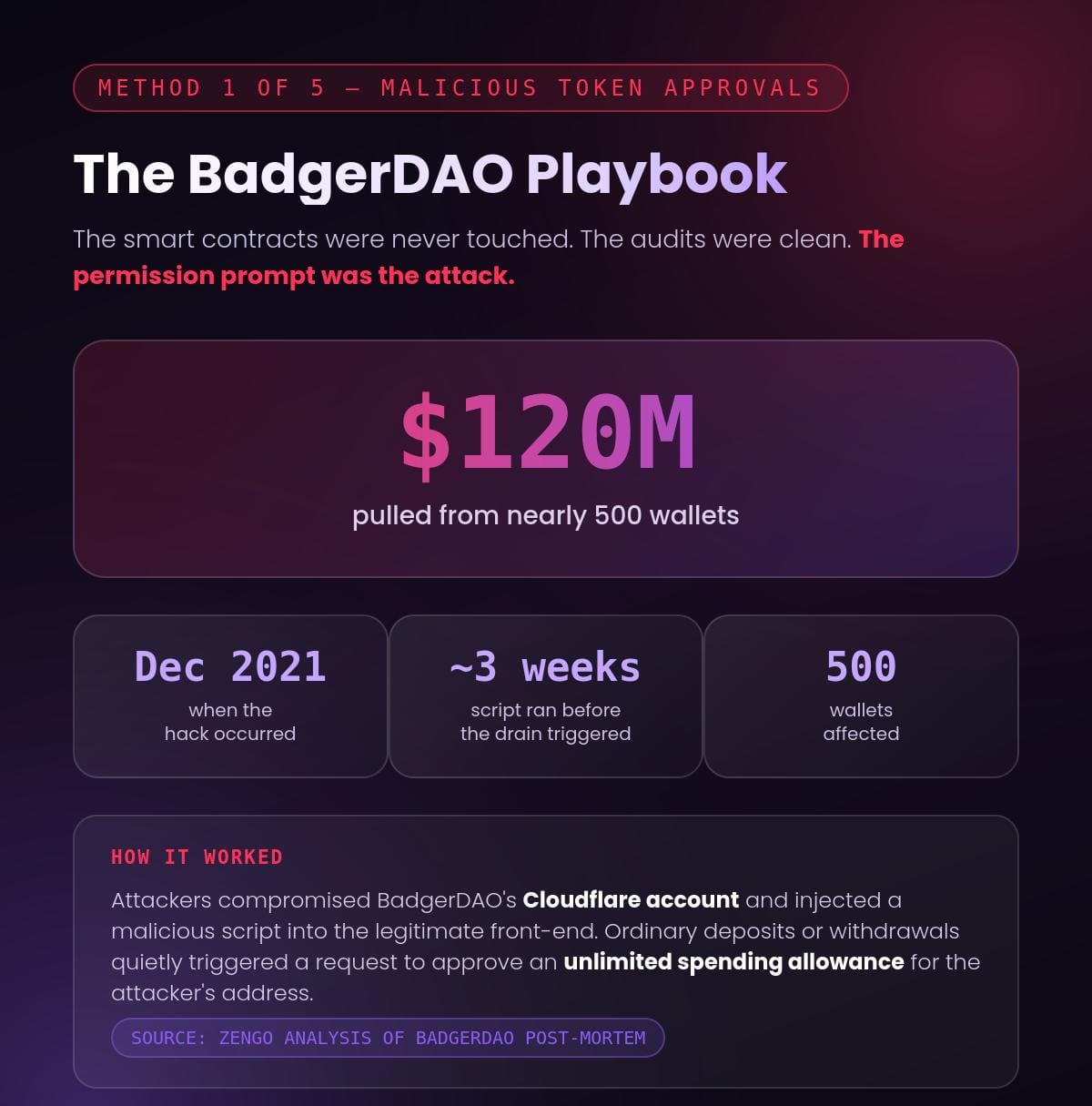
One of the most prominent examples of permission abuse is the BadgerDAO hack, which unfolded in December 2021. BadgerDAO, a decentralized autonomous organization focused on bringing Bitcoin to DeFi, was a respected and audited protocol. Its front-end website, where users interacted with the protocol’s smart contracts, had been considered secure for months.
The Attack Mechanism and Chronology: The attackers did not exploit a bug in BadgerDAO’s smart contracts, nor did they gain access to users’ seed phrases. Instead, they compromised BadgerDAO’s Cloudflare account, a content delivery network used to serve the website. This allowed them to inject a malicious script directly into the legitimate front-end. For approximately three weeks leading up to the main exploit, this script quietly operated in the background. When users visited the BadgerDAO website to perform routine operations like depositing or withdrawing funds, the injected script surreptitiously added an extra, hidden request to their wallet prompt. This request asked users to approve an "unlimited spending allowance" for the attacker’s wallet address on their ERC-20 tokens.
The Impact: Believing they were simply confirming a standard transaction, hundreds of users, many of whom were experienced DeFi participants, unknowingly granted this broad approval. On December 2, 2021, the attacker triggered the drain, systematically siphoning approximately $120 million worth of various ERC-20 tokens from nearly 500 wallets. According to technical post-mortems, including analysis by ZenGo, the smart contracts themselves remained untouched and secure throughout the incident. The website’s URL was correct, its SSL certificate valid, and the interface familiar. The only anomaly was the subtle addition of a permission prompt for more access than the transaction required.
Analysis and Implications: The BadgerDAO incident was a stark wake-up call, demonstrating that even sophisticated users could be compromised by front-end manipulation. It highlighted the critical distinction between smart contract security and front-end security, and the danger of blind trust in user interfaces. In response, security-conscious users and wallet providers have emphasized the importance of scrutinizing every detail of a transaction prompt. Tools like Etherscan’s Token Approval Checker became indispensable, allowing users to review and revoke standing approvals tied to their addresses, a practice now widely recommended as a periodic security audit.
The Deceptive Power of Signatures: Blind Signing and Ice Phishing
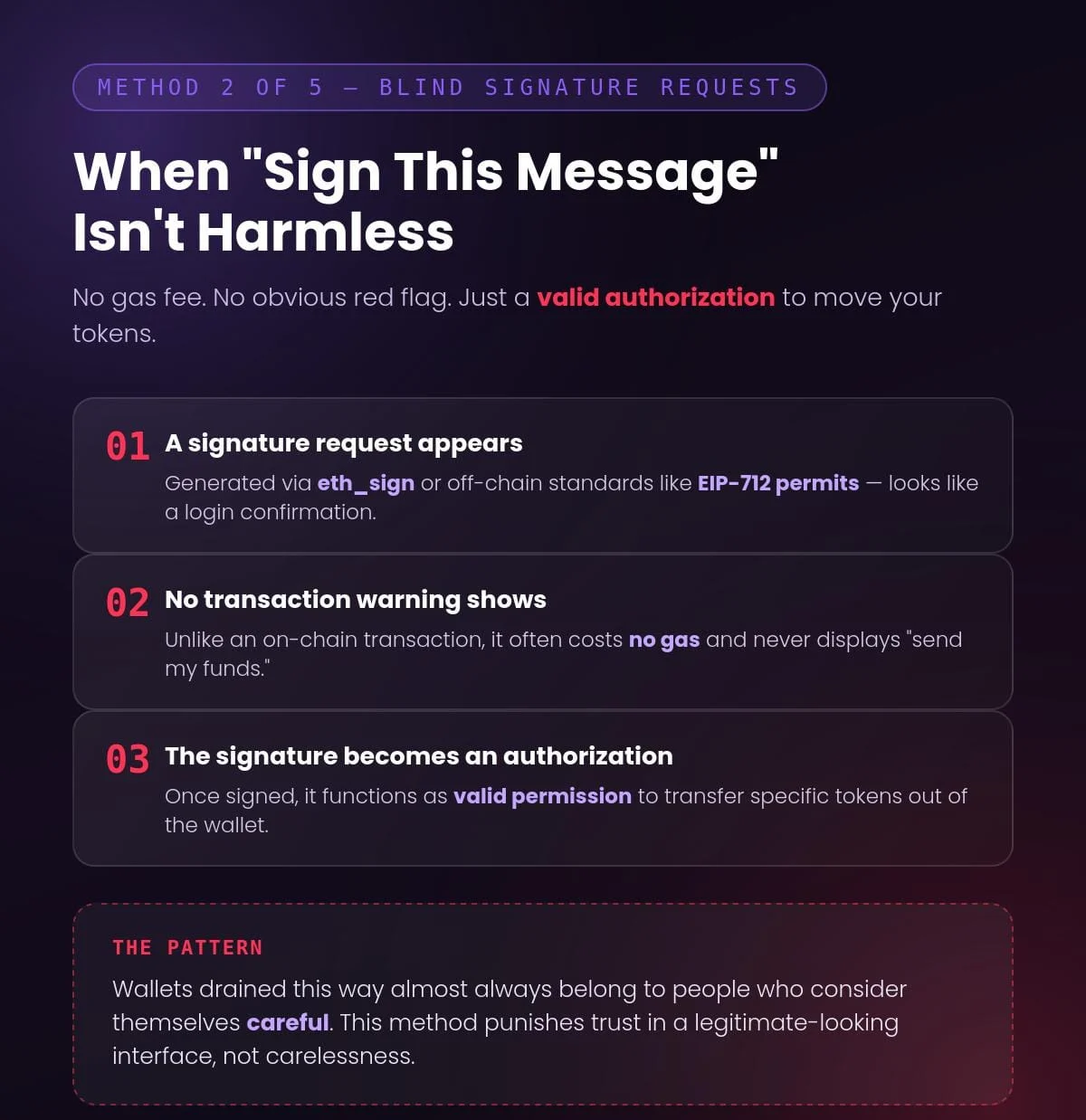
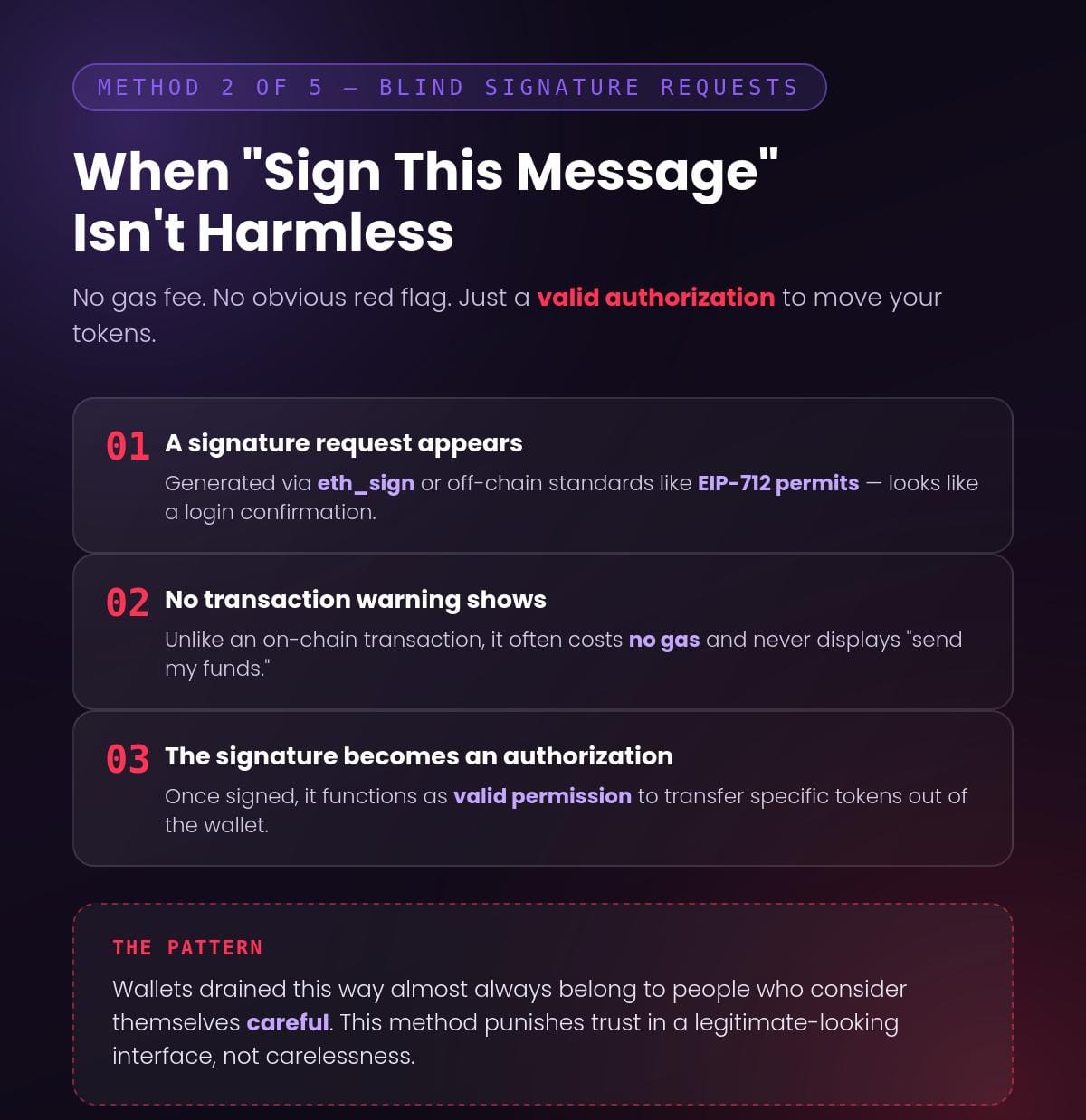
Beyond explicit token approvals, another insidious method involves signature requests, particularly those generated through general-purpose signing functions like eth_sign or off-chain standards such as EIP-712 permits. Unlike on-chain transactions, signature requests typically do not involve gas fees and can appear to be harmless identity verifications or login confirmations. This deceptive simplicity is precisely what makes them so exploitable.
Mechanism of Exploitation: A malicious dApp can construct a signature request that, once signed by the user, functions as a valid authorization to transfer specific tokens out of their wallet. The crucial detail is that the wallet interface might only display a generic "Sign this message" prompt, without clearly detailing the implications of the signature. Users, accustomed to signing messages for dApp logins or minor confirmations, might click "approve" without realizing they are essentially signing away control of their assets.
"Ice Phishing": Security researchers coined the term "ice phishing" to describe this broader category of attacks. The term gained traction because of its relevance to incidents like BadgerDAO, where users were tricked into signing permission grants rather than having their credentials stolen outright. It’s a method that preys on trust in seemingly legitimate interfaces, even among users who consider themselves highly careful. The danger lies in the lack of clear, human-readable information about what is being signed, leaving users to "blindly" sign transactions that could have devastating consequences. Reports indicate that wallets drained this way often belong to individuals who are otherwise diligent about their security, underscoring that this attack punishes trust, not just carelessness.
The Rise of Wallet Drainers: Malicious dApp Permissions
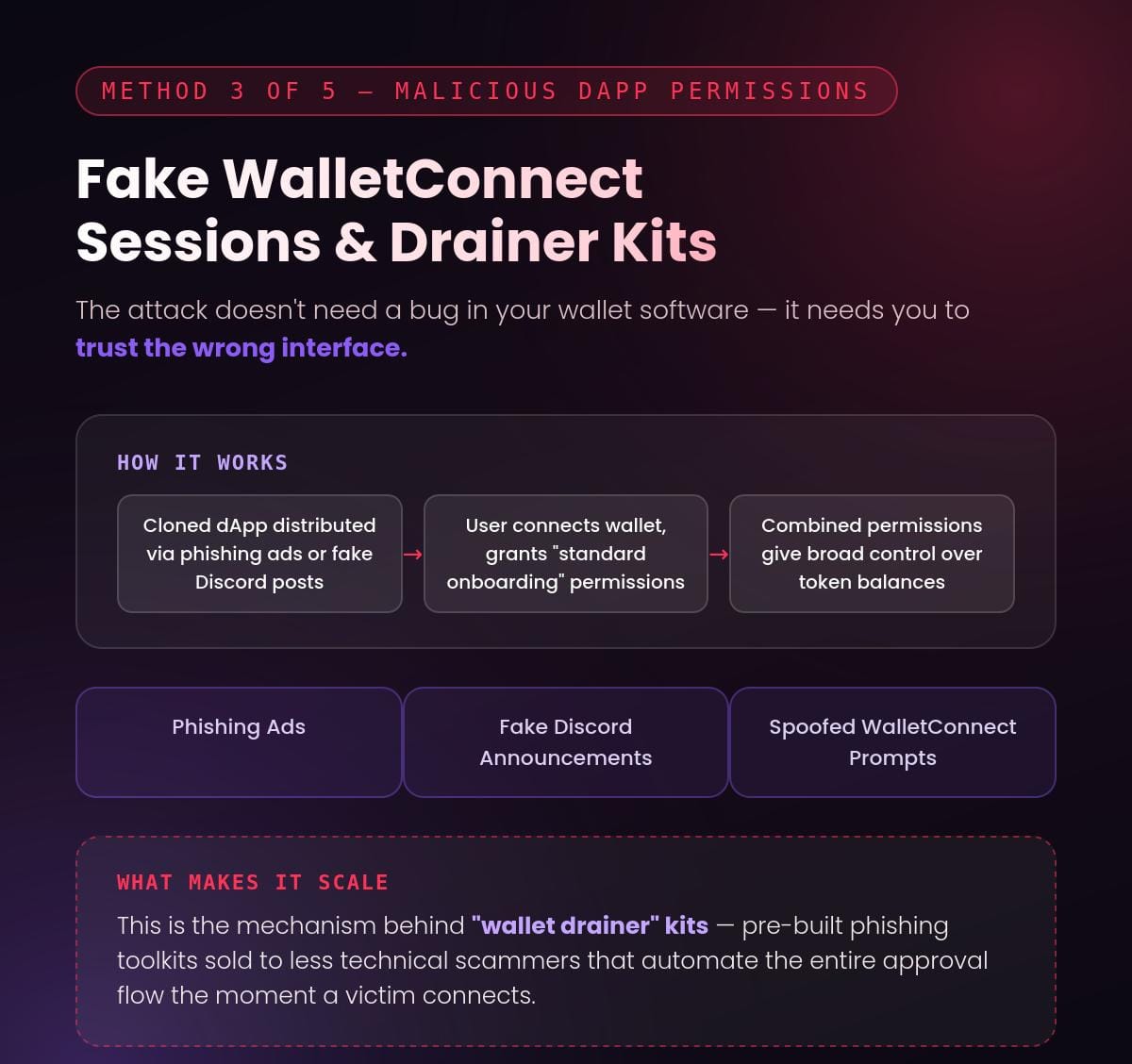
The third method operates at the connection layer, rather than solely at the transaction or approval layer. This involves the proliferation of fake or cloned decentralized applications, often disseminated through sophisticated phishing campaigns. These campaigns utilize deceptive ads, fake announcements on platforms like Discord, or spoofed WalletConnect prompts to lure users.
The Wallet Drainer Ecosystem: Attackers meticulously craft these fake dApps to look identical to popular, trusted platforms. Once a user connects their wallet to such a fraudulent dApp, it immediately requests a batch of permissions. These permissions are often disguised as standard onboarding steps, but when combined, they grant the attacker’s underlying smart contract broad authority over the user’s token balances. This is the core mechanism behind what the industry now refers to as "wallet drainer" kits. These pre-built phishing toolkits are readily available for purchase on underground forums, democratizing sophisticated attacks for less technical scammers. They automate the entire malicious approval flow the moment a victim connects their wallet.
Why It’s So Effective: What makes this method particularly challenging to defend against is that it exploits no bug in legitimate wallet software like MetaMask or Trust Wallet. The attack relies entirely on the interface’s ability to convince the user that a scam site is the real thing. Every subsequent permission granted, from connecting the wallet to approving specific token transfers, is technically authorized by the user. The psychological element of urgency, coupled with the familiarity of the cloned interface, often overrides a user’s caution. Recent data from blockchain security firms indicates a significant increase in the use of wallet drainers, with millions of dollars lost annually through these sophisticated phishing operations.
Subtle Traps: Address Poisoning and Human Habit
Not all sophisticated attacks require users to sign or approve anything directly related to smart contract interactions. Address poisoning is a more insidious method that exploits simple human habit and the mechanics of blockchain transaction history.
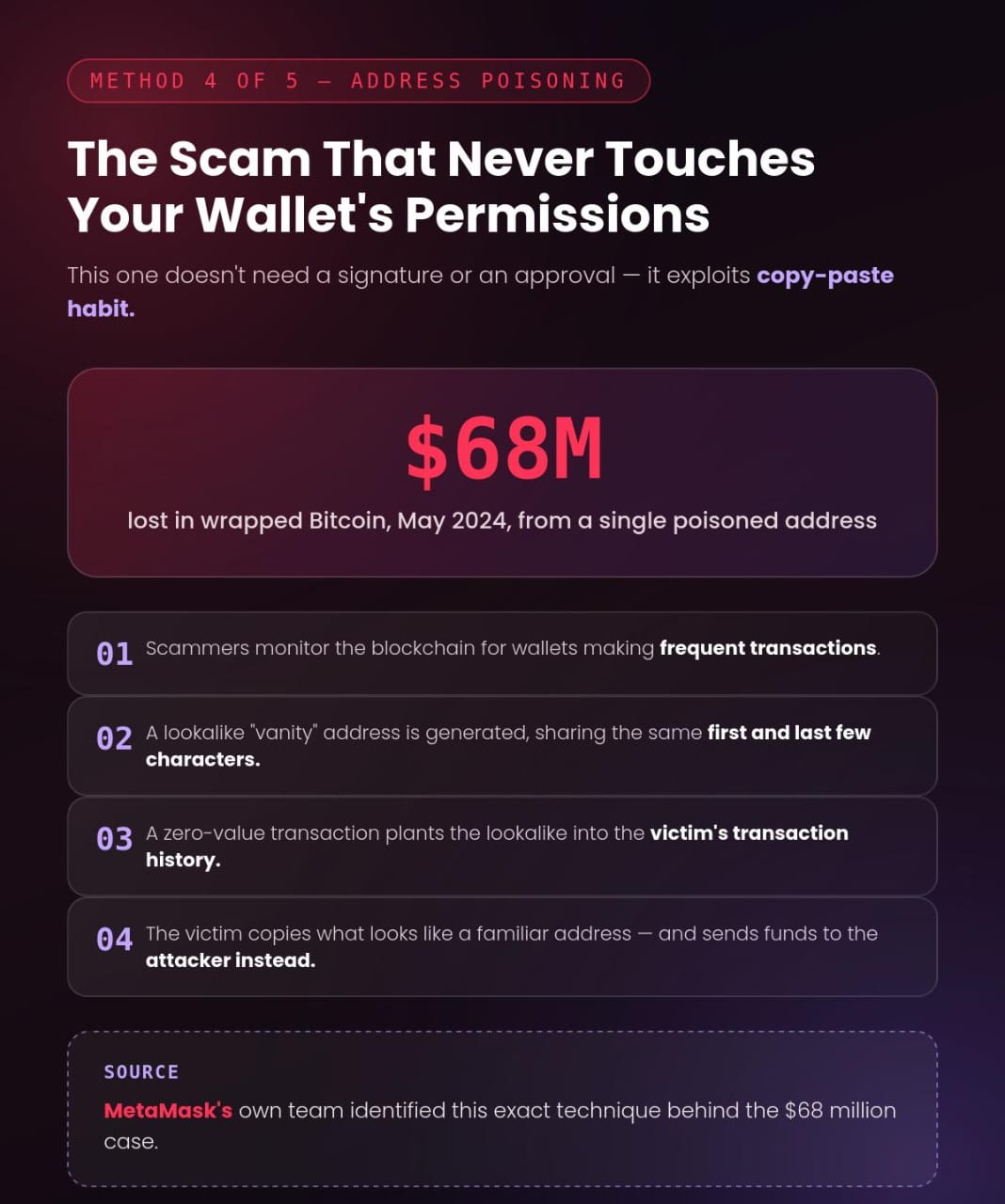
Mechanism: As detailed by MetaMask’s security guides, scammers actively monitor the blockchain for wallets that engage in frequent transactions. Once a target is identified, the attacker generates a "vanity" address – a wallet address specifically designed to share the same first and last few characters as an address the victim has genuinely interacted with before. For instance, if a victim frequently sends funds to 0xAbc...Xyz, the attacker might generate an address like 0xAbc...Qwe or 0xAbc...RstXyz.
The Bait: The attacker then sends a zero-value or negligible-value transaction (e.g., 0 ETH) from this lookalike address to the victim’s wallet. This seemingly innocuous transaction serves a crucial purpose: it quietly plants the malicious lookalike address into the victim’s transaction history, often appearing close to legitimate past interactions.
The Trap: The next time the victim intends to send funds to their legitimate, frequently used address, they might navigate to their transaction history, copy what looks like the correct address, but unknowingly copy the attacker’s poisoned lookalike instead. Since many users only verify the first and last few characters of an address – a habit reinforced by the lengthy, complex nature of blockchain addresses – the subtle difference often goes unnoticed.
Notable Incident: MetaMask’s team themselves highlighted this exact technique as the mechanism behind a staggering loss in May 2024, where a single victim lost an estimated $68 million in wrapped Bitcoin (wBTC) after copying a poisoned address directly from their own transaction history. This incident underscored that even robust wallet security and user awareness of seed phrase protection are insufficient against attacks that leverage human cognitive biases and habits. Address poisoning doesn’t exploit a technical vulnerability in the wallet; it exploits a vulnerability in human attention and verification processes.
The Airdrop Lure: Permit-Based Drainer Signatures
The proliferation of token airdrops, a popular method for distributing new tokens to early adopters or loyal users, has created a fertile ground for a new breed of scam that combines elements of phishing, social engineering, and permission abuse.
Context and Exploitation: Scammers capitalize on the excitement and urgency surrounding genuine token launches and anticipated airdrops. They build sophisticated fake "claim your airdrop" websites, often promoted through spoofed official-looking social media accounts or direct messages. These fraudulent sites are meticulously designed to mimic legitimate platforms.
Mechanism: The Permit Signature: Instead of merely requesting a wallet connection, these sites often prompt users for a "Permit" signature. Permit signatures (e.g., EIP-2612 for ERC-20 tokens) are a gasless, off-chain authorization standard designed to make legitimate DeFi transactions more convenient by allowing users to sign an approval message once, which can then be used by a third party (like a dApp) to execute a transaction on their behalf later, without requiring another on-chain approval. This bypasses the need for the user to pay gas for the approval transaction itself.
The Delayed Drain: The malicious "claim" site asks the user to sign a Permit message that, unbeknownst to them, authorizes the attacker to move specific tokens out of their wallet. Crucially, because Permit signatures are off-chain, the attacker doesn’t need to execute the drain immediately. They can hold onto the signed permit and use it days or even weeks later to move the specified tokens. This delay makes tracing the theft back to the original phishing site considerably harder for the victim, as the connection between the malicious interaction and the fund loss is obscured over time. This method thrives on the emotional state of urgency and "fear of missing out" (FOMO) that genuine airdrop announcements often induce.
Proactive Defense: Fortifying Your Digital Assets
In light of these evolving threats, a comprehensive and multi-layered approach to crypto security is no longer optional but essential. Protecting your seed phrase is the first line of defense, but it must be complemented by vigilant scrutiny of all wallet interactions.
- Treat Every Approval with Suspicion: Adopt a zero-trust mindset for every approval, signature, and connection request your wallet presents. Understand that functionally, for an attacker, an unlimited token approval can be as devastating as gaining access to your seed phrase.
- Regularly Audit Token Approvals: Make it a habit to periodically review and revoke old or unnecessary token approvals. Tools like Etherscan’s Token Approval Checker (for Ethereum and EVM-compatible chains) or similar tools on other blockchains (e.g., BSCScan, PolygonScan) allow users to see which dApps have permission to spend their tokens and to revoke those permissions. This simple step can mitigate the risk from past malicious approvals or compromised dApps.
- Utilize Hardware Wallets: For significant asset holdings, hardware wallets (e.g., Ledger, Trezor) offer a crucial layer of protection. They isolate your private keys from your internet-connected device, meaning transactions must be physically confirmed on the device itself. This makes it significantly harder for malicious scripts or phishing sites to trick you into signing away funds, as you must manually verify the transaction details on a trusted screen.
- Exercise Extreme Caution with dApp Connections and Signatures: Before connecting your wallet to any dApp, or signing any message, meticulously verify the URL. Bookmark legitimate sites and use them exclusively. Never click on links from unofficial sources, emails, or social media ads. When signing a transaction or message, ensure your wallet provides clear, human-readable details about what you are authorizing. If the prompt is vague or generic, proceed with extreme caution or decline the request.
- Educate Yourself Continuously: Stay informed about the latest scam techniques. Resources from reputable wallet providers like MetaMask’s safety documentation, as well as community-driven security guides, are invaluable. Understanding common attack patterns empowers you to identify and avoid them.
- Consider Multi-Signature Wallets: For shared funds or extremely high-value holdings, multi-signature (multi-sig) wallets add an extra layer of security by requiring multiple approvals (from different private keys) to execute a transaction. This distributes control and significantly raises the bar for attackers.
- Implement Transaction Simulators: Some advanced wallets and security tools now offer transaction simulation features. These tools attempt to predict the outcome of a transaction before you sign it, helping to reveal if a seemingly benign interaction would, in fact, result in unexpected fund transfers.
The Evolving Threat Landscape and Future Outlook
The crypto security landscape is a dynamic battlefield, with attackers constantly adapting their methods to exploit new technologies and user behaviors. While security audits of smart contracts are crucial, they do not negate the need for robust front-end security and, most importantly, user vigilance. The industry is responding with initiatives like account abstraction (ERC-4337), which aims to make wallets more flexible and potentially integrate advanced security features like transaction batching, social recovery, and clearer transaction previews directly into the wallet experience.
However, until such advancements become universally adopted and foolproof, the onus remains largely on the individual user. The ongoing battle between convenience and security will continue to shape the development of Web3. What is unequivocally clear is that the era of simply protecting a seed phrase as the sole security measure is over. Recovering funds after any of these sophisticated methods succeed is rare, often impossible, and usually costs everything. A few minutes spent understanding and implementing proactive security measures can be the difference between safeguarding your digital wealth and suffering irreversible losses.
Disclosure: This is not trading or investment advice. Always do your research before buying any cryptocurrency or investing in any services.
Follow us on Twitter @themerklehash to stay updated with the latest Crypto, NFT, AI, Cybersecurity, and Metaverse news!