The digital asset landscape has witnessed a significant shift in its hierarchy as BNB, the native utility token of the BNB Chain ecosystem, reclaimed its position as the fourth-largest cryptocurrency by market capitalization. By successfully surpassing XRP in May, BNB has re-established its dominance within the upper echelons of the market, sparking a renewed debate regarding its long-term valuation potential. While the immediate focus remains on BNB’s ability to reclaim its previous all-time highs and potentially breach the $2,000 threshold, more ambitious projections suggesting a price point between $10,000 and $20,000 have surfaced. However, a rigorous quantitative analysis suggests that such astronomical targets would require a fundamental expansion of the global cryptocurrency market cap far beyond current levels.
The Mathematical Reality of a Five-Digit BNB Valuation
To understand the feasibility of BNB reaching a $10,000 or $20,000 price point, one must look at the underlying market capitalization requirements. Currently, BNB maintains a market capitalization of approximately $80.6 billion. At this valuation, it trails only Bitcoin (BTC), Ethereum (ETH), and the stablecoin USDT. For BNB to reach a price of $10,000 per token, the math dictates a staggering shift in valuation.
The BNB ecosystem operates on a deflationary model, with a long-term goal of reducing the total supply to 100 million tokens through a systematic burn process. Based on this projected supply of 100 million tokens, a $10,000 price tag would result in a total market capitalization of $1 trillion. To put this in perspective, a $1 trillion valuation is roughly equivalent to the current market capitalization of Bitcoin, the world’s first and largest cryptocurrency. For a utility-based token like BNB to match the valuation of the primary "digital gold" asset, the entire crypto sector would likely need to undergo a massive wave of institutional adoption and global integration.
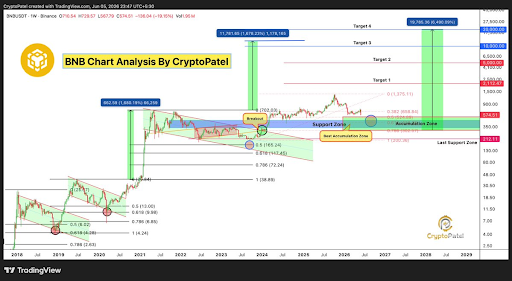
The projections become even more complex when considering a $20,000 target. At a supply of 100 million tokens, a $20,000 price would imply a $2 trillion market capitalization for BNB alone. This figure currently exceeds the combined value of the entire cryptocurrency market, including Bitcoin and all altcoins. Analysts, including the prominent market commentator Crypto Patel, have noted that such targets are not grounded in current market realities. While long-term growth is possible, suggesting a $20,000 price in the near term is often viewed more as speculative marketing than objective financial analysis.

Historical Context and the Path to $2,000
The historical performance of BNB provides a roadmap for its potential recovery. The asset reached an all-time high in the region of $1,370, representing a peak market capitalization of nearly $185 billion. This previous success demonstrates that the market has the appetite to value BNB at significant multiples of its current price.
The immediate "bull case" for BNB involves reclaiming this $1,300 to $1,500 zone. Achieving this would not only signify a full recovery from previous market downturns but would also place BNB in a position to challenge Ethereum’s market dominance. Analysis indicates that if BNB were to reach $1,500 at its current circulating supply, its market capitalization would sit at approximately $203 billion. This would effectively put it on par with Ethereum’s current valuation, assuming Ethereum’s price remained stagnant—a scenario that is unlikely given the high correlation between major crypto assets.
The Competitive Landscape: BNB vs. Ethereum
The narrative of the "flippening"—the moment one cryptocurrency overtakes another in market cap—has long been a staple of crypto discourse. Having already distanced itself from XRP, BNB’s next major hurdle is Ethereum. The competition between the two is not merely a matter of price, but of ecosystem utility, developer activity, and decentralized finance (DeFi) dominance.
Ethereum currently leads in terms of Total Value Locked (TVL) and the number of decentralized applications (dApps). However, the BNB Chain has carved out a significant niche by offering lower transaction fees and faster block times, making it a preferred choice for retail-focused DeFi and gaming applications. Recent data suggests that the BNB Chain is increasingly dominating global stablecoin transactions, a key metric for real-world utility. Furthermore, the growth of Real World Assets (RWA) on the BNB Chain, which recently hit a valuation of $3 billion, indicates that the ecosystem is diversifying beyond speculative trading.
For BNB to realistically overtake Ethereum, it would need to sustain its growth in the RWA and stablecoin sectors while maintaining its deflationary supply mechanics. A "flip" could occur if BNB returns to record-breaking levels during a period where Ethereum faces regulatory headwinds or slower-than-expected upgrades.

The Impact of Tokenomics: The Burn Mechanism
A critical component of BNB’s value proposition is its "Auto-Burn" protocol. Unlike many other assets with inflationary supplies, BNB is designed to become scarcer over time. The burn mechanism is two-fold:
- Real-time Burn: A portion of the gas fees spent on the BNB Chain is permanently removed from circulation.
- Quarterly Burn: Binance uses a formula based on the price of BNB and the number of blocks generated on the BNB Chain to determine the amount of BNB to be repurchased and burned each quarter.
The ultimate goal of these mechanisms is to reduce the total supply from its original 200 million tokens to 100 million. This scarcity is a primary driver for long-term price appreciation. As the supply decreases, the market capitalization required to reach higher price targets also decreases, making targets like $2,000 or $3,000 more mathematically attainable over a multi-year horizon.
Risk Factors: The Binance Concentration Risk
Despite the bullish projections, BNB faces a unique set of challenges often referred to as "concentration risk." Because BNB is intrinsically linked to the Binance exchange, its value is highly sensitive to the regulatory and operational health of the platform.
Almost every primary driver for BNB—from exchange fee discounts and Launchpad participation to the maintenance of the BNB Chain—is adjacent to or managed by Binance. Consequently, legal challenges faced by the exchange, such as the high-profile settlements with the U.S. Department of Justice (DOJ) and the Commodity Futures Trading Commission (CFTC), have historically led to volatility in BNB’s price.
Institutional adoption is also a double-edged sword. While amendments by firms like Grayscale and VanEck regarding potential BNB-related investment products suggest growing institutional interest, these same institutions are highly sensitive to regulatory compliance. Any further legal scrutiny of Binance or its former leadership could dampen the institutional appetite for BNB, regardless of its technical merits or burn rate.
Timeline and Long-term Projections
Market analysts who maintain a bullish outlook for BNB generally project a gradual ascent rather than a vertical spike. A credible trajectory suggests that BNB could reclaim its old highs and push toward $3,000 within the current or next market cycle, driven by broader crypto adoption and the continued reduction in supply.
The more extreme targets of $10,000 to $20,000 are typically placed in a much longer timeframe, with some models suggesting these levels might only be reached by 2029 or later. This timeline assumes several conditions are met:
- The total cryptocurrency market capitalization grows to exceed $10 trillion.
- BNB Chain becomes the primary infrastructure for global stablecoin and RWA transactions.
- The supply of BNB successfully reaches the 100 million token target.
- Regulatory clarity is achieved in major markets, allowing for full institutional integration.
Broader Market Implications
The movement of BNB is often viewed as a bellwether for the "altcoin" market. As the highest-valued non-stablecoin altcoin after Ethereum, BNB’s ability to sustain high valuations provides confidence to the broader ecosystem. If BNB can successfully decouple from the specific news cycles of the Binance exchange and be viewed primarily as a decentralized infrastructure asset, it could pave the way for a new era of platform-based valuations.
In conclusion, while the mathematical path to a $20,000 BNB remains a distant and difficult prospect requiring a total transformation of the global financial landscape, the journey toward $2,000 and beyond is supported by robust tokenomics and increasing on-chain utility. Investors and analysts alike remain focused on the interplay between supply scarcity, ecosystem growth, and the ever-present regulatory environment that defines the future of the fourth-largest digital asset.