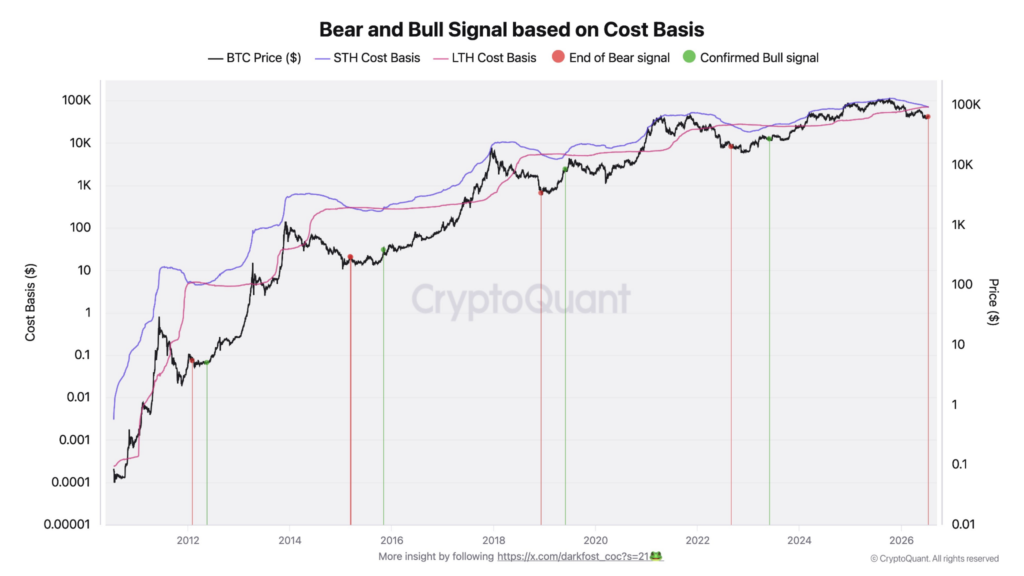
On-chain indicators are flashing a potential turning point for Bitcoin, suggesting that the protracted nine-month bear market may be entering its final, albeit crucial, phase. A prominent crypto analyst, known by the pseudonym Darkfost, recently highlighted a significant on-chain event: a downward crossover of the cost basis between Short-Term Holders (STH) and Long-Term Holders (LTH). This development, confirmed over a three-day period, is being interpreted by many in the cryptocurrency community as a historically reliable signal for the conclusion of a bear cycle.
The significance of this STH/LTH cost basis crossover lies in its depiction of investor behavior and market sentiment. Short-Term Holders are typically defined as those who have held their Bitcoin for less than 155 days, often characterized by more speculative trading patterns. Long-Term Holders, conversely, are investors who have held their assets for longer periods, generally exhibiting a more conviction-based approach to the market. When the cost basis of STHs falls below that of LTHs, it implies that recent buyers are acquiring Bitcoin at progressively lower prices, effectively bringing down the average purchase price for this group. This downward pressure on the STH cost basis, particularly when it intersects and potentially dips below the LTH cost basis, suggests a capitulation event where newer, less committed investors are exiting their positions at a loss. This, in turn, can create a foundational support level for the market, paving the way for a potential recovery.
Darkfost’s analysis, shared widely across social media platforms, included a compelling graph illustrating this trend. The visual representation depicted a dramatic decline in the STH cost basis, plummeting from a peak of approximately $112,500 down to a current level around $69,000. This substantial drop signifies that a significant number of short-term investors have been forced to sell their holdings at a loss, effectively "washing out" weaker hands from the market. The overlap and subsequent potential descent of the STH cost basis below the LTH cost basis mark a critical juncture. It suggests that the average acquisition price for recent entrants into the market is now lower than that of the more established, long-term holders. This scenario is often observed at the tail end of bear markets, as it indicates that the market has absorbed selling pressure from a broad spectrum of participants, including those who entered at higher prices during the preceding bull run.
The implications of this crossover are multifaceted. Firstly, it suggests that the most intense period of selling pressure might be subsiding. As STHs exit at a loss, their selling pressure diminishes, potentially creating a more stable environment for Bitcoin to consolidate and eventually rebound. Secondly, the lower cost basis for STHs could serve as an attractive entry point for new investors or a signal for existing investors to initiate or increase their Dollar Cost Averaging (DCA) strategies. DCA, a method of investing a fixed amount of money at regular intervals, can be particularly effective in a bear market. By consistently buying at lower prices, investors can gradually lower their average acquisition cost and position themselves to benefit significantly when the market eventually turns bullish.

Historical Precedents and Market Cycles
To fully appreciate the current situation, it is essential to contextualize it within Bitcoin’s historical market cycles. Bitcoin has historically exhibited a roughly four-year cycle, often influenced by its halving events, which reduce the rate at which new Bitcoins are created. These cycles typically involve a period of rapid price appreciation (bull market), followed by a significant downturn (bear market), and then a period of accumulation and sideways movement before the next upswing. The current bear market, which began in late 2021 after Bitcoin reached its all-time high, has been one of the longest and most severe in its history, lasting approximately nine months as of the time of this analysis.
The STH/LTH cost basis crossover has historically been a leading indicator of bear market bottoms. During previous bear markets, such as the one in 2018-2019, a similar crossover preceded the eventual price recovery. The prolonged nature of the current bear market has led some to question whether these traditional cycles are still relevant. However, on-chain data, like the STH/LTH cost basis, often provides a more objective perspective, reflecting the underlying economic realities of the market rather than purely speculative sentiment.
The fact that this signal has occurred after a nine-month downturn suggests that the market has undergone a significant cleansing process. This process typically involves the capitulation of weaker holders, the consolidation of assets by stronger hands, and the establishment of new price floors. The current STH cost basis of $69,000, while still significantly below Bitcoin’s all-time high of over $69,000 (which was briefly touched in late 2021 before a subsequent plunge), represents a notable shift in the average entry price for recent participants.
Supporting Data and On-Chain Metrics
Beyond the STH/LTH cost basis, other on-chain metrics can provide further context to the potential end of the bear market. These include:
- Net Unrealized Profit/Loss (NUPL): This metric measures the total unrealized profit or loss of all Bitcoin holders. When NUPL is in the red (indicating a net unrealized loss), it often coincides with bear market bottoms. A sustained move back into positive territory can signal a recovery.
- Exchange Net Position Change: This tracks the net flow of Bitcoin into and out of cryptocurrency exchanges. Large net outflows can indicate that investors are moving their assets to cold storage, signaling their intention to hold for the long term, which is a bullish sign. Conversely, net inflows can suggest selling pressure.
- Miner Revenue and Hashrate: The profitability of Bitcoin miners is a crucial indicator. As Bitcoin prices fall, miner revenue decreases, potentially leading to less efficient miners shutting down. A sustained hashrate, however, suggests that miners are still actively participating, which can indicate confidence in future price appreciation.
- Active Addresses and Transaction Volume: While not always a direct indicator of bottoms, an increase in active addresses and transaction volume can signal renewed interest and activity in the network, which often accompanies a market recovery.
While specific real-time data for these metrics would require direct access to blockchain analytics platforms, the general trend observed in the STH/LTH cost basis crossover aligns with the typical characteristics of a market bottoming process. The data presented by Darkfost suggests that the average cost for short-term holders has fallen significantly, indicating that the market is now trading at levels where new participants are acquiring Bitcoin at substantially reduced prices compared to recent peaks.
The Future Outlook and Potential Scenarios
The confirmation of the STH/LTH cost basis crossover is a powerful signal, but it does not guarantee an immediate end to the bear market. Several factors will influence the future trajectory of Bitcoin’s price:
- Confirmation of a Bottom: While the crossover indicates favorable conditions, a definitive market bottom is typically confirmed by a sustained period of price consolidation followed by a clear upward trend. Some analysts believe that Bitcoin might still experience further downside before establishing a solid bottom, potentially dipping below its current low of around $58.5k. Others remain optimistic that the current price levels could represent the nadir.
- The Upward Crossover: The ultimate confirmation of a new bull market would be a subsequent upward crossover of the STH and LTH cost bases. This would signify that newly acquired Bitcoin is appreciating in value, and that short-term holders are once again realizing profits, a hallmark of a healthy bull market. However, this event could take months, or even over a year, to materialize, highlighting the importance of patience and long-term perspective.
- Macroeconomic Factors: The broader macroeconomic environment continues to play a significant role in the cryptocurrency market. Inflationary pressures, interest rate hikes by central banks, and geopolitical events can all influence investor sentiment and risk appetite, impacting Bitcoin’s price alongside traditional assets.
- Regulatory Developments: Evolving regulatory frameworks for cryptocurrencies globally can also introduce uncertainty or provide clarity, influencing institutional adoption and investor confidence.
Despite the potential for continued volatility, the current on-chain signals suggest that Bitcoin is demonstrating resilience and adhering to its cyclical patterns. The maturation of the Bitcoin network, as evidenced by the consistent behavior of its holders, suggests that the fundamental principles driving its market cycles remain intact. Even as some critics argue that the traditional four-year cycle is becoming obsolete, the current data indicates that investor behavior, at least for Bitcoin, continues to follow these established rhythms.
The falling STH cost basis to $69,000 is not just a number; it represents a significant shift in the market’s economic underpinnings. It signifies that the pain of the bear market has likely forced out speculative players, creating a more robust foundation for future growth. While the path forward may not be entirely smooth, the on-chain evidence provides a compelling argument that the end of Bitcoin’s prolonged bear market may finally be in sight. Investors and observers will be closely watching for further confirmations and the eventual upward crossover of the STH and LTH cost bases as definitive proof of a new bull cycle.