Governance votes within the decentralized autonomous organization (DAO) landscape often unfold with minimal fanfare, typically concluding with a predictable outcome dictated by a few large wallets and garnering little attention beyond the immediate community. However, the current situation at World Liberty Financial (WLFI) stands in stark contrast to this norm. A new governance proposal, designed to incentivize active participation among WLFI token holders, has rapidly amassed overwhelming on-chain approval, yet simultaneously ignited a fervent wave of dissent and anger across community discussion channels. This stark dichotomy between the ballot box and the public forum represents the core narrative here, highlighting a complex interplay of trust, incentive design, and the inherent challenges of decentralized governance ahead of the September 28 deadline.
The Proposal: An Attempt to Forge a Committed Electorate
At its core, the WLFI proposal, accessible directly on the project’s governance portal, introduces a novel mechanism intended to address a perennial problem plaguing DAOs: voter apathy and the transient nature of token holder engagement. The initiative posits a clear trade-off: sustained commitment in exchange for a tangible yield. Specifically, WLFI holders are asked to lock their tokens for a minimum duration of 180 days. Crucially, merely locking tokens is insufficient to qualify for rewards. Participants must also actively engage in governance by casting at least one vote every 90 days throughout their lock period. Failure to meet this recurring participation threshold results in the forfeiture of reward eligibility, while consistent engagement triggers payouts from the WLFI treasury.
This structured approach is a direct response to the common phenomenon of "drive-by voting," where token holders acquire voting power, participate in an initial decision, and then withdraw from active governance, leaving critical decisions to a concentrated, often unrepresentative, subset of the community. By intertwining rewards not just with staking but with a mandatory, quarterly voting cadence, WLFI aims to cultivate a persistent, engaged electorate rather than relying on sporadic spikes in turnout. This model represents an evolution of the project’s earlier staking-linked governance framework, now refined to demand more consistent, active participation. The mechanics, including exact voting weights and the live tally, are transparently available on WLFI’s official governance portal, ensuring real-time public scrutiny of the process.
Early Voting Dynamics: A Lopsided Mandate from the On-Chain Ledger

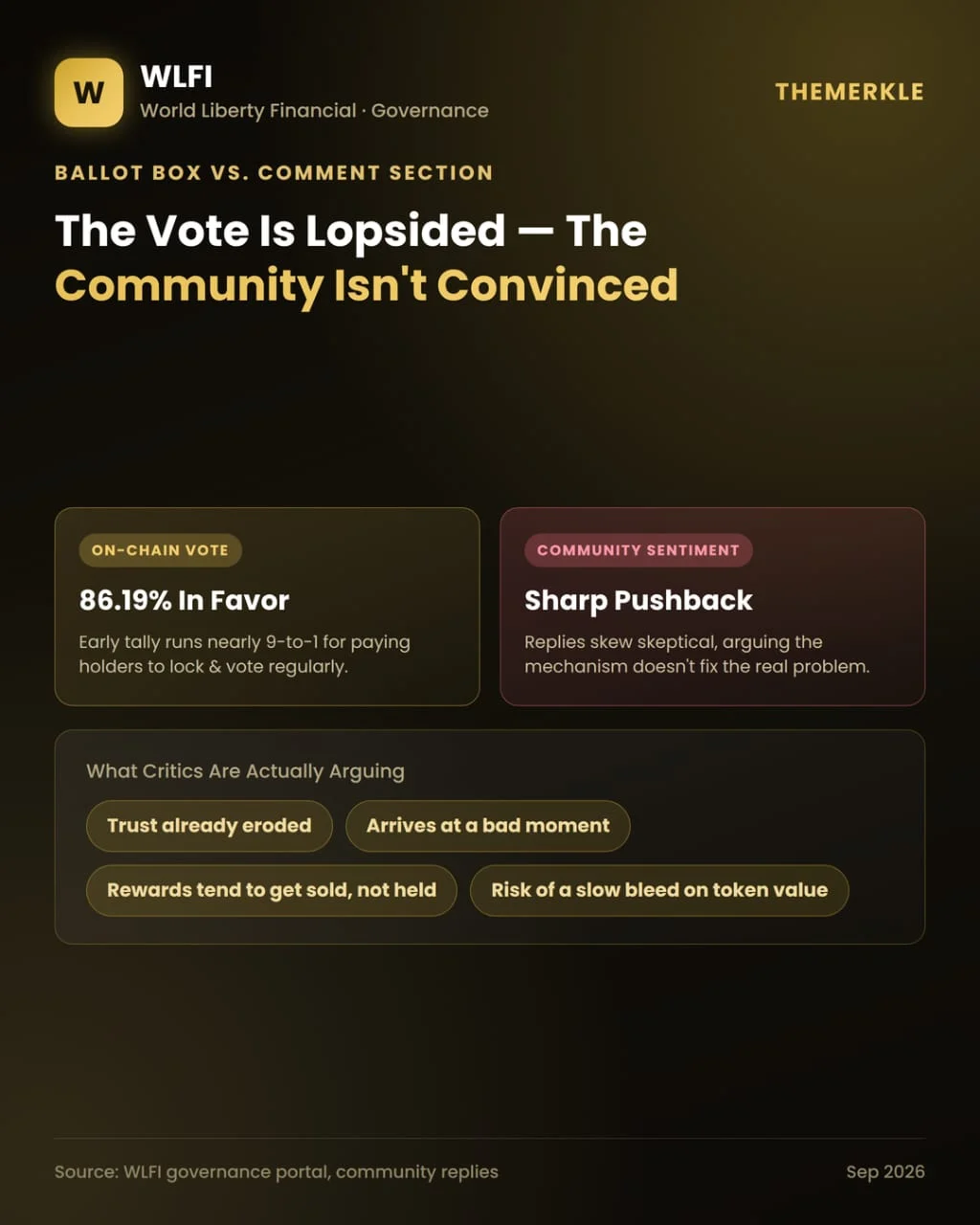
The initial 24 hours of voting provided an unequivocal, albeit potentially misleading, snapshot of on-chain sentiment. The proposal quickly garnered an overwhelming majority, with approximately 86.19% of the votes cast in favor, against a mere 12.91% opposition. Such a decisive early margin typically suggests broad community consensus or, alternatively, the swift mobilization of powerful voting blocs. In the context of WLFI, the latter scenario bears particular scrutiny.
Historical precedent within WLFI’s own governance record offers valuable context. An earlier staking-related proposal witnessed a near-unanimous 99% approval rate, yet this outcome was achieved with only around 1,800 total votes, and significantly, over three-quarters of the total voting weight originated from just ten distinct wallets. This pattern suggests a highly concentrated distribution of voting power, where a small number of large holders can disproportionately influence outcomes. Should this historical trend persist in the current vote, the impressive 86.19% approval figure may reflect the concentrated conviction of a few influential entities rather than widespread grassroots enthusiasm. This dynamic underscores a critical challenge in decentralized governance: distinguishing between numerical majority and genuine community sentiment, especially as more votes trickle in towards the September 28 deadline. The rapid accumulation of ‘yes’ votes from potentially large holders early in the cycle could be a strategic move to establish an undeniable lead, potentially discouraging later opposition from smaller, more fragmented token holders.
Community Outcry: A Discordant Chorus of Skepticism and Frustration
While the on-chain tally paints a picture of overwhelming approval, a deeper dive into WLFI’s community forums, social media channels, and discussion threads reveals a dramatically different narrative. Far from celebrating the proposal’s imminent passage, a vocal segment of the community is expressing intense frustration and skepticism. This significant divergence between the official vote count and public sentiment is the true heart of the WLFI story.
Critics argue that the proposed rewards-for-participation model arrives at an inopportune moment, failing to address what they perceive as more fundamental issues plaguing the project. A widely circulated post, emblematic of this sentiment, bluntly articulates several core grievances:
- Eroding Trust: Many holders feel that trust in the WLFI token and the project team has significantly diminished over time. This erosion of confidence is often linked to sustained price pressure on the token, which has seen considerable volatility and downward trends in recent periods. Without addressing the underlying reasons for this perceived loss of trust, critics argue that incentive schemes are merely superficial fixes.
- Unfavorable Timing: The proposal’s introduction is viewed by some as poorly timed, particularly given ongoing market conditions or specific challenges faced by WLFI. In a bearish market or during periods of project uncertainty, the focus, critics contend, should be on core development, utility enhancement, or strategic partnerships, rather than on mechanisms to boost governance participation.
- Reward Liquidation and "Slow Bleed": A primary concern revolves around the economic impact of treasury-funded rewards. Critics fear that any rewards distributed will be immediately sold by recipients, contributing to further sell pressure on the WLFI token. If governance rewards are consistently liquidated rather than reinvested or held, the mechanism risks becoming a "slow bleed" on the treasury and the token’s value, rather than fostering long-term alignment. This concern is amplified by the project’s recent history of price pressure and public governance disputes involving some of its largest holders, which have only exacerbated anxieties about tokenomics sustainability.
- Team Disconnect: A recurring accusation is that the WLFI team either lacks a coherent long-term strategy or is out of touch with the lived experiences and concerns of its token holders. This perception of disconnect further fuels skepticism regarding the efficacy and genuine intent behind the proposal. Critics suggest that the team might be prioritizing metrics like participation rates over substantive improvements to the ecosystem’s fundamental value proposition.
This intense criticism highlights a crucial dimension that raw vote tallies cannot capture: even a proposal that achieves overwhelming on-chain approval can fail to convince a substantial portion of the community that its underlying tokenomics and strategic rationale are sound. The debate centers on whether the proposed incentive structure truly builds a committed community or merely attracts "yield farmers" whose primary motivation is short-term profit extraction, potentially at the expense of long-term token health.

Broader Implications: A Stress Test for DAO Governance
Regardless of the final tally on September 28, this WLFI governance proposal serves as a significant stress test for a fundamental question confronting nearly every governance-token project: can sustained, meaningful participation truly be "bought" through financial incentives, or does paying people to vote merely create a different form of apathy, where engagement becomes a perfunctory act to collect rewards rather than a genuine exercise in shaping protocol direction?
WLFI’s bet is that a recurring, treasury-funded incentive can effectively solve the pervasive problem of low voter turnout and disengagement. Proponents of the proposal would argue that by creating a direct financial link between active governance and personal gain, the project can foster a more robust and responsive decision-making body. They might point to the success of similar models in traditional finance, where shareholder incentives are often tied to participation and long-term commitment. Furthermore, a consistent voting base could lead to more stable governance, reducing the risk of sudden, low-turnout decisions being swayed by malicious actors or fleeting interests. The 180-day lock-up period and the quarterly voting requirement are designed to filter out the most speculative participants, ideally retaining those with a longer-term vested interest in the protocol’s success.
However, the vocal skeptics in the replies are placing their bets elsewhere. They contend that no amount of yield can adequately fix a foundational trust problem. If token holders lack faith in the project’s leadership, its long-term vision, or the fundamental value proposition of the WLFI token, then financial incentives for governance might only serve to mask deeper structural issues. Their concerns echo a broader debate within the crypto space about the sustainability of treasury-funded incentives, particularly when faced with significant market headwinds or internal project challenges. If rewards are perceived as a means to prop up engagement rather than a natural outcome of a thriving ecosystem, they risk being counterproductive.
Moreover, the debate touches upon the very philosophy of decentralized governance. Is the ideal DAO one where participants are intrinsically motivated by the desire to contribute to a shared vision, or is it a system where economic incentives are necessary to ensure functionality? The WLFI situation highlights the tension between these two ideals. While the proposal aims to increase active participation, critics fear it might inadvertently create a class of "professional voters" who prioritize the reward mechanism over diligent research and thoughtful deliberation on proposals. This could potentially lead to rubber-stamping decisions, eroding the very decentralized spirit that DAOs are meant to embody.
The Path Forward: Transparency and Long-Term Viability

As the September 28 deadline approaches, all eyes will be on the final vote tally and, more importantly, the ensuing community reaction. The on-chain vote, conducted transparently on WLFI’s governance portal, ensures that the outcome is verifiable and immutable. Yet, the challenge for World Liberty Financial will extend far beyond simply securing a "yes" vote. The project must navigate the significant chasm between its on-chain mandate and the palpable discontent expressed by a segment of its community.
The successful implementation of this proposal will depend not only on its technical execution but also on the WLFI team’s ability to rebuild trust, articulate a clear vision for the token’s long-term utility beyond governance rewards, and address the fundamental concerns about tokenomics and market stability. The outcome of this vote, and the subsequent evolution of WLFI’s governance model, will offer valuable lessons not just for its own community but for the broader decentralized finance ecosystem grappling with the complexities of fostering truly engaged and representative governance. The fundamental question remains: can financial incentives bridge the gap between passive token ownership and active, meaningful decentralized governance, or do they merely create a new set of challenges for projects striving for true decentralization and community alignment? The unfolding drama at World Liberty Financial offers a live case study in this critical ongoing debate.
Disclosure: This is not trading or investment advice. Always do your research before buying any cryptocurrency or investing in any services.
Follow us on Twitter @themerklehash to stay updated with the latest Crypto, NFT, AI, Cybersecurity, and Metaverse news!