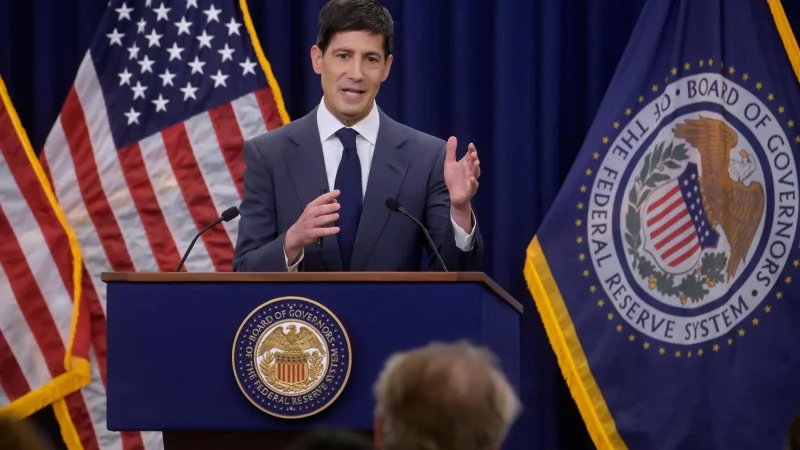
The Federal Open Market Committee (FOMC) concluded its two-day policy meeting on Wednesday by raising the benchmark federal funds rate by 25 basis points, establishing a new target range of 3.75% to 4%. This decision marks a significant shift in the central bank’s monetary trajectory, representing the first interest rate increase since July 2023. The move underscores the Federal Reserve’s commitment to steering the national economy back toward its long-term inflation target of 2%, signaling that the period of monetary easing observed throughout late 2024 and 2025 has reached a definitive conclusion.
The 12-0 unanimous vote reflects a cohesive stance among policymakers, who characterized the current economic environment as one of solid expansion despite the persistence of elevated price levels. In its official policy statement, the Federal Reserve noted that while inflation has moderated from its historical peaks, it remains above the desired threshold, necessitating a more restrictive stance to ensure price stability. The committee further emphasized that the labor market remains resilient and that capital investment and productivity growth continue to provide a robust foundation for the broader economy.
A New Phase in Monetary Policy: The Path from 2023 to 2026
To understand the significance of Wednesday’s hike, it is essential to examine the Federal Reserve’s actions over the preceding three years. In July 2023, the central bank implemented what many believed at the time to be the final rate hike of that cycle, bringing the federal funds rate to a range of 5.25% to 5.50%. For over a year, the Fed maintained these elevated rates to combat the post-pandemic inflationary surge.
By September 2024, as inflation showed signs of sustained cooling and the labor market began to signal potential softening, the Fed initiated a series of rate cuts. This easing cycle continued through the end of 2025, gradually lowering the target range to 3.50% to 3.75%. The objective of that period was to achieve a "soft landing"—stabilizing prices without triggering a significant recession. However, the data emerging in the first half of 2026 suggested that the "last mile" of the inflation fight would be more difficult than anticipated. Stubborn service-sector costs and resilient consumer demand prompted the FOMC to pivot back to a tightening bias, culminating in the current 25 basis point increase.
Cryptocurrency Markets React to Regulatory and Monetary Headwinds
The digital asset market experienced a period of high volatility leading up to and immediately following the Fed’s announcement. Bitcoin, the world’s largest cryptocurrency by market capitalization, had been under considerable downward pressure throughout the week. Before the Fed release, Bitcoin was trading near $75,500, marking a decline of approximately 5% since Monday.
Much of this early-week weakness was attributed not just to macroeconomic uncertainty, but to specific legislative developments in Washington. On Tuesday, the United States Senate failed to advance the CLARITY Act, a piece of legislation widely viewed by the industry as a critical step toward establishing a clear regulatory framework for digital assets in the U.S. The legislative stalemate injected a sense of caution into the market, weighing heavily on investor sentiment.
However, the immediate reaction to the Fed’s rate hike was surprisingly positive. As soon as the 25 basis point increase was confirmed—a move that had been largely anticipated by institutional traders—Bitcoin began to surge. The asset climbed above the $76,000 threshold, suggesting that the "hawkish" news had already been priced into the market. This "sell the rumor, buy the news" phenomenon was mirrored across other major cryptocurrencies:
- Ethereum (ETH): After falling more than 8% since the start of the week to trade near $2,380, Ethereum saw a modest recovery of over 1% following the announcement.
- Solana (SOL): Trading near $96 prior to the news, Solana followed the broader market trend with a post-announcement advance.
- XRP: Perhaps the hardest hit during the weekly sell-off with a 15% decline to $1.26, XRP also stabilized and saw gains exceeding 1% as the market digested the Fed’s statement.
Traditional Markets and the Surge in Treasury Yields
The impact of the Federal Reserve’s decision was equally pronounced in traditional financial sectors. In the days leading up to the meeting, the bond market signaled a clear expectation of higher-for-longer interest rates. The yield on the 10-year Treasury note—a global benchmark for borrowing costs—breached the 5% mark on Tuesday. This represented the highest yield level seen since 2007, reflecting investor anxiety over persistent inflation and the government’s fiscal trajectory.
While the yield eased slightly to 4.95% on Wednesday following the Fed’s communication, the broader equity markets remained cautious. The S&P 500 and the tech-heavy Nasdaq Composite were both trading roughly 2% below their early September highs. Investors in the equity space are grappling with the dual reality of a strong economy, which supports corporate earnings, and higher interest rates, which discount the value of future cash flows and increase the cost of debt servicing.
Precious metals, often viewed as a hedge against inflation but sensitive to rising yields, also faced headwinds. Gold prices retreated by approximately 3.5% from their September peaks, while silver saw a decline of roughly 4%. Because gold does not yield interest, it typically becomes less attractive to investors when Treasury yields rise, as the opportunity cost of holding the metal increases.
Economic Fundamentals and the "Resilient" Narrative
A central component of the FOMC’s justification for raising rates is the surprising durability of the American economy. Despite the high-interest-rate environment of the past few years, the Fed described economic activity as "expanding at a solid pace." Several key metrics support this assessment:
- Consumer Spending: Domestic spending has remained resilient, buoyed by a strong labor market and accumulated household wealth. Even as borrowing costs for credit cards and mortgages rise, consumer demand has not buckled as severely as many economists predicted in 2024.
- Productivity and Investment: The Fed highlighted strong productivity growth and robust capital investment. This suggests that businesses are continuing to invest in technology and infrastructure, potentially increasing the economy’s non-inflationary growth capacity in the long run.
- Labor Market Stability: Job gains have consistently kept pace with the growth of the workforce. The unemployment rate has remained relatively stable, hovering near historic lows, which provides the Fed with the "policy space" to raise rates without immediate fear of triggering mass layoffs.
Market Probabilities and the October Outlook
The Fed’s decision on Wednesday did not come as a surprise to professional market participants. Hours before the official statement, the CME FedWatch Tool—which measures the probability of FOMC rate moves based on Fed Funds futures pricing—indicated an 88% chance of a 25 basis point hike.
The focus of the financial community has now shifted to the upcoming October meeting. Market sentiment remains deeply divided on whether Wednesday’s move was a "one-and-done" adjustment or the start of a new series of hikes. Current futures pricing suggests a 54% probability that the Fed will pause in October, keeping rates at the 3.75% to 4% range. However, a significant minority of traders are already pricing in the possibility of another 25 basis point increase if inflation data for the remainder of September remains hot.
Analysis of Implications
The resumption of rate hikes carries several implications for the global economy. First, it reinforces the "higher-for-longer" mantra that has dominated central bank rhetoric. By raising rates now, the Fed is signaling that it will not tolerate a stall in the disinflationary process.
For the housing market, the 10-year Treasury yield’s climb toward 5% likely means that mortgage rates will remain elevated, further straining affordability for first-time buyers. For the corporate sector, the increase in the federal funds rate will raise the cost of floating-rate debt, potentially squeezing profit margins for highly leveraged firms.
In the crypto sector, the resilience of Bitcoin following the hike suggests that the market is becoming increasingly macro-aware. While regulatory hurdles like the failure of the CLARITY Act remain a primary concern, the fact that digital assets rallied on a "hawkish" Fed decision indicates a high level of institutional maturity and the presence of "dip-buyers" who view $75,000 as a significant support level.
As the Federal Reserve continues to navigate this complex landscape, the "dot plot" and future press conferences from Chair Jerome Powell will be scrutinized for any hint of a terminal rate. For now, the message from the central bank is clear: the fight against inflation is not yet won, and the Fed is prepared to use its tools to ensure a timely return to the 2% objective.