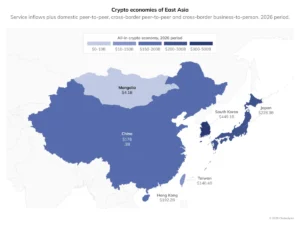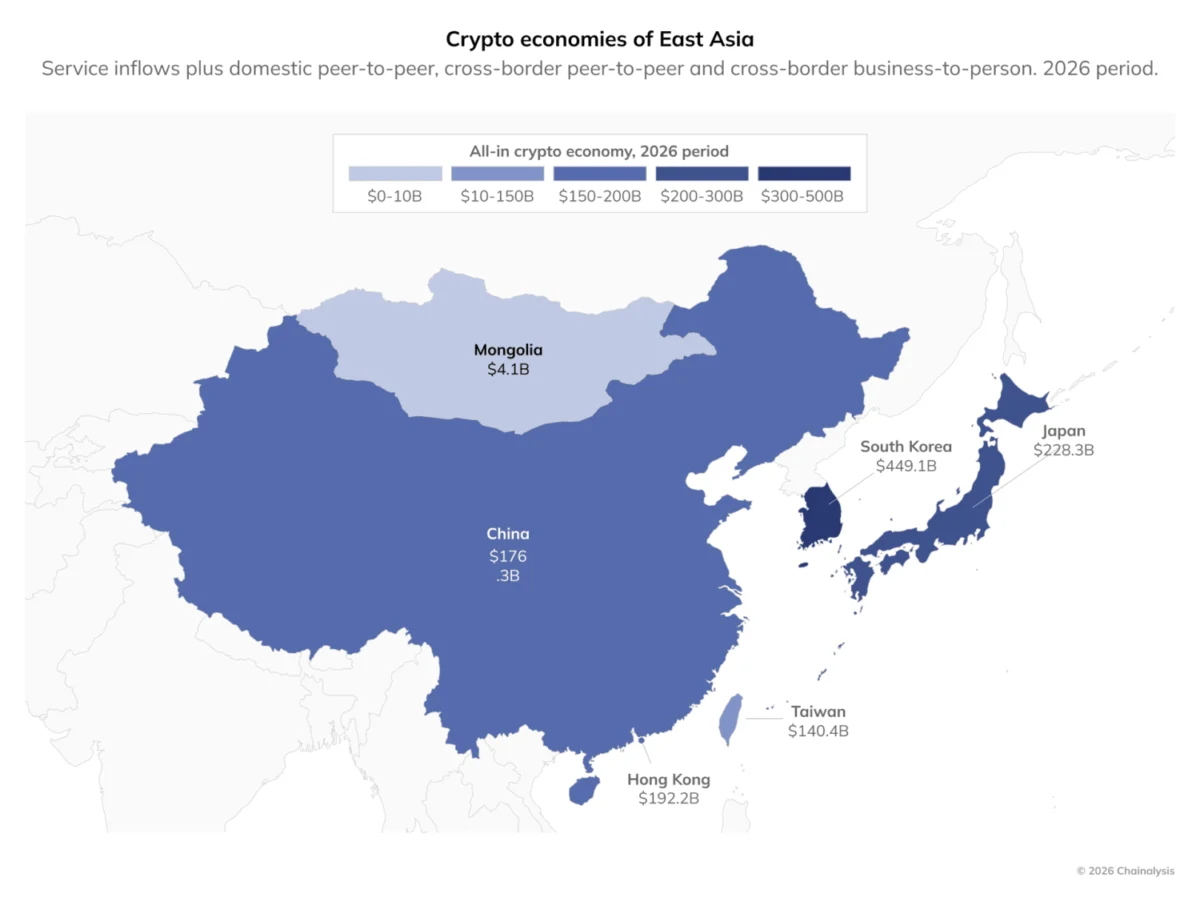
The cryptocurrency landscape in East Asia has emerged as one of the most complex and multifaceted digital asset ecosystems in the world, characterized by a sharp divergence in regulatory strategies and user behavior. Between July 2025 and June 2026, the region’s crypto economy underwent a modest contraction in line with global bear market trends; however, this topline data masks significant pockets of hyper-growth and structural evolution. While the broader market tightened, institutional platforms in Hong Kong saw an 87% surge in inflows, and South Korean retail investors pivoted aggressively toward artificial intelligence (AI)-linked assets, driving a $449 billion national crypto economy. These developments signal a shift from a purely speculative retail-driven region to a sophisticated hub where institutional firepower and grassroots adoption coexist under increasingly distinct national frameworks.

Regional Overview: A Tale of Four Markets
The East Asian crypto economy is currently defined by four distinct pillars: the retail-heavy market of South Korea, the institutional gateway of Hong Kong, the DeFi-integrated consumer market of Japan, and the resilient peer-to-peer (P2P) economy of Mainland China. Despite a global downturn, the region remains a cornerstone of the global industry, with South Korea ranking fifth in the 2026 Global Crypto Adoption Index.
The period from mid-2025 to mid-2026 saw a 12.3% year-over-year growth in South Korea’s exchange ecosystem, largely fueled by a massive influx of capital into AI-themed digital assets. In contrast, Japan’s market began to pivot toward decentralized exchanges (DEXs), where inflows rose by 36% as users sought sophisticated trading instruments. Hong Kong, meanwhile, solidified its status as the region’s "settlement layer," with institutional platforms accounting for 16% of all service inflows—nearly triple the share of any neighboring market.

South Korea: The Retail Powerhouse and the AI-Crypto Convergence
South Korea remains the largest crypto economy in East Asia, with a total valuation of $449 billion during the study period. This growth is uniquely attributed to a "retail-first" culture that frequently outpaces institutional participation. Unlike other global markets where major financial institutions lead the charge, South Korea’s growth was driven by individual traders seeking high-risk, high-reward opportunities.
The Rise of the AI Trade
A defining characteristic of the Korean market in 2026 was the thematic alignment between traditional equities and digital assets. South Korea’s mainstream stock market is heavily influenced by SK Hynix, a global leader in memory chip production essential for AI data centers. This "AI fever" spilled over into the crypto sector, where AI-focused tokens became the most popular investment category by June 2026.

Trading volume for AI cryptocurrencies in South Korea reached 19.5 times the rate seen in Japan and significantly outperformed major global currencies like the Euro and the British Pound in terms of asset-class share. The most prominent assets included:
- Worldcoin (WLD): Leading the pack with $7.41 billion in volume.
- SAHARA: A newcomer contributing $3.2 billion.
- VIRTUAL and BIO: Combined for nearly $4.7 billion in activity.
Regulatory and Tax Chronology
The South Korean market is currently in a state of transition. While the government has historically been cautious, February 2026 marked a pivotal moment when authorities began easing a long-standing ban on corporate crypto trading. Currently, every major domestic bank and securities firm has established a digital asset team, though most remain in a "preparatory mode," running pilots for stablecoins and tokenization.

A significant factor sustaining retail volume is the absence of a capital gains tax on crypto profits. Although a 22% tax has been proposed and delayed multiple times, it is currently scheduled for 2027. Experts suggest that if this tax is implemented alongside broader corporate access, the Korean market could shift from retail dominance to a more balanced institutional-retail equilibrium by 2028.
Hong Kong: The Institutional Settlement Layer
Hong Kong has successfully positioned itself as the institutional hub of East Asia, with a $192 billion crypto economy that prioritizes regulatory clarity and professional-grade services. The city’s strategic focus on stablecoins, real-world asset (RWA) tokenization, and central bank digital currencies (CBDCs) has attracted a specific class of participant: the institutional platform.

B2B Corridor and Inflow Growth
Institutional platforms, including over-the-counter (OTC) desks, custody providers, and market makers, captured 16% of Hong Kong’s service inflows in 2026. This is a significant increase from the 9% share recorded in 2024. The city received approximately $24 billion in inbound business-to-business (B2B) transfers—six times the volume of Japan and 44 times that of South Korea.
The data suggests that institutional capital is not merely passing through Hong Kong but is "settling" within its regulated perimeter. Net B2B inflows have climbed steadily since mid-2022, reaching $17.4 billion by mid-2026. This trend stands in stark contrast to unregulated wallet activity, which has seen consistent net outflows, indicating a flight to quality and compliance.

Policy Milestones
The Hong Kong government’s "Five-Year Plan" and latest Policy Address have been instrumental in this growth. By issuing the first stablecoin licenses in 2026 and initiating market testing with institutional participants, the city has provided a predictable environment for large-scale capital. As SB Seker, Head of APAC at Binance, noted, Hong Kong has demonstrated that "regulatory clarity and financial innovation can advance in parallel."
Japan: Sophisticated Traders and DeFi Integration
Japan’s $228 billion crypto economy is often characterized as conservative, yet the 2026 data reveals a highly sophisticated consumer base. While centralized exchange (CEX) activity remained flat, decentralized exchange (DEX) activity surged by over 200% since 2022.

The Perpetual Futures Trend
Japanese traders have shown a particular affinity for perpetual futures and on-chain hedging. This is largely attributed to a population well-versed in foreign exchange (FX) markets. These "power traders" utilize platforms like Hyperliquid to manage macro exposure, treating crypto venues as extensions of their broader equity and currency portfolios.
Tax Reform as a Catalyst
Historically, Japan’s growth has been hampered by a maximum marginal tax rate of 55% on crypto gains. However, a series of tax reforms advanced in July 2026 aimed at reducing this to a flat 20% rate. Local experts, including Arisa Toyosaki of Binance Japan, believe this reform will catalyze a massive shift in retail sentiment over the next 12 months, potentially unlocking billions in sidelined capital.

Mainland China: The Peer-to-Peer Shadow Economy
Despite an official ban on crypto services, Mainland China’s crypto economy remains substantial, estimated at a minimum of $176 billion. The market is almost entirely driven by peer-to-peer (P2P) flows, which accounted for 59.1% of the total economy in 2026—a 3.5-fold increase in share over the previous year.
The Social Credit System Impact
A critical turning point occurred in March 2025, when the Chinese government expanded its social credit system into the financial and internet sectors. This system, which blacklists individuals for various behavioral infractions, appears to have inadvertently pushed users toward stablecoins.

Data shows a dramatic increase in domestic stablecoin payments starting in March 2025, with monthly growth rates for transfers under $1,000 exceeding 1,000%. This suggests that individuals blacklisted from traditional banking or those seeking to avoid pervasive monitoring are utilizing stablecoins as a functional domestic payment rail.
Velocity of Money
The "velocity" of stablecoins in China—how often a unit of currency changes hands—is a remarkable 33.2 times per year. This is more than three times the global average and far higher than any of its regional peers (Japan at 9.9x, Hong Kong at 6.1x). This high turnover confirms that Chinese users treat stablecoins as working capital for commerce rather than a long-term store of value.

Chronology of Key Events (2025–2026)
- March 2025: China expands its Social Credit System, triggering a surge in domestic P2P stablecoin activity.
- July 2025: The start of the study period; global bear market pressures lead to a modest contraction in East Asian crypto inflows.
- October 2025: Japan introduces its first yen-denominated stablecoin, JPYC, aimed at international remittances.
- February 2026: South Korea begins easing the ban on corporate crypto trading; Hong Kong issues its first batch of stablecoin licenses.
- June 2026: AI-crypto assets reach peak volume in South Korea, dominating won-denominated exchange books.
- July 2026: Japan advances major tax reforms to lower the maximum rate on crypto gains to 20%.
Broader Implications and Future Outlook
The evolution of the East Asian crypto market offers a real-world case study on the impact of regulation. While China’s prohibition has merely shifted activity to unmonitored P2P channels, the supervised-access regimes in Hong Kong, Japan, and South Korea are successfully pulling activity into the licensed perimeter.
The next twelve months will be a "testing phase" for these regulatory models. In Hong Kong, the focus will be on whether the city can maintain its lead as an institutional corridor as other jurisdictions like Singapore ramp up competition. In South Korea, the 2027 tax cliff remains the primary variable for retail demand. For Japan, the success of yen-denominated stablecoins like JPYC and JPYSC will determine if the country can bridge the gap between its traditional financial system and the burgeoning on-chain economy.

As Daniel Kim, CEO of Tiger Research, concluded, Asia remains a "rare region" that possesses both the grassroots retail depth and the institutional firepower necessary to lead the next cycle of global crypto adoption. The data from 2026 suggests that while the "hype" phases of crypto may fluctuate, the structural integration of digital assets into the East Asian economy is now an irreversible trend.