The PUMP coin experienced a significant price surge on October 4, climbing by 15% to reach $0.006369. This notable upward movement was observed amidst a broader recovery across the cryptocurrency market and was closely accompanied by substantial activity from large-scale investors, often referred to as "whales." The token, which is intrinsically linked to the innovative Pump.fun platform, saw its market valuation approach an estimated $2.95 billion, positioning it as the 35th largest cryptocurrency by market capitalization among those currently tracked.
This specific rally for PUMP did not occur in isolation. The wider cryptocurrency market demonstrated a collective gain of 0.77%, pushing its total capitalization to approximately $2.9 trillion. Leading digital assets provided a strong foundation for this recovery, with Bitcoin consistently holding above the $85,000 mark. Ethereum, the second-largest cryptocurrency, traded robustly near $2,699, while XRP saw its value reach $1.50, indicating a broad-based positive sentiment returning to the digital asset landscape. A crucial element contributing to PUMP’s ascent was the discernible accumulation by whales, with on-chain analytics highlighting two distinct wallet movements totaling approximately $3.58 million. Simultaneously, the derivatives market for PUMP also saw a sharp expansion in open interest, while positive readings from the Moving Average Convergence Divergence (MACD) technical indicator reinforced a potential target price of $0.007, contingent upon the token successfully clearing immediate resistance levels and maintaining critical support.
The Anatomy of a Surge: Whale Accumulation and Strategic Moves
On-chain data provided by leading blockchain trackers offered a granular view into the significant whale activity that preceded and accompanied PUMP’s price surge. One particularly noteworthy transaction involved a wallet identified as "Netherlol." This wallet executed a substantial purchase of 383.34 million PUMP tokens, an acquisition valued at approximately $2.4 million at the time of the transaction. What made this particular move stand out to market observers was that it marked Netherlol’s first recorded purchase of PUMP in over a year, according to blockchain tracking services. Such a prolonged period of dormancy followed by a major re-entry often signals a renewed conviction in the asset’s potential from a sophisticated investor, potentially based on internal analysis or external market signals.
In a separate but equally significant development, a newly established wallet, identified by the address GnZqfY, withdrew 189.22 million PUMP tokens from the MEXC cryptocurrency exchange. This transfer was valued at approximately $1.18 million by Lookonchain, which reported the transaction roughly seven hours prior to its public update. When combined, these two distinct transactions accounted for the movement of an impressive 572.56 million PUMP tokens, with a cumulative value of approximately $3.58 million. This considerable volume of token movement naturally drew heightened attention to the ongoing trend of whale accumulation.
It is crucial, however, to differentiate the implications of these two types of transactions. Netherlol’s action represented a direct purchase, indicating fresh buying pressure being injected into the market. This directly contributes to demand and can exert upward pressure on price. Conversely, the withdrawal from an exchange by GnZqfY, while also a large movement, carries a different set of implications. An exchange withdrawal merely relocates tokens that may have been acquired earlier. While it reduces the supply of PUMP available for immediate trading on that specific exchange, potentially creating scarcity, it does not necessarily represent new buying. Holders typically move assets into private custody for various reasons, including long-term holding strategies, participation in decentralized finance (DeFi) protocols, or simply for enhanced security. These tokens are not permanently removed from circulation and can be transferred back to an exchange at a later date.
While the PUMP coin price advanced concurrently with these reported wallet movements, it is important for analysts to exercise caution in establishing a direct causal connection. On-chain data primarily reveals the what and when of transactions, but rarely the why. For instance, Lookonchain did not provide insights into Netherlol’s specific motivations for returning to the market after a year, nor did it disclose the intended holding period for either wallet’s tokens. Nevertheless, the sheer scale of these transfers undeniably contributes to market sentiment and liquidity dynamics. Continued, sustained whale accumulation, particularly in the form of direct purchases, could indeed underpin demand and support future price advances for PUMP. However, these two reported transactions alone, without a broader pattern of persistent accumulation, cannot singularly explain the more extensive market recovery witnessed across the crypto landscape.
Broader Market Context: A Rising Tide Lifts All Boats?

The PUMP coin’s impressive rally unfolded against a backdrop of a broadly resurgent cryptocurrency market. The overall market capitalization, which had been fluctuating, saw a healthy increase, reaching approximately $2.9 trillion. This aggregate growth underscores a renewed confidence among investors, likely fueled by a confluence of macroeconomic factors, evolving regulatory landscapes, and anticipation of future industry developments.
Bitcoin, as the undisputed market leader and a key indicator for the entire crypto ecosystem, played a pivotal role in setting the positive tone. Its ability to maintain a strong position above $85,000 signaled robust underlying demand and resilience against potential downward pressures. Bitcoin’s price stability and upward momentum often act as a psychological anchor for altcoins, instilling confidence that allows capital to flow into other digital assets. Similarly, Ethereum, the foundational blockchain for numerous decentralized applications and the second-largest cryptocurrency, trading near $2,699, demonstrated continued strength. Ethereum’s performance is often seen as a barometer for the health of the DeFi and NFT sectors, and its sustained value indicates ongoing utility and developer activity.
XRP’s climb to $1.50 is also notable, though its price movements are often influenced by specific legal developments concerning Ripple Labs, rather than solely broader market trends. Positive news or perceived progress in its ongoing legal challenges can often trigger significant rallies for XRP, attracting a dedicated base of investors. The simultaneous positive performance of these major cryptocurrencies suggests a systemic improvement in market sentiment, moving beyond isolated asset-specific rallies. This "rising tide lifts all boats" scenario creates a fertile ground for smaller, more volatile assets like PUMP to experience accelerated gains, especially when coupled with specific catalysts like whale activity. Analysts often point to factors such as anticipation of future Bitcoin halving events, growing institutional adoption, and increasing clarity in regulatory frameworks as potential drivers for this broader market recovery.
Understanding PUMP: The Phenomenon of a Platform Token
To fully grasp the significance of PUMP’s recent performance, it is essential to understand its origins and purpose within the crypto ecosystem. PUMP is associated with Pump.fun, a novel and increasingly popular platform designed to facilitate the rapid and "fair" launch of new cryptocurrencies, particularly memecoins. Launched with the explicit goal of democratizing token creation, Pump.fun allows users to deploy new tokens without the need for initial liquidity, pre-sales, or complex coding knowledge. Instead, liquidity is built directly into the token’s bonding curve as users buy and sell, providing a transparent and often more accessible launch mechanism compared to traditional methods.
The platform gained significant traction, especially within the Solana ecosystem, by addressing common pain points associated with new token launches, such as "rug pulls" (where developers abandon a project and steal investor funds) and unfair distribution. Pump.fun aims to mitigate these risks by ensuring that every token launched on its platform has inherent liquidity from its inception, which grows with trading activity. The "PUMP coin" itself, as referred to in the market data, is understood to be a specific token that has gained prominence, likely either as a governance token for the Pump.fun platform or as a highly successful memecoin launched on the platform, garnering significant attention due to its association. Given the context of its market capitalization and trading activity, it functions as a distinct tradable asset whose value is often tied to the success and visibility of the underlying Pump.fun platform and the broader memecoin phenomenon it represents.
The speculative nature inherent to memecoins means that tokens associated with launchpads like Pump.fun are often subject to rapid price swings driven by community sentiment, social media trends, and, crucially, large-scale investor movements. The platform’s unique model, while promoting fairer launches, does not entirely negate the inherent volatility and risk associated with speculative assets. PUMP’s positioning within this dynamic segment of the market makes it highly susceptible to narratives and momentum, a factor that whale accumulation can significantly amplify.
Derivatives Market Activity: Fueling Volatility and Price Discovery
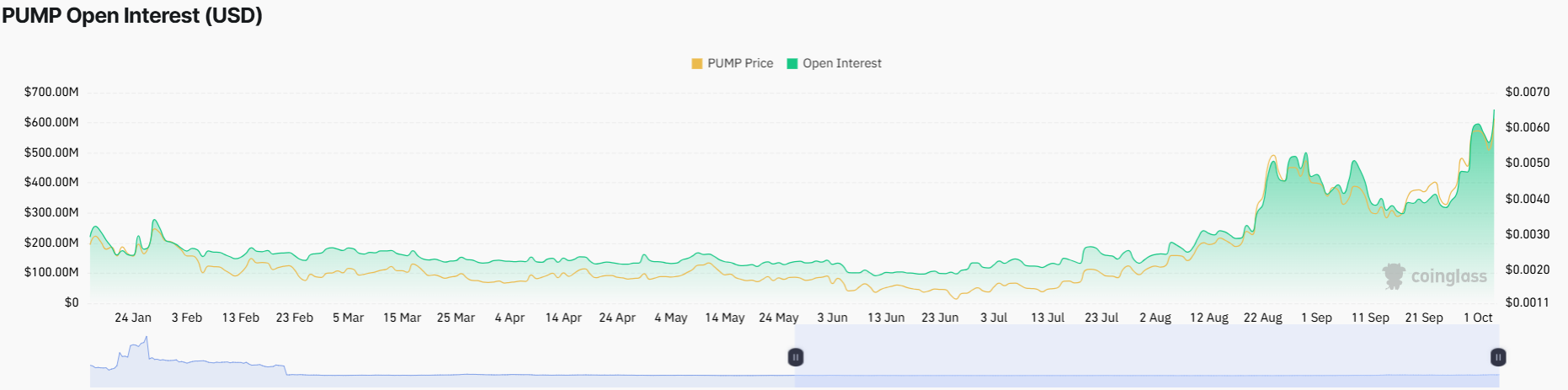
The PUMP coin’s price surge was not solely a function of spot market trading and whale accumulation; the derivatives market also played a critical role, indicating a heightened level of speculative interest and contributing to price discovery. Data from CoinGlass, a leading crypto derivatives analytics platform, revealed a significant increase in PUMP’s open interest (OI), which surged by 25.77% to reach an impressive $669.62 million. Open interest represents the total number of outstanding derivatives contracts (such as futures or options) that have not yet been settled or closed. A substantial increase in OI typically signals a growing influx of new capital into the derivatives market for that asset, indicating increased speculative activity and a potentially stronger conviction among traders regarding future price movements.
Accompanying this rise in open interest, derivatives trading volume for PUMP also saw a notable uptick, increasing by 3.64% to approximately $1.08 billion over the reported period. High trading volume in the derivatives market often indicates robust liquidity and active participation, further confirming the intense interest surrounding PUMP. This heightened activity in both OI and trading volume suggests that a significant portion of the market was positioning itself for further price action, either through long (buy) or short (sell) contracts.
The liquidation data further underscored the volatility and rapid price movements. Initially, CoinGlass figures indicated liquidations totaling $390,000, with short positions accounting for the majority of these losses. Liquidations occur when a trader’s leveraged position is forcibly closed by an exchange because their collateral falls below a required maintenance margin, usually due to adverse price movements. When short positions are liquidated, it means traders betting on a price decline were forced to buy back the asset to cover their positions, thereby adding to the buying pressure and potentially accelerating the price rally—a phenomenon often referred to as a "short squeeze." A subsequent check by CoinGlass within a 24-hour period showed an even more substantial amount, approximately $3.22 million, in liquidations across all positions for PUMP. This larger figure indicates significant market volatility, catching both long and short traders off guard at various points, but with the initial data highlighting short positions bearing the brunt of the losses during the upward price movement. The interplay between the spot market, where whales were accumulating, and the derivatives market, where speculative bets were being placed and liquidated, created a powerful feedback loop that amplified PUMP’s price surge.
Technical Outlook: Navigating Resistance and Support
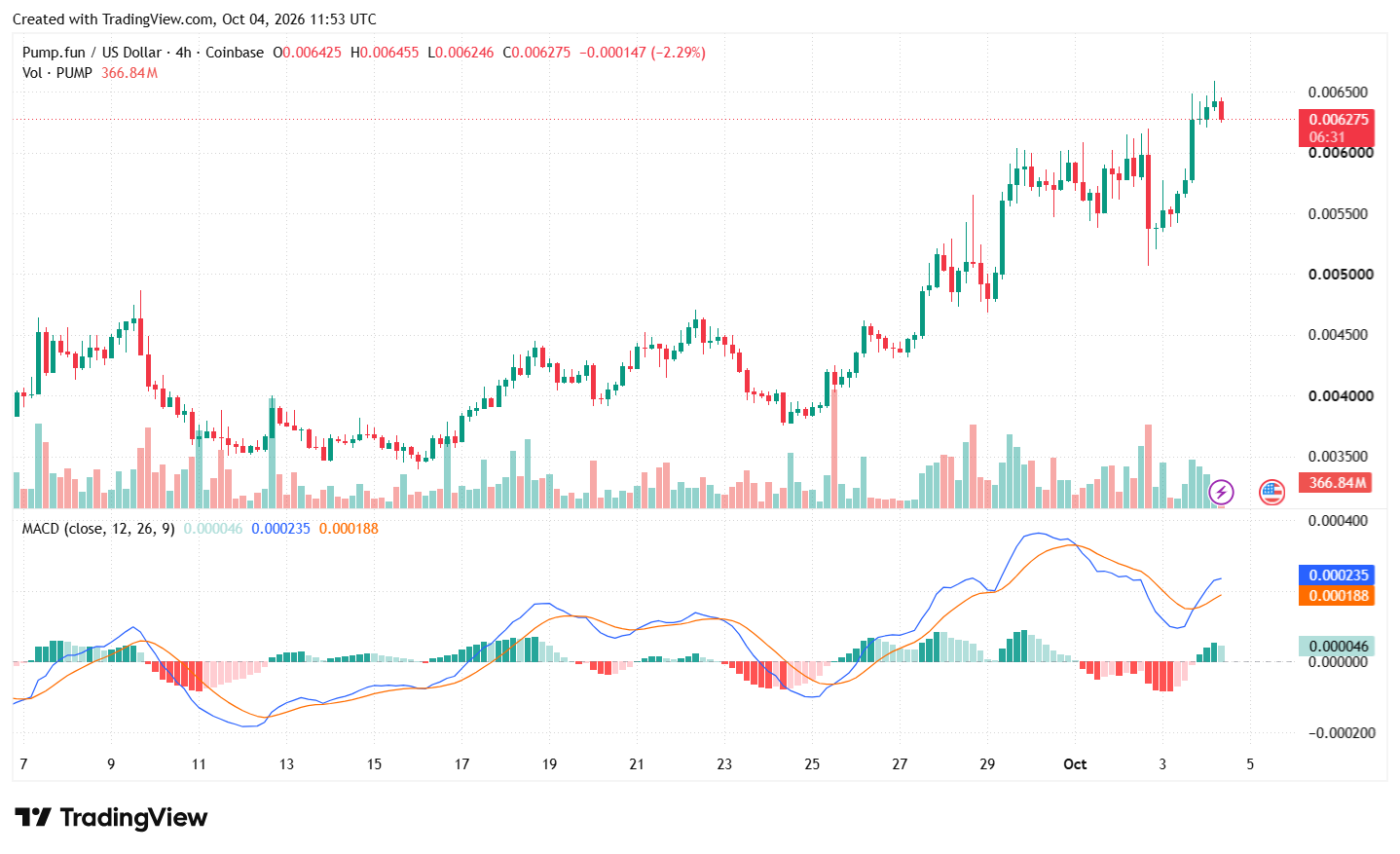
From a technical analysis perspective, the PUMP coin’s price action on the four-hour timeframe presented a constructive picture, maintaining a rising channel and recovering effectively to the area around $0.006. Technical indicators provided further insights into the token’s momentum and potential future trajectory. The Relative Strength Index (RSI), a momentum oscillator that measures the speed and change of price movements, stood at 65.77. This reading is typically considered strong, indicating robust buying pressure, but it remains below the conventional overbought threshold of 70, suggesting that there might still be room for further upward movement before the asset becomes excessively stretched.
The Moving Average Convergence Divergence (MACD) indicator also presented a bullish signal. The MACD line was measured at 0.000241, successfully exceeding the signal line, which was at 0.000189. This crossover is a classic bullish indicator, suggesting that short-term momentum is accelerating faster than long-term momentum. Furthermore, the MACD histogram, which represents the divergence between the MACD line and the signal line, registered a positive value of 0.000052. A positive and expanding histogram indicates strengthening bullish momentum following a recent decline, confirming the upward trend.
These technical readings, while supportive of a constructive interpretation, come with the inherent caveat that momentum indicators alone cannot definitively confirm the continuation of a breakout. They provide probabilistic insights, not guarantees. For PUMP to sustain its upward trajectory, it must successfully navigate key resistance levels. Immediate resistance was identified near $0.00655. A sustained move and close above this nearer barrier would significantly strengthen the case for a further advance towards the more psychologically and technically significant $0.007 level. From its price of $0.006369 on October 4, reaching the $0.007 target would require an additional increase of approximately 9.91%.
Conversely, failure to clear the immediate resistance at $0.00655 could see the PUMP coin price revisit the critical support level at $0.006. This level aligns with the bottom of the established rising channel, making it a crucial zone for bulls to defend. A decisive break below $0.006 and the ascending channel would signal a weakening of the current bullish structure, potentially exposing the token to a retest of its recent rebound area around $0.0055. Traders and investors will be closely monitoring these levels for confirmation of either continued upward momentum or a potential correction.
Implications and Future Trajectory
The recent 15% surge in PUMP coin’s price, driven by significant whale activity and a recovering broader market, carries multiple implications for investors and the wider cryptocurrency ecosystem. In the short term, the renewed interest from large wallet holders could foster a positive sentiment feedback loop, attracting more retail investors and generating further buying pressure. The robust technical indicators, coupled with expanding derivatives interest, suggest that PUMP might have the momentum to test higher resistance levels. However, the inherent volatility of tokens associated with memecoin platforms means that these gains can be ephemeral. Investors who entered at higher price points during previous rallies might view the current surge as an opportunity to exit, potentially capping further significant upside in the near term.
For the long term, the sustainability of PUMP’s value will likely depend on several factors beyond mere speculative interest. The continued innovation and adoption of the Pump.fun platform itself will be crucial. If Pump.fun successfully expands its utility beyond purely memecoin launches or introduces new features that enhance its value proposition, it could provide a more fundamental basis for PUMP’s price. However, the memecoin market segment is notoriously fickle, often driven by fleeting trends and social media hype. The "whale accumulation" observed, while bullish in the short term, also highlights the potential for concentrated ownership to influence price swings, raising concerns about market manipulation or "pump-and-dump" schemes. Retail investors entering such markets should exercise extreme caution, conducting thorough due diligence and understanding the high risks involved.
The broader impact of such rallies on the cryptocurrency market is mixed. On one hand, it demonstrates the vibrant and dynamic nature of the digital asset space, attracting new participants and showcasing the potential for rapid wealth creation. On the other hand, the speculative nature of memecoins and platform tokens like PUMP can sometimes draw regulatory scrutiny, especially concerning investor protection and market integrity. Regulators globally are increasingly looking at ways to supervise decentralized platforms and the assets launched on them, and significant price volatility often serves as a trigger for such attention. The continued performance of PUMP will therefore be a litmus test for how such platform-related tokens can navigate both market dynamics and an evolving regulatory landscape.
Concluding Remarks
The PUMP coin’s impressive 15% rally on October 4th, underpinned by substantial whale activity and a supportive wider market recovery, marks a significant moment for the token and its associated Pump.fun platform. The confluence of large-scale investor purchases, increased derivatives market engagement, and positive technical signals paints a picture of renewed optimism and speculative interest. While the immediate outlook appears constructive, with potential targets around $0.007 in focus, the journey ahead remains conditional on overcoming key resistance levels and maintaining crucial support.
The events of October 4th serve as a vivid reminder of the multifaceted forces that drive cryptocurrency prices – from on-chain whale movements to broader market sentiment and the intricate dance of technical indicators. As the PUMP coin navigates these dynamics, market participants will be keenly observing whether this surge represents a sustainable upward trend or a temporary spike within a highly volatile asset class. The ultimate trajectory of PUMP will depend on the sustained interest from its community, the ongoing utility and innovation of the Pump.fun platform, and the broader health and regulatory evolution of the cryptocurrency market itself. Investors are advised to remain vigilant, employing robust risk management strategies in this exciting yet unpredictable segment of the digital economy.