
BNB, the native utility token of the Binance ecosystem and the primary gas token for the BNB Chain, has once again solidified its position as a dominant force in the digital asset landscape. After successfully reclaiming its position in the upper echelons of the market by overtaking XRP in total valuation during the second quarter of the year, the narrative surrounding the token has shifted from short-term recovery to long-term price discovery. While the asset has demonstrated remarkable resilience in the face of regulatory scrutiny and leadership transitions, a new wave of technical and fundamental analysis is challenging the feasibility of "moonshot" price targets. While some enthusiasts suggest a trajectory toward $10,000 or even $20,000 per token, seasoned market analysts are highlighting the staggering mathematical and macroeconomic hurdles that must be cleared for such valuations to become a reality.
The current market sentiment for BNB is characterized by a blend of cautious optimism and structural ambition. As it stands, BNB maintains a market capitalization of approximately $80.6 billion, securing its spot as the fourth-largest cryptocurrency by market cap, trailing only Bitcoin, Ethereum, and the stablecoin USDT. However, to understand where the token is going, one must first reconcile its current valuation with the ambitious projections circulating within the analyst community.
The Mathematical Reality of a Five-Figure BNB
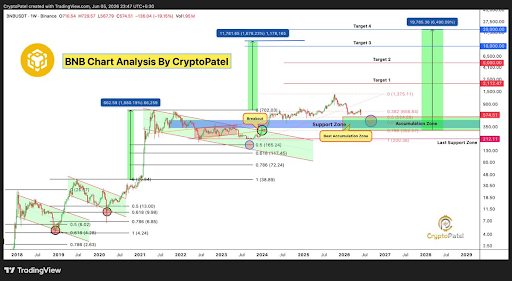
Crypto Patel, a prominent analyst whose technical breakdowns frequently circulate on social media, recently provided a comprehensive overview of the price ceilings for BNB. The core of this analysis rests on the relationship between token supply and market capitalization. BNB operates under a unique deflationary mechanism, where the total supply is intended to eventually reach a cap of 100 million tokens through a series of quarterly "burns" and real-time transaction fee destructions.
At a projected supply of 100 million tokens, a price target of $10,000 per BNB would imply a total market capitalization of $1 trillion. To put this into perspective, a $1 trillion valuation is roughly equivalent to the current market capitalization of Bitcoin, the world’s first and most dominant cryptocurrency. For BNB to reach this milestone, it would essentially need to capture the same level of global capital allocation and institutional trust that Bitcoin has spent over a decade cultivating.

The analysis becomes even more complex when considering the $20,000 price target. At this level, BNB would command a $2 trillion market capitalization. This figure currently exceeds the combined valuation of the entire cryptocurrency market, including Bitcoin, Ethereum, and thousands of altcoins. For a single utility token to reach such a height, the total crypto market would likely need to expand into the tens of trillions of dollars, a scenario that requires massive global adoption, the integration of blockchain into mainstream finance, and a significant devaluation of fiat currencies. Patel warned investors that near-term targets of $20,000 are often the product of marketing rather than objective financial analysis, suggesting that such valuations are unlikely to be reached before 2029 at the earliest.
The Competitive Landscape: Overtaking Ethereum
The immediate hurdle for BNB is not $10,000, but rather the gap between itself and Ethereum. Since mid-May, BNB has widened its lead over XRP, but Ethereum remains a formidable second-place contender. The "flippening"—a term used to describe one asset overtaking another in market cap—between BNB and Ethereum is a frequent topic of debate.
Under current market conditions, for BNB to match Ethereum’s valuation of approximately $203 billion, the price of BNB would need to climb to roughly $1,500. This target is within the realm of possibility, as it sits near the token’s previous all-time high zones. However, this comparison assumes that Ethereum’s price remains stagnant. In a bullish market environment, where BNB is surging toward new highs, Ethereum is historically likely to experience a correlated rise. Therefore, for BNB to actually flip Ethereum, it would need to significantly outperform the broader market, driven by a unique catalyst such as a massive migration of developers from Ethereum to the BNB Chain or a significant regulatory advantage.
Historical Context and the Evolution of BNB
To understand the current valuation of BNB, one must look back at its evolution. Launched in 2017 through an Initial Coin Offering (ICO), BNB was originally an ERC-20 token on the Ethereum network, designed to provide fee discounts to users of the Binance exchange. Its initial price was a mere $0.15. The launch of the Binance Chain in 2019 and the subsequent Binance Smart Chain (BSC) in 2020 transformed the asset from a simple exchange voucher into a foundational layer for decentralized finance (DeFi).
The "DeFi Summer" of 2020 and 2021 served as a major tailwind for BNB. As Ethereum struggled with high gas fees and network congestion, the BNB Chain offered a faster, cheaper alternative. This led to an explosion of decentralized applications (dApps), yield farming protocols, and NFT marketplaces on the network, driving the price of BNB to an all-time high of approximately $1,370 in late 2021. This historical peak proved that BNB could command a market cap nearing $200 billion, providing a blueprint for its potential return to those levels.

The Binance Concentration Risk
Despite the technical strengths of the BNB Chain, analysts point to a significant structural risk: the concentration of the token’s value within the Binance ecosystem. Unlike Bitcoin, which is decentralized and lacks a single point of failure, or Ethereum, which has a diverse ecosystem of independent developers and foundations, BNB’s value drivers are almost entirely adjacent to the Binance exchange.
The burn mechanism is funded by Binance’s profits; the token’s primary utility is within the Binance exchange; and the BNB Chain, while technically decentralized through its validator set, remains heavily influenced by the exchange’s infrastructure and institutional custody services. This creates a "concentration risk" where any legal or regulatory challenges faced by Binance directly impact the price of BNB.
The industry saw this play out in 2023 and early 2024 when Binance navigated a multi-billion dollar settlement with the U.S. Department of Justice and the resignation of its founder, Changpeng "CZ" Zhao. While the transition to new leadership under Richard Teng has been viewed as a step toward institutional maturity, the market remains sensitive to the "Binance premium." Any future regulatory headwinds in major markets like the United States or the European Union could act as a ceiling on BNB’s price growth, regardless of its technical utility.
Supply Dynamics and the Burn Mechanism
A critical factor in the long-term price appreciation of BNB is its aggressive deflationary policy. The token utilizes two distinct burn mechanisms:
- The Auto-Burn: A quarterly event where Binance uses a portion of its profits to buy back and destroy BNB tokens. The amount is determined by a formula based on the price of BNB and the number of blocks produced on the BNB Chain during the quarter.
- BEP-95: A real-time burning mechanism introduced in late 2021 that destroys a portion of the gas fees spent on the BNB Chain. This ensures that as network activity increases, the rate of token destruction also increases.
This supply-side pressure is what makes the $2,000 to $3,000 price targets appear realistic to many analysts. If the total supply continues to shrink while demand for the BNB Chain’s ecosystem grows—particularly through the tokenization of Real World Assets (RWAs), which recently hit a $3 billion valuation on the chain—the fundamental value per token must logically rise.
Institutional Adoption and the ETF Horizon
The prospect of institutional investment remains the "wild card" for BNB’s valuation. Recent amendments by major asset managers like Grayscale and VanEck regarding potential altcoin ETFs have fueled speculation that a BNB-based exchange-traded fund could eventually reach the market. While Bitcoin and Ethereum have already crossed the ETF finish line in the U.S., the path for BNB is more complex due to the aforementioned concentration risk and the SEC’s historical stance on exchange-affiliated tokens.
However, if a BNB ETF were to be approved, it would provide a conduit for trillions of dollars in traditional institutional capital to flow into the asset. This institutional "wall of money" is often cited as the only realistic way for BNB to reach the $10,000 mark, as it would shift the asset from a retail-driven utility token to a standard component of institutional portfolios.
Conclusion: A Measured Outlook
The consensus among professional analysts is that while BNB has a clear path to reclaiming its all-time highs and potentially reaching the $2,000 to $3,000 range in the next market cycle, the five-figure targets remain speculative. Reaching $10,000 or $20,000 would require a fundamental shift in the global financial system, where the total cryptocurrency market cap expands by several orders of magnitude.
For investors, the narrative of BNB is one of utility and resilience. Its ability to maintain its top-five ranking despite immense regulatory pressure is a testament to its deeply embedded role in the crypto economy. However, as Crypto Patel and others suggest, the math of market capitalization provides a sobering reality check to the more exuberant corners of the market. The journey of BNB from here will likely be defined by how well it can decouple from exchange-specific risks and establish itself as an indispensable layer of the global decentralized infrastructure. For now, the focus remains on the $1,500 to $2,000 horizon—a goal that is both ambitious and, based on historical data, entirely within the realm of possibility.