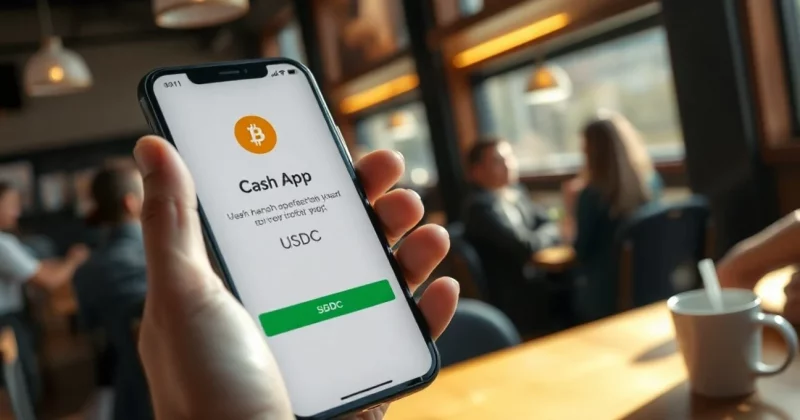
Cash App, a prominent financial services platform operated by Jack Dorsey’s Block Inc., has officially entered the stablecoin payments arena, marking a significant milestone for consumer adoption of digital assets. As of May 27th, the company commenced a phased rollout of USD Coin (USDC) send-and-receive functionality to approximately 15 million of its nearly 60 million monthly active users, representing a substantial quarter of its user base. This integration, which leverages the high-speed and low-cost Solana blockchain, allows users to instantly convert USDC into their existing U.S. dollar Cash Balance within the app, effectively blurring the lines between traditional fiat currency and stable digital assets for everyday transactions.
The strategic move positions Cash App as one of the largest consumer-facing platforms to embrace stablecoin payments, signaling a growing mainstream acceptance of cryptocurrencies beyond speculative trading. This development not only expands Cash App’s digital asset offerings but also has profound implications for the Solana ecosystem, the stablecoin market, and the broader fintech landscape.
How the Integration Transforms User Experience
At its core, the Cash App-Solana integration is designed for unparalleled user simplicity. Each Cash App user is assigned a unique blockchain deposit address specifically for USDC transactions. This innovative approach means that individuals outside the Cash App ecosystem can directly send USDC to a Cash App account using any standard Solana-compatible wallet. The seamlessness of the process is further amplified by the app’s automated conversion mechanism. Upon receiving USDC, it is instantly converted to the user’s U.S. dollar Cash Balance, eliminating the need for users to manage separate cryptocurrency wallets, navigate complex cross-chain bridges, or worry about volatile gas fees that have historically plagued blockchain transactions, particularly on more congested networks.
Block’s decision to select Solana as the settlement layer for this groundbreaking feature was a deliberate choice driven by the blockchain’s inherent strengths. Solana is renowned for its exceptional transaction speeds and remarkably low transaction costs. In contrast, the fluctuating and often prohibitive fees on the Ethereum mainnet, especially during periods of high network congestion, would render small, everyday payments economically unfeasible. Solana’s transaction costs, which typically hover below a single cent, effectively democratize micropayments, making them a viable reality for a platform with Cash App’s scale.
The rollout, which began this week, is projected to achieve full availability for all eligible users by the end of the current week. This rapid expansion from the initial 25% user cohort to the broader Cash App user base underscores Block’s commitment to swift and efficient deployment of new functionalities.
From Bitcoin Pioneer to a Comprehensive Digital Asset Suite
Cash App’s journey into digital assets began years ago with its robust support for Bitcoin (BTC). Users have been able to buy, sell, and utilize Bitcoin for payments, notably through the Lightning Network, a layer-two scaling solution that enables faster and cheaper Bitcoin transactions. The addition of USDC represents a significant and deliberate strategic evolution for the platform. While Bitcoin serves as an excellent store of value and a popular speculative asset, its inherent price volatility can present challenges for everyday payment scenarios. Sending a precise $50 to a friend using Bitcoin might involve anxieties about price fluctuations between the moment the transaction is initiated and when it is received and confirmed, a concern that is largely mitigated by stablecoins.
USDC, issued by Circle and backed by a consortium of financial institutions, is pegged at a 1:1 ratio to the U.S. dollar. Its stability is underpinned by reserves comprising cash and short-dated U.S. Treasuries, ensuring its value remains consistent with the dollar. This stability makes it an ideal medium for transactions where predictable value is paramount.
Block first unveiled its ambitious plans for stablecoin integration in November 2025. At that time, the company outlined its intention to introduce USDC support on the Solana blockchain, alongside enhancements to its existing Bitcoin payment features. The current May rollout effectively delivers on that roadmap, aligning closely with the timeline Block initially projected for a launch in early 2026. This measured yet consistent approach to product development demonstrates Block’s strategic foresight in navigating the evolving digital asset landscape.
Implications for Investors and the Broader Market
The integration of stablecoin payments by a platform with nearly 60 million monthly active users carries substantial downstream effects across the digital asset ecosystem. Solana, in particular, is poised to experience a potentially dramatic surge in transaction volume as Cash App scales its USDC payment capabilities across its entire user base. This influx of activity could solidify Solana’s position as a leading blockchain for consumer-facing applications and decentralized finance (DeFi) services.
For Circle, the issuer of USDC, this partnership is equally consequential. The integration with Cash App has the potential to significantly boost USDC’s circulation and daily transaction volume, thereby strengthening its competitive standing against other major stablecoins, most notably Tether’s USDT, in the fiercely contested stablecoin market. As consumers become more accustomed to using USDC for everyday transactions, its utility and adoption are likely to grow, further solidifying its role in the global digital economy.
Block itself stands to unlock new revenue streams through this stablecoin initiative. Potential revenue opportunities include conversion spreads on currency exchanges, transaction fees, or even yield generated from the USDC reserves held on behalf of its users. Cash App’s existing Bitcoin trading services already contribute substantially to Block’s revenue, and the addition of stablecoin services offers a complementary and potentially lucrative avenue for growth.
The trend of established financial and payment giants embracing stablecoins is becoming increasingly evident. PayPal launched its own stablecoin, offering its vast user base a gateway into digital currencies. Stripe, another major payment processor, acquired the stablecoin infrastructure company Bridge, signaling its commitment to facilitating stablecoin payments. Now, Cash App’s routing of consumer transactions through Solana further underscores this industry-wide pivot towards integrating digital assets into mainstream financial services.
However, as with any innovation in the rapidly evolving cryptocurrency space, regulatory uncertainty remains a significant factor. The legislative landscape surrounding stablecoins in the United States is still in flux. Any future regulatory framework could introduce new requirements that fundamentally alter the economics of offering such services. The potential for stablecoins to disrupt legacy remittance services, which typically charge fees ranging from 5% to 10%, is substantial. Companies like Western Union, a long-standing player in the remittance market, could face increasing competition from more efficient and cost-effective stablecoin-based solutions. The successful integration of stablecoins by platforms like Cash App paves the way for a future where cross-border payments and remittances become significantly more accessible and affordable for millions globally.
A Deeper Dive into the Technology and User Benefits
The underlying technology facilitating this seamless experience is worth further examination. Solana’s architecture, which employs a unique Proof-of-History (PoH) consensus mechanism in conjunction with Proof-of-Stake (PoS), allows for exceptionally high transaction throughput. This means that the network can process thousands of transactions per second, a critical factor for a platform like Cash App that handles millions of users and a high volume of daily transactions. The low transaction fees, often referred to as "gas fees" in the blockchain context, are a direct consequence of this efficient network design and high capacity.
For the end-user, the benefits are manifold. The elimination of complex wallet management simplifies the user journey, making it accessible to individuals who may not have prior experience with cryptocurrency. The automatic conversion of USDC to USD ensures that users always see and interact with familiar dollar amounts, mitigating the perceived complexity and risk associated with volatile digital assets. This "set it and forget it" approach to stablecoin payments is a crucial step in demystifying cryptocurrency for the average consumer.
The strategic decision to integrate with Solana also highlights a growing trend of platform diversification within the blockchain space. While Ethereum has long been the dominant force in smart contract platforms, its scaling challenges have created opportunities for alternative blockchains like Solana, Avalanche, and Polygon. By choosing Solana, Block is not only capitalizing on its technological advantages but also contributing to the growth and decentralization of the broader blockchain ecosystem.
Furthermore, the integration provides a powerful use case for USDC beyond its established role in decentralized finance. USDC’s utility as a stable, digital dollar is now being demonstrated in a mainstream consumer payment context, potentially increasing its adoption and recognition among a wider audience. This expansion of utility could lead to greater demand for USDC, further solidifying its position as a leading stablecoin.
The Future of Payments: A Block Perspective
Block’s move into stablecoin payments reflects a broader vision for the future of financial services, one that embraces digital assets as an integral component of the payment landscape. The company, under Jack Dorsey’s leadership, has consistently demonstrated a commitment to innovation in financial technology, from its early adoption of Bitcoin to its current exploration of stablecoins.
The company’s strategic focus appears to be on building an inclusive financial ecosystem that offers a range of services catering to diverse user needs. By integrating stablecoins, Cash App is not only expanding its product offering but also positioning itself to capitalize on the growing demand for digital asset solutions. This move is consistent with the broader trend of fintech companies seeking to bridge the gap between traditional finance and the burgeoning world of cryptocurrencies.
The success of this integration will likely depend on several factors, including continued user adoption, ongoing technological advancements on the Solana blockchain, and the evolving regulatory environment. However, the initial rollout and the company’s proactive approach suggest a strong conviction in the potential of stablecoin payments to reshape the consumer finance landscape. As Cash App continues to roll out this feature to its entire user base, the real-world impact and adoption rates will be closely watched by industry observers and competitors alike. The implications are far-reaching, potentially setting a new standard for how consumers interact with and utilize digital currencies in their daily financial lives.
The journey from a Bitcoin-centric platform to a comprehensive digital asset suite underscores Block’s adaptability and forward-thinking strategy. By embracing stablecoins and leveraging the efficiency of the Solana blockchain, Cash App is not just keeping pace with innovation; it is actively shaping the future of consumer payments. This development marks a pivotal moment, signaling that stablecoins are moving beyond niche applications and into the mainstream of everyday financial transactions.
This article was edited by Editorial Team. For more information on how we create and review content, see our Editorial Policy.