ZIG Finance, an evolving financial technology firm, and World Liberty Financial, a key player in the stablecoin market, have announced a strategic partnership aimed at revolutionizing cross-border payments by deploying the USD1 stablecoin to finance global remittances. This collaboration marks a significant step in integrating digital assets into real-world economic activities, addressing critical liquidity challenges faced by money transfer businesses worldwide.
The inaugural product stemming from this partnership is a specialized PayFi Vault hosted on Concrete, a platform designed for real-world asset (RWA) vaults. This vault is engineered to provide short-term liquidity to money-transfer businesses (MTOs) facilitating the complex flow of remittances between various countries. The alliance is particularly noteworthy, not merely for its utilization of a stablecoin, but for the strategic positioning and evolution of ZIG, which began its journey in 2018 as Zignaly, a social platform enabling retail users to mirror experienced traders, and has since transformed into a regulated-products business. This pivot underscores a deliberate strategy to leverage its expertise in structuring and distributing investment opportunities for institutional-grade applications.
The Global Remittance Landscape and the Need for Innovation
The global remittance market is a colossal industry, with the World Bank reporting that remittances to low- and middle-income countries alone reached an estimated $667 billion in 2023. This vital flow of funds, often from migrant workers to their families in their home countries, underpins economic stability and development across many regions. However, the process of sending and receiving these funds is frequently plagued by inefficiencies, including high transaction fees, slow settlement times, and reliance on traditional banking hours that do not align with a globalized, 24/7 economy.
Money transfer operators (MTOs) are the backbone of this system, but they routinely encounter a critical operational challenge: the need for ready cash to pre-fund transfers before the actual settlement occurs. This liquidity gap often necessitates short-term funding solutions, which can be costly and cumbersome using conventional financial instruments. Traditional banking rails, with their fixed operating hours and geographical limitations, further complicate the swift and economical movement of funds, especially across diverse time zones and regulatory environments. This inherent friction leads to higher operational costs for MTOs, which are often passed on to the end-users in the form of elevated fees or less favorable exchange rates.
Deep Dive: The ZIG and World Liberty Financial Partnership
At the core of this innovative partnership, ZIG Markets, the distribution arm of the ZIG group, assumes a pivotal role. It is responsible for originating, structuring, and distributing the investment opportunities that underpin the PayFi Vault. USD1, World Liberty Financial’s stablecoin, serves as the fundamental settlement and treasury layer for the entire program. The PayFi Vault’s initial deployment specifically targets the financing of short-duration payment and remittance flows, offering a dynamic solution to the MTOs’ liquidity needs. ZIG views this as merely the initial phase, envisioning a broader suite of products where USD1 can transition from idle stablecoin liquidity into active, real economic engagement and seamlessly return, generating returns along the way.

A spokesperson for ZIG emphasized the strategic significance of this partnership, stating, "Our collaboration with World Liberty Financial is a testament to ZIG’s commitment to bridging the gap between innovative digital finance and tangible economic impact. We are leveraging our expertise in structuring financial products to unlock the inherent efficiency of stablecoins, particularly USD1, for a critical global service like remittances. This initiative not only addresses a significant pain point for MTOs but also sets the stage for a new paradigm in how capital flows through the digital economy."
World Liberty Financial, for its part, highlighted the expanded utility of USD1. "USD1 was designed for robust, efficient, and transparent financial transactions," a representative noted. "Partnering with ZIG allows us to extend its application into real-world financial infrastructure, directly supporting the operational needs of global money transfer businesses. This move validates USD1’s potential as a stable, reliable asset for powering international commerce and humanitarian aid, ultimately contributing to a more inclusive and efficient global financial system."
Operational Mechanics: How the PayFi Vault Functions
The PayFi Vault on Concrete operates by lending short-term liquidity to MTOs. These operators, needing cash on hand to initiate transfers before final settlement, can now access capital from the vault. The inherent advantages of stablecoin capital for this purpose are manifold: it operates around the clock, independent of traditional banking hours in either the sending or receiving country, enabling 24/7 liquidity. This continuous availability drastically reduces delays and allows MTOs to execute transactions with greater speed and efficiency. As the short-term flows settle, the capital seamlessly returns to the vault, ready to be redeployed, thus earning a consistent return for the liquidity providers.
The immediate impact on the end-user – the individual sending money or the merchant receiving payment – is indirect. The current announcement does not suggest the introduction of a new application or a change in existing fee structures at the user interface level. However, the intended effect is upstream: by enabling operators to pre-fund transfers more cheaply and consistently, the partnership aims to reduce the operational costs and risks for MTOs. The extent to which these efficiencies translate into lower fees or better exchange rates for end-users will depend on how individual operators choose to pass on these benefits. Nonetheless, the potential for a more streamlined, cost-effective, and reliable remittance service is substantial.
ZIG’s Contribution: Structuring, Origination, and Risk Management
While USD1’s advancements in payments have garnered significant attention, including coverage from major financial outlets like Reuters and partnerships with entities like Visa, the ZIG-World Liberty Financial collaboration shines a spotlight on a different, yet equally crucial, aspect: the capital behind the payment rail. This partnership is not about the stablecoin as a mere payment mechanism but about the sophisticated financial engineering that structures the lending, originates the credit, and manages the short-term credit risk. ZIG’s expertise lies precisely in this domain: acting as the originator and structurer of these financial products, rather than merely an issuer or network provider.
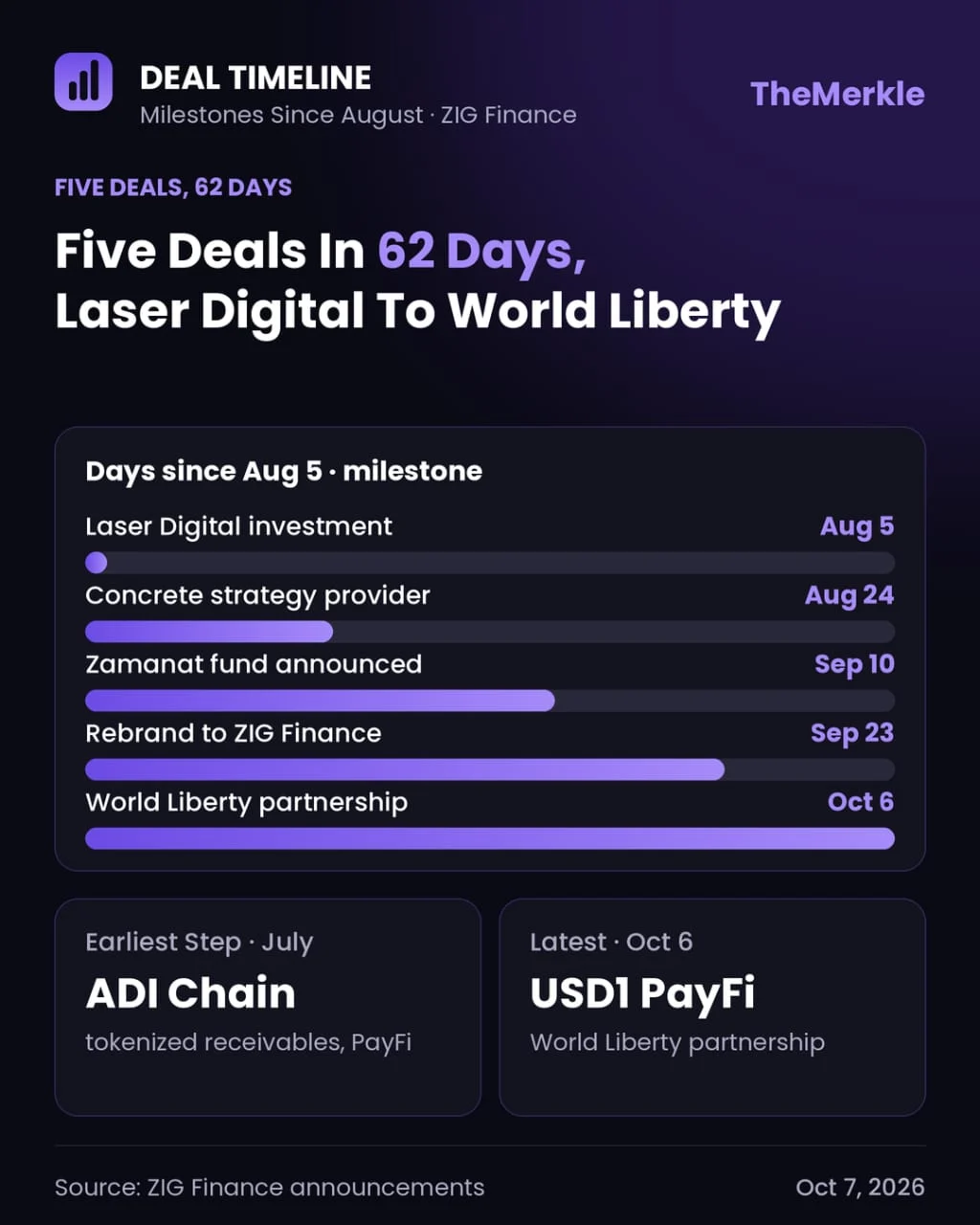
ZIG’s track record in this specialized area is already established. When Concrete launched its USD1 Real-World Asset (RWA) vault on August 24, ZIG Markets was identified as one of the original strategy providers. In that capacity, ZIG Markets was already supplying settlement liquidity to money-transfer operators and cross-border payment businesses. This prior engagement demonstrates ZIG’s proven capability in this sector. Other strategies within Concrete’s RWA vaults also covered private credit and digital infrastructure, indicating a broader focus on bridging traditional finance with decentralized solutions. The current World Liberty Financial deal represents a significant expansion of an already operational and successful product line for ZIG.

ZIG’s Strategic Evolution: From Social Trading to Regulated Products
The journey of ZIG, from its origins as Zignaly in 2018, a social trading platform focused on retail users, to its current iteration as a regulated-products business, is a compelling narrative of strategic adaptation and growth. Initially, Zignaly empowered retail investors to copy the trading strategies of experienced professionals, democratizing access to complex financial markets. This foundational experience honed ZIG’s core competency in packaging and distributing investment strategies, albeit initially for a different audience.
Over the past two years, ZIG has meticulously shifted its focus, transitioning from retail-centric social trading to packaging sophisticated financial products for institutional clients. This deliberate pivot was driven by an recognition of the evolving regulatory landscape, the increasing institutional interest in digital assets, and the untapped potential for structured products within the nascent decentralized finance (DeFi) space. The ability to distribute structured products has remained a consistent core skill throughout ZIG’s evolution, and it is precisely this expertise that the stablecoin payments market, particularly in the RWA context, critically needs. By leveraging its background in structuring complex investment opportunities, ZIG is uniquely positioned to bridge the operational gap between stablecoin liquidity and the real economic demand for efficient cross-border financing.
World Liberty Financial’s Vision for USD1 in Payments
World Liberty Financial’s commitment to expanding the utility of its USD1 stablecoin beyond mere transactional payments has been well-documented. USD1 is designed to be a compliant, transparent, and highly liquid stablecoin, aiming to solve many of the inefficiencies inherent in traditional financial systems. Its adoption as a settlement and treasury layer in ZIG’s PayFi Vault aligns perfectly with World Liberty Financial’s broader vision of positioning USD1 as a foundational asset for a wide range of global financial services, from remittances to supply chain finance and beyond. The partnership underscores the growing trend of stablecoins moving beyond speculative trading to become integral components of the real economy, offering unparalleled speed, cost-efficiency, and global reach.
The RWA Trend and Stablecoin Utility
The partnership is also indicative of a broader trend within the digital asset ecosystem: the increasing focus on Real-World Assets (RWAs). RWAs refer to tangible or intangible assets from traditional finance (like real estate, commodities, or, in this case, short-term credit for MTOs) that are tokenized or represented on a blockchain. This movement seeks to unlock liquidity, enhance transparency, and introduce programmatic efficiencies into traditional financial markets by leveraging blockchain technology.
Stablecoins, by their very nature, are foundational to the RWA movement, acting as the primary medium of exchange and settlement. By using USD1 to finance real-world payment flows, ZIG and World Liberty Financial are not just facilitating remittances; they are actively contributing to the maturation of the RWA sector, demonstrating how digital assets can create new financial primitives and unlock value in existing markets. This trend is expected to continue growing, as more traditional financial institutions and businesses explore the benefits of tokenization and blockchain integration.

The ZIG Token: Understanding its Role and Tokenomics
For those monitoring the broader ZIG ecosystem, the partnership has implications for the ZIG token. According to ZIG’s tokenomics documentation, ZIG Markets’ revenue streams are earmarked for open-market buybacks of the ZIG token, with these buybacks slated to commence on July 1, 2026. The long-term objective of this buyback program is to acquire up to 500 million ZIG tokens. This mechanism directly links the operational success and growth of ventures like the PayFi Vault to the demand for the ZIG token. As the vault expands and the underlying short-term loans generate revenue for ZIG Markets, a portion of these earnings is intended to be used to repurchase ZIG tokens from the open market, potentially creating upward pressure on its price.
At approximately $0.0598 (based on live data at the time of the original article’s publication) and with a market capitalization under $150 million, the ZIG token is currently categorized as a micro-cap asset. Tokens in this segment are typically characterized by higher volatility, meaning that significant price swings, in either direction, are common. Investors and participants in the ZIG ecosystem will be closely watching the execution of these buyback programs and the overall growth of ZIG Markets’ initiatives to assess the long-term impact on the token’s value proposition.
Looking Ahead: Key Metrics and Future Prospects
While the announcement delineates a clear intent and a promising initial product, the true measure of success will be observed through several key metrics. The most immediate indicators to monitor include:
- Size and Growth of the PayFi Vault: The total value locked (TVL) within the PayFi Vault will be a direct measure of its adoption and the volume of liquidity it is channeling into remittance financing.
- Performance of Underlying Loans: The quality and repayment rates of the short-term loans extended to MTOs will be crucial. High performance indicates robust risk management and a viable financial model.
- USD1 Flow Through the Program: Tracking the velocity and volume of USD1 stablecoin moving through the vault will demonstrate its efficiency and utility as a settlement layer.
- Laser Digital TVL Target: The progress towards any stated TVL targets, such as those potentially associated with broader institutional adoption or specific partnerships, will provide further insight into ZIG’s overall growth trajectory.
- Execution of ZIG Token Buybacks: Post-July 2026, the tangible evidence of open-market buybacks, as outlined in the tokenomics, will be a critical factor for ZIG token holders.
For those interested in following the real-time activity and growth of the ZIG ecosystem, various on-chain analytics and data platforms offer transparency. Native-chain activity, particularly for the UZIG asset, is visible on Zigscan. Lending and yield pools that incorporate ZIG can be tracked on DefiLlama, providing insights into its integration within the broader decentralized finance landscape. Furthermore, the BNB Chain contract for ZIG can be monitored on BscScan and GeckoTerminal, offering detailed transaction data and market performance metrics.
In conclusion, the partnership between ZIG Finance and World Liberty Financial represents a significant stride in bridging the innovative capabilities of stablecoins and blockchain technology with the tangible needs of the global remittance market. By addressing the critical liquidity requirements of money transfer operators through a structured, efficient, and 24/7 stablecoin-powered vault, this collaboration has the potential to enhance the speed, reduce the cost, and improve the reliability of cross-border payments. As ZIG continues its evolution into a regulated products business and World Liberty Financial expands USD1’s utility, the financial world will be watching closely to see how this venture redefines the future of global money movement.
Disclosure: This is not trading or investment advice. Always do your research before buying any cryptocurrency or investing in any services.