The digital ledger network Blast, which once boasted a Total Value Locked (TVL) exceeding $2 billion, has announced its imminent shutdown, with recent data from DefiLlama revealing its 24-hour chain revenue plummeted to a mere $110. This precipitous decline, representing roughly the cost of a decent pair of athletic shoes, underscores a critical and often overlooked aspect of tokenomics: the sustainability, or lack thereof, of projects heavily reliant on large-scale airdrops for initial traction. The closure of Blast, alongside the earlier winding down of ZeroLend, offers a compelling case study on how generous token giveaways, intended to bootstrap ecosystems, can paradoxically hasten their demise by attracting transient speculators rather than fostering genuine, long-term user engagement and revenue generation.
Blast’s Meteoric Rise and Abrupt Fall: A Deep Dive into Unsustainable Incentives
Blast emerged onto the blockchain scene with significant fanfare, positioning itself as an Ethereum Layer-2 solution that offered native yield on ETH and stablecoins. Its unique selling proposition and the backing of prominent figures in the crypto space, including Blur founder Pacman, quickly propelled its TVL to over $2 billion shortly after its launch, making it one of the fastest-growing Layer-2s. The mechanism for this rapid growth was primarily a "points program" that incentivized early deposits, promising future airdrops of its native BLAST token. This strategy generated immense hype and liquidity, but as the recent announcement confirms, this liquidity proved to be largely "rented" rather than earned through organic utility.
On July 26, 2024, the Blast team delivered the sobering news: the network would be shutting down. The official statement cited that "ongoing costs exceed the revenue the chain generates and that it sees no credible path to sustainability." This candid admission highlights a fundamental flaw in its business model. Users have been given until October 26 to withdraw their assets through the standard interface, after which they will be required to interact directly with the underlying bridge contracts on Ethereum – a process that is often more complex and less user-friendly, potentially stranding less technically proficient users.
DefiLlama’s data paints a stark picture of Blast’s economic reality leading up to its closure. As of the announcement, the total value locked (TVL) on Blast had dwindled to a mere $32.14 million, a staggering drop from its peak. Furthermore, the 24-hour chain fees stood at $124, with the actual chain revenue even lower at $110. While the platform also showed approximately $20,800 in 24-hour app revenue, the caveat is crucial: almost all of this was attributed to a single, now-deprecated lending protocol, offering little insight into the overall economic health or intrinsic demand for Blast’s services. Another figure, a "bridged-TVL" of about $117 million, which includes assets bridged in and Blast’s own tokens, also fails to alter the core narrative: the chain itself was generating negligible revenue from its operations. The network’s lifecycle, from its highly anticipated airdrop to its closure announcement, spanned roughly two years and three months, a relatively brief existence given its initial promise.
Chronology of Blast’s Decline:
- Late 2023: Blast announces its Layer-2 solution, generating significant excitement with its native yield and points program for future airdrops. Early deposits flood in, rapidly pushing TVL past $2 billion.
- Early 2024: The BLAST token officially launches, with a substantial portion allocated for airdrops based on accrued points and other incentives. Initial price volatility ensues.
- Mid-2024: User activity and TVL begin a steady decline as initial airdrop incentives wane and the speculative interest shifts. Chain revenue starts to dwindle.
- July 26, 2024: Blast team announces the shutdown, citing unsustainable operating costs and lack of a viable path to profitability.
- October 26, 2024: Deadline for users to withdraw assets via the normal interface. After this date, direct interaction with Ethereum bridge contracts will be necessary.
The Generous Airdrop: A Double-Edged Sword

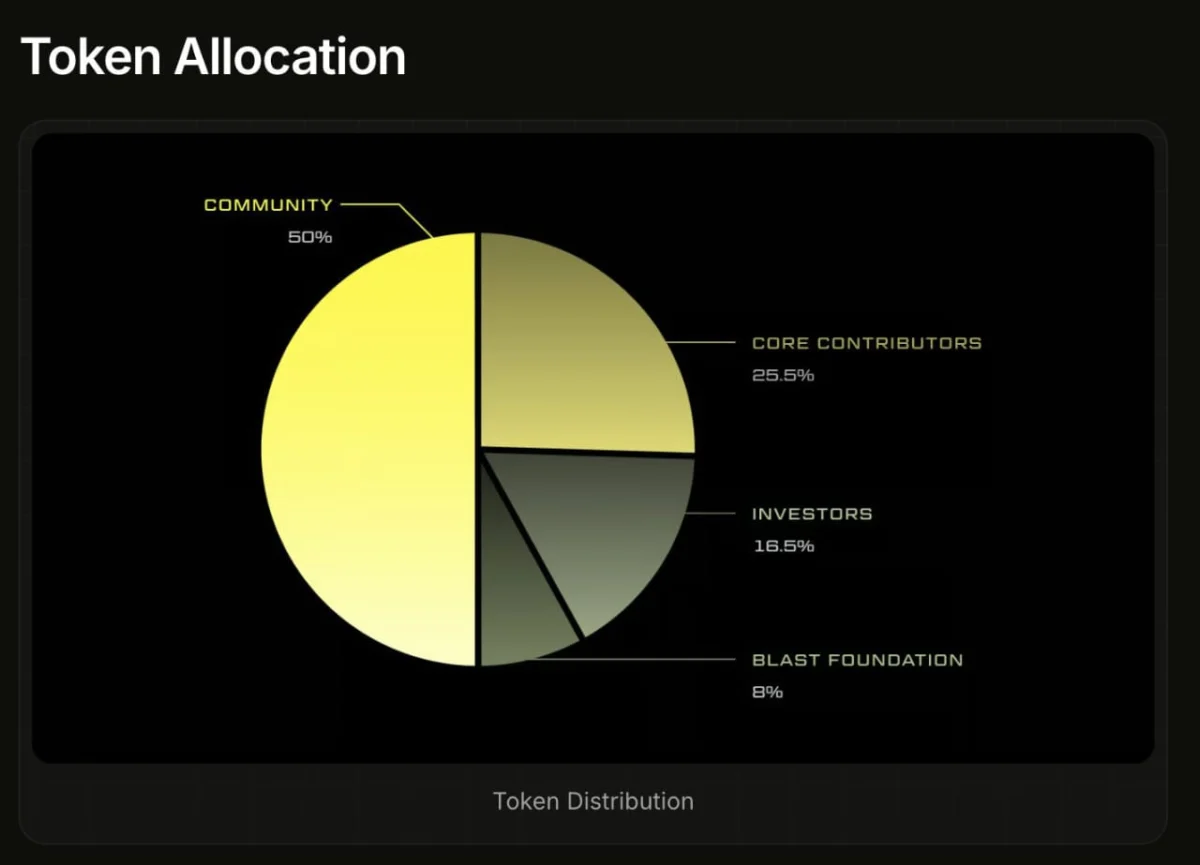
Blast’s tokenomics documentation explicitly detailed a highly aggressive airdrop strategy. Of the total 100 billion BLAST supply, a substantial 50% was earmarked for community allocation. Phase 1 distributed 7% to Blast Points holders and another 7% to Blast Gold recipients. Phase 2 added a prorated 5%, and the Blur Foundation received 3% in Phase 1, bringing the total initial airdrop allocation to approximately 22% of the total supply. This massive giveaway was intended to decentralize ownership and incentivize network participation.
However, a critical detail in the tokenomics was the linear unlocking of the community allocation over three years from the token launch. This meant that even as network usage and liquidity began to drain away, new tokens continued to reach wallets. This sustained downward pressure on the token’s value, coupled with a lack of organic demand, proved devastating. DefiLlama currently values the entire BLAST token at approximately $19 million, with individual tokens trading near $0.00027 – a stark contrast to any initial price expectations. The continuous supply influx, combined with dwindling utility, created a perfect storm for value erosion.
ZeroLend: A Parallel Narrative of Airdrop-Induced Fragility
Blast is not an isolated incident. Earlier in 2026, the decentralized lending protocol ZeroLend announced its own cessation of operations, mirroring many of the same issues observed with Blast. ZeroLend, an Aave V3 fork deployed across several Layer-2 networks, also pursued an aggressive airdrop strategy. Its token documentation reserved a staggering 53% of the ZERO supply for the community, with an initial airdrop accounting for roughly 18% of the total supply. Notably, 40% of these airdropped tokens were released upfront, contributing to immediate sell pressure.
On February 17, 2026, the ZeroLend team announced its decision to wind down after three years of operation. The reasons cited were familiar: "inactive chains, lost oracle support, and thin lending margins." DefiLlama’s data for ZeroLend paints a clear picture of its financial struggles. Gross protocol revenue, which peaked at around $2.04 million in the first quarter of 2025, steadily declined to between $229,000 and $419,000 per quarter, eventually plummeting to approximately $59,000 in the third quarter of 2026. Its TVL stands at a mere $1.45 million, and the ZERO token trades near $0.00000073, a fraction of its recorded high of $0.0058. The generous airdrop, far from guaranteeing long-term viability, failed to halt the project’s slide. In an attempt to mitigate user losses, the ZeroLend team even pledged to use its own Linea airdrop allocation to partially refund affected users, a move that underscores the project’s desperate efforts to salvage user trust amidst its closure.
The Economics of Airdrops: Why Free Tokens Attract Visitors, Not Customers
The fundamental flaw in relying heavily on large airdrops as a primary growth strategy lies in the perverse incentives they create. A points program or a significant token giveaway is, at its core, a payment for participation. Individuals attracted by such incentives, often termed "airdrop farmers" or "mercenary capital," are primarily driven by the prospect of financial gain from the free tokens. Their engagement is transactional and short-term; once the payout ends or the value proposition diminishes, they move on to the next opportunity.
Blast’s early deposits, driven by its points program even before a token existed, exemplify this phenomenon. A significant portion of that initial liquidity was "rented" rather than "earned." It arrived with the expectation of a future reward and departed once that reward was distributed or its value eroded. The mistake made by many projects, including Blast and ZeroLend, is treating a one-time or time-limited giveaway as a sustainable revenue model. A genuine business, whether in Web2 or Web3, requires a customer base that consistently pays more for its services than it costs to provide them. Neither Blast nor ZeroLend managed to cultivate such a customer base once the artificial incentives of the airdrops ceased.

Broader Implications for the Blockchain Ecosystem and Tokenomics Design
The closures of Blast and ZeroLend serve as critical lessons for the broader blockchain ecosystem, particularly for new projects contemplating their go-to-market and token distribution strategies.
- Rented vs. Organic Liquidity: The cases highlight the stark difference between liquidity attracted by financial incentives (rented) and liquidity driven by genuine product utility and organic demand (earned). While initial incentives can kickstart a network, they must quickly transition to sustainable value propositions.
- The Farmer Mentality: Airdrops often attract users whose primary goal is to extract value rather than contribute to the network’s long-term health. These users typically dump tokens immediately, creating significant selling pressure and hindering price stability.
- Sustainable Revenue Models: Projects must prioritize developing clear, viable revenue models from the outset. Transaction fees, protocol fees, or other forms of value capture are essential for covering operational costs and investing in future development. Without them, even projects with substantial initial funding are doomed.
- Tokenomics as a Reflection of Value: The design of tokenomics should align with the project’s long-term vision and value proposition. A massive initial supply directed towards airdrops, especially with rapid unlocking schedules, can undermine the token’s perceived value and utility.
- Differentiating Successful Airdrops: While the narrative of "big airdrop equals dead" might seem tempting, it’s an oversimplification. Projects like Uniswap and Arbitrum, which also conducted large airdrops, continue to thrive. The key differentiator is often whether a robust product and genuine market demand existed before or concurrently with the airdrop. Uniswap had a proven product with significant organic usage, and its airdrop rewarded existing users, fostering loyalty. Arbitrum provided a much-needed scaling solution for Ethereum, attracting users with tangible benefits beyond just token incentives. In these cases, airdrops served to decentralize governance and reward early adopters of an already valuable service, rather than being the sole driver of initial adoption.
- The "Weak Product" Syndrome: A large giveaway aimed at attracting mercenary capital can effectively mask a weak or underdeveloped product for a year or two. However, it rarely fixes fundamental product-market fit issues. Once the incentives dry up, the underlying lack of utility becomes painfully apparent.
Not All Airdrops Are Doomed: The Importance of Product-Market Fit
It’s crucial to acknowledge that not all projects with small or no airdrops succeed, nor do all large airdrops inevitably lead to failure. Botanix, a Bitcoin Layer-2 that reportedly grew without a token, airdrop, or points program, still announced its shutdown in June 2026, citing low fee revenue and weak demand. This reinforces the idea that while airdrops can be problematic, the ultimate determinant of survival is whether real usage can pay the bills after any initial rewards or incentives cease.
The size of an airdrop matters primarily in how it shapes the user base. A massive giveaway designed to attract speculative farmers will likely result in a user base primarily interested in extracting value. Conversely, a thoughtfully designed airdrop that rewards loyal, active users of an already functional product can strengthen a community and decentralize governance effectively.
Conclusion: A Call for Sustainable Innovation
The demise of Blast and ZeroLend serves as a potent reminder that innovation in the blockchain space must be built on sustainable economic models, genuine utility, and organic community growth, rather than fleeting speculative interest. While airdrops can be a powerful tool for initial distribution and community bootstrapping, they are not a substitute for a compelling product and a clear path to profitability. For new projects, investors, and users alike, the lesson is clear: scrutinize the underlying economics, demand generation, and long-term vision, not just the size of the promised token rewards. The crypto market, maturing rapidly, is increasingly distinguishing between projects that offer lasting value and those that merely offer temporary payouts.