Sub-Saharan Africa has emerged as the fastest-growing cryptocurrency economy in the world, recording a 13.4% year-over-year increase to reach a total value of $101 billion between July 1, 2025, and June 30, 2026. While the region remains the smallest crypto market in terms of absolute transaction volume, its rapid expansion highlights a significant shift in how individuals and businesses across the continent are navigating traditional financial barriers. This growth is primarily fueled by a demand for practical financial solutions, including affordable remittances, efficient cross-border business settlements, and a hedge against local currency volatility.

According to recent industry data, the surge in activity is not merely speculative but is deeply rooted in the necessity for accessible financial services. In many Sub-Saharan African nations, traditional banking infrastructure remains fragmented, expensive, and slow. For individuals, digital assets offer a streamlined alternative for managing personal finances and sending money across borders. For the business sector, cryptocurrency—and specifically stablecoins—enables faster and more cost-effective payments, bypassing the high fees and delays associated with the legacy banking systems that currently clear only a small fraction of intra-African payments within the continent.
The Divergent Paths of South Africa and Nigeria
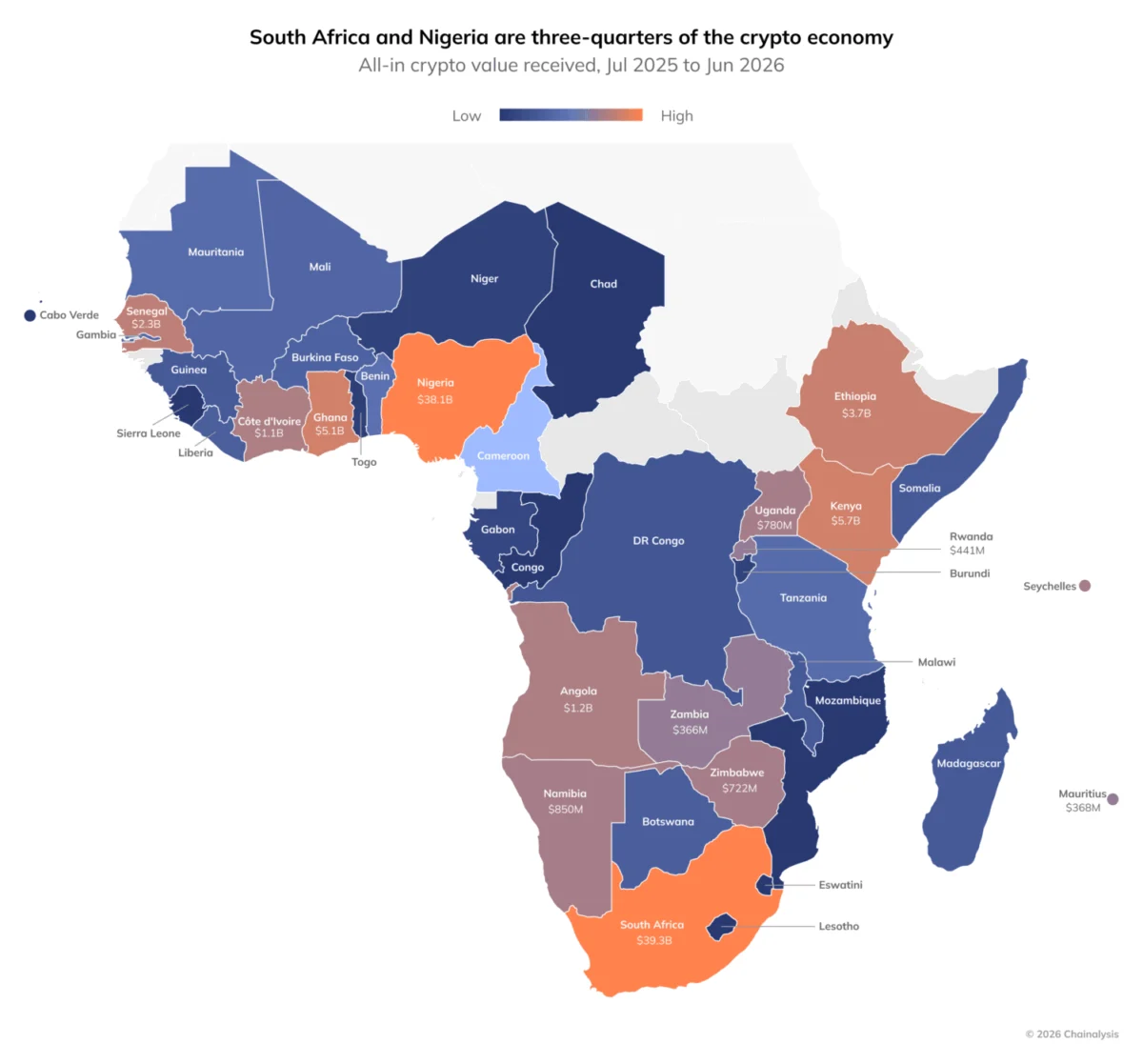
The regional crypto landscape is dominated by two primary powerhouses: South Africa and Nigeria. Together, these two nations account for more than 75% of all cryptocurrency activity in Sub-Saharan Africa. However, the data reveals that these markets are moving in different directions, influenced by local regulatory environments and economic conditions.

South Africa has solidified its position as the region’s largest and most robust crypto economy. During the reporting period, the country’s crypto market reached $39.3 billion, representing a staggering 52% year-over-year growth. This expansion occurred despite a global "crypto winter," suggesting a high level of institutional and retail resilience. Growth in South Africa was broad-based, spanning across peer-to-peer (P2P) stablecoin flows and service-related transactions. The country has also leveraged its established financial infrastructure to become a conduit for international crypto investment into the rest of the continent.
In contrast, Nigeria, the region’s second-largest market, saw its crypto economy reach $38.1 billion, a slight 3% decline compared to the previous year. While centralized exchange (CEX) activity in Nigeria grew, it was offset by a significant 45% drop in decentralized exchange (DEX) activity and a 17% decline in cross-border P2P flows. Despite this marginal dip in total volume, Nigeria remains a global leader in grassroots adoption, ranking third on international indices. The Nigerian market is increasingly characterized by a shift toward domestic platforms as regulatory friction with international exchanges has pushed users toward local alternatives.

The Stablecoin Revolution and the Decline of Bitcoin Dominance
One of the most profound shifts in the Sub-Saharan African crypto market is the meteoric rise of stablecoins. Between 2022 and 2026, the value of stablecoins received through P2P channels in the region grew more than sixfold, jumping from $2.3 billion to $14.6 billion. During the same period, the total value of Bitcoin received fell by 60%, dropping from $36 billion to $14.6 billion.
This transition underscores a pivot toward utility. In a region where local currencies often face high inflation and depreciation, stablecoins—typically pegged to the U.S. dollar—provide a vital mechanism for preserving value. They allow users to hold dollar-denominated assets without the need for traditional foreign-currency bank accounts, which are often difficult to open and maintain in many African jurisdictions.

Philip Kwaw Sebuabe, Head of the Virtual Assets Department at the Bank of Ghana, noted that stablecoins are increasingly attracting interest beyond simple trading. He emphasized their role in cross-border payments, remittance settlements, and as a store of value. This sentiment is echoed by Gillian Darko, Vice President of Strategy at Yellow Card, who identified stablecoins as the single biggest opportunity for the region over the coming year. Darko highlighted their potential to connect fragmented payment systems with broader savings and investment tools.
Crypto as a Solution for High-Cost Remittances
The high cost of traditional remittances is a major driver of crypto adoption in Sub-Saharan Africa. The World Bank reports that the average cost of sending a $200 transfer to the region is 7.9%, the highest rate globally. For countries like The Gambia and Lesotho, where remittances account for more than 20% of GDP, these high fees represent a significant economic drain.

Crypto-based remittances offer a way to bypass these costs. Research shows that crypto remittance inflows from Western nations reached $888 million during the reporting period, a 36% increase year-over-year. The number of transactions grew even faster, rising 43% to over one million individual transfers. North America remains the dominant source of these flows, contributing $645 million, largely due to sizable diaspora communities from Nigeria, Ghana, and Ethiopia.
Interestingly, the data suggests that diaspora size alone does not determine crypto usage. While Western Europe hosts 64% of the region’s diaspora, it accounts for only 10% of crypto remittances. Conversely, Canada and the United States show much higher per-capita crypto outflows to Africa. For example, Canada recorded an outflow of $736 per Sub-Saharan Africa-born resident, whereas Western Europe averaged only $17.90. This disparity is likely due to the more mature crypto markets and higher mainstream adoption of digital assets in North America compared to certain European markets.

Expanding Intra-Regional Business Corridors
Beyond personal transfers, cryptocurrency is becoming an essential tool for intra-regional trade. Traditional cross-border business payments in Africa are plagued by inefficiencies, often requiring transactions to be routed through correspondent banks in Europe or North America before reaching a neighboring African country.
The report highlights that active intra-regional crypto payment corridors nearly doubled during the period, increasing from 80 to 152. Total transaction volume in these corridors more than tripled, rising from $34.3 million to $116.5 million. This growth suggests that African businesses are increasingly turning to digital assets to facilitate trade with one another, reducing the time and cost associated with traditional banking.

South Africa plays a central role in this ecosystem, acting as a regional hub. Crypto flows from South Africa often mirror established Foreign Direct Investment (FDI) patterns, particularly into Nigeria, Kenya, and Zimbabwe. This alignment suggests that crypto is being integrated into existing business relationships and trade routes, providing a digital layer to the continent’s real-world economy.
Retail Integration: Paying for Coffee with Bitcoin in South Africa
While much of the growth is institutional or business-driven, South Africa is witnessing a unique surge in retail crypto usage. The country has developed a robust "real-world" crypto economy where consumers use digital assets for everyday purchases.

This trend is supported by innovative infrastructure. In 2025, the "Scan to Pay" service and the MoneyBadger platform launched a program allowing consumers to pay with Bitcoin at over 600,000 merchant locations. By August 2026, this footprint had expanded to nearly 700,000 locations. Carel van Wyk, CEO of MoneyBadger, reported that half of these transactions are for amounts under $13, indicating that crypto is becoming a part of daily spending habits for items like groceries and meals. E-commerce also accounts for nearly 48% of the total payment value on the platform, showing a balanced split between physical and digital retail.
The Regulatory Chronology and Future Outlook
The trajectory of the African crypto market has been heavily influenced by a rapidly evolving regulatory landscape. Governments in the region have moved from skepticism and outright bans to a more structured, albeit cautious, framework of oversight.

- 2021–2023: Nigeria maintained strict restrictions on banks serving crypto exchanges, which led to a surge in P2P trading as users moved away from centralized platforms.
- December 2023: The Central Bank of Nigeria lifted the ban on banks facilitating crypto transactions, signaling a shift toward regulation rather than prohibition.
- 2025: Ghana and Kenya passed comprehensive Virtual Asset Service Provider (VASP) acts to bring clarity to the market and protect consumers.
- July 2026: Nigeria’s President signed an Executive Order on Virtual Asset Coordination, establishing a council to harmonize regulation across the Central Bank and the SEC.
- August 2026: South Africa’s National Treasury and Reserve Bank (SARB) published a draft Crypto Asset Manual to integrate digital assets into the country’s capital flow management framework.
Despite these advancements, challenges remain. In South Africa, the SARB recently announced a rethink of certain draft rules following industry backlash over restrictive offshore transfer limits. In Nigeria, higher capital requirements for digital asset operators, set to take effect by June 2027, may lead to market consolidation, favoring larger, well-funded firms.
Implications for Financial Connectivity
The data from the 2025–2026 period makes one thing clear: cryptocurrency in Sub-Saharan Africa has moved beyond the "hype" phase and into a phase of practical utility. The region’s 13.4% growth rate is a testament to the technology’s ability to solve real-world problems that traditional finance has failed to address.

The long-term significance of this growth depends on whether digital assets can be fully integrated into the broader financial infrastructure. Mercy Emmanuel, Stablecoin Lead at Flutterwave, noted that the most successful innovations in the African market will be those that "reduce friction in existing financial activities" rather than those that add complexity.
As stablecoins become the preferred medium for remittances and business settlements, and as retail infrastructure continues to expand in markets like South Africa, the region is positioning itself as a global laboratory for the future of finance. The next twelve months will be critical as new regulations in Nigeria, Ghana, and South Africa take hold, determining whether the continent can maintain its momentum as a leader in digital asset adoption and financial innovation.