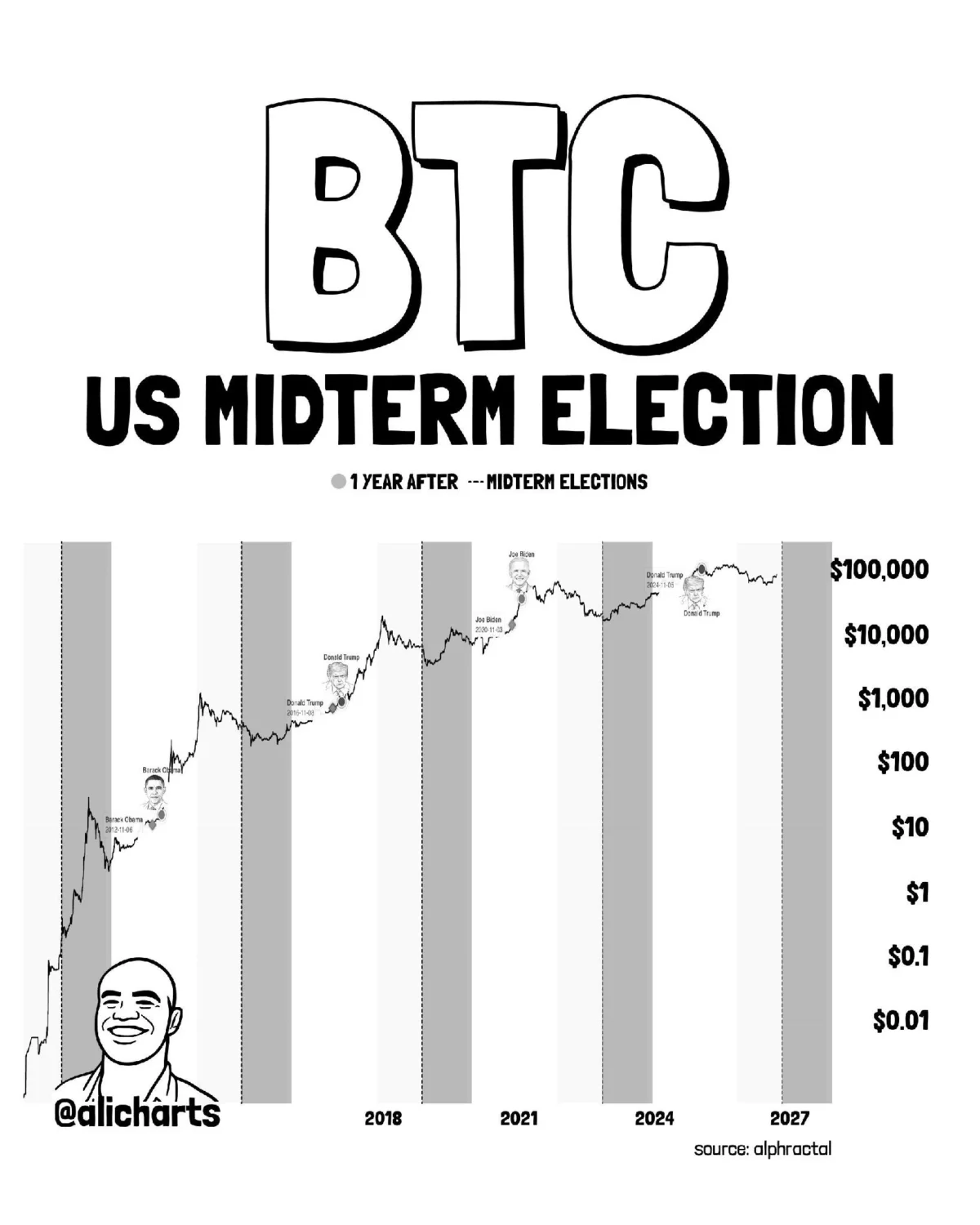
Bitcoin (BTC) may be navigating a critical "danger zone" in the lead-up to its upcoming halving event, with several prominent analysts suggesting that a deeper correction could be on the horizon before a potential recovery in 2027. This outlook is drawing parallels to historical price action observed around U.S. midterm election cycles, suggesting a period of volatility and potential downturns in the short to medium term.
Historical Parallels and Midterm Election Cycles
Analysts are closely examining past patterns, particularly the behavior of Bitcoin around U.S. midterm elections, to forecast potential future movements. Satoureireal, an analyst at CryptoQuant, has highlighted data from blockchain analysis firm Alphractal, indicating significant corrections in Bitcoin’s price around the 2018 and 2022 midterm elections. In both instances, Bitcoin experienced substantial drawdowns before eventually bottoming out and initiating a recovery phase in the subsequent year. For example, the cryptocurrency hit its low point in late 2018, followed by a rebound in 2019. Similarly, the 2022 bear market eventually gave way to a recovery in 2023.
This historical correlation raises a pertinent question: could a similar pattern unfold in the lead-up to the next midterm elections, potentially setting the stage for a significant recovery in 2027? Satoureireal’s analysis, shared via a post on X (formerly Twitter), also pointed to recurring volatility surrounding U.S. midterms. In some cycles, Bitcoin has seen a rally preceding an election, only to experience a sell-off afterward. Conversely, other cycles have witnessed declines emerging later in the election period.

"During the previous two midterm election cycles in 2018 and 2022, Bitcoin experienced significant corrections before forming a bottom and entering a recovery phase in the following year," Satoureireal stated, emphasizing the pattern observed.
However, it is crucial to note that these historical relationships do not definitively prove that elections are the sole catalysts for Bitcoin sell-offs. A multitude of other macroeconomic factors, including market liquidity, monetary policy adjustments, investor sentiment and positioning, and broader economic conditions, can significantly influence price movements.
Technical Analysis and Bullish Foundations
Beyond the midterm election comparisons, technical analysts are also identifying potentially bullish chart patterns. Frank Cappelleri, founder of CappThesis, has drawn similarities between Bitcoin’s current chart structure and the patterns that preceded its previous major recovery phases.
In a recent interview with CNBC, Cappelleri discussed Bitcoin’s current cycle drawdown, which he noted was approximately 54%, in comparison to the nearly 70% decline observed between 2022 and 2023. He expressed a cautiously optimistic view, stating, "This also looks like a bullish pattern to me," referencing how the earlier significant decline ultimately paved the way for a robust recovery as market momentum returned.

While Cappelleri stopped short of predicting another rally of the magnitude seen in Bitcoin’s previous advance, which approached an impressive 400%, he suggested that the current price action could be laying a foundational base for future growth. "I’m not calling for that, but I am calling for a very similar foundation to be leveraged and potentially get back to new highs again," he remarked. His analysis implies that Bitcoin might be establishing a solid base from which it could launch another upward trend, potentially reaching new all-time highs by early 2027.
Contrasting Historical Perspectives and Key Levels
Despite these optimistic technical indicators, not all historical comparisons paint an immediately bullish picture. Popular analyst Ali Charts has recently drawn attention to Bitcoin’s consistent declines following previous U.S. midterm elections. His research indicates a pattern of post-election downturns, with Bitcoin experiencing a 72% drop after the 2010 midterms, a 65% fall after the 2014 elections, a 52% decrease after the 2018 vote, and a 27% reduction following the 2022 midterms.
In a detailed thread on X, Ali Charts identified $73,000 as a critical level to monitor should this historical pattern of post-election declines repeat. This price point could serve as a significant support or resistance area, depending on whether Bitcoin holds above or falls below it.
On-Chain Data and Shifting Investor Behavior
Adding another layer to the market analysis, on-chain data is revealing subtle but significant shifts in investor behavior that could influence Bitcoin’s trajectory. Glassnode, a leading on-chain analytics firm, reported that profit-taking by short-term Bitcoin holders has recently eased. This cohort had previously contributed to selling pressure in recent weeks. The firm noted that the proportion of exchange inflows from short-term holders who were in profit reached a one-year high before subsequently returning to its average level over the past year. This suggests a potential cooling off of immediate selling pressure from this segment of the market.

Simultaneously, Santiment, another prominent analytics firm, has reported a notable increase in accumulation by wallets holding between 10 and 10,000 Bitcoins. These "new whales" have accumulated approximately 88,987 BTC in a single month, from September 19th onwards. Their combined holdings have now surpassed 13.69 million BTC, marking the highest level seen since April.
This sustained accumulation by mid-tier and larger holders is a significant indicator of underlying confidence in Bitcoin’s long-term prospects. Santiment commented on this trend, stating, "Bitcoin still drives much of crypto’s direction, so persistent accumulation from its largest influential holders can support not only BTC, but confidence across the market." The firm’s observation suggests that the buying activity from these influential wallets could provide a crucial stabilizing force, potentially bolstering market confidence even amidst price volatility.
The Impact of the Bitcoin Halving
The approaching Bitcoin halving event, a pre-programmed reduction in the rate at which new Bitcoins are created, is a pivotal factor in discussions about the cryptocurrency’s future. Historically, halvings have been associated with increased price appreciation in the months and years following the event, as the reduced supply of new Bitcoin meets consistent or growing demand. The next halving is anticipated in April 2024.
However, the current market sentiment suggests that the pre-halving period might be characterized by uncertainty and potential price consolidation or correction. Investors are likely to be weighing the long-term bullish implications of the halving against immediate macroeconomic headwinds and historical cyclical patterns.
Broader Market Implications and Outlook
The interplay of these factors—historical election cycles, technical chart patterns, on-chain data, and the impending halving—creates a complex and dynamic market environment for Bitcoin. While some analysts foresee a period of potential downturn before a sustained recovery, others are identifying bullish undercurrents that could support a rebound.
The observed accumulation by significant wallet holders provides a degree of optimism, suggesting that large investors remain committed to Bitcoin. This behavior could act as a buffer against substantial sell-offs, even if short-term corrections occur. The easing of profit-taking by short-term holders also indicates a potential reduction in immediate selling pressure.
At the time of reporting, Bitcoin was trading at approximately $80,341, showing a modest increase of 1.02% over the preceding 24 hours. This price action reflects the current state of flux in the market, with buyers and sellers engaging amidst a backdrop of mixed signals and analyst commentary.
The coming months will be critical in determining whether Bitcoin adheres to historical patterns of midterm election volatility, experiences a pre-halving consolidation, or begins to chart a new course. Investors and market watchers will be keenly observing key price levels, on-chain metrics, and macroeconomic developments for further clues about Bitcoin’s path forward. The anticipation of the halving event, coupled with the cyclical tendencies observed in historical data, suggests that the cryptocurrency market is poised for a period of significant interest and potential transformation.