Bitcoin’s Coinbase Premium has hit a four-year low, a metric not seen since the market bottoming in November 2022 following the catastrophic implosion of the FTX exchange. This significant decline in the premium, which reflects the price difference between Bitcoin on Coinbase and its USDT-denominated price on Binance, occurs against a backdrop of renewed market volatility, exacerbated by reports of a historic $6.4 billion security breach involving Binance, the world’s largest cryptocurrency exchange. Despite the prevailing bearish sentiment, some market analysts suggest that this extreme pessimism could paradoxically signal a potential buying opportunity for Bitcoin.
The Significance of the Coinbase Premium: A Barometer of U.S. Investor Demand
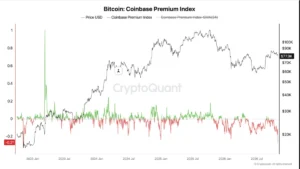
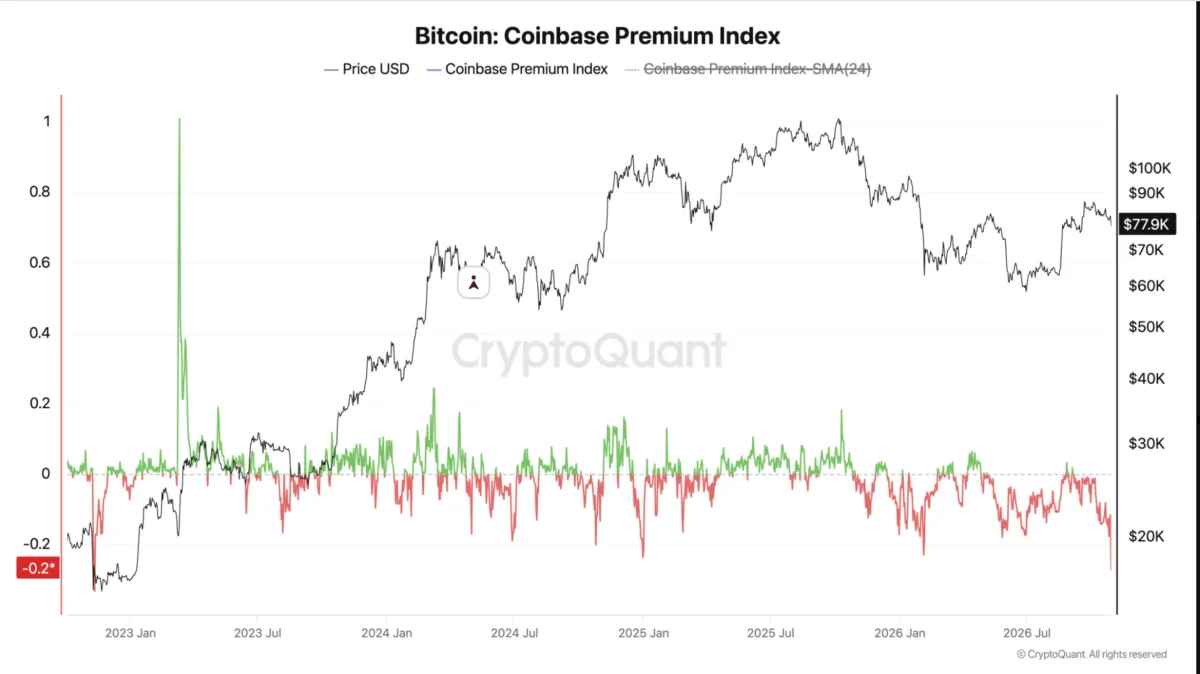
The Coinbase Premium Index, as tracked by CryptoQuant, measures the percentage difference between Bitcoin’s dollar price on Coinbase and its USDT price on Binance. Currently standing at approximately -0.2%, this translates to a price gap of roughly $156 when Bitcoin is trading around $77,900. Historically, Coinbase has been regarded as a key indicator of demand from U.S. investors, including both institutional players and retail traders operating in the dollar-based market. A sustained negative premium typically suggests that Bitcoin is trading at a discount on Coinbase compared to Binance. This scenario can be indicative of several market dynamics: increased selling pressure originating from U.S. market participants, a subdued appetite for fresh Bitcoin acquisitions among U.S. traders, or a combination of both. While this single indicator does not offer definitive proof of investor behavior, a consistent negative premium points towards weaker demand on a pivotal U.S. trading platform, potentially signaling a cooling of enthusiasm or increased caution among a significant segment of the investor base.
Echoes of the FTX Era: A Historical Low and its Implications
The current level of the Coinbase Premium is drawing parallels to November 2022, a period marked by extreme market distress. Following the collapse of Sam Bankman-Fried’s FTX empire, which sent shockwaves throughout the cryptocurrency industry, Bitcoin’s price eventually bottomed out in the $15,500 to $16,000 range. The return of the Coinbase Premium to such lows, particularly in conjunction with other negative market indicators, has revived concerns about a potential market downturn. The FTX implosion was a watershed moment, leading to increased scrutiny of exchanges, a loss of trust among many investors, and a significant deleveraging across the crypto ecosystem. The current market conditions, while not directly mirroring the systemic collapse of FTX, are characterized by a pervasive sense of uncertainty and risk aversion, which can amplify downward price pressures.
The Binance Security Breach: A New Catalyst for Market Volatility
Adding to the existing market jitters, recent reports of a massive $6.4 billion security breach at Binance have intensified the sell-off. This incident, if confirmed to be the largest cryptocurrency theft on record, could have far-reaching implications for market confidence and regulatory oversight. While details are still emerging, the sheer scale of the alleged theft has understandably rattled investors, leading to a significant price correction across the cryptocurrency market. Bitcoin, as the bellwether of the crypto market, has experienced a notable decline in response to this news. The breach raises critical questions about the security protocols of major exchanges and the robustness of the underlying blockchain infrastructure.
Contrarian Viewpoint: Extreme Bearishness as a Bullish Signal?
Amidst this confluence of negative market signals, a prominent figure in the crypto analytics space has offered a contrarian perspective. Ki Young Ju, the CEO of CryptoQuant, believes that the current wave of extreme bearish sentiment, as evidenced by the plummeting Coinbase Premium and broader market fear, could paradoxically be a precursor to a bullish reversal. His assertion, articulated on X (formerly Twitter), suggests that when sentiment reaches such a low point, it often signifies that most of the selling pressure has been exhausted, and the market may be poised for a rebound.
"Market sentiment is bearish enough to be bullish, imo," Ki Young Ju stated, accompanied by a chart illustrating the declining Coinbase Premium. This "fear can be greed" philosophy is a well-known principle in financial markets, suggesting that when fear is at its peak, asset prices may have been oversold, creating an opportunity for shrewd investors to enter the market at attractive valuations. The logic behind this view is that prolonged periods of fear and capitulation often precede periods of recovery, as residual selling pressure diminishes and speculative buying interest begins to emerge.
Bitcoin’s Price Action and the Crypto Fear and Greed Index
The impact of the Binance security breach and the general market sentiment is evident in Bitcoin’s recent price action. The flagship cryptocurrency has fallen by more than 5%, dipping below the $77,000 mark. This decline underscores the sensitivity of Bitcoin to negative news and the broader market’s response to perceived risks.
Further corroborating the prevailing sentiment, the Crypto Fear and Greed Index, a widely watched indicator that gauges market sentiment, has plunged to 30. This reading firmly places the market in the "Fear" zone, marking its lowest point since August 14th. The index, which ranges from 0 (extreme fear) to 100 (extreme greed), provides a valuable snapshot of investor psychology. A reading below 50 indicates fear, while a score below 25 suggests extreme fear. The current level suggests a significant degree of apprehension among investors, who are likely concerned about potential further downside and the implications of the security incident.
Binance’s Response and Reassurance Efforts
In response to the escalating concerns surrounding the security breach, Binance has moved swiftly to reassure its users and the broader market. The exchange has pledged to cover all losses resulting from the incident using its own funds. Reports indicate that Binance has allocated over $6.34 billion to address the fallout, with a significant portion of this fund, approximately $5 billion, earmarked to cover the exact token assets affected by the breach. This commitment from Binance aims to mitigate the immediate financial impact on its users and prevent a cascading effect of panic throughout the ecosystem.

Richard Teng, CEO of Binance, also took to X to address the situation. While the specific statement referenced in the original article is not fully detailed, Teng’s public communications typically focus on transparency, security enhancements, and user protection. His statements often aim to quell fears, emphasize the exchange’s commitment to security, and provide updates on the investigation and recovery process. Binance’s proactive approach, if effectively communicated and executed, could play a crucial role in restoring confidence in the platform and, by extension, the wider crypto market.
Broader Implications and the Path Forward
The current market environment presents a complex interplay of factors. On one hand, the Coinbase Premium’s drop and the heightened fear index signal significant selling pressure and investor apprehension. The reported Binance breach introduces a new layer of systemic risk and uncertainty. On the other hand, the historical context of such low sentiment levels, coupled with the proactive measures taken by Binance, could indeed present a contrarian bullish opportunity for those willing to look beyond the immediate panic.
However, caution remains the prevailing sentiment among many traders and investors. The resumption of Binance withdrawals, which may have been temporarily halted or impacted by the security incident, will be a key development to monitor. Greater clarity surrounding the full extent of the breach, the methodology used to exploit the vulnerability, and the effectiveness of Binance’s response will be crucial in determining the market’s next move.
The cryptocurrency market has historically demonstrated resilience and a capacity for rapid recovery following periods of significant downturns. While the current situation is undoubtedly challenging, the underlying technological innovation and the growing adoption of digital assets suggest a long-term growth trajectory. Whether the current dip represents a temporary setback or a more significant correction will depend on a multitude of factors, including the resolution of the Binance incident, macroeconomic conditions, and broader regulatory developments. For now, the market remains in a state of flux, with both bearish pressures and the potential for a contrarian bullish shift vying for dominance. The coming days and weeks will be critical in shaping the narrative and determining the immediate future for Bitcoin and the broader cryptocurrency landscape.