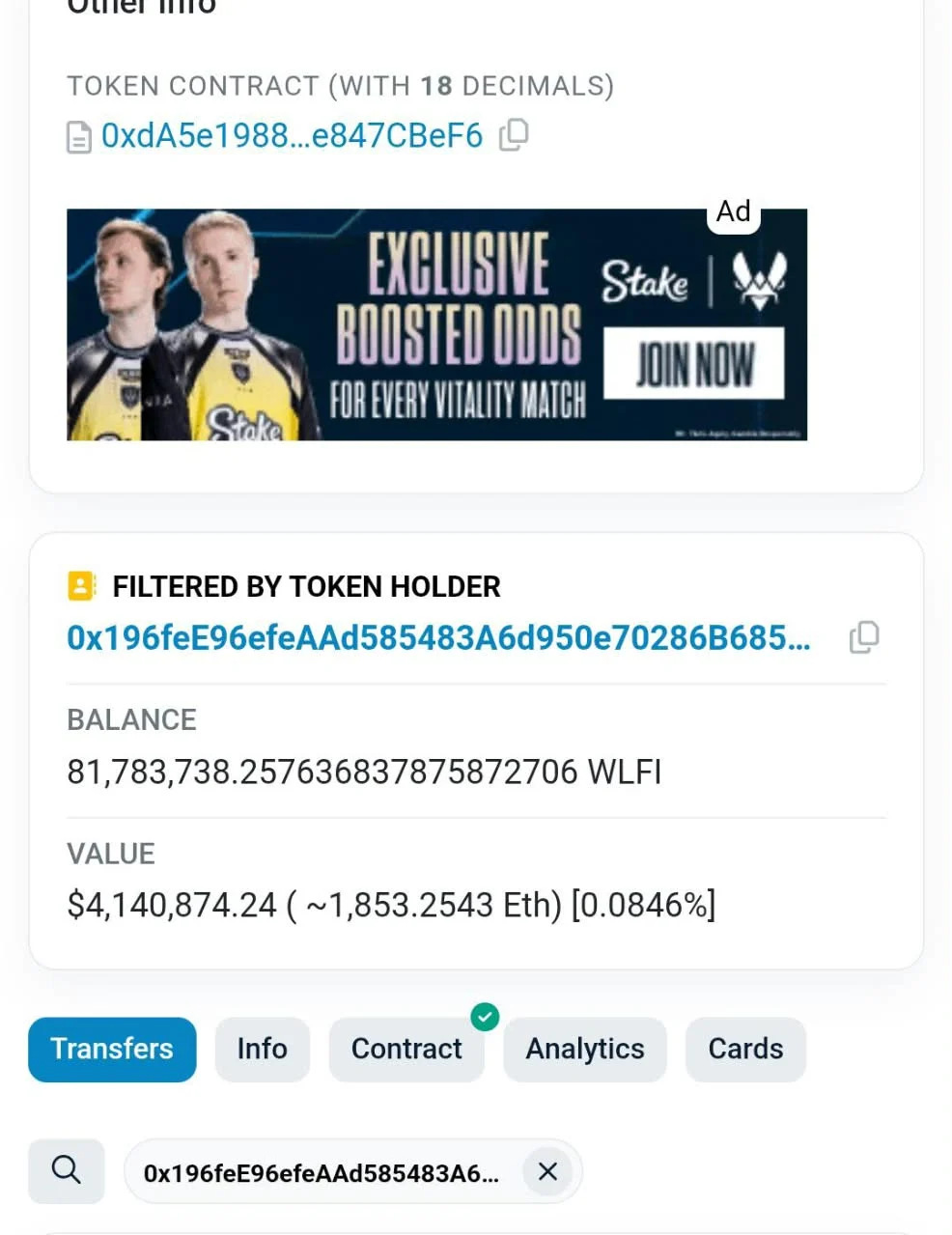
The World Liberty Financial (WLFI) staking contract has seen a significant surge in locked tokens, now holding an impressive 81.78 million WLFI, rendering the previously widely cited 0.17% figure of circulating supply obsolete. As of October 30, 2023, the updated percentage stands at approximately 0.26%. However, this growth narrative is overshadowed by a critical concern regarding the sustainability of the reward pool: at the current payout rate, the remaining USD1 in the pool is projected to deplete in early February 2024, roughly 50 days before the earliest 180-day staking locks are scheduled to conclude in late March 2024. This impending shortfall presents a significant challenge for the protocol and its committed stakers, highlighting the inherent risks in high-yield decentralized finance (DeFi offerings).
The Evolving Landscape of WLFI Staking: Background and Initial Traction
World Liberty Financial (WLFI) operates within the burgeoning ecosystem of decentralized finance, aiming to provide various financial services underpinned by blockchain technology. At its core, WLFI utilizes a native cryptocurrency, also named WLFI, which plays a pivotal role in its governance and economic model. Staking, a fundamental mechanism in many blockchain networks, allows token holders to lock their assets for a predetermined period, contributing to the network’s security, validating transactions, or participating in governance decisions. In return, stakers typically receive rewards, often in the form of additional tokens or stablecoins, as an incentive for their commitment. This mechanism is crucial for fostering long-term token holding, reducing circulating supply, and promoting active community engagement.
The WLFI staking program officially launched on October 1, 2023, initiating a 180-day lock-up period for stakers and requiring active participation in governance through voting every 90 days to remain eligible for rewards. These stringent requirements were established following a September 14, 2023, governance vote that passed with over 99% community consensus, signaling a strong desire for committed participation within the WLFI ecosystem. The initial two weeks saw considerable enthusiasm, with reports on October 14, 2023, indicating that 54.18 million WLFI tokens had been locked, representing approximately 0.17% of the total circulating supply at the time. This initial uptake was seen as a positive indicator of community trust and interest in the protocol’s long-term vision.
Updated Staking Metrics: Growth, Shifting Dynamics, and Supply Context
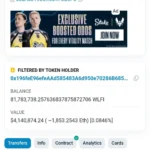
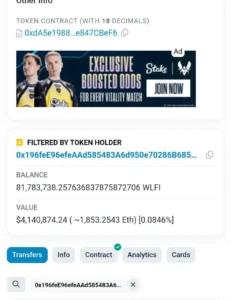
A deeper examination of the WLFI staking contract as of October 30, 2023, reveals significant shifts in key metrics. The staking contract, officially documented by World Liberty Financial as 0x196feE96efeAAd585483A6d950e70286B6851923, now holds precisely 81,783,738.26 WLFI tokens. This figure, verified through Etherscan and corroborated by the protocol’s official staking dashboard, represents a substantial increase of 27.6 million WLFI tokens, or approximately 51%, in just 16 days since the October 14 report. The current staked value is estimated at roughly $4.14 million based on prevailing WLFI market prices.
This accelerated accumulation of locked tokens necessitates an immediate update to the circulating supply percentage. Against a consistent circulating supply figure of approximately 31.78 billion WLFI, as reported by platforms like CoinGecko, the new total of 81.78 million staked tokens translates to an updated share of approximately 0.257%, or rounded to 0.26% of the circulating supply. While this represents a notable increase from the initial 0.17%, it is crucial to note that even with this growth, staked WLFI still accounts for well under 1% of the total circulating tokens. The discussion around WLFI’s total supply often oscillates between a maximum of 100 billion tokens and Etherscan’s reported on-chain supply of 96.72 billion. Regardless of the exact total supply figure used, the proportion of staked WLFI remains relatively modest, indicating a vast untapped potential for further community engagement or, conversely, a limited initial commitment from the broader token holder base.
Slowdown in Staking Velocity Post-Initial Rush
Despite the impressive overall growth, a granular analysis of the staking pace reveals a discernible slowdown after the initial rush. In the first 13 days of the program, from October 1 to October 14, an average of approximately 4.17 million WLFI tokens flowed into the contract daily. However, over the subsequent 16 days, from October 14 to October 30, this average daily influx significantly decreased to about 1.73 million WLFI. This represents a substantial slowdown of approximately 59% in the daily staking rate.

Several factors could contribute to this deceleration. The initial period of any new DeFi offering often witnesses a surge of early adopters and large holders seeking to maximize initial yields. As these early participants commit their tokens, the pool of immediately available tokens for staking might diminish. Furthermore, the inherent commitment required by WLFI staking – a mandatory 180-day lock-up period coupled with the 90-day governance voting requirement – makes it a more demanding proposition than typical flexible yield products. This long-term commitment, preventing quick withdrawals and requiring active participation, might deter more cautious or less engaged investors, leading to a more measured pace of new stakes in the later stages. The concept of "super nodes," requiring a formidable 50 million WLFI stake for eligibility, also underscores the significant commitment expected from top-tier participants; currently, the entire staking contract holds barely enough for one and a half such super nodes, illustrating the high bar for such status.
The Reward Pool Conundrum: High APR, Limited Lifespan, and Critical Discrepancy
One of the most perplexing aspects of the current WLFI staking landscape is the apparent increase in the displayed Annual Percentage Rate (APR) despite a substantial rise in staked tokens. The staking dashboard explicitly states that the variable rate "can decrease as more WLFI is staked." Yet, the displayed APR rose from 82.41% on October 14 to a striking 92.07% by October 30. This counterintuitive trend can be primarily attributed to two factors: the variable reward rate mechanism which is dynamic and the fluctuating market price of the WLFI token. If the token’s price declines, the USD value of the tokens paid out as rewards also decreases, potentially allowing for a higher token-denominated APR to maintain a certain USD value of rewards per staked token, or simply reflecting a mathematical adjustment based on the underlying token price volatility.
The sustainability of the reward pool, denominated in USD1 (a stablecoin), is where the most critical concerns emerge. The protocol’s "all-time rewards" pool has seen a modest increase, growing from 1.25 million USD1 at launch to 1.30 million USD1 by October 30, indicating that approximately 50,000 USD1 has been added since the program’s inception. However, the gap between all-time rewards and currently available rewards, which represents the amount already allocated or paid out, has significantly widened. On October 14, this gap stood at 80,000 USD1; by October 30, it had surged to 230,000 USD1. This means that approximately 150,000 USD1 in rewards has been distributed or earmarked in just 16 days.
Based on the current displayed rate and the pace of allocation, the remaining 1.07 million USD1 in the reward pool is being depleted at an implied annual rate of about $3.81 million. At this rate, the available rewards would last for approximately 103 days from October 30, 2023, leading to an estimated depletion date in early February 2024.
The Critical Mismatch: Locks Outlive Rewards
This projection introduces a severe mismatch when compared to the mandatory lock-up periods for stakers. Tokens initially staked on October 1, 2023, are subject to a 180-day lock, meaning they will not become available for withdrawal until approximately March 30, 2024. Similarly, tokens staked on October 30, 2023, will be locked until around April 28, 2024.
The stark reality is that the reward pool is projected to run empty in early February 2024, which is approximately 50 days before the earliest locked tokens from October 1 become available for withdrawal. The original report’s introductory statement highlighted a concern that the pool would "run out about 100 days before the earliest 180-day locks end." While the precise calculation based on the updated figures points to a roughly 50-day gap, the sentiment remains the same: a significant portion of the mandated lock-up period for early stakers would proceed without any available rewards from the current pool.
World Liberty Financial’s dashboard includes clear disclaimers, stating that "rewards are not guaranteed" and "today’s rate does not represent what you will earn over your staking period." While these disclaimers are standard practice in DeFi to manage expectations, the substantial projected shortfall raises questions about the protocol’s long-term reward strategy and its ability to sustain the attractive APRs initially advertised. The protocol has demonstrated a willingness to add to the pool once, but without further, more substantial top-ups, the advertised 92% rate cannot realistically hold for the entire 180-day lock period for a significant number of stakers.

Governance, Commitment, and Project Sustainability
The design of WLFI staking, with its 180-day lock and 90-day voting requirement, was clearly intended to cultivate a committed and engaged community. The overwhelming support for these measures in the September 14 governance vote underscores this ambition. These rules transform staking from a simple yield-generating activity into a more profound commitment to the protocol’s long-term health and governance. However, the sustainability of the reward mechanism is paramount to maintaining this commitment. If stakers perceive that the promised rewards are not delivered for the full duration of their lock, it could erode trust and dampen future participation in governance or staking initiatives.
The existence of a "super node" tier, requiring a 50 million WLFI stake, further emphasizes the project’s aspiration for substantial, long-term token holder engagement. The fact that the entire staking contract currently holds only about 81.78 million WLFI means that this threshold represents a significant barrier, indicating that the overall staking pool is still relatively nascent in terms of large-scale, dedicated participation.
World Liberty Financial’s response to this impending reward pool depletion will be critical. While their disclaimers manage expectations, the implicit understanding in staking is that rewards will be available throughout the lock period, especially when the protocol itself sets such a long commitment. Historically, many DeFi protocols face the challenge of maintaining attractive, yet sustainable, APRs. Protocols often resort to treasury allocations, fee redistribution, or new token emissions to replenish reward pools. WLFI has already topped up the pool once, demonstrating a capacity and willingness to intervene. However, the scale of the current shortfall suggests that a more substantial and potentially recurring commitment would be necessary to ensure stakers receive their anticipated rewards for the entire lock duration.
Implications for Stakers and the WLFI Ecosystem
The situation presents a complex set of implications for both existing and potential WLFI stakers, as well as the broader ecosystem.
For current stakers, especially those who committed early, the news of the reward pool’s impending depletion before their unlock dates is a significant concern. They entered into a 180-day contract with the expectation of receiving rewards for that entire period. A shortfall means they might experience a substantial portion of their lock-up without any yield, effectively transforming their commitment into a purely speculative hold based on future token price appreciation, rather than a yield-generating investment. This could lead to frustration and a sense of unmet expectations.
Prospective stakers are now faced with a difficult decision. While the displayed APR of 92.07% remains highly attractive, the analysis clearly indicates that this rate is unlikely to be sustained for the full 180-day lock period without further intervention from World Liberty Financial. This necessitates a more thorough due diligence process, weighing the high potential returns against the significant risk of premature reward cessation. Investors must assess WLFI’s capacity and willingness to replenish the pool, and consider alternative scenarios where rewards might significantly diminish or cease altogether.
The impact on investor confidence in the WLFI project could be substantial. If the reward pool is allowed to run dry without a clear and timely replenishment strategy, it could lead to a perception of poor treasury management or a lack of commitment to staker incentives. Such sentiment can negatively affect token price stability, reduce future participation in governance and staking, and potentially deter new investors from entering the ecosystem. Trust is a fragile commodity in DeFi, and the transparent handling of this reward pool issue will be crucial for WLFI’s reputation.

From a tokenomics perspective, while staking generally aims to reduce circulating supply and promote price stability, the current reward pool issue introduces a counteracting force. If stakers become disillusioned, the moment their tokens unlock, there could be an increased selling pressure as they exit their positions, especially if the perceived value proposition of staking has diminished. This could counteract any positive price effects from the initial locking of tokens.
In the broader DeFi context, WLFI’s situation is not unique. Many high-APR protocols struggle with long-term sustainability, often relying on continuous token emissions or unsustainable treasury draws. The challenge lies in creating a reward mechanism that is both attractive enough to incentivize participation and robust enough to be sustained through organic protocol revenues or a well-managed treasury over extended periods. WLFI’s ability to navigate this period will serve as a case study for how protocols can manage expectations and deliver on commitments in the face of dynamic market conditions and reward pool mechanics.
Conclusion
The World Liberty Financial staking contract has demonstrated robust growth, with 81.78 million WLFI tokens now locked, representing an updated 0.26% of circulating supply. However, this positive momentum is significantly tempered by the critical finding that the current USD1 reward pool is projected to deplete in early February 2024, approximately 50 days before the earliest 180-day staking locks conclude in late March 2024. While the displayed 92.07% APR is compelling, its sustainability for the full lock period is highly questionable without further intervention.
This scenario underscores the inherent risks and complexities within the high-yield DeFi landscape. For WLFI, the imperative is clear: proactive and transparent communication, coupled with a credible strategy for replenishing the reward pool, will be essential to maintain staker confidence and ensure the long-term viability of its staking program. Stakers, in turn, are reminded of the fundamental principle of due diligence, evaluating not just the advertised rates but also the underlying mechanics and sustainability of reward pools before committing their assets for extended periods. The coming months will be a crucial test for World Liberty Financial as it navigates this challenge and strives to honor the commitment it asks of its community.
Disclosure: This is not trading or investment advice. Always do your research before buying any cryptocurrency or investing in any services.