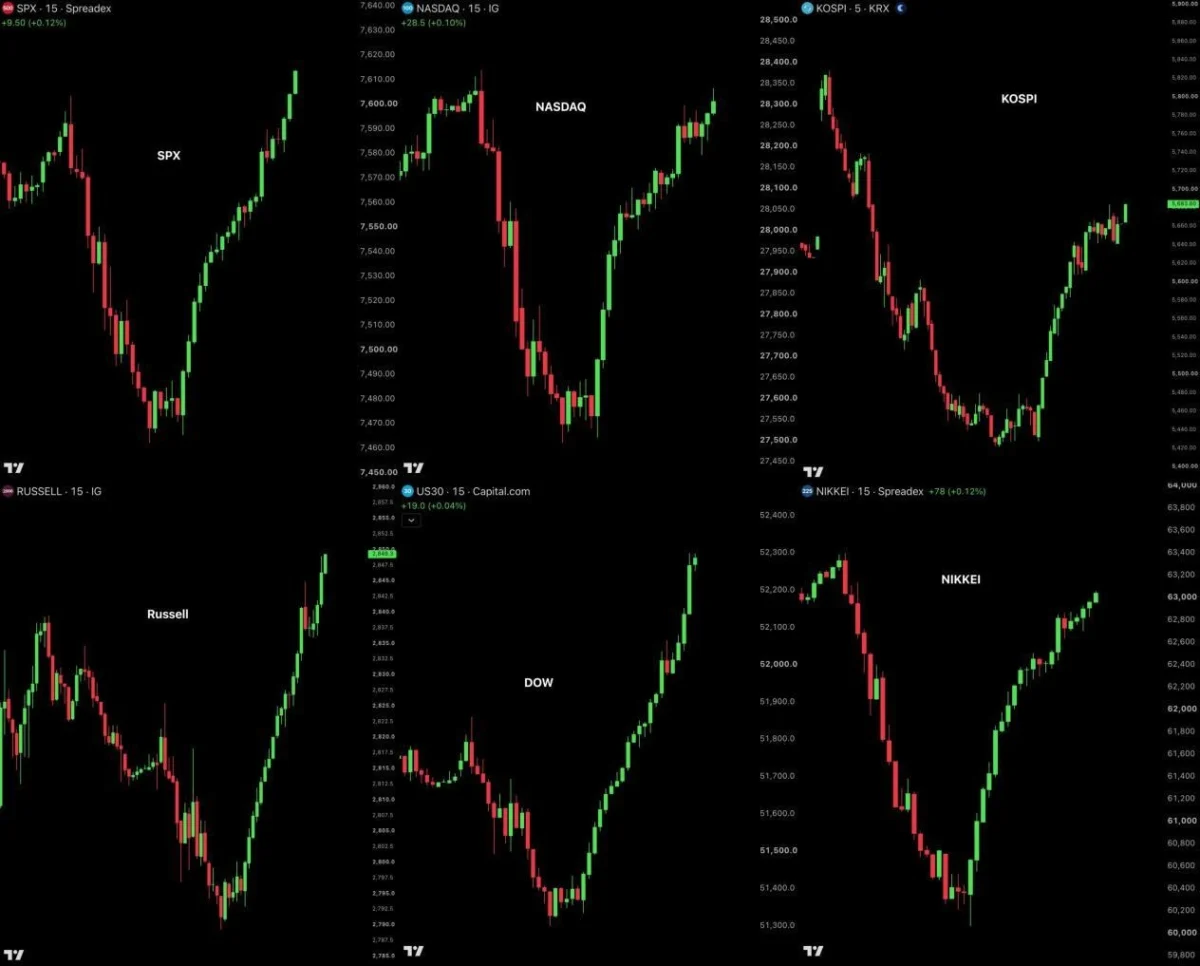
Wall Street experienced a dramatic and swift turnaround in its trading sessions following the conclusion of the U.S. midterm elections, shedding earlier losses as investors recalibrated their outlook based on the implications of Democrats securing control of both chambers of Congress. This significant market recalibration has, in turn, drawn renewed attention to Bitcoin and the broader cryptocurrency ecosystem, as traders meticulously assess the interplay between the political outcomes and the evolving landscape of crypto regulations.
The magnitude of this market recovery was particularly noteworthy, especially considering the initial sharp sell-off that preceded it. Prior to the clearer election results, NASDAQ futures had seen a decline exceeding 2%, a reaction to early indicators suggesting a potential Democratic sweep. Major Asian markets, including Japan’s Nikkei and South Korea’s KOSPI, also bore the brunt of this initial uncertainty, registering considerable losses. However, in a decisive shift, these key indices subsequently rebounded from their session lows. The S&P 500 demonstrated resilience by recovering 2.18%, while the NASDAQ surged by 3.13%. The Dow Jones and Russell 2000 also posted gains of 2.16% and 2.31%, respectively. Across the Pacific, Japan’s Nikkei 225 climbed an impressive 5.09%, and South Korea’s KOSPI rose by 4.71%, underscoring a broad-based return of investor confidence.
Shifting Investor Sentiment and the "Blue Wave" Effect
Analysts, such as those at Bull Theory, attributed the striking market reversal to a fundamental reassessment by investors regarding the implications of a Democratic-controlled Congress for President Donald Trump’s remaining term. While the projection indicated Democrats would hold sway in both legislative chambers starting January 3, 2027, Republicans were set to maintain control until that date. Crucially, President Trump’s executive authority, including his power to veto legislation, remained intact. Overriding such a veto would necessitate a two-thirds majority in both the House and the Senate, a threshold that Democrats, on their own, could not achieve.
This political dynamic suggests a scenario where advancing President Trump’s legislative agenda might become more challenging, without necessarily empowering Democrats to unilaterally enact their most ambitious policy changes. Investors appear to be adjusting their expectations to this nuanced political reality rather than perceiving the election outcome as an immediate existential threat to the financial markets.
Bitcoin’s Resilience Amidst Political Volatility
The cryptocurrency market, particularly Bitcoin, mirrored the broader financial market’s initial reaction. Bitcoin experienced a dip during the election-related sell-off, briefly trading in the vicinity of the $75,000 mark as the likelihood of a Democratic victory in both congressional chambers became more pronounced. However, the cryptocurrency demonstrated a notable recovery as the uncertainty surrounding the political landscape began to dissipate.
Dick Lo, founder of TDX Strategies, elaborated on this phenomenon, explaining that the rebound was a direct consequence of the reduction in election-related ambiguity. "Bitcoin dropped initially in response to the Democratic sweep of the midterm elections, but has since recovered as a clear outcome resolves political uncertainty," Lo stated in comments to CoinDesk. He further posited that a unified Democratic Congress is generally perceived as less conducive to the advancement of pro-crypto legislation. Conversely, a divided government, as was the prevailing political structure, tends to make sweeping, market-unfriendly policy changes less probable.

Technical Indicators and Broader Market Concerns
Despite the easing of election-related risks, analytics platform 10x Research issued a cautionary note, highlighting that Bitcoin and Ethereum remain at a critical technical juncture. In a statement on the social media platform X, the firm indicated, "While our systematic trend models remain technically short both Bitcoin and Ethereum, fading consensus to trade against established signals demands exceptional risk/reward skew."
10x Research advised traders to look beyond immediate political developments when evaluating whether the recent correction represents a temporary pause in a broader bull market or the harbinger of a more substantial shift in market trajectory. Their analytical framework emphasizes longer-term market indicators, the support levels provided by trading volume, and key price thresholds. This approach aims to guide investors in determining whether to maintain a defensive stance or consider adopting more bullish investment positions.
Underlying Risks and Future Outlook
The post-election market rebound, while positive, does not entirely negate other inherent risks that continue to confront digital assets. TDX Strategies, for instance, pointed to recent security breaches at cryptocurrency exchanges as a potential drag on investor sentiment, even as the receding political uncertainty creates a more conducive environment for market recovery.
The firm’s analysis suggests that while the immediate political storm has passed, the cryptocurrency market is still navigating technical resistance levels for key assets like Bitcoin and Ethereum. Consequently, market participants will be closely observing whether the broader market rebound translates into sustained and robust buying interest across the entire cryptocurrency spectrum. The ability of these digital assets to break through these technical barriers will be a crucial determinant of their future price action.
Historical Context and Regulatory Precedents
The cryptocurrency market has historically demonstrated a sensitivity to regulatory developments and political shifts. Past instances of proposed or enacted regulations have often triggered significant price volatility. For example, in the United States, discussions around stablecoin regulation, the potential classification of cryptocurrencies as securities, and the implementation of robust anti-money laundering (AML) and know-your-customer (KYC) protocols have consistently influenced market sentiment.
The midterm election outcome, by potentially leading to a more unified or conversely, a more gridlocked legislative environment, directly impacts the pace and nature of these regulatory discussions. A divided government, as historically observed, can sometimes lead to a slower, more incremental approach to new legislation, which can be viewed favorably by markets seeking stability and predictability. Conversely, a unified government might accelerate the passage of more significant, potentially disruptive regulatory frameworks.
The Role of Institutional Adoption
Amidst these political and regulatory considerations, the ongoing trend of institutional adoption continues to be a significant tailwind for the cryptocurrency market. Major financial institutions, asset managers, and corporations have increasingly explored or integrated digital assets into their portfolios and operations. This trend, driven by factors such as the search for uncorrelated assets, the potential for high returns, and the growing recognition of blockchain technology’s utility, provides a foundational layer of support for the market, even in the face of short-term political or economic uncertainties.
The increasing involvement of institutional players often brings with it a greater demand for regulatory clarity. These entities typically operate within stringent compliance frameworks and require a predictable regulatory environment to fully engage with digital assets. Therefore, the political landscape, and the potential for regulatory shifts it portends, remains a critical factor influencing the pace and depth of this institutional adoption.
Economic Factors and Bitcoin’s Trajectory
Beyond political events, broader economic conditions continue to play a pivotal role in shaping Bitcoin’s trajectory. Factors such as inflation rates, interest rate policies of central banks, and global economic growth prospects are integral to investor decision-making. In periods of high inflation, Bitcoin has often been viewed as a potential hedge, similar to gold, due to its finite supply. However, its price is also sensitive to risk appetite, often moving in correlation with traditional risk assets like technology stocks, especially during times of economic uncertainty.
The Federal Reserve’s monetary policy, particularly its stance on interest rates, has a direct impact on the cost of capital and liquidity in the financial system, influencing investor willingness to allocate funds to riskier assets like cryptocurrencies. As the economic outlook evolves, these macroeconomic forces will continue to interact with political developments and regulatory news to shape the overall market sentiment for digital assets.
The Evolving Crypto Landscape
The cryptocurrency market itself is not static. Innovations in decentralized finance (DeFi), the growing interest in non-fungible tokens (NFTs), and the development of new blockchain protocols are continuously expanding the use cases and investor appeal of digital assets. These technological advancements create their own market dynamics, independent of traditional financial market movements or political events.
However, the regulatory environment remains a critical factor in fostering the growth and mainstream acceptance of these innovations. Clear and well-defined regulatory frameworks can provide the necessary guardrails to protect investors and promote innovation, while overly restrictive or ambiguous regulations can stifle development and deter mainstream adoption. The outcome of the midterm elections and the subsequent legislative agenda will therefore have a significant bearing on how these evolving crypto landscapes are shaped.
Conclusion: A Market Navigating Complexity
In summary, the Wall Street recovery following the U.S. midterm elections, and its ripple effect on Bitcoin and the broader cryptocurrency market, underscores the intricate relationship between political events, economic factors, and investor sentiment. While the immediate uncertainty has receded, leaving room for market recovery, underlying technical challenges and broader economic considerations continue to influence the trajectory of digital assets. The cryptocurrency industry, characterized by its rapid innovation and inherent volatility, will continue to be shaped by a complex interplay of these forces, with regulatory developments remaining a paramount concern for all stakeholders. The coming months will be crucial in observing how these dynamics unfold and whether the current rebound can sustain momentum amidst the ever-evolving global financial and political landscape.