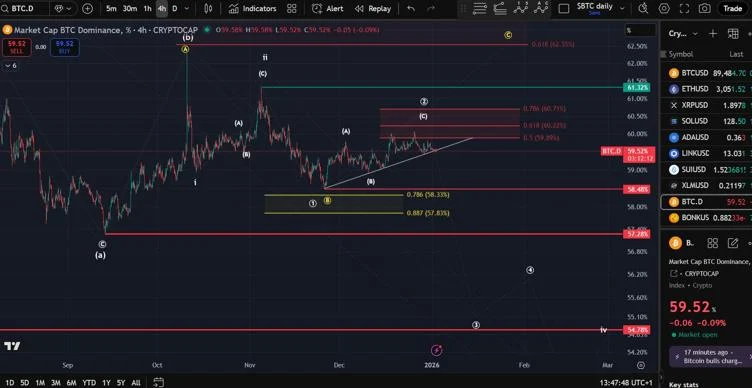
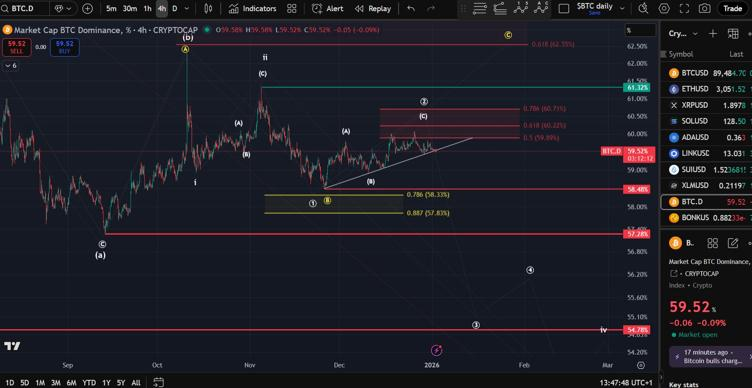
The cryptocurrency market is currently navigating a pivotal transition as Bitcoin, the industry’s primary benchmark, exhibits signs of exhaustion after a prolonged period of dominance. Recent technical analysis and market data suggest that the capital which once flowed almost exclusively into the flagship digital asset is beginning to migrate toward the broader altcoin market. This shift, highlighted by market analyst Justcryptopays and supported by broader institutional research, points toward a potential "alt-season"—a period where alternative cryptocurrencies outperform Bitcoin in terms of percentage gains. The catalyst for this shift appears to be Bitcoin’s recent breach of a long-standing ascending trendline and its precarious struggle to maintain the $90,000 psychological support level.
The Technical Erosion of Bitcoin’s Dominance
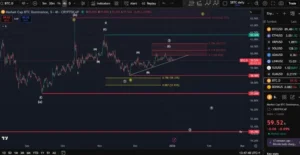
For much of late 2024 and the beginning of 2025, Bitcoin acted as the undisputed engine of the crypto economy. However, technical indicators now suggest a cooling-off period. Market analyst Justcryptopays recently identified a significant break below a key trendline that had previously acted as a reliable floor for Bitcoin’s price action. In technical analysis, such a breach often signals a change in market structure, transforming previous support into resistance and dampening the immediate bullish momentum.
As Bitcoin currently trades around the $90,525 mark, the struggle to hold the $90,000 level is more than just a numerical fluctuation; it represents a psychological battleground for investors. When a leading asset fails to sustain high-profile benchmarks, it often leads to a "sideways" market or a consolidation phase. Historically, during these periods of Bitcoin consolidation, capital does not exit the crypto ecosystem entirely. Instead, it seeks higher-beta opportunities within the altcoin sector, where smaller market caps allow for more significant percentage movements on lower relative volume.
Understanding Capital Rotation Dynamics
The phenomenon of capital rotation is a well-documented cycle within the digital asset space. It typically begins with Bitcoin leading a market rally, attracting institutional and retail capital due to its perceived safety and liquidity. Once Bitcoin reaches a valuation peak or enters a range-bound state, investors begin to harvest profits and "rotate" those gains into Ethereum and other large-cap assets like Solana or XRP.
Following the large-caps, the capital usually trickles down into mid-cap projects and eventually into speculative assets, including memecoins and emerging decentralized finance (DeFi) protocols. Current market observations suggest we are in the early stages of this rotation. The breach of Bitcoin’s trendline acts as a signal to "risk-on" traders that the immediate upside for the primary asset may be limited, making the risk-reward ratio for altcoins more attractive.
The 2025 Bearish Hangover and the 2026 Outlook
As the market enters 2026, it carries the weight of the bearish momentum that characterized much of 2025. The previous year was marked by regulatory scrutiny, macroeconomic uncertainty, and a general tightening of global liquidity. For bulls to regain control in the altcoin market, they must overcome these historical headwinds.

The start of 2026 is being viewed by many as a "clean slate" for the industry. While Bitcoin’s struggle at $90,000 provides a cautious backdrop, it also creates the necessary stability for altcoins to flourish. If Bitcoin can maintain a stable range—even if it is not making new all-time highs—it provides a "low volatility" environment that encourages speculation in more volatile assets. Research suggests that an altcoin rally is not necessarily dependent on Bitcoin crashing, but rather on Bitcoin remaining stable enough to reduce market-wide fear.
Key Altcoins Positioned for Growth
Several prominent digital assets are positioned to benefit from this potential capital migration. Ethereum (ETH), the second-largest cryptocurrency by market capitalization, remains the primary beneficiary of any alt-season. With its extensive ecosystem of Layer 2 scaling solutions and its role as the foundation for the majority of DeFi and NFT activity, Ether is often the first stop for capital leaving Bitcoin.
Solana (SOL) has also emerged as a formidable competitor, often outperforming the broader market during periods of high retail interest due to its high throughput and low transaction costs. Similarly, XRP and Cardano (ADA) continue to maintain significant communities and institutional interest, particularly as regulatory frameworks in various jurisdictions become clearer.
Beyond the established "Blue Chip" altcoins, the market is seeing a resurgence in memecoins. While often criticized for their lack of fundamental utility, memecoins serve as a barometer for retail sentiment. When liquidity flows into these assets, it typically indicates a high level of "risk-on" appetite among individual investors, a necessary component for a sustained alt-season.
The Role of Institutional Research and Market Sentiment
Binance Research and other major analytical firms have noted that the "Altcoin Season Index"—a metric that tracks whether the top 50 altcoins are outperforming Bitcoin over a 90-day period—has begun to show signs of life. While not yet at the "75%" threshold typically used to declare an official alt-season, the upward trajectory is unmistakable.
Institutional sentiment is also shifting. With the maturation of Spot Bitcoin ETFs, many institutional investors are now looking toward the possibility of Ethereum ETFs and other diversified crypto products. This institutionalization of the asset class provides a layer of liquidity that was absent in previous cycles. If institutional players begin to view altcoins as viable diversification tools rather than purely speculative bets, the potential for a prolonged rally increases significantly.
Strategic Implications for Investors
The current market environment presents a complex landscape for both short-term traders and long-term holders. For traders, the increased volatility in the altcoin sector offers opportunities for high-frequency gains. However, the breach of Bitcoin’s trendline serves as a reminder of the inherent risks; if Bitcoin were to experience a sharp correction rather than a sideways consolidation, it could drag the entire market down, regardless of individual altcoin fundamentals.
For long-term investors, the current phase represents a period of "accumulation and positioning." As capital rotates, assets that have been undervalued during Bitcoin’s dominance may finally see their prices align with their technological developments and ecosystem growth. The challenge lies in identifying which projects have the resilience to survive the bearish pressures of the previous year and the utility to thrive in a more mature market.
Broader Economic and Regulatory Context
The shift toward altcoins is also happening against a backdrop of evolving global economic conditions. As central banks navigate the "last mile" of inflation control and consider interest rate adjustments, the liquidity available for high-risk assets like cryptocurrencies remains sensitive to macroeconomic shifts.
Furthermore, the regulatory landscape in 2026 is expected to be more defined than in previous years. With several major court cases involving the SEC and various crypto entities reaching conclusions, the "regulatory fog" is beginning to lift. Clearer rules of engagement for altcoins could unlock significant capital from traditional finance sectors that were previously hesitant to engage with assets of uncertain legal status.
Conclusion: A Balanced Market Structure
The evidence suggests that the cryptocurrency market is moving toward a more balanced distribution of capital. Bitcoin’s inability to decisively conquer and hold levels above $90,000, combined with its technical trendline breach, has created a vacuum that altcoins are eager to fill. While the "bearish momentum of 2025" remains a factor, the early signals of 2026 point toward a market where Ethereum, Solana, XRP, and others may finally step out of Bitcoin’s shadow.
As the rotation continues, the focus for market participants will likely shift from "Bitcoin only" strategies to diversified portfolios that capture the growth of the broader Web3 and DeFi ecosystems. Whether this leads to a full-blown "alt-season" or a more measured redistribution of wealth, the dynamics of the digital asset market are undeniably evolving, presenting fresh possibilities for the year ahead. Vigilant observation of Bitcoin’s support levels and the Altcoin Season Index will be crucial for those looking to capitalize on this potential market awakening.