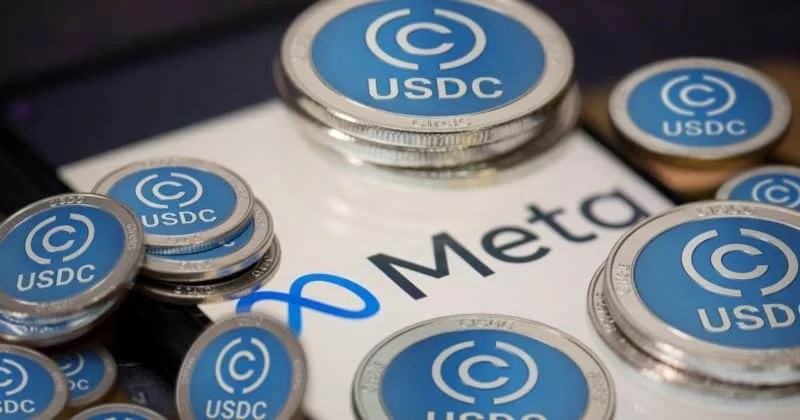
After a hiatus spanning four years, Meta, the global social media conglomerate formerly known as Facebook, has strategically re-entered the burgeoning stablecoin market. The company, under the leadership of Mark Zuckerberg, has commenced a phased rollout of digital currency payouts to a select group of content creators in Colombia and the Philippines. This significant move leverages the USDC stablecoin, specifically operating on the Solana and Polygon blockchain networks. This development, detailed on Meta’s official business support webpage, signals a renewed commitment to exploring and integrating cryptocurrency solutions within its expansive digital ecosystem, marking a notable shift from its prior, more ambitious stablecoin ventures.
The mechanics of this new payout system are designed to be accessible to creators who are comfortable with cryptocurrency. To be eligible for these digital currency disbursements, creators must establish a link between their existing Facebook payout accounts and a compatible cryptocurrency wallet. The company has specified a range of widely recognized wallets that meet these requirements, including MetaMask, Kraken, Phantom, and Binance. A crucial condition for participation is that the chosen wallet must demonstrably support USDC transactions on either the Solana or Polygon blockchain. This emphasis on interoperability with established cryptocurrency infrastructure underscores Meta’s pragmatic approach to its current stablecoin integration.
A key aspect of Meta’s current strategy is its deliberate omission of an integrated "off-ramp" solution. This means that creators who receive their payouts in USDC will not be able to directly convert the stablecoin into their local fiat currency within the Meta platform itself. Instead, they will be required to undertake a multi-step process to liquidate their earnings. This typically involves transferring their USDC holdings from their connected wallet to a third-party cryptocurrency exchange. On these exchanges, creators will then need to trade their USDC for their respective local currency, such as the Colombian Peso or the Philippine Peso. Following this exchange, they can then initiate a withdrawal to their traditional bank accounts. It is important to note that this process will invariably incur fees associated with the cryptocurrency exchange, a factor creators must consider when calculating their net earnings.
In managing the complexities of cryptocurrency transactions, Meta has partnered with Stripe, a leading financial services company. Stripe will be responsible for handling the crypto-specific tax reporting requirements associated with these payouts. This collaboration ensures that creators receive the necessary documentation for their tax obligations, in addition to Meta’s standard financial reporting forms. The involvement of Stripe, a company with extensive experience in facilitating online payments and navigating regulatory landscapes, suggests a commitment to compliance and a streamlined user experience, even within the novel domain of crypto payouts.
This strategic re-entry into the stablecoin space arrives after a period of significant upheaval and strategic recalibration for Meta. The company’s previous foray into digital currency, the ambitious Libra project, which was later rebranded as Diem, ultimately faced insurmountable regulatory hurdles and widespread public scrutiny. Launched with the vision of creating a global, borderless digital currency, Libra encountered fierce opposition from central banks, governments, and financial regulators worldwide, who expressed concerns about its potential impact on monetary policy, financial stability, and consumer protection. After years of intense lobbying and restructuring, the Diem Association announced the sale of its intellectual property and technology to Silvergate Capital Corporation in early 2022, effectively marking the end of Meta’s direct involvement in creating its own independent cryptocurrency.
However, the cessation of the Diem project did not signal a complete abandonment of the cryptocurrency space by Meta. Instead, the company appears to have adopted a more measured and phased approach, exploring stablecoin integrations rather than attempting to build a proprietary global currency from the ground up. This shift in strategy is attributed, in part, to an evolving regulatory environment. As governments and regulatory bodies have begun to develop more nuanced frameworks for digital assets, including stablecoins, Meta may perceive a more conducive landscape for its initiatives. Furthermore, renewed internal efforts within Meta have likely focused on leveraging existing, well-established stablecoins and blockchain networks, thereby mitigating some of the risks and complexities associated with building an entirely new financial infrastructure. The company’s webpage explicitly states that it has resumed "exploring stablecoins" under these improved conditions.
The current collaboration with Stripe extends beyond just cryptocurrency payouts. Meta and Stripe have a long-standing partnership that spans various aspects of e-commerce and financial transactions. Just last month, Stripe introduced a new one-click checkout system on Facebook, designed to enhance the purchasing experience for users. This system enables shoppers to complete transactions with advertisers like Fanatics and Quince efficiently, underscoring the deep integration of Stripe’s payment solutions within Meta’s advertising and commerce platforms. This established relationship provides a solid foundation for the current stablecoin payout initiative, leveraging existing trust and technical infrastructure.
The Evolution of Meta’s Digital Currency Ambitions: A Chronology
Meta’s journey into the realm of digital currencies is marked by a series of ambitious projects, setbacks, and strategic pivots. Understanding this timeline is crucial to contextualizing the current stablecoin payout initiative.
-
June 2019: Meta (then Facebook) officially unveils the Libra cryptocurrency project. The vision is to create a global digital currency backed by a basket of fiat currencies and government securities, aiming to facilitate low-cost, instant cross-border payments for billions of unbanked and underbanked individuals worldwide. The Libra Association, a consortium of companies, is established to govern the project.
-
October 2019 – March 2020: Intense regulatory scrutiny and opposition emerge from governments and central banks globally. Concerns are raised about potential impacts on monetary sovereignty, financial stability, money laundering, and data privacy. Several founding members, including PayPal, Visa, Mastercard, and eBay, withdraw from the Libra Association due to these pressures.
-
April 2020: The Libra Association announces significant modifications to its design, including a shift towards supporting multiple stablecoins, each pegged to a different fiat currency, rather than a single, multi-currency asset. This was an attempt to appease regulators and address concerns about systemic risk.
-
December 2020: The project is rebranded as "Diem" (Latin for "day"), an effort to distance itself from the initial controversies and present a more streamlined, focused vision. The Diem Association continues to work towards launching a stablecoin.
-
January 2021: Meta announces its intention to launch a digital wallet called "Novi" to support the Diem currency. David Marcus, head of Meta’s crypto efforts at the time, testifies before the U.S. Congress, emphasizing the project’s commitment to compliance.
-
February 2022: The Diem Association announces the sale of its intellectual property and technology to Silvergate Capital Corporation. This effectively marks the dissolution of the Diem project, citing an inability to overcome regulatory obstacles.
-
Late 2022 – Early 2023: Reports emerge of Meta exploring new avenues in the cryptocurrency space, including potential integrations with existing stablecoins rather than attempting to launch its own. This period signifies a strategic shift towards leveraging established blockchain infrastructure and regulatory-friendly approaches.
-
Mid-2023 onwards: Meta begins testing and rolling out stablecoin payouts to creators, initially focusing on USDC on the Solana and Polygon networks for specific markets like Colombia and the Philippines. This marks the company’s official return to practical application of stablecoins within its platform.
Supporting Data and Market Context
The decision by Meta to re-enter the stablecoin market is occurring within a dynamic and rapidly evolving cryptocurrency landscape. Stablecoins, digital tokens designed to maintain a stable value relative to a specified asset, typically a fiat currency like the US dollar, have seen exponential growth in adoption and market capitalization.
-
Market Size and Growth: As of early 2024, the total market capitalization of stablecoins exceeds $120 billion USD. Tether (USDT) and USD Coin (USDC) are the two largest stablecoins by market cap, each commanding tens of billions of dollars. This significant market size indicates a substantial existing user base and a growing demand for stable, digital forms of value.
-
USDC’s Position: USD Coin (USDC) is a prominent stablecoin issued by Circle Internet Financial and Coinbase through the Centre Consortium. It is known for its transparency, with regular attestations of its reserves. USDC operates on multiple blockchain networks, including Ethereum, Solana, Polygon, and others, offering flexibility and interoperability. Its adoption by Meta on Solana and Polygon suggests a preference for networks that offer faster transaction speeds and lower fees compared to Ethereum’s mainnet, which can be beneficial for frequent payout distributions.
-
Solana and Polygon Networks:
- Solana: Known for its high throughput and low transaction costs, Solana has emerged as a popular platform for decentralized applications (dApps) and NFT marketplaces. Its architecture is designed for speed, which could be advantageous for processing a high volume of creator payouts.
- Polygon: A Layer-2 scaling solution for Ethereum, Polygon offers significantly faster and cheaper transactions than the Ethereum mainnet. It has gained widespread adoption by major companies and projects looking to build on Ethereum’s ecosystem while mitigating scalability issues.
-
Creator Economy Growth: The global creator economy is booming, with millions of individuals generating income through content creation on platforms like Facebook, Instagram, YouTube, and TikTok. Providing creators with more flexible and efficient payment options, including digital currencies, is becoming increasingly important for talent retention and attraction. Meta’s move directly addresses this need.
Potential Implications and Analysis
Meta’s re-entry into the stablecoin arena, albeit in a more focused capacity than its initial Libra/Diem ambitions, carries several significant implications for the company, the cryptocurrency industry, and the broader creator economy.
-
Enhanced Creator Monetization and Global Reach: By offering payouts in USDC, Meta is providing creators, particularly those in emerging markets like Colombia and the Philippines, with a more accessible and potentially faster way to receive payments. This can reduce reliance on traditional banking systems, which can be slow and costly for international transactions. For creators, this could mean more immediate access to their earnings, enabling better financial planning and investment. The ability to receive payments in a globally recognized stablecoin also opens up possibilities for creators to participate more readily in the decentralized finance (DeFi) ecosystem.
-
Testing Ground for Future Integrations: This initiative can be viewed as a strategic pilot program. If successful, it could pave the way for wider adoption of cryptocurrency payouts across Meta’s entire suite of platforms, including Instagram and WhatsApp. It also allows Meta to gather valuable data and experience in managing cryptocurrency transactions and user adoption within a controlled environment. This experience could inform future decisions about further cryptocurrency integrations, potentially including direct payments between users or e-commerce functionalities.
-
Regulatory Navigation and Compliance: Meta’s careful selection of established stablecoins (USDC) and blockchain networks (Solana, Polygon), along with its partnership with Stripe for tax reporting, demonstrates a more cautious and compliant approach compared to the Libra/Diem era. This strategy aims to mitigate regulatory risks by operating within existing frameworks and leveraging established infrastructure. The success of this program could also contribute to the broader acceptance and regulatory clarity surrounding stablecoins.
-
Competition and Innovation in the Creator Economy: This move intensifies competition among social media platforms to offer the most attractive monetization tools for creators. By embracing cryptocurrency, Meta is positioning itself as an innovator in creator payments, potentially attracting creators who are already engaged with or interested in digital assets. This could spur other platforms to explore similar payment solutions.
-
Challenges and User Adoption: While the move is promising, several challenges remain. The reliance on third-party exchanges for off-ramping can be a friction point for less crypto-savvy creators. Education and support will be crucial to ensure widespread adoption and understanding. The volatility of cryptocurrency markets, though mitigated by stablecoins, still requires creators to be aware of the risks and manage their assets appropriately. Furthermore, the regulatory landscape for stablecoins is still evolving globally, and future policy changes could impact Meta’s operations.
Official Responses and Industry Reactions (Inferred)
While specific official statements from Meta regarding this particular rollout are primarily found on their support pages, the broader context suggests a deliberate strategy. Mark Zuckerberg himself has previously expressed interest in the potential of blockchain technology and digital currencies, indicating a long-term vision for their integration.
The choice of USDC, a stablecoin known for its regulatory compliance and transparency, suggests a desire to work within established financial and regulatory expectations. Circle, the issuer of USDC, has consistently emphasized its commitment to regulatory adherence and has welcomed partnerships that promote responsible stablecoin adoption.
Stripe’s continued collaboration with Meta on payment solutions underscores their confidence in Meta’s ability to implement such initiatives effectively. Stripe’s expertise in navigating complex payment ecosystems, including emerging digital assets, positions them as a key partner in ensuring compliance and operational efficiency.
The broader cryptocurrency industry is likely to view this move as a positive validation of stablecoins and their utility. Major cryptocurrency exchanges that support USDC and the Solana and Polygon networks will likely see increased activity from creators looking to convert their payouts. Developers and projects on these networks may also benefit from increased user adoption and transaction volume.
Conclusion
Meta’s re-entry into the stablecoin market, through creator payouts using USDC on Solana and Polygon, represents a significant evolution in its approach to digital currencies. Moving away from the ambitious creation of its own global currency, the company is now strategically leveraging existing, regulated stablecoin infrastructure. This measured approach, combined with a focus on specific markets and creator monetization, signals a pragmatic path forward. The success of this initiative could have far-reaching implications, not only for Meta’s platforms and its vast network of creators but also for the broader acceptance and integration of stablecoins into the mainstream digital economy. As the creator economy continues to grow and digital asset adoption matures, Meta’s calculated steps in this space warrant close observation.