
Bhutan has formally denied reports suggesting a significant divestment of its Bitcoin holdings, a move that has ignited considerable discussion within the cryptocurrency community. The denials come in the wake of on-chain data analysis by Arkham Intelligence, which indicated a substantial reduction in Bitcoin reserves attributed to wallets linked to the Himalayan nation’s sovereign wealth fund, Druk Holding and Investments (DHI). While officials maintain that no major sales have occurred recently, the discrepancy between the blockchain data and official statements has fueled ongoing speculation regarding the nation’s cryptocurrency strategy and financial management.
Unveiling the Discrepancy: On-Chain Data vs. Official Statements
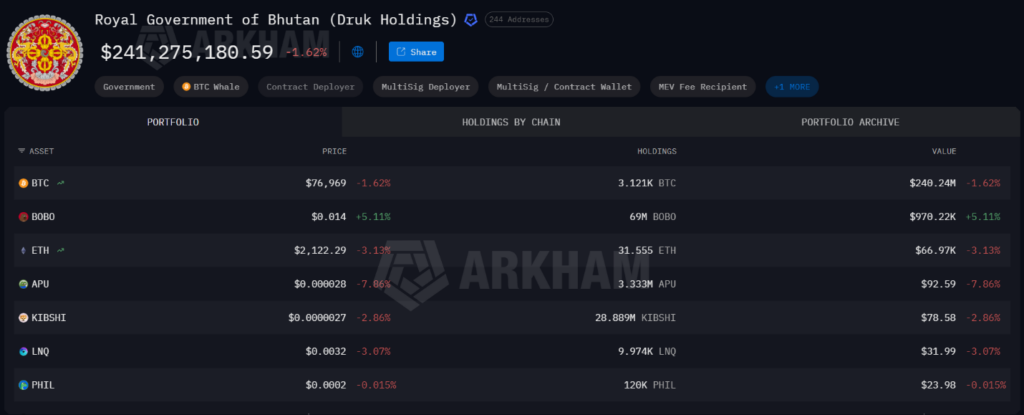
The catalyst for this unfolding narrative is the analysis of wallet activity by Arkham Intelligence, a prominent blockchain analytics firm. According to their findings, wallets purportedly associated with Bhutan’s DHI, which at its zenith in October 2024 allegedly held close to 13,000 Bitcoin (BTC), now reportedly contain just over 3,100 BTC. This dramatic apparent decrease has led to widespread conjecture that Bhutan may have liquidated a substantial portion of its digital asset reserves over the past year, especially given Bitcoin’s recent record highs.
However, in direct contradiction to these on-chain observations, Bhutanese officials have unequivocally stated that no such large-scale sales have taken place. Ujjwal Deep Dahal, CEO of DHI, communicated to CoinDesk via email that he could not recall the last time the organization engaged in selling Bitcoin. This official stance, while denying outright sales, has not provided a clear explanation for the observed wallet movements, nor has it disputed the attribution of the wallets to Bhutan. This ambiguity has left the door open for various interpretations within the crypto sphere, including potential internal asset reallocations, collateral arrangements, or other sophisticated financial maneuvers that may not constitute a direct sale to the open market.
A Timeline of Bhutan’s Bitcoin Journey
Bhutan’s involvement with Bitcoin began not through direct purchase, but through a strategic initiative focused on hydro-powered mining. This approach was heralded as an environmentally conscious method of accumulating digital assets, leveraging the nation’s abundant hydroelectric power resources.
- Early Accumulation Phase: While specific dates are not publicly disclosed, it is understood that Bhutan began its Bitcoin mining operations several years ago, gradually building its treasury through energy-intensive processes. The nation’s commitment to sustainable energy provided a unique advantage in the mining landscape, often characterized by high energy consumption and environmental concerns.
- Peak Holdings Identified: Arkham Intelligence data suggests that Bhutan’s Bitcoin reserves reached their peak around October 2024, with an estimated holding of nearly 13,000 BTC. This period coincided with a generally bullish sentiment in the cryptocurrency market.
- Observed Wallet Activity: In recent months, analysis of on-chain data revealed significant outgoing transactions from wallets attributed to Bhutan. These transfers were noted to involve entities such as OKX and Galaxy Digital, commonly associated with centralized exchanges and institutional trading platforms, which often facilitate large-scale asset movements and sales.
- Recent Official Denials: In response to mounting speculation fueled by the on-chain data, DHI officials have publicly denied any recent large-scale Bitcoin sales, with the CEO stating he could not recall the last time such a transaction occurred.
Supporting Data and Analyst Perspectives
The Arkham Intelligence report is not an isolated observation. Blockchain analysts have been monitoring large wallet transfers linked to Bhutan for some time. The movement of significant Bitcoin amounts to exchanges is a well-understood precursor to potential sell-offs. When coupled with the substantial decrease in the total Bitcoin held in these identified wallets, the inference of a sale becomes a logical, albeit unconfirmed, conclusion for many observers.

The destinations of these outgoing transactions are particularly noteworthy. Transfers to platforms like OKX and Galaxy Digital suggest a structured approach to asset management. These platforms are equipped to handle large volumes of cryptocurrency and often serve as conduits for institutional investors looking to enter or exit positions. For a nation holding a substantial treasury, these platforms would be logical choices for managing such significant movements, whether for strategic reallocation or eventual sale.
Bhutan’s Sustainable Mining Initiative: A Cornerstone of its Crypto Strategy
Bhutan’s unique approach to acquiring Bitcoin through hydroelectricity-powered mining has been a defining characteristic of its digital asset strategy. This method has been consistently promoted as a sustainable and environmentally responsible endeavor, aligning with the nation’s broader development goals.
The country reportedly operates multiple state-backed mining facilities, designed to harness its abundant renewable energy. Officials have emphasized that these operations have remained active, even amidst broader industry challenges and fluctuations in mining profitability. Favorable weather conditions have reportedly contributed to strong hydroelectric output, ensuring the continuity of mining activities. Furthermore, Bhutan has been engaged in upgrading its mining infrastructure with newer, more efficient equipment to maintain competitiveness in an evolving industry.
This focus on sustainable mining presents a stark contrast to the energy-intensive practices of many other mining operations globally, which have faced increasing scrutiny and regulatory pressure due to their environmental impact. Bhutan’s model has been presented as a potential blueprint for other nations looking to engage with the cryptocurrency space responsibly.
Broader Industry Context: Mining Profitability and Market Pressures
The speculation surrounding Bhutan’s Bitcoin holdings occurs against a backdrop of significant challenges within the global Bitcoin mining industry. A recent report from digital asset investment firm CoinShares highlighted a difficult financial period for many mining companies following the latest Bitcoin halving cycle.
The report indicated a substantial surge in average mining costs for public companies in late 2025, while mining revenues weakened due to a decline in "hash price" metrics. This confluence of factors has created one of the most challenging operating environments for miners in recent years, with several firms reportedly operating at or below their profitability thresholds.
Against this backdrop, some analysts have speculated that Bhutan might have reduced its mining activity or sold reserves to mitigate operational pressures. The observation of a lack of fresh inflows into wallets associated with Bhutan’s mining operations in recent months has further fueled these concerns, suggesting a potential shift in resource allocation or operational strategy.
Implications for Bhutan’s "Gelephu Mindfulness City" Project
The controversy surrounding Bhutan’s Bitcoin reserves has also cast a spotlight on the nation’s ambitious future plans, particularly the "Gelephu Mindfulness City" project. Late last year, Bhutan announced its intention to allocate up to 10,000 BTC towards the development of this major economic and innovation zone, designed to attract significant international investment.
At the time of the announcement, this pledge represented one of the largest state-backed commitments of Bitcoin for a development project globally. However, if Arkham Intelligence’s estimates regarding Bhutan’s current Bitcoin reserves are accurate, the nation may no longer hold sufficient BTC to fully realize this commitment. This potential shortfall raises questions about the project’s funding mechanisms and Bhutan’s ability to leverage its digital asset treasury as envisioned.
The situation underscores the inherent volatility and strategic considerations involved in holding significant amounts of cryptocurrency. While Bhutan has maintained a unique and sustainable approach to its Bitcoin holdings, the recent events highlight the complex interplay between on-chain data, official pronouncements, and the evolving landscape of both the cryptocurrency market and national development strategies. The lack of definitive clarification from Bhutanese officials means that the market and observers will continue to analyze every transaction and statement with keen interest, seeking to understand the true trajectory of the nation’s digital asset reserves and their role in its future economic aspirations.