The global cryptocurrency market is currently navigating a complex phase of consolidation, yet seasoned market analysts and structural strategists are pointing toward a significant shift in the digital asset landscape. While Bitcoin remains the primary driver of market sentiment, a growing consensus suggests that a selection of major altcoins—including XRP, Solana (SOL), Cardano (ADA), BNB, Tron (TRX), and Dogecoin (DOGE)—is positioned for a multi-year expansion that could redefine the sector’s valuation by the end of the decade. This projected growth is increasingly linked to specific technical milestones within the Ethereum ecosystem, which historically serves as the primary gateway for liquidity flowing into the broader altcoin market.
The Multi-Year Altcoin Cycle: A Strategic Overview
Market commentator Osemka recently provided a comprehensive outlook on the current trajectory of the altcoin sector, identifying what appears to be the early stages of a "minor impulse" within a much larger, multi-year cycle. According to this thesis, the current market movements are not merely isolated fluctuations but part of a structured four-year expansion pattern that has characterized the cryptocurrency industry since its inception. Osemka suggests that the initial phase of this rally will unfold over the coming months, likely providing a period of upward momentum before a temporary market pause or correction toward the end of the year.
However, the most significant capital inflows are not expected to reach their peak until 2027. This long-term perspective aligns with the historical behavior of digital assets, where prolonged periods of accumulation and infrastructure building eventually give way to parabolic growth phases. The analyst’s view, which has remained consistent since mid-2025, posits that the current expansion is following a traditional four-year cycle, albeit one with deeper institutional involvement and more sophisticated market mechanics than previous iterations.
Historical Context and the Magnitude of Expansion
To understand the potential scale of the upcoming rally, analysts frequently point to the historical performance of the altcoin market capitalization. In previous cycles, "Altcoin Seasons" have demonstrated the ability to generate exponential returns that far outpace the broader financial markets.
During the 2017 cycle, the total altcoin market capitalization (excluding Bitcoin) experienced a meteoric rise. Starting from a relatively modest base of approximately $10 billion, the sector expanded to over $600 billion at its peak. This represented a staggering 6,000 percent increase in total value, driven largely by the Initial Coin Offering (ICO) boom and the first wave of mainstream retail interest.
The subsequent cycle, spanning 2020 and 2021, saw the sector move from a valuation of around $90 billion to approximately $1.7 trillion. While the percentage gain was lower—roughly 1,800 percent—the sheer volume of capital entering the market was significantly higher. This period was defined by the emergence of Decentralized Finance (DeFi), the rise of Non-Fungible Tokens (NFTs), and the first serious signs of institutional adoption.
Crypto strategist Mark Chadwick argues that the current market structure is even more robust than in 2017 or 2021. He notes that the market now benefits from deeper capital pools, a more resilient technological infrastructure, and the gradual emergence of tokenized financial markets. These factors, combined with increasing regulatory clarity in several major jurisdictions, could provide the foundation for what some believe will be the largest altcoin cycle in history.
The Ethereum Catalyst: Why the Milestone Matters
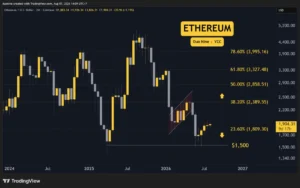
The title’s reference to an Ethereum "milestone" points to a critical technical and psychological threshold that often precedes an altcoin explosion. In the hierarchy of digital assets, Ethereum (ETH) acts as a bridge between Bitcoin and the rest of the market. Historically, when Ethereum achieves price discovery or breaks through major resistance levels against Bitcoin (the ETH/BTC pair), it signals to investors that the market’s risk appetite has increased.
Analysts are closely watching Ethereum’s ability to maintain its dominance and clear specific price targets. A decisive move by Ethereum—often referred to as the "flippening" of sentiment—acts as a catalyst for liquidity to rotate into high-cap assets like XRP, Solana, and Cardano. Furthermore, the successful integration of Layer 2 scaling solutions and the potential for increased institutional demand through spot Ethereum ETFs (Exchange-Traded Funds) are seen as the primary milestones that could unlock the next wave of capital for the broader ecosystem.
Profiles of the Leading Contenders
Each of the assets mentioned by analysts carries a unique value proposition and specific catalysts that could drive their individual expansions:
XRP and Cross-Border Utility: Ripple’s XRP has long been a focal point of institutional interest, particularly in the realm of cross-border payments. Despite years of regulatory headwinds in the United States, the asset remains a top contender for global financial integration. Some projections suggest that the volume of cross-border payments utilizing XRP-based technology could reach $10 trillion by 2030. As legal clarity improves, the potential for XRP to reclaim its position as a dominant liquidity bridge remains high.
Solana and the Race for Speed: Solana has emerged as the primary challenger to Ethereum’s dominance in the dApp and NFT space. Known for its high throughput and low transaction costs, Solana has become a favorite for retail users and developers alike. Analysts believe that if Solana can maintain its key support levels and continue to improve network stability, it has a clear path toward reclaiming and exceeding its previous all-time highs.
Cardano and the Voltaire Era: Cardano continues to focus on a research-driven approach to blockchain development. With the "Voltaire" era bringing decentralized governance to the forefront, ADA remains a significant player for investors seeking a long-term, stable ecosystem. While its price action has been more conservative compared to its peers, its structural signals indicate a period of accumulation that could precede a major breakout.
BNB and Ecosystem Integration: As the native token of the Binance ecosystem, BNB remains one of the most utility-dense assets in the market. Its role in transaction fees, launchpads, and the Binance Smart Chain (now BNB Chain) provides a constant source of demand. The asset’s performance is often tied to the health of the broader exchange ecosystem and the continued burning of tokens, which reduces supply over time.
Dogecoin and the "Meme-to-Utility" Pipeline: Once viewed solely as a joke, Dogecoin has evolved into a cultural phenomenon with significant market cap. The "Elon Musk effect" continues to play a role in its volatility, but the community is increasingly looking toward technical upgrades and potential integration into mainstream payment platforms to provide long-term value.
Current Market Pressures and Macroeconomic Headwinds
Despite the optimistic long-term outlook, the immediate market environment remains challenging. Data from CoinMarketCap indicates a recent 2.37% drop in the total market cap, as "fear" once again becomes the dominant sentiment among retail traders.
Several factors are contributing to this short-term pressure:
- Macroeconomic Uncertainty: Persistent inflation and the shifting policies of the Federal Reserve regarding interest rates continue to affect "risk-on" assets like cryptocurrencies.
- Geopolitical Tensions: Global instability often leads to a "flight to safety," which can temporarily drain liquidity from the crypto markets into traditional assets like gold or the U.S. Dollar.
- Regulatory Scrutiny: While clarity is improving, the ongoing legal battles between the SEC and various crypto entities continue to create a "wait-and-see" atmosphere among institutional investors.
The Path Toward 2027: A Chronology of Expectations
If the current analyst projections hold true, the next three years will likely follow a specific chronological development:
- 2024 – Late 2025: The Accumulation and Minor Impulse Phase. During this period, the market is expected to test local highs, followed by a series of corrections. This is the "shakeout" phase where weaker hands exit the market, and institutional players build their positions.
- 2026: The Infrastructure Breakout. As tokenization of real-world assets (RWA) becomes more mainstream and Ethereum achieves its key scalability milestones, the "altcoin season" will likely begin in earnest.
- 2027: The Peak Expansion. This is the year many analysts identify as the potential peak of the current cycle. If the 2017 and 2021 patterns repeat at a larger scale, this period could see the total altcoin market cap reaching multi-trillion dollar levels.
Conclusion and Broader Implications
The potential for a massive expansion in XRP, Solana, Cardano, and other major altcoins is not merely a product of speculation but is rooted in historical cycle analysis and the evolving structure of global finance. The shift from a retail-driven market to one characterized by institutional participation and real-world utility marks a turning point for the industry.
While short-term volatility and macroeconomic pressures may cause temporary setbacks, the underlying trend suggests a sector that is maturing. If Ethereum can lead the way by attaining its critical milestones, the resulting "liquidity waterfall" could propel the altcoin market into its most significant growth phase to date. Investors and market participants are now watching the 2027 horizon, anticipating a rally that could dwarf the historic moves of the past decade.