


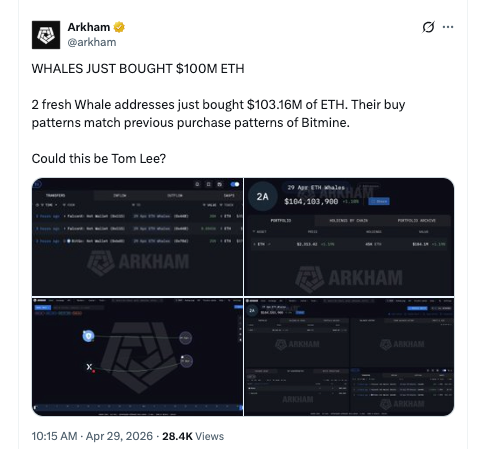
A significant acquisition of Ethereum (ETH) totaling approximately $103 million has been executed by an entity identified as an Ethereum whale, according to recent on-chain intelligence reported by Arkham. The transactions, which saw substantial amounts of ETH transferred to newly established wallet addresses, originated from institutional liquidity providers, specifically identified as FalconX and BitGo. This large-scale purchase has drawn parallels to earlier buying patterns attributed to BitMine, a firm associated with prominent market analyst Tom Lee.
The on-chain intelligence firm Arkham shared details of this significant transaction via its official X (formerly Twitter) account. The report indicated that the whale acquired a total of 45,000 ETH. At the time of the transaction, this amount was valued at nearly $103 million. The acquisition was split between two major institutional platforms: 20,000 ETH was purchased from FalconX, and an additional 25,000 ETH was bought from BitGo. The ultimate destination of these funds, the newly created wallets, has led to speculation about their intended use, whether for future accumulation or other strategic purposes within the Ethereum ecosystem.
Arkham’s analysis highlighted a striking resemblance between the current transaction structure and previous purchases made by BitMine. Key similarities include the utilization of fresh, previously unused wallet addresses for the acquired assets and the sourcing of these assets from established institutional liquidity hubs. While this pattern strongly suggests a connection to BitMine’s operational strategy, Arkham cautioned that there is currently no definitive, publicly released confirmation or press statement from Tom Lee’s firm to substantiate this direct link.
Tom Lee, a well-regarded figure in the financial markets, has been a vocal proponent of Ethereum’s long-term potential, even amidst the network’s ongoing developmental challenges and market fluctuations. His perspective has often positioned Ethereum as a strategic asset, particularly in the context of global economic and geopolitical uncertainties. For instance, Lee has previously described Ethereum as a "wartime store of value," a characterization that underscores its perceived resilience and potential to preserve wealth during periods of heightened instability, a sentiment amplified by recent global events, including geopolitical tensions and economic volatility.
The strategy employed by BitMine, conceptually aligned with Michael Saylor’s approach to Bitcoin accumulation, centers on building a substantial ETH holding. The firm’s ambitious objective is to eventually possess approximately 5% of Ethereum’s total circulating supply. This target, often referred to as the "Alchemy of 5%," represents a significant commitment to the second-largest cryptocurrency by market capitalization.
As of recent data, Ethereum’s total market capitalization hovers around $274 billion. To achieve its target of holding 5% of the total supply, BitMine would need to acquire an additional substantial amount of ETH. With its current holdings estimated at around 5 million ETH, representing approximately 4.21% of the total supply, the firm would require an investment of roughly $1.7 billion at current market prices to reach its ambitious goal. This contrasts with Michael Saylor’s MicroStrategy, which, while also pursuing a significant accumulation strategy, focuses exclusively on Bitcoin. Given Bitcoin’s larger market capitalization of approximately $1.5 trillion, MicroStrategy’s equivalent goal would necessitate a substantially larger investment, roughly five times that of BitMine’s ETH target.
Institutional Interest and the Ethereum Landscape
The acquisition by a large Ethereum whale underscores a growing trend of institutional interest in the long-term utility and economic model of the Ethereum network. While significant accumulation activities are a more common occurrence within the Bitcoin market, such large-scale ETH purchases by identifiable entities are less frequent. This difference can be partly attributed to the evolving regulatory landscape and the market’s perception of both assets.
The subdued performance of Ethereum Exchange Traded Funds (ETFs) in attracting comparable levels of investor attention as their Bitcoin counterparts has also contributed to a more discernible tracking of major ETH buyers. In a market environment that may be characterized by caution, identifying large players becomes more straightforward, especially during periods of price consolidation or downturn.
Despite the absence of direct confirmation, the transaction structure itself provides compelling evidence of increasing institutional confidence in Ethereum’s fundamental value proposition. Beyond mere price appreciation, major players are reportedly accumulating and securing ETH through on-chain staking. This feature, unique to Proof-of-Stake (PoS) networks like Ethereum, allows investors to earn rewards by participating in network validation, a mechanism not available to Bitcoin investors who rely on Proof-of-Work (PoW) consensus. The ability to generate passive income through staking further enhances Ethereum’s appeal as a long-term investment, attracting capital that seeks yield in addition to capital gains.
The Evolution of Ethereum: Beyond Linear Growth
The narrative surrounding Ethereum’s development and market performance is often characterized as non-linear, suggesting a series of fundamental shifts rather than a gradual, incremental progression. This perspective is particularly relevant when considering the network’s transition to Proof-of-Stake with "The Merge" and subsequent upgrades like the Dencun upgrade, which introduced crucial scalability improvements through proto-danksharding. These events represent paradigm shifts that fundamentally alter the network’s economics, security, and efficiency.
Market experts often point to these foundational upgrades as drivers of Ethereum’s long-term value. The transition to PoS significantly reduced the network’s energy consumption and introduced a staking yield mechanism, altering its economic model from a purely speculative asset to one with inherent yield-generating capabilities. This has broadened its appeal to a wider range of investors, including institutions that prioritize sustainable and yield-bearing assets.
The Dencun upgrade, in particular, with its implementation of EIP-4844 (proto-danksharding), is designed to drastically reduce transaction fees for Layer 2 scaling solutions. By introducing "blobs" of data that can be posted to the Ethereum mainnet more efficiently, L2s can process transactions at a fraction of the current cost. This is a critical step towards making decentralized applications (dApps) more accessible and user-friendly, potentially unlocking new use cases and driving broader adoption. The implications of reduced fees are far-reaching, impacting everything from decentralized finance (DeFi) protocols to non-fungible token (NFT) marketplaces and gaming applications built on Ethereum.
Broader Market Implications and Future Outlook
The substantial ETH purchase, regardless of the ultimate buyer’s identity, signals a strong conviction in Ethereum’s future trajectory. This accumulation by a significant player suggests that sophisticated market participants are looking beyond short-term price fluctuations and are positioning themselves for the long-term growth and utility of the Ethereum network.
The increasing institutional allocation towards ETH, particularly through direct accumulation and staking, contrasts with the more speculative nature of some earlier crypto investments. It points towards a maturation of the digital asset market, where fundamental utility, technological innovation, and economic models are becoming increasingly important factors in investment decisions.
Furthermore, the comparison with Bitcoin’s market dynamics highlights the distinct evolutionary paths of the two leading cryptocurrencies. While Bitcoin remains a primary store of value and a digital gold narrative, Ethereum is increasingly being viewed as a programmable digital asset with a multifaceted utility, serving as the backbone for a vast and expanding decentralized economy. The ongoing development of Ethereum, with its focus on scalability, efficiency, and sustainability, positions it as a crucial infrastructure for the future of the internet and finance.
The continued accumulation by large holders, coupled with the ongoing technological advancements, suggests that Ethereum is entering a new phase of its development. This phase is likely to be characterized by sustained growth in its ecosystem, increased adoption of its native applications, and a deepening integration into the broader financial landscape. The $103 million purchase serves as a tangible indicator of this evolving sentiment and the strategic importance that major market players are placing on Ethereum’s future.














