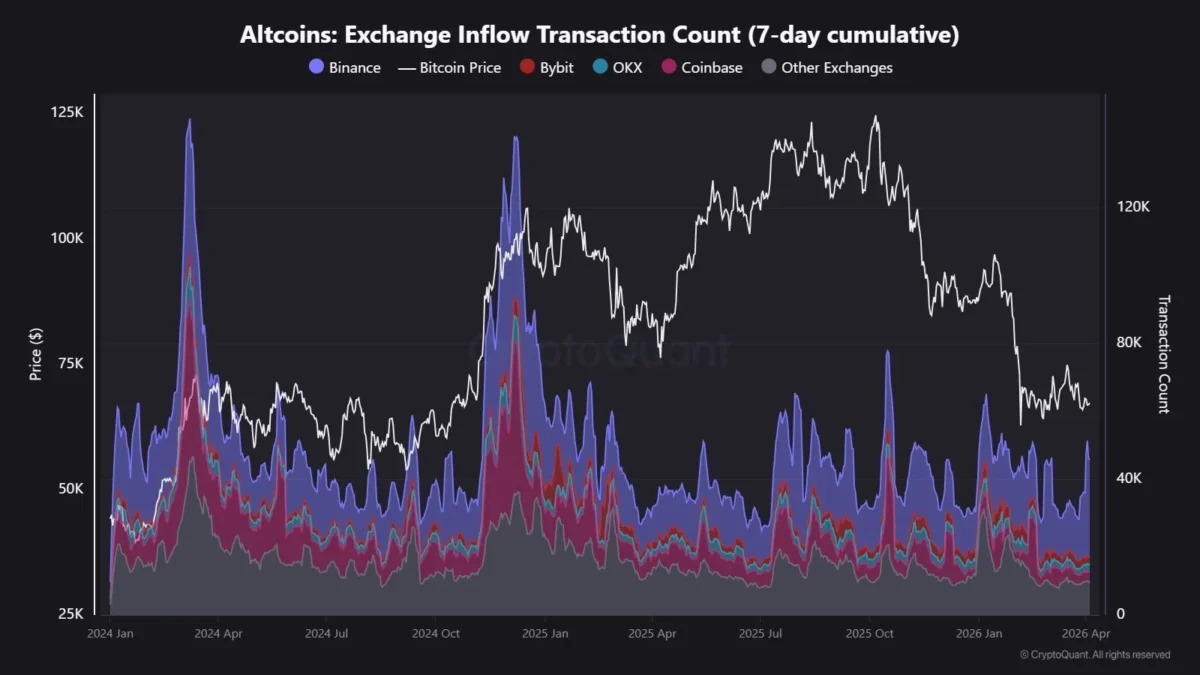
The global cryptocurrency landscape encountered a significant localized anomaly on April 2, as transaction data from Binance, the world’s largest digital asset exchange by volume, revealed a massive surge in altcoin inflows that was not mirrored by its primary competitors. Market analysts and on-chain data providers identified a spike of approximately 34,000 altcoin inflow transactions, marking the highest level of such activity in nearly a quarter. While a surge of this magnitude typically suggests a broad-based resurgence in altcoin interest, the absence of similar data points on platforms such as Coinbase, OKX, and Bybit indicates that this movement was driven by factors exclusive to the Binance ecosystem.
Detailed investigations into the timing of this activity suggest that the influx was not a vote of confidence in the altcoin sector itself, but rather a tactical migration of liquidity toward newly launched financial instruments. On April 1, just twenty-four hours prior to the recorded spike, Binance expanded its suite of traditional finance (TradFi) offerings by launching futures contracts tied to West Texas Intermediate (WTI) crude oil and natural gas. This strategic expansion allowed crypto-native traders to gain exposure to global energy markets using their existing accounts and collateral, effectively siphoning speculative capital away from volatile digital assets and into commodity-linked derivatives.
The Anatomy of the April 2nd Inflow Anomaly
The transaction spike identified by CryptoQuant analyst Maartunn stands out due to its isolated nature. In a standard market recovery, liquidity flows are generally distributed across the major exchanges as arbitrageurs and retail traders react to global price signals. However, on April 2, while Binance saw its highest inflow count in three months, other major venues remained relatively stagnant. This divergence serves as a critical indicator that the "altcoin" activity was merely a conduit for a different type of trade.
Inflow transactions represent the movement of assets from private wallets or other exchanges into a centralized platform. Usually, high inflows are interpreted as a bearish signal, suggesting that investors are preparing to sell their holdings. In this specific context, the data suggests a more nuanced behavior: traders were moving altcoin holdings onto Binance to serve as margin or liquidity for the newly available commodity pairs. By leveraging their existing crypto portfolios, traders could enter positions in the oil and gas markets without needing to offramp into fiat currency or exit the Binance ecosystem.

Chronology of the Commodity Expansion
The timeline of events highlights a rapid shift in trader priorities. Over the last several months, Binance has incrementally integrated traditional assets into its futures platform, beginning with precious metals like gold and silver. These instruments were designed to bridge the gap between the high-volatility crypto market and the more macro-driven traditional markets.
On April 1, the platform officially listed WTI Crude Oil and Natural Gas futures. These commodities are currently at the center of intense global scrutiny due to ongoing geopolitical tensions in the Middle East and Eastern Europe, as well as fluctuating demand forecasts from major industrial economies. The timing of the launch provided an immediate outlet for crypto traders looking to hedge against inflation or capitalize on energy price volatility. By April 2, the "footprint" of this migration became visible on-chain. The 34,000 transactions recorded were the mechanical result of thousands of users repositioning their capital to participate in these new markets.
The Erosion of Altcoin Market Structure
While the inflow spike benefited Binance’s overall volume, it painted a concerning picture for the altcoin market’s internal health. The total market capitalization of cryptocurrencies, excluding the top ten assets—often referred to by the "OTHERS" ticker on technical charts—has shown persistent signs of exhaustion. Currently hovering around the $172 billion mark, the sector is struggling to maintain the bullish momentum seen in previous cycles.
Technical analysis of the weekly charts reveals a "lower high" structure, a classic bearish signal indicating that each successive recovery attempt is weaker than the last. After failing to sustain a breakout above the $300 billion threshold in mid-2025, the altcoin market has entered a phase of distribution. The price action has slipped below the 50-week moving average and has recently tested the 200-week moving average, suggesting a transition from a growth phase into a corrective or range-bound environment.
The migration of capital toward commodities further complicates this recovery. In a liquidity-constrained environment, every dollar moved into an oil futures contract is a dollar removed from the bid-side liquidity of mid-cap and small-cap altcoins. This internal "cannibalization" of crypto liquidity means that even if the total value locked within exchanges remains stable, the price support for altcoins continues to erode.

Macroeconomic Drivers and Speculative Rotation
The shift from altcoins to commodities reflects a broader change in the profile of the modern crypto trader. Once characterized by a "buy and hold" mentality focused on decentralized technology, a significant portion of the market now consists of sophisticated speculators who prioritize volatility and macro trends over asset class loyalty.
Commodities like WTI crude and natural gas are currently responding to high-impact global events, including OPEC+ production cuts and shifts in U.S. energy policy. For a trader accustomed to the 24/7 volatility of the crypto market, these energy futures offer a familiar risk-reward profile but with the added benefit of being tied to tangible global economic drivers.
Financial analysts note that this rotation is a symptom of a "risk-off" sentiment within the crypto sector specifically. While Bitcoin remains a dominant store of value, the speculative appetite for "utility tokens" or "meme coins" has faced stiff competition from traditional assets that are now more accessible than ever. The integration of TradFi tickers into crypto interfaces effectively lowers the barrier to entry for diversification, allowing capital to flow out of altcoins with unprecedented speed.
Technical Support Levels and Future Outlook
For the altcoin market to reclaim its structural strength, it would need to see a sustained move back above the $200 billion market cap level. However, current volume patterns suggest that selling pressure remains aggressive during downturns, while buying participation during rallies is tepid. This asymmetry is a hallmark of a distribution phase, where larger holders are gradually exiting positions.
Key levels to watch in the coming months include:

- The $160–$170 Billion Range: This is the current primary support zone. A failure to hold this level could trigger a rapid decline toward the $130 billion mark, representing a further 20% drawdown for the broader altcoin market.
- The 100-Week Moving Average: Reclaiming this level with high volume would be the first signal that the capital rotation has slowed and that organic demand for altcoins is returning.
- Commodity Volume vs. Altcoin Volume: If WTI and Gold futures continue to sit among the top five traded pairs on Binance, it confirms that the exchange is successfully pivoting toward a multi-asset brokerage model, potentially at the expense of its original altcoin-centric identity.
Implications for the Exchange Ecosystem
The success of Binance’s commodity integration is likely to prompt a response from other major exchanges. If Coinbase or OKX perceive that they are losing active traders to Binance’s TradFi suite, they may be forced to accelerate their own listings of traditional instruments. This would mark a fundamental shift in the cryptocurrency industry, moving away from a "crypto-only" ethos toward a unified "everything exchange" model.
For investors, this evolution provides more tools for portfolio management but introduces new risks. The interdependency between crypto liquidity and commodity prices means that a shock in the energy markets could now trigger forced liquidations of crypto collateral, creating a new bridge for contagion between traditional and digital markets.
In conclusion, the April 2nd transaction spike on Binance was a landmark event that masked a deeper shift in market dynamics. It was not a sign of an "altcoin season" on the horizon, but rather a demonstration of how quickly speculative capital can pivot when new, macro-relevant opportunities emerge. As altcoins continue to battle technical headwinds and a lack of fresh narratives, the migration toward commodities highlights a maturing—and increasingly pragmatic—trading base that prioritizes profit over the underlying asset’s technology.