



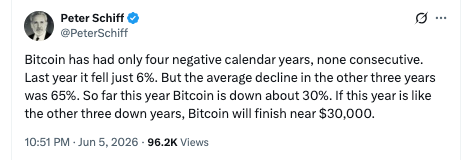
Veteran financial commentator and ardent Bitcoin critic Peter Schiff has once again voiced his bearish outlook on the flagship cryptocurrency, predicting a potential plunge to $30,000 by 2026. This latest pronouncement comes in the wake of a recent price correction that saw Bitcoin dip below the $60,000 mark. Schiff, known for his advocacy of gold as a superior store of value, leveraged historical price action to forecast a significant downturn for Bitcoin, drawing parallels with previous sharp corrections observed in 2014, 2018, and 2022. His analysis suggests a possible 65% devaluation in 2026, which would bring its market value back to levels not seen in several years, posing a significant challenge to its long-term viability according to his perspective.
Schiff’s critique is particularly pointed towards the leveraged investment strategies employed by entities such as MicroStrategy, led by Michael Saylor. He has consistently warned that such aggressive accumulation of Bitcoin, often financed through debt or other financial instruments, creates systemic risk. The recent sale of a small fraction of MicroStrategy’s Bitcoin holdings – 32 BTC, valued at approximately $1.9 million – by the company ignited speculation about the sustainability of their strategy and the potential for larger liquidations. Saylor, a vocal proponent of Bitcoin as a treasury reserve asset, has committed to delivering 11% annual yields on his STRC stock, with proceeds predominantly directed towards acquiring more Bitcoin. This strategy has positioned MicroStrategy as one of the largest institutional holders of the digital asset, accumulating close to one million Bitcoin.
However, Schiff remains unconvinced by Saylor’s assurances that he will never be forced to liquidate these holdings. He posits that the inherent volatility of Bitcoin, coupled with the financial pressures that could arise from market downturns or debt obligations, could compel Saylor to offload a substantial portion of MicroStrategy’s reserves. Such a move, in Schiff’s view, would trigger a cascading effect, leading to a significant price crash for Bitcoin. This scenario, he argues, would validate his long-held thesis about the speculative and unsustainable nature of Bitcoin as an investment.
Historical Precedents and Schiff’s Analysis

Peter Schiff’s predictions are not new; he has been a consistent voice of skepticism regarding Bitcoin’s long-term prospects since its inception. His recent commentary on X (formerly Twitter) highlights a pattern he identifies in Bitcoin’s price history, characterized by significant cyclical downturns. He points to the following periods as evidence of Bitcoin’s propensity for dramatic price drops:
- 2014: A significant crash followed the euphoria of late 2013, with Bitcoin losing a substantial portion of its value.
- 2018: The aftermath of the 2017 bull run saw Bitcoin enter a prolonged bear market, shedding over 80% of its peak value.
- 2022: Following the all-time highs of late 2021, Bitcoin experienced another severe correction, influenced by macroeconomic factors and broader market sentiment.
Schiff’s current thesis revolves around the observation that Bitcoin has historically not experienced two consecutive years of major losses. He notes that 2025 saw a minor loss for the cryptocurrency. If 2026 were to follow with another significant downturn, he argues, it would represent a departure from this historical pattern and could indeed signal deeper structural issues affecting Bitcoin’s long-term appeal and market resilience. He projected in his tweet: "If Bitcoin follows the pattern of the last two major bear markets, and has another 65% year in 2026 after a minor loss in 2025, it could plunge to $30,000. That would mean two consecutive years of major losses, something that has never happened before."
This projection is based on the assumption that the market will continue to behave in a manner consistent with past cycles, a common approach in financial analysis but one that is inherently subject to change. The cryptocurrency market, while exhibiting cyclical behavior, is also influenced by a rapidly evolving technological landscape, increasing institutional adoption, and shifting regulatory frameworks, all of which can introduce new dynamics.
The MicroStrategy Factor: A Potential Catalyst?
The role of Michael Saylor and MicroStrategy in the Bitcoin ecosystem cannot be overstated. Their persistent accumulation strategy has been a significant factor in driving institutional interest and legitimizing Bitcoin as an asset class for corporate treasuries. However, this concentration of holdings also presents a potential point of vulnerability.
Schiff’s contention is that Saylor’s commitment to Bitcoin is so profound that a significant market downturn could force him into a corner. If MicroStrategy’s debt obligations, incurred to finance its Bitcoin purchases, become unsustainable due to falling Bitcoin prices, a forced liquidation could ensue. Such an event, given MicroStrategy’s substantial holdings, would undoubtedly exert immense selling pressure on the market.
In a follow-up to his initial prediction, Schiff responded to a user’s query about this scenario: "Michael Saylor is a major shareholder in MicroStrategy, and he has aggressively bought Bitcoin. If he is forced to liquidate his Bitcoin, it will cause a massive crash. Saylor insists that this will never happen, but I believe that he is wrong." This statement encapsulates Schiff’s core concern: that the leverage employed by MicroStrategy creates a precarious situation that could unravel under adverse market conditions.
MicroStrategy’s recent sale of 32 BTC, though minuscule in the context of their total holdings, has been interpreted by some as a sign of potential stress, while others view it as a routine rebalancing or a strategic maneuver. Saylor himself has consistently maintained that MicroStrategy has no intention of selling its Bitcoin, emphasizing their long-term conviction in the asset. The company’s financial statements and earnings calls typically provide details on their Bitcoin strategy and any associated risks, offering a more comprehensive picture of their financial health and commitment. As of recent reports, MicroStrategy’s substantial Bitcoin holdings are largely financed through a combination of equity and debt, with the company actively managing its loan-to-value ratios to mitigate risks associated with price volatility.
Market Dynamics and Counterarguments
While Schiff’s bearish pronouncements often gain traction, particularly during market downturns, proponents of Bitcoin offer a different perspective. They highlight Bitcoin’s increasing adoption, its role as a hedge against inflation, and its decentralized nature as factors that contribute to its long-term resilience.

The narrative that Bitcoin is inherently flawed due to its volatility overlooks the broader context of nascent asset classes. Many established assets, such as equities and commodities, have also experienced periods of extreme volatility throughout their history. Bitcoin’s supporters argue that its price fluctuations are a function of its relatively young market and ongoing maturation.
Furthermore, the argument that Bitcoin is susceptible to a single entity’s liquidation event often fails to account for the sheer size and decentralization of the Bitcoin market. While a large sale by a major holder would undoubtedly impact the price, the market has demonstrated an ability to absorb significant selling pressure over time. The increasing diversification of Bitcoin ownership, with millions of individuals and a growing number of institutional investors holding the asset, contributes to its overall stability.
One response to Schiff’s critique, shared by a user on X, underscored this point: "Bitcoin has survived worse crashes in previous cycles, and its proponents argue that it would be able to survive the latest crash too, rising stronger than ever." This sentiment reflects the belief among many in the crypto community that Bitcoin’s historical resilience in the face of significant price drops is a testament to its fundamental strength and its capacity for recovery. Each cycle of boom and bust, they argue, ultimately strengthens the network and solidifies its position as a digital store of value and a medium of exchange.
Broader Implications and Future Outlook
Peter Schiff’s predictions, while often met with skepticism by the cryptocurrency community, serve as a reminder of the inherent risks and volatilities associated with digital assets. His consistent critique, particularly during periods of market downturn, prompts a deeper examination of the factors that influence Bitcoin’s price and its long-term sustainability.

The debate between Schiff and Bitcoin proponents like Michael Saylor represents a broader philosophical divergence regarding the future of money and investment. Schiff’s faith in traditional assets like gold contrasts sharply with the transformative vision of digital currencies as a new paradigm in finance.
The future trajectory of Bitcoin will likely be shaped by a confluence of factors, including:
- Regulatory Clarity: Evolving regulatory frameworks globally will significantly influence institutional adoption and investor confidence.
- Technological Advancements: Continued development of the Bitcoin network, including scaling solutions and enhanced security, will be crucial for its long-term viability.
- Macroeconomic Conditions: Global economic trends, inflation rates, and interest rate policies will continue to play a significant role in asset allocation and investor sentiment.
- Adoption and Utility: The extent to which Bitcoin is adopted for everyday transactions and as a reliable store of value will ultimately determine its success.
While Peter Schiff’s predictions of a severe Bitcoin crash may not materialize as he forecasts, his commentary highlights the speculative nature of the cryptocurrency market and the importance of due diligence for investors. The coming years will undoubtedly be critical in shaping Bitcoin’s legacy, with its ability to withstand further volatility and demonstrate sustained utility being key determinants of its ultimate place in the global financial landscape. The cryptocurrency’s journey, marked by dramatic highs and lows, continues to be a subject of intense scrutiny and debate.














