


Elon Musk’s burgeoning artificial intelligence venture, SpaceXAI, marked a significant milestone on Wednesday with the public release of Grok 4.5. This launch represents the first public model from the entity since the strategic merger between SpaceX and xAI concluded in February, further amplified by SpaceX’s pending $60 billion deal to acquire Cursor, an AI coding assistant company. Positioned not as the pinnacle of raw AI capability, but rather as a highly optimized solution for specific professional workflows, Grok 4.5 is meticulously engineered to cater to the demands of coders, engineers, and a broad category the company terms "knowledge workers." This expansive definition encompasses a diverse range of professionals, from software developers meticulously crafting code to legal teams sifting through intricate contracts and finance departments constructing complex Excel models. The release signals a calculated pivot in the fiercely competitive AI landscape, prioritizing accessibility and operational efficiency over an outright claim to frontier model supremacy.
The Strategic Imperative: Cost and Speed Redefine Value
In an era dominated by a relentless pursuit of ever-more powerful AI models, SpaceXAI’s pitch for Grok 4.5 stands out for its pragmatism. The company openly acknowledges that its new model may not outperform every competitor on every metric. Instead, its core value proposition is anchored in its remarkable affordability and speed, particularly when compared to its Western counterparts. Grok 4.5 is priced at a competitive $2 per million input tokens and $6 per million output tokens. This aggressive pricing strategy starkly contrasts with market leaders like Anthropic’s primary flagship, Claude Opus 4.8, which commands $5 per million input tokens and $25 per million output. Similarly, OpenAI’s newly launched top-tier model, GPT 5.6 Sol, also unveiled on Wednesday, is priced at $5 per million input tokens and a premium $30 per million output tokens.
Elon Musk himself took to X, the social media platform he owns, to clarify Grok 4.5’s strategic positioning. He stated that the model is "roughly comparable to Opus 4.7, but much faster." This comparison is crucial, as Opus 4.7 was Anthropic’s previous flagship model, since succeeded by Opus 4.8, and more recently by Claude Fable 5, which now represents Anthropic’s cutting-edge offering. Musk’s framing underscores a deliberate trade-off: a conscious decision to optimize for speed and cost, even if it means sacrificing some measure of raw, bleeding-edge capability. To validate this approach, Musk highlighted the real-world utility of Grok 4.5, citing its successful deployment and integration by engineers at his other ventures, Tesla and SpaceX, as tangible proof of its efficacy in demanding professional environments. This internal validation strategy aims to build confidence among potential enterprise users, demonstrating the model’s practical application in high-stakes engineering and development contexts.
Unpacking the Benchmarks: A Mixed Picture
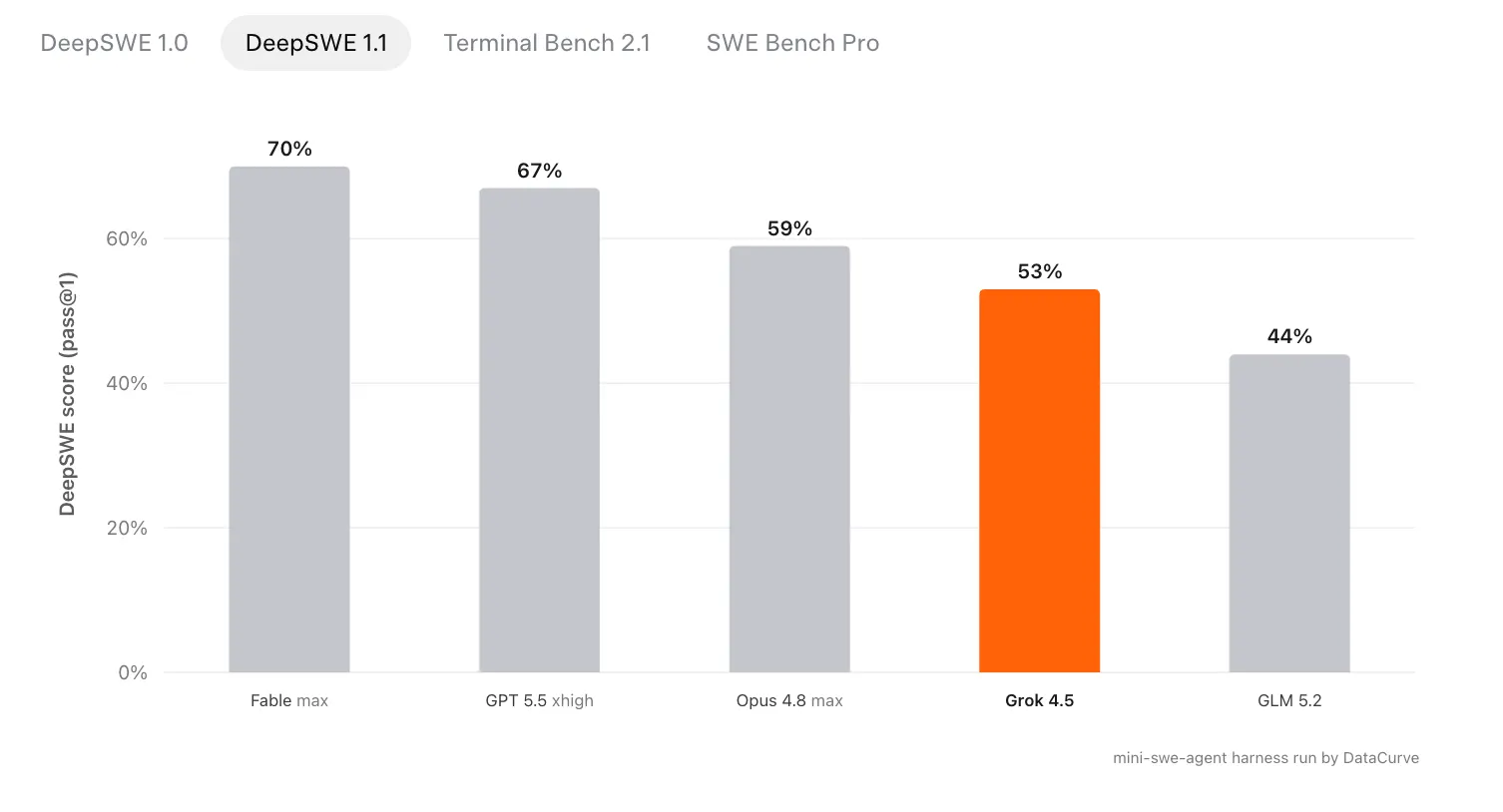
Upon its launch, SpaceXAI presented four key benchmark results for Grok 4.5, offering a nuanced view of its performance relative to industry leaders. The first, DeepSWE 1.1, is a critical measure of an AI’s ability to reliably resolve real-world software bugs submitted by developers. This benchmark utilizes a standardized testing setup to ensure fair comparison across models, with scores indicating the percentage of issues successfully fixed. In this demanding test, Grok 4.5 achieved a score of 53%, placing it behind Claude Opus 4.8, which scored 59%, and OpenAI’s GPT 5.5, which led with 67%. Anthropic’s frontier model, Claude Fable 5, topped the chart with an impressive 70%.
Another significant benchmark, SWE Bench Pro, evaluates an AI’s proficiency across a collection of software engineering problems, again scored by resolution rate. Here, Grok 4.5 demonstrated stronger performance, posting a resolution rate of 64.7%. This score was sufficient to surpass GPT 5.5, which registered 58.6% on this particular test. However, Claude Opus 4.8 maintained its lead at 69.2%, while Fable 5 solidified its position at the forefront with an 80.4% resolution rate. It is important to note that SpaceXAI’s benchmarks compared Grok 4.5 against GPT 5.5, not the newer GPT 5.6 Sol. This is due to the synchronous launch timing, with GPT 5.6 Sol being announced merely hours after Grok 4.5’s unveiling, making a direct, immediate comparison infeasible for the initial benchmark publication.
This pattern of competitive, yet not leading, performance has been a consistent characteristic across multiple Grok releases. SpaceXAI has consistently leveraged enormous computational resources, including the Memphis supercomputer "Colossus" with its total capacity across more than 200,000 Nvidia GB300 GPUs, to train its models. While the sheer scale of this hardware investment is immense, often dwarfing the resources available to other labs whose models currently outrank Grok on these benchmarks, the resulting models have consistently landed in the top tier but rarely secured the absolute first position. With Grok 4.5, the notable shift lies not only in its performance but also in its aggressive pricing strategy and a refined approach to training data, influenced by the pending acquisition of Cursor.
The Unfolding Chronology and Strategic Acquisitions
The journey to Grok 4.5 is rooted in a series of strategic moves by Elon Musk to consolidate and expand his footprint in the rapidly evolving AI sector. xAI, initially launched by Musk in July 2023 with a stated mission to "understand the true nature of the universe" and develop an AI that is "truth-seeking," quickly became a significant player. Its initial Grok models garnered attention for their capabilities and their integration with the X platform.
The pivotal moment arrived in February of the current year with the formal closure of the merger between SpaceX and xAI. This consolidation brought xAI under the broader umbrella of SpaceX, a move that integrated a formidable AI research and development arm directly into Musk’s space exploration and internet services empire. The rationale behind this merger was multifaceted: to leverage SpaceX’s immense computational infrastructure, benefit from its engineering talent, and create a synergistic ecosystem where AI advancements could directly support and accelerate projects like Starlink and future space missions, while also providing robust AI services to external clients.
Following the merger, the focus quickly shifted to enhancing xAI’s offerings. The pending acquisition of Cursor, an AI-powered code editor, for an estimated $60 billion, became a critical component of the Grok 4.5 development narrative. Cursor’s specialized expertise in developer tools and its rich dataset of developer session data, including debugging traces and real code edits, proved invaluable. This integration allowed SpaceXAI to train Grok 4.5 on a more practical, real-world corpus of coding activities, moving beyond static code repositories to capture the dynamic and iterative nature of software development. This strategic input, combined with the vast computational power of Colossus, aimed to imbue Grok 4.5 with a deeper, more practical understanding of coding challenges.
The launch of Grok 4.5 on Wednesday, July 8th, 2026, coincided with other major AI announcements, notably OpenAI’s GPT 5.6 Sol. This simultaneous release underscores the accelerating pace of innovation and competition within the AI industry, where companies are constantly vying for market share and technological leadership.
The Efficiency Argument: Real-World Savings and Iteration
While Grok 4.5’s raw performance benchmarks present a mixed picture, the compelling argument for its adoption lies firmly in its efficiency mathematics. This is where SpaceXAI aims to disrupt the market, especially for organizations that operate AI at scale. On the SWE Bench Pro tasks, for instance, Grok 4.5 demonstrated remarkable token efficiency, consuming an average of just 15,954 output tokens to successfully complete each job. In stark contrast, Claude Opus 4.8, performing the same tasks, burned through a staggering 67,020 output tokens – a dramatic 4.2x difference in token usage.
For enterprises and development teams that run AI models at high volume, this disparity in token consumption translates into profound and tangible cost savings, compounding significantly beyond the already lower price per token. Consider a large software company with thousands of developers, each making hundreds of AI requests daily for code generation, debugging, and review. The aggregate cost difference could amount to millions of dollars annually. Even if Grok 4.5 scores slightly lower in certain quality benchmarks, the combination of cheaper tokens and significantly higher efficiency in usage allows for a greater number of iterations, explorations, and problem-solving attempts without incurring exorbitant expenses. This capability is particularly valuable in agile development environments where rapid prototyping and iterative refinement are standard practice.
Furthermore, the model’s operational speed of 80 tokens per second places it firmly in the "fast-model" category. This high throughput is crucial for real-time applications and interactive development environments, where latency can severely impact user experience and productivity. Developers can receive near-instantaneous feedback, suggestions, and code completions, streamlining their workflow and reducing context switching.
The Cursor Influence and Training Practices
The integration of Cursor AI’s expertise and data has been a cornerstone of Grok 4.5’s development. By training the model on actual developer session data, including intricate debugging traces and real-time code edits, rather than merely static repositories, SpaceXAI aimed to imbue Grok 4.5 with a more dynamic and practical understanding of software development challenges. This approach allows the model to learn from the iterative, problem-solving process of human developers, theoretically leading to more contextually aware and useful outputs for coding tasks.
It is worth noting that xAI’s training practices have drawn scrutiny in the past. Elon Musk, during court proceedings related to his involvement with OpenAI, openly admitted that xAI had, at times, utilized OpenAI models for training purposes. This time, however, the pipeline for Grok 4.5’s specialized coding capabilities runs through a platform that SpaceX is in the process of acquiring outright, providing a more vertically integrated and controlled training environment. This direct ownership and control over the data source are expected to enhance the model’s performance and ensure compliance with internal standards.
Real-World Application and Accessibility
For developers and engineering teams engaged in high-volume coding tasks, the mathematical advantage of Grok 4.5 appears compelling. It offers capabilities roughly comparable to Anthropic’s previous flagship, Opus 4.7, but at a significantly reduced cost – approximately 60% less per input token. While those at the absolute frontier of AI research or requiring the highest possible raw capability might still gravitate towards models like Claude Fable 5, which demonstrably leads in every category SpaceXAI chose to publish, Grok 4.5 carves out a powerful niche for practical, everyday enterprise use.
Early, independent tests provide some initial user feedback. A quick test of a Grok build on Hermes indicated that the model was "underwhelming" for creative writing tasks, suggesting that its specialization might come at the cost of broader generative capabilities. However, it was found to be "acceptable" on a simple coding task, reinforcing its intended focus and utility.
Grok 4.5 is readily available via API, as well as on the Hermes and Grok build platforms. It boasts a substantial context window of half a million tokens, equivalent to approximately 400,000 words. Such a large context window is a critical feature for developers, enabling the AI to process and understand extensive codebases, comprehensive documentation, and entire project files, thereby providing more relevant and coherent assistance.
While the model is immediately available in many regions, European users will have to exercise patience. SpaceXAI has indicated that Grok 4.5 is slated to reach the EU market in mid-July. This phased rollout might be attributed to ongoing regulatory reviews, data privacy considerations, or logistical preparations for deployment across the diverse European digital landscape.
Broader Impact and Implications
The launch of Grok 4.5, with its aggressive pricing and emphasis on efficiency, is poised to send ripples across the AI industry. It challenges the prevailing narrative that only the most powerful, and often most expensive, models can deliver substantial value. By offering a high-performance, cost-effective alternative, SpaceXAI could compel competitors like OpenAI and Anthropic to re-evaluate their pricing structures, particularly for enterprise clients who are increasingly scrutinizing their AI expenditures. This could lead to a broader market shift towards more democratized access to advanced AI tools.
Grok 4.5’s strategy of targeting the "workhorse" AI niche – providing reliable, efficient assistance for specific professional tasks rather than chasing frontier model supremacy – represents a mature approach to AI product development. It acknowledges that for many practical applications, an optimal balance of capability, cost, and speed is more valuable than pushing the absolute limits of performance at any price. This shift in focus could influence future AI development strategies, encouraging more emphasis on model optimization, efficiency, and application-specific training rather than a singular pursuit of generalized intelligence.
Furthermore, Grok 4.5 strengthens Elon Musk’s broader technological ecosystem. Its deep integration with SpaceX and Tesla’s engineering workflows positions it as a critical internal tool, while its public availability extends its utility to the wider developer community. The vertical integration with Cursor signals a growing trend of AI companies acquiring specialized data and talent to refine their offerings, creating more tailored and effective solutions. As the AI market continues to evolve, Grok 4.5 stands as a testament to the power of strategic positioning and a keen understanding of user needs, potentially reshaping how enterprises leverage artificial intelligence for productivity and innovation.














