


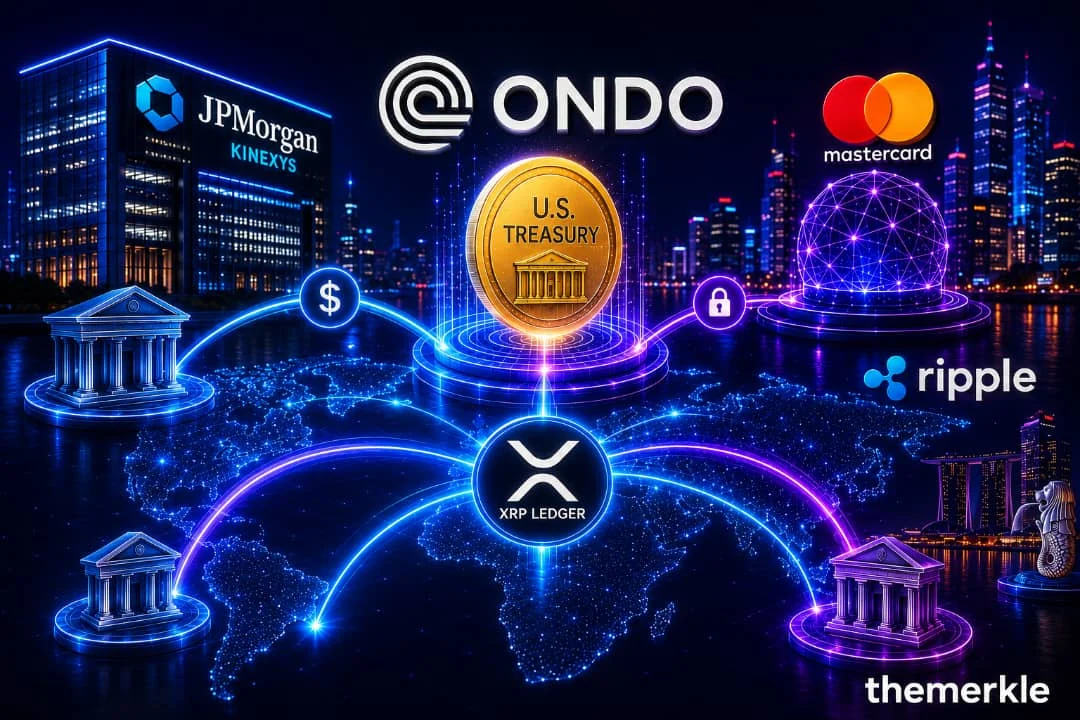
A landmark pilot transaction, orchestrated by Ondo Finance in collaboration with financial giants JPMorgan Chase, Mastercard, and Ripple, has successfully connected the XRP Ledger with traditional interbank settlement networks. This groundbreaking initiative represents a critical development at the confluence of legacy finance and nascent blockchain technology, showcasing a tangible pathway for tokenized assets to integrate seamlessly into global financial infrastructure. The successful execution of this pilot marks a significant inflection point, demonstrating the viability of near real-time, cross-border settlement for tokenized U.S. Treasuries, unhindered by conventional banking hours and geographical constraints.
The Dawn of a New Financial Epoch: Bridging Digital and Traditional Rails
The core achievement of this collaborative effort lies in its ability to facilitate the international and interbank settlement of tokenized U.S. Treasuries in a timeframe previously unattainable within traditional systems. This monumental step forward transcends mere technological novelty, laying the groundwork for markets that can operate 24 hours a day, seven days a week, effectively dissolving the barriers imposed by disparate time zones and institutional processing cycles. At the heart of this success is an intricately designed workflow that leverages the strengths of multiple platforms, creating a robust and efficient multi-layered financial infrastructure.
Ondo Finance, a leading provider of tokenized real-world assets, spearheaded the on-chain aspect of the transaction. Utilizing the XRP Ledger, Ondo performed a direct on-chain redemption of its tokenized U.S. Treasury product, OUSG. This action capitalized on the inherent speed, transparency, and immutability that blockchain systems offer, serving as a vital proof of concept for the dynamic interaction of tokenized assets within large-scale financial markets. The public announcement by Ondo Finance meticulously detailed the role assigned to each participant, illuminating the sophisticated synergy now emerging between blockchain innovation and established financial infrastructure. This convergence is not merely theoretical; it is unfolding in measurable, real-world transactions.
Understanding Tokenized Real-World Assets and Their Ascendance
To fully appreciate the significance of this pilot, it is essential to understand the concept of tokenized real-world assets (RWAs). Tokenization involves converting the rights to an asset, such as real estate, commodities, or, in this case, U.S. Treasuries, into a digital token on a blockchain. These tokens represent fractional ownership or claims to the underlying asset, offering enhanced liquidity, transparency, and programmability. The market for tokenized RWAs has seen exponential growth and institutional interest over the past few years. According to a report by Boston Consulting Group (BCG) and Polymath, the market for tokenized illiquid assets alone could reach $16 trillion by 2030, with a broader projection for tokenized securities and other assets potentially exceeding tens of trillions.
U.S. Treasuries, known for their stability and liquidity, are particularly attractive candidates for tokenization. Tokenizing these assets allows for instant settlement, reduced counterparty risk, and fractional ownership, opening them up to a wider range of investors and facilitating their use as collateral or liquidity instruments across various digital ecosystems. Ondo Finance’s OUSG product, for instance, provides investors with exposure to U.S. Treasury bills and short-term government bonds through an on-chain token, combining the benefits of traditional money market funds with the efficiency of blockchain. This pilot demonstrates that experimental blockchain technology is rapidly transitioning into practical, impactful applications within the global financial landscape.
A Chronology of Collaboration: The Transaction Unpacked
The successful execution of this cross-border transaction was far more than a symbolic gesture; it represented a functioning multi-layered financial infrastructure moving real value through disparate networks. The process unfolded in several critical stages, each leveraging the specialized capabilities of the participating entities:
-
Ondo Finance Initiates On-Chain Redemption: The journey commenced with Ondo Finance redeeming its tokenized Treasury product, OUSG, on the XRP Ledger. This initial step, performed on a public blockchain, served to settle the transaction’s digital asset leg. By leveraging the XRP Ledger, known for its speed and low transaction costs, Ondo demonstrated the efficiency of on-chain asset management and redemption. This phase showcased the capability of a decentralized network to manage and process the underlying claims of a real-world asset.
-
Mastercard’s Multi-Token Network (MTN) as the Interoperability Layer: Following the on-chain redemption, Mastercard’s Multi-Token Network (MTN) played a pivotal role as an intelligent routing layer. MTN facilitated the secure and efficient routing of transaction instructions from JPMorgan Chase’s Kinexys platform to JPMorgan’s blockchain-based settlement platform. Mastercard’s MTN is designed to enable various types of digital value to be exchanged across different blockchain networks and traditional payment systems, providing the critical interoperability needed to bridge the gap between distinct financial ecosystems. Its involvement underscored a commitment to developing secure and scalable solutions for the future of digital payments.
-
JPMorgan Chase’s Kinexys and Interbank Settlement: Kinexys, JPMorgan Chase’s blockchain-based platform, then took over the traditional banking side of the transaction. Kinexys handled the settlement of the delivery in U.S. dollars, ensuring that the liquidity triggered by the blockchain redemption was seamlessly realized within the conventional banking system. Kinexys is a key component of JPMorgan’s broader Onyx blockchain initiative, which aims to provide wholesale payments and digital asset services. This stage was crucial for demonstrating how a blockchain-initiated event could seamlessly trigger actions within established financial frameworks, ensuring regulatory compliance and stability.
-
Final Settlement to Ripple Bank’s Local Account in Singapore: In the concluding stage, the funds were directly sent to Ripple bank’s local account in Singapore. This final step completed the transaction, creating an elegant combination of decentralized blockchain infrastructure and centralized banking networks. The choice of Singapore, a prominent global financial hub actively promoting digital asset innovation, further highlighted the international scope and forward-thinking nature of the pilot. This end-to-end execution showcased how previously siloed financial systems can function together as a seamless transaction pipeline, moving value efficiently across borders and technological divides.
Statements and Reactions: A Glimpse into Strategic Intent
While specific direct quotes from executives regarding this particular pilot were not immediately released beyond Ondo’s announcement, the strategic alignment and public statements from these industry leaders provide insight into their motivations and vision.
A spokesperson for Ondo Finance would likely emphasize the successful validation of OUSG’s utility and the broader potential of tokenized U.S. Treasuries. They might state, "This pilot transaction is a monumental step for Ondo Finance and the entire tokenized asset ecosystem. It unequivocally demonstrates that OUSG can function as a highly liquid, transparent, and seamlessly integrated asset within both on-chain and traditional financial environments. Our collaboration with industry titans like JPMorgan, Mastercard, and Ripple proves that the future of finance is interoperable, and Ondo is proud to be at the forefront of this transformation, bringing real-world assets onto the blockchain with institutional-grade reliability."
Executives at JPMorgan Chase have consistently articulated their strategic investments in blockchain technology through their Onyx division. A statement from JPMorgan would likely underscore their commitment to modernizing wholesale payments and asset management. They might comment, "JPMorgan Chase is dedicated to exploring and implementing innovative technologies that enhance efficiency, reduce risk, and improve client experience in financial markets. The successful integration of Kinexys within this multi-party pilot further validates our strategic investments in blockchain-based solutions. This collaboration highlights the potential for a hybrid architecture where cutting-edge digital capabilities complement and strengthen existing financial infrastructure, paving the way for more connected and resilient global financial systems."
Mastercard has been vocal about its vision for a "Multi-Token Network" to facilitate the secure and compliant movement of digital assets. A Mastercard representative might state, "Our participation in this landmark pilot reaffirms Mastercard’s commitment to driving innovation and interoperability in the digital asset space. The Multi-Token Network is designed to be the connective tissue that bridges diverse digital ecosystems with traditional finance. This transaction showcases MTN’s capability to securely and efficiently route complex digital asset settlements, demonstrating how we can empower financial institutions to unlock the full potential of blockchain for cross-border payments and asset transfers, ultimately creating a more inclusive and efficient global economy."
Finally, Ripple has long championed the XRP Ledger for its speed and cost-efficiency in cross-border payments. A Ripple executive would likely highlight the XRP Ledger’s role in institutional finance. They might remark, "This collaboration is a powerful testament to the XRP Ledger’s robust capabilities and its increasing relevance in institutional finance. By directly connecting the XRP Ledger with interbank settlement rails, we are demonstrating its capacity to facilitate real-time, cross-border value transfer for tokenized assets. Ripple is committed to building the infrastructure for a future where money moves as efficiently as information, and this pilot with Ondo, JPMorgan, and Mastercard is a significant stride towards that vision, further solidifying the XRP Ledger’s position as a critical layer for global liquidity and settlement."
Broader Implications: Reshaping the Global Financial Landscape
This development represents a profound point of inflection for tokenized assets at large. The successful completion of this transaction unequivocally proves that tokenized assets can now break free from isolated blockchain ecosystems and integrate into mainstream financial infrastructure. They are progressing beyond merely being a new asset class to becoming full-stack elements of the broader financial services infrastructure, capable of connecting directly to banks, payment networks, and cross-border settlement systems. The ramifications of this shift extend far beyond incremental advances in speed and efficiency.
One of the most significant implications is the promise of 24/7 financial markets. While traditional financial markets have historically shut down at the close of the business day, this pilot demonstrates the ability for transactions to close during holidays or outside conventional banking hours. This capability allows for a truly global, "always-on" economy, facilitating continuous liquidity and reducing settlement risk by eliminating market gaps.
Furthermore, the process introduces unprecedented levels of programmability and transparency that traditional systems have struggled to scale. By leveraging blockchain technology, the need for multiple intermediaries and the associated counterparty risk can be significantly reduced through tokenization and automated settlement. This pilot validates these benefits not just in theory, but in an actual, high-stakes financial environment, marking a crucial step towards widespread adoption.
For traditional finance, this pilot underscores a strategic pathway for modernization without wholesale replacement of existing systems. Instead, it demonstrates a powerful model of complementary integration, where cutting-edge blockchain technology enhances the capabilities of established financial institutions. It promises improved operational efficiency, reduced costs, and the potential for innovative new financial products and services built upon a more transparent and resilient foundation.
For the participating entities, the benefits are clear:
- Ondo Finance solidifies its leadership position in the tokenized RWA market, with OUSG gaining crucial validation for institutional interoperability.
- JPMorgan Chase further validates its extensive blockchain investments through Onyx and Kinexys, reinforcing its role as a leader in fintech innovation and the modernization of wholesale payments.
- Mastercard showcases the practical application and value proposition of its Multi-Token Network, positioning itself at the forefront of digital asset payments and interoperability solutions.
- Ripple strengthens the XRP Ledger’s credibility and utility in institutional finance, particularly for high-value, cross-border payments and asset transfers, demonstrating its capability beyond speculative trading.
This pilot could very well act as a blueprint for future collaborations, encouraging other institutions to explore similar integrations. The success of this transaction unequivocally confirms that the long-debated convergence between blockchain and traditional finance is no longer a distant future goal; it is unfolding, measurably, one groundbreaking transaction at a time. This collaboration is not just about moving money; it’s about pioneering a more connected, efficient, and transparent global financial system for the 21st century.
Disclosure: This is not trading or investment advice. Always do your research before buying any cryptocurrency or investing in any services.














