



The dramatic upward revision is directly attributable to an exceptionally strong earnings season, particularly for the second quarter of 2026. Data compiled by Bloomberg Intelligence, and highlighted by The Kobeissi Letter, revealed that an impressive 86% of S&P 500 companies surpassed analyst expectations. This sentiment was echoed by LSEG, which independently reported that 86% of the 492 reporting companies managed to top estimates, significantly outperforming the long-term average beat rate of 67.5%. Such widespread outperformance signals a fundamental shift in corporate profitability, driven by factors beyond mere cyclical recovery.
The AI Imperative: A Catalyst for Historic Growth
At the heart of this optimistic outlook is the unprecedented buildout of artificial intelligence infrastructure. Nathaniel Welnhofer, an analyst at Bloomberg Intelligence, explicitly identified the AI infrastructure boom as the primary catalyst for the stronger 2026 earnings projections. Initially, the direct beneficiaries were predominantly chipmakers and hardware providers integral to AI development. However, the ripple effects have expanded considerably, now encompassing cloud services, digital advertising platforms leveraging AI, data center operators, and even companies benefiting from strategic AI-related investment income. This expansion underscores AI’s pervasive influence, transcending niche technology sectors to become a foundational driver of economic activity.
The investment cycle in AI has moved beyond speculative hype, transitioning into a critical phase of implementation and monetization. Corporations globally are pouring capital into AI research, development, and deployment, recognizing its potential to revolutionize operations, enhance product offerings, and unlock new revenue streams. This massive capital allocation fuels demand for high-performance computing components, specialized software, and advanced data infrastructure, creating a robust ecosystem of beneficiaries. The current wave of AI integration is not merely about incremental improvements but about fundamental business model transformations, which analysts are now factoring into long-term earnings models.
Sectoral Surge: Communication Services Leads the Way
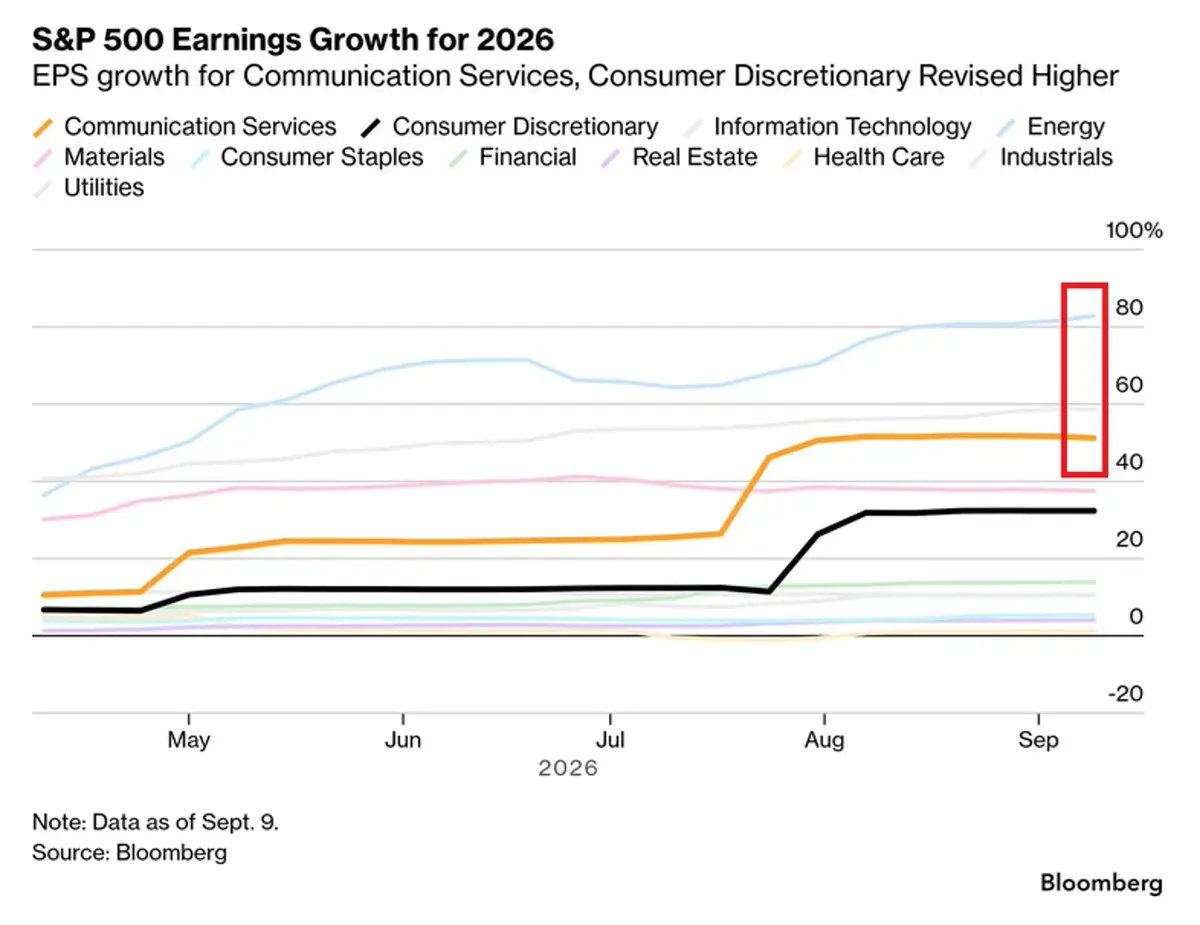
The impact of AI on corporate earnings has not been uniform across all sectors, but some have experienced particularly dramatic upward revisions. The Communication Services sector recorded the largest upward adjustment among major industry groups. Its projected 2026 earnings growth soared to an astounding 51%, a significant leap from the 26% growth projected at the start of the second quarter. This surge is largely attributed to companies like Alphabet, which demonstrated robust performance through strengthened digital advertising revenues, increasingly powered by AI-driven targeting and optimization, as well as new AI monetization strategies across its various platforms. Other companies within the sector also reported substantial earnings surprises, reflecting the broader benefits of AI integration in media, entertainment, and telecommunications.

Following closely, the Consumer Discretionary sector also saw its projected growth climb significantly, moving from approximately 12% to an impressive 32%. A major contributor to this upgrade was Amazon, which reported profits at roughly three times market expectations. Amazon’s performance was bolstered by its e-commerce strength and, crucially, by its dominant position in cloud computing through Amazon Web Services (AWS), which is a key provider of AI infrastructure and services. Beyond Amazon, a diverse group of consumer-facing companies, including Target, Walmart, TJX, Ross Stores, and Estée Lauder, also exceeded analyst estimates and raised their forward guidance, indicating resilient consumer spending and effective operational management, often enhanced by AI-driven efficiencies in logistics, inventory, and customer engagement.
The Bloomberg chart provided further insights into the breadth of the revision cycle, indicating that Energy earnings are projected to rise approximately 83% in 2026, driven by factors such as robust commodity prices and operational efficiencies. Information Technology profits, the core of the AI revolution, were forecast to increase by roughly 59%, underscoring the sector’s continued dominance in driving overall market growth. These figures highlight a widespread positive trend, suggesting that the benefits of technological advancement and economic dynamism are permeating various layers of the market.
Accounting Nuances and Investment Gains
While the underlying operational strength was undeniable, the second quarter also contained an important accounting effect that significantly amplified aggregate earnings figures. Reuters reported that aggregate S&P 500 second-quarter earnings were tracking approximately 52% higher from a year earlier. However, a crucial distinction emerged: excluding large mark-to-market gains primarily recorded by Alphabet and Amazon, the earnings growth would still have reached a substantial 33%. This adjusted figure, while lower, still represents the strongest pace of earnings growth since 2021, indicating robust organic performance even without the one-off accounting boosts.
Amazon, for instance, recorded an extraordinary $53.4 billion in second-quarter non-operating pre-tax income. A significant portion of this income was linked to unrealized investment gains, particularly from its strategic stake in Anthropic, a leading artificial intelligence startup. Similarly, Alphabet booked substantial unrealized investment gains, reflecting the increasing valuation of its venture capital portfolio, which includes numerous AI-focused companies. These mark-to-market adjustments, while legitimate under accounting standards, represent paper gains rather than direct operational profits, offering a nuanced perspective on the headline figures. Nevertheless, they underscore the immense value creation occurring in the AI ecosystem and the strategic positioning of major tech players in this burgeoning field.
Goldman Sachs further elucidated the profound impact of AI infrastructure companies, estimating that they generated roughly one-third of the total S&P 500 Earnings Per Share (EPS) growth during the quarter. This significant contribution demonstrates how deeply capital expenditures and strategic investments in AI have permeated the earnings picture, translating directly into shareholder value. The firm’s analysis underscores the shift from mere AI potential to measurable financial outcomes, reinforcing the analyst community’s confidence in the longevity of the AI-driven earnings expansion.
Analyst Revisions and Elevated Market Targets
The stronger profit outlook is already manifesting in elevated market targets from leading investment banks. Barclays, for example, raised its 2026 S&P 500 EPS estimate to $365 from its previous projection of $337. Concurrently, the bank lifted its year-end index target to 7,950 from 7,800, citing sustained AI investment and healthy economic activity as key supporting factors. This revision reflects a growing consensus that corporate America is on a stronger financial footing than previously assumed, primarily due to the transformative power of AI.
Other prominent financial institutions have also adjusted their forecasts upward, reflecting a broader optimism across Wall Street. UBS, Goldman Sachs, and Citigroup have all projected year-end S&P 500 index levels of 8,000 or higher, signalling a bullish stance rooted in stronger expected profits and continued economic expansion. These forecasts are not merely aspirational; they are built upon detailed bottom-up analyses of corporate earnings, sector-specific growth drivers, and macroeconomic indicators, with AI emerging as a dominant theme in their models. The collective upward revision by these influential firms suggests a fundamental recalibration of market expectations, moving beyond a wait-and-see approach to actively pricing in the benefits of the AI revolution.
Navigating Risks and Uncertainties
Despite the overwhelmingly positive sentiment, the earnings expansion still carries identifiable risks that warrant careful consideration. Barclays, while optimistic, flagged the sustainability of AI spending as a key uncertainty. The current pace of investment is extraordinary, and any slowdown due to technological saturation, regulatory hurdles, or shifts in corporate priorities could impact future earnings. Furthermore, rising memory costs, a critical component for AI hardware, are beginning to exert pressure on technology margins. As demand for high-bandwidth memory (HBM) and other advanced components escalates, supply chain constraints and pricing power could erode profitability for some players.
Beyond AI-specific challenges, broader macroeconomic factors continue to pose risks. Higher interest rates, a consequence of persistent inflationary pressures and central bank efforts to stabilize prices, could restrict valuation expansion. Companies relying heavily on debt financing for their AI investments might face increased borrowing costs, potentially dampening future growth. Persistent inflation also has the potential to erode consumer purchasing power, impacting the Consumer Discretionary sector and potentially slowing overall economic activity. The geopolitical landscape, trade tensions, and unforeseen global events also remain perennial risks that could disrupt supply chains, dampen investor confidence, and alter the trajectory of corporate earnings.
For now, the prevailing data unequivocally demonstrate that artificial intelligence is influencing more than just market sentiment; it is fundamentally reshaping earnings estimates, sector forecasts, and expectations for broader corporate profitability. The shift marks a measurable and significant change from the pre-season outlook, as stronger reported results have directly translated into higher profit expectations for 2026 and beyond. As companies continue to integrate AI into their operations and product offerings, the market will closely monitor these trends, discerning between sustainable growth fueled by innovation and potential overvaluation driven by speculative fervor. The unfolding narrative of AI’s impact on corporate earnings promises to be a defining characteristic of the current economic cycle.














