


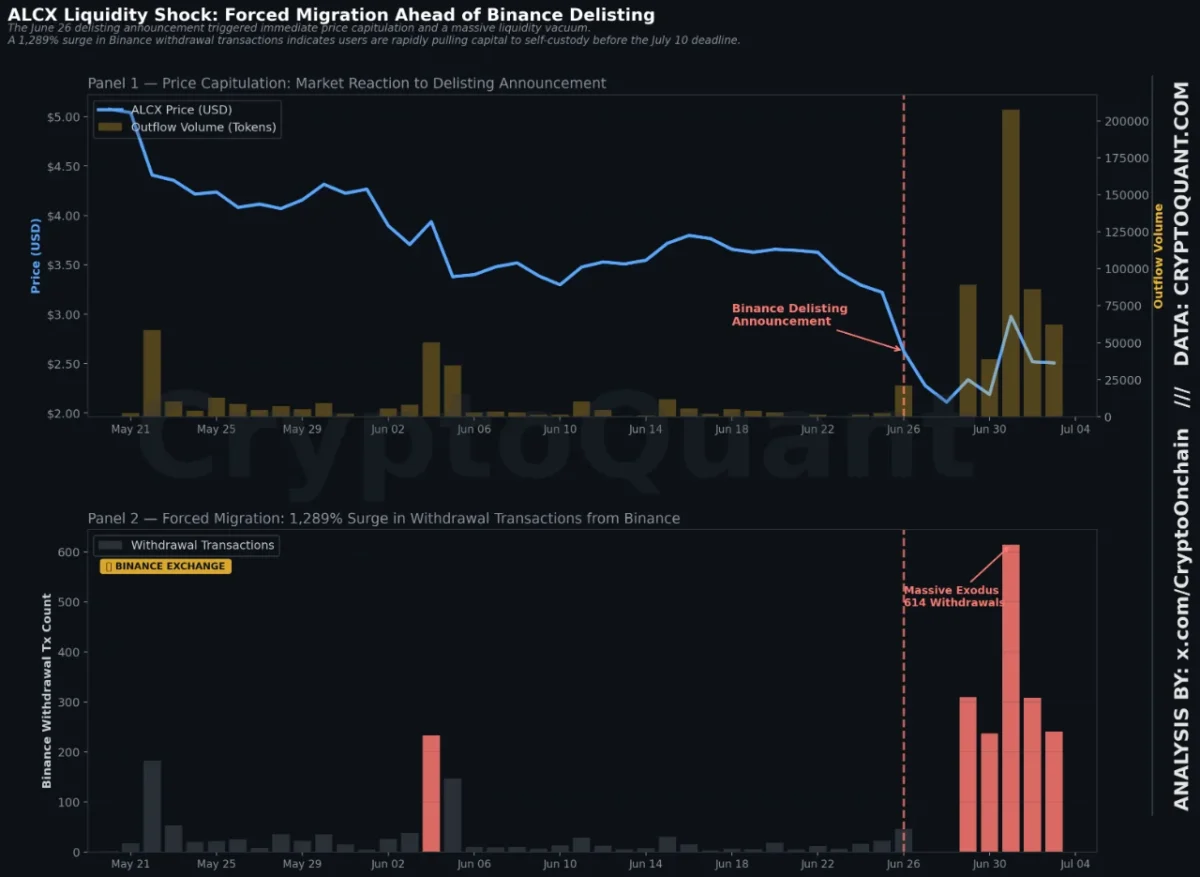
The cryptocurrency ALCX has experienced a dramatic downturn in value and a significant upheaval in its on-chain dynamics following an announcement from Binance, one of the world’s largest cryptocurrency exchanges, detailing its plans to delist the token. This decision, communicated on June 26, triggered an immediate and sharp decline in ALCX’s market price, alongside an unprecedented surge in withdrawal activity from the exchange, as traders and investors scrambled to reposition their holdings ahead of the critical July 10 deadline. The unfolding situation highlights the profound impact that major exchange decisions can have on even well-established digital assets, forcing a rapid redistribution of liquidity and testing the resilience of underlying projects.
Chronology of a Delisting and Market Reaction
The catalyst for the current market turbulence around ALCX was Binance’s official statement on June 26, confirming the impending removal of ALCX trading pairs. This announcement immediately sent shockwaves through the market, resulting in a precipitous 30% drop in ALCX’s price within hours. The sharp devaluation was not merely a reaction to the news but a direct consequence of the sudden loss of a major trading venue, prompting a wave of selling pressure and a re-evaluation of the token’s market access and perceived stability.
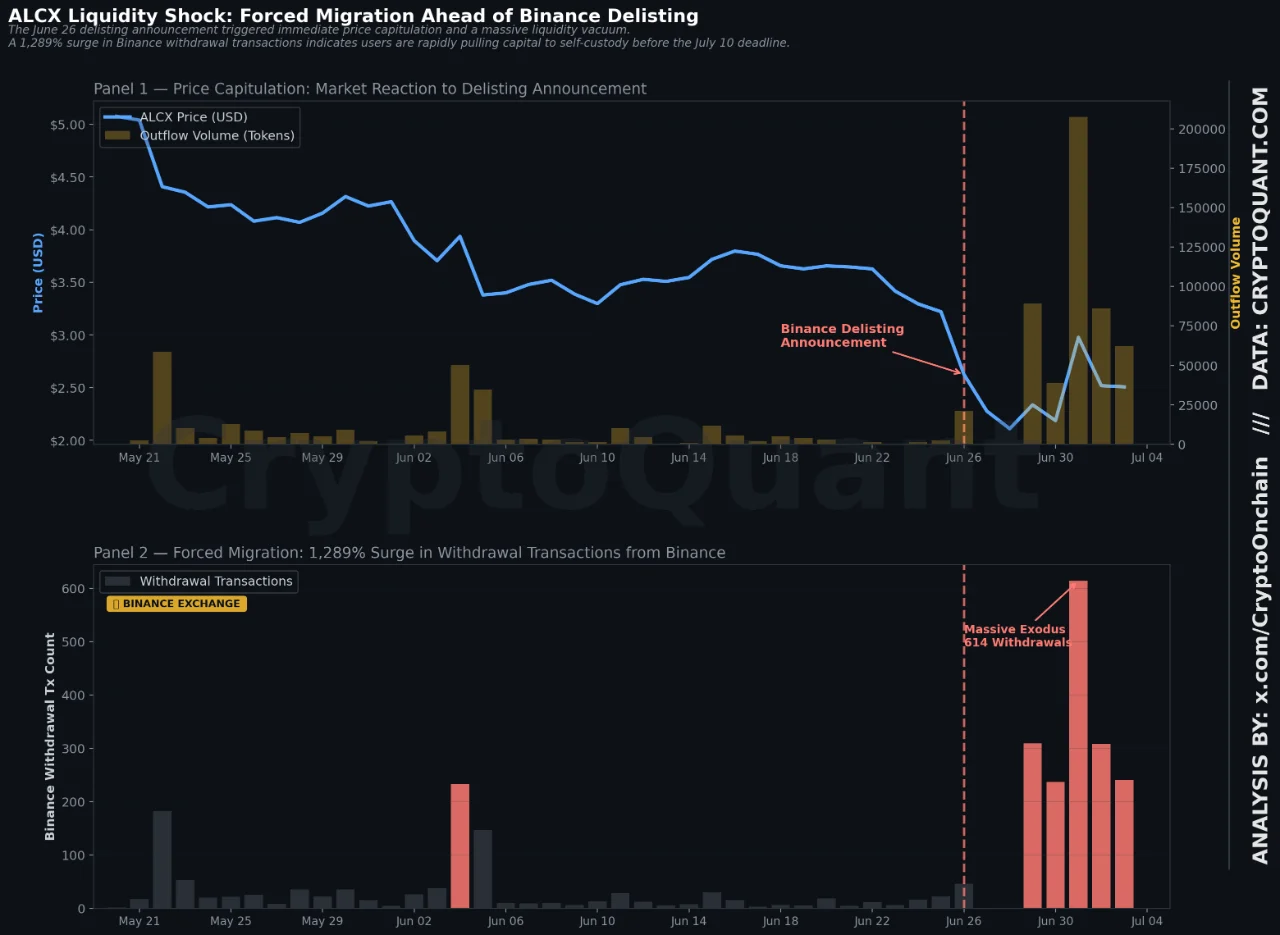
Following the initial price crash, on-chain data began to reflect a rapid and substantial shift in investor behavior. Binance withdrawal activity for ALCX surged dramatically, reaching levels far exceeding the typical daily baseline. By July 1, just five days after the announcement, withdrawal transactions from Binance had skyrocketed by an astonishing 1,289% week-over-week. This translated to 614 withdrawals on that single day, marking the highest recorded level of outflow activity for ALCX during the observed period. This intense migration off Binance signals a collective effort by investors to move their assets to self-custody or alternative exchanges where ALCX will continue to be supported and traded. The July 10 deadline looms large, intensifying this repositioning as the final date for trading and withdrawals on Binance approaches.
Deep Dive into On-Chain Data: A Forced Migration
The on-chain data provides a granular view of the "forced migration" phenomenon unfolding within the ALCX ecosystem. Beyond the headline-grabbing withdrawal surge, a more complex picture emerges when examining exchange flows in both directions. While Binance outflows increased by 1,484% week-over-week, illustrating the mass exodus, Binance inflows also climbed dramatically by 3,856%. This simultaneous surge in both inflows and outflows points to an intense period of repositioning rather than a simple one-way exit.
Analysts interpret this pattern as a multi-faceted response to the delisting. Some holders, recognizing the imminent cessation of trading, appear to be sending their ALCX tokens back to Binance specifically to liquidate their positions before the deadline. This contributes to the selling pressure and ensures they can exit their investment via one of the largest and most liquid platforms, even if at a reduced price. Concurrently, a larger cohort of investors is actively withdrawing ALCX from Binance, opting for self-custody in personal wallets or transferring their holdings to other centralized or decentralized exchanges that will continue to list the token. This dual movement underscores the urgency and strategic decisions being made by ALCX holders to mitigate potential losses and maintain access to liquidity.
The net effect of these movements has been a significant reduction in the amount of tradable ALCX liquidity remaining on Binance. The platform, once a primary hub for ALCX trading, is rapidly shedding its holdings of the token, creating a temporary liquidity vacuum. This dynamic can lead to increased price volatility and slippage on the remaining Binance order books as the supply dwindles and demand thins out.
Further reinforcing the narrative of liquidity migration, the data reveals persistent negative net flows, registering a substantial 285%. This metric indicates that significantly more capital is leaving Binance than entering it, solidifying the view that ALCX liquidity is steadily and unequivocally migrating away from the exchange. This trend is critical for understanding the long-term implications for ALCX, as its future trading environment will be defined by its presence on these alternative platforms.

Network Activity Climbs Despite Price Weakness: A Paradox of Reorganization
A seemingly counterintuitive trend has emerged amidst ALCX’s price decline: an increase in overall network activity. Despite the sharp drop in value, active addresses on the ALCX network surged by 107%, while total token transfers witnessed an astounding 510% increase after the delisting news broke. At first glance, such a spike in activity might suggest renewed adoption or stronger demand. However, a closer examination reveals that this is primarily a reflection of user reorganization rather than organic growth.
The heightened network activity is driven by investors and holders actively transferring assets between their personal wallets and various decentralized or centralized platforms. This intensive movement is a direct response to the upcoming delisting, as individuals prepare for trading to cease on Binance. It signifies a collective effort to secure assets, find new trading venues, and adapt to a reconfigured market landscape for ALCX. This distinguishes the current activity from genuine demand-driven growth, which would typically be accompanied by price appreciation. Instead, it illustrates a period of intense operational adjustments by the ALCX community.
Understanding Alchemix (ALCX) and Binance’s Delisting Framework
To fully grasp the implications of this event, it is crucial to understand both the project in question and the context of exchange delistings. Alchemix is a decentralized finance (DeFi) protocol that enables users to obtain "self-repaying" loans. It allows users to deposit collateral (such as DAI or ETH) and mint synthetic tokens (alAssets) that represent a future yield from their deposited collateral. The yield generated by the deposited collateral is automatically used to repay the loan over time, offering a unique approach to borrowing and lending in DeFi. ALCX is the native governance token of the Alchemix protocol, granting holders voting rights on protocol upgrades and parameter changes. The project has garnered a dedicated community and has been a notable player in the DeFi space.
Binance, as the largest cryptocurrency exchange by trading volume, wields immense influence over the market. Its listing and delisting decisions can significantly impact a token’s liquidity, price, and overall market perception. Exchanges typically have stringent review processes for the assets they list to ensure a healthy and secure trading environment for their users. While Binance has not publicly disclosed the specific reasons for ALCX’s delisting, common factors that lead to such decisions include:
- Poor Performance: Low trading volume, insufficient liquidity, and stagnant user activity.
- Project Viability: Concerns about the project’s development, team commitment, or long-term roadmap.
- Regulatory Compliance: Changes in regulatory landscapes or failure to meet evolving compliance standards.
- Network Stability/Security: Issues with the underlying blockchain, smart contract vulnerabilities, or network attacks.
- Community Engagement: Lack of active community support or poor public communication.
While the exact criteria ALCX may have failed to meet remain undisclosed by Binance, the decision underscores the exchange’s commitment to regularly assessing its listed assets. For a project like Alchemix, a delisting from Binance is a significant blow, challenging its market access and requiring a strategic pivot to maintain liquidity and community engagement on other platforms.
Statements and Reactions from Related Parties (Inferred)
While no official statements specifically addressing the ALCX delisting have been broadly publicized beyond the initial announcement, typical reactions from involved parties can be logically inferred:
Binance: It is highly probable that Binance’s stance aligns with its general policy on asset reviews. A likely statement from the exchange would emphasize its commitment to maintaining a high-quality trading environment. For instance, a representative might state: "Binance regularly reviews all listed assets to ensure they meet our high standards for quality, liquidity, and project viability. Our goal is to protect our users and maintain a healthy, transparent, and secure trading ecosystem. Tokens that no longer meet these criteria may be subject to delisting after careful consideration."
Alchemix Project Team: The Alchemix team would undoubtedly be focused on reassuring its community and facilitating a smooth transition for ALCX holders. Their likely response would involve: "The Alchemix team acknowledges Binance’s decision and is actively working to ensure a seamless transition for all ALCX holders. We encourage our community to migrate their tokens to other prominent decentralized exchanges (DEXs) and centralized exchanges (CEXs) where ALCX remains actively traded. Our commitment to the Alchemix protocol’s long-term vision, ongoing development, and vibrant community remains unwavering, and we are dedicated to strengthening our presence across alternative trading venues."
Market Analysts: Crypto market analysts would likely view this event as a critical case study in the power of centralized exchanges and the challenges faced by smaller-cap altcoins. A common analytical perspective might be: "Delistings from major platforms like Binance serve as stark reminders of the inherent risks in the altcoin market. While immediate price and liquidity shocks are inevitable, the true test for ALCX will be its ability to consolidate liquidity on other exchanges and demonstrate continued utility and community support. This ‘forced migration’ can, paradoxically, strengthen a project’s decentralization if it successfully diversifies its trading venues."
Broader Impact and Implications
The delisting of ALCX from Binance carries significant implications, not only for the token and its community but also for the broader cryptocurrency market:
For ALCX Holders: The immediate impact is the necessity to transfer assets, which can incur transaction fees and create logistical hurdles. Furthermore, the loss of Binance’s deep order books means that ALCX holders may face increased slippage when executing trades on smaller exchanges, potentially leading to less favorable prices. The psychological impact of a major exchange losing confidence in a token can also lead to reduced investor sentiment and sustained selling pressure.
For the Alchemix Protocol: The delisting presents a substantial challenge to the Alchemix project. It necessitates a renewed focus on strengthening listings on other centralized exchanges and bolstering liquidity on decentralized platforms. The protocol’s ability to maintain its trading volume and attract new users will be crucial for its long-term viability. It also serves as a reputational blow, potentially impacting developer confidence and future partnerships. The Alchemix team must now work diligently to ensure the protocol’s core functionality and utility remain unaffected by the trading venue changes.
For the Crypto Market: This event underscores the immense power wielded by centralized exchanges like Binance. Their decisions can profoundly influence a token’s fate, highlighting the risks associated with single-exchange reliance. It also reinforces the importance of regulatory compliance and robust project fundamentals, as exchanges continually evaluate assets against these criteria. For other altcoin projects, the ALCX delisting serves as a cautionary tale, emphasizing the need for diversified exchange listings, strong community engagement, and consistent development to mitigate the impact of such events.
Liquidity Reorganization May Drive Short-Term Volatility
The current on-chain picture strongly suggests that ALCX is undergoing a significant redistribution of liquidity, rather than experiencing typical market-driven activity. Binance, having served as one of the token’s primary trading venues, has left a temporary liquidity vacuum. As traders continue to relocate funds and market makers adjust their inventories across other platforms, this transition phase is likely to produce elevated volatility. The period leading up to and immediately following the July 10 delisting date will be particularly critical as the market adapts to a new trading environment for ALCX.
While the data confirms substantial selling pressure and large-scale fund movements, it is vital to recognize that much of the recent network activity has been driven by defensive positioning and logistical necessity rather than organic growth or renewed speculative interest. The longer-term impact on ALCX’s price and its overall market position will heavily depend on how quickly liquidity stabilizes across the exchanges that continue to support the token. The project’s ability to retain its community, attract new users to its decentralized applications, and prove its fundamental value in a fragmented trading landscape will ultimately determine its trajectory post-Binance delisting. The coming weeks will be a crucial test for Alchemix, as it navigates this significant market disruption and seeks to re-establish its footing in the broader crypto ecosystem.














