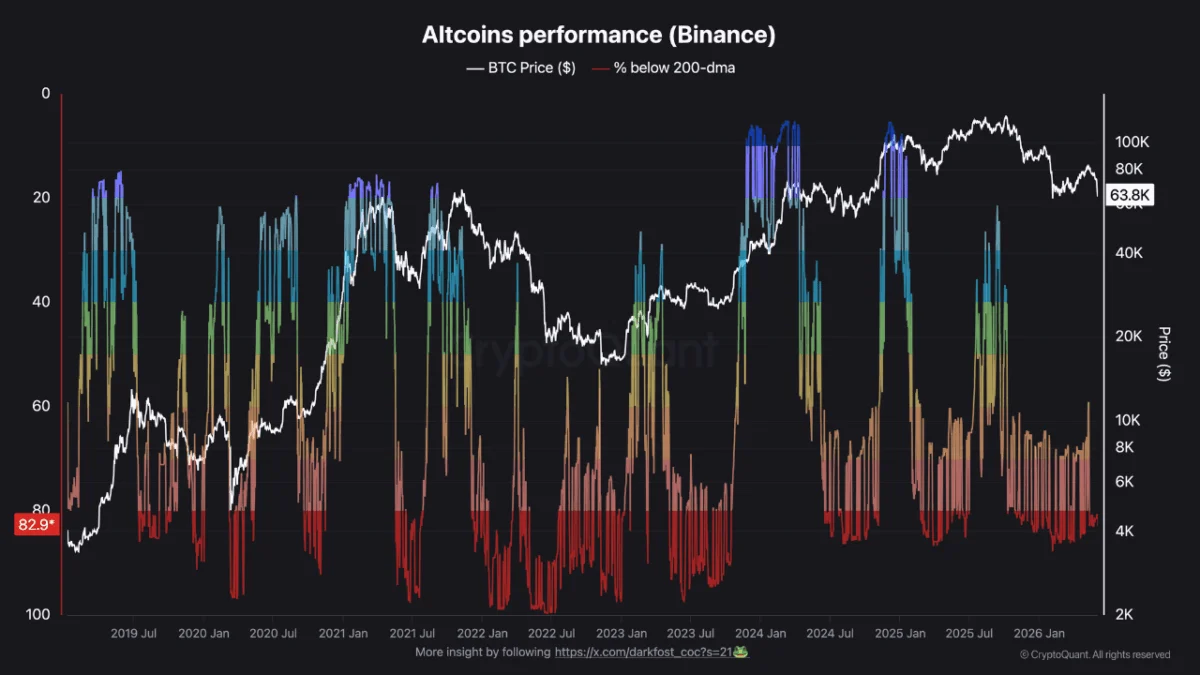
The global cryptocurrency market is currently navigating a period of intense volatility and structural realignment, characterized by a sharp divergence between Bitcoin’s relative resilience and the deepening struggles of the broader altcoin sector. Recent data indicates that the alternative cryptocurrency market is facing one of its most challenging phases in the current cycle, with a staggering 83% of all altcoins now trading below their 200-day moving average (200DMA). This technical milestone, often regarded by institutional traders as the definitive "line in the sand" between bullish and bearish long-term trends, highlights a systemic lack of momentum that has persisted despite Bitcoin’s occasional surges toward all-time highs.
The downturn in the digital asset space does not exist in a vacuum. It follows a catastrophic session in the United States financial markets, where over $1 trillion in market capitalization was erased in a single Friday trading session. This massive sell-off was primarily driven by a cooling of the artificial intelligence (AI) and semiconductor sectors, which have served as the primary engines of equity growth over the past eighteen months. As the S&P 500 retreated by 2.6% and the tech-heavy Nasdaq plummeted by 4.7%, the "risk-off" sentiment quickly bled into the crypto markets. Bitcoin recorded a 4% decline, but the impact on altcoins was far more pronounced, exposing the fragility of liquidity in the secondary tier of the digital asset ecosystem.
The Structural Decline of Altcoin Valuations
According to a comprehensive analysis by seasoned market observer Darkfost, the current state of the altcoin market suggests a "rust" that runs deeper than mere temporary price fluctuations. Since December 2024, altcoins have largely failed to maintain a positive correlation with Bitcoin’s price movements. In previous cycles, a surge in Bitcoin typically led to an "altcoin season," where capital would rotate from the market leader into higher-beta assets. However, the 2024-2025 cycle has seen a breakdown of this traditional rotation.
The 200-day moving average is a critical metric used to smooth out price data and identify long-term trends. When an asset trades below this level, it suggests that the average investor over the last six months is currently in a loss position, creating significant "overhead supply" as sellers look to break even on rallies. With 83% of altcoins currently trapped below this level, the market is signaling a lack of new capital inflow. Darkfost notes that this reading is among the weakest recorded in the current market cycle, suggesting that the "altcoin season" many retail investors have been waiting for remains elusive.
Historically, the share of altcoins trading below the 200DMA has fluctuated between 60% and 90% during bearish or consolidatory phases. The fact that the market is currently at the higher end of this range indicates a structural weakness. While Bitcoin has benefited from the introduction of spot Exchange-Traded Funds (ETFs) and institutional adoption, altcoins have largely been left behind, struggling with a lack of clear use cases, regulatory ambiguity, and a saturated market featuring thousands of new token launches that dilute available liquidity.
The $520 Billion Valuation Collapse
The financial consequences of this underperformance are starkly illustrated by the TOTAL3 chart, a metric provided by TradingView that tracks the total market capitalization of all cryptocurrencies excluding Bitcoin and Ethereum. This index is often used as a proxy for the health of the "true" altcoin market. Data reveals that the TOTAL3 valuation has shed approximately $520 billion since its peak in late 2024.
At its height, the combined altcoin market cap (minus the two leaders) approached nearly $1.2 trillion. As of February 2025, that figure has contracted to roughly $670 billion. This contraction has effectively erased months of gains, returning the sector to valuation levels last seen in November 2024. The velocity of this capital flight underscores the precarious nature of speculative assets during times of global economic uncertainty. As investors seek safety, they are increasingly concentrating their holdings in Bitcoin, which is viewed as a "digital gold," or retreating to stablecoins and cash, leaving the broader altcoin market in a liquidity vacuum.

A Chronology of Market Stagnation
To understand the current predicament, it is necessary to examine the timeline of the 2024-2025 market cycle. The trajectory of altcoins has been marked by brief periods of euphoria followed by long stretches of attrition:
- December 2023 – March 2024: The market experienced a broad-based rally fueled by the anticipation of the Bitcoin spot ETF approvals. During this window, nearly 90% of altcoins were trading above their 200DMA, marking the strongest breadth expansion since the 2017 bull run.
- April 2024 – September 2024: Following the Bitcoin halving, the market entered a period of "sideways" price action. While Bitcoin remained relatively stable, altcoins began to bleed value as the initial hype surrounding Layer 2 solutions and memecoins started to fade.
- October 2024 – December 2024: A brief resurgence occurred, with several mid-cap assets reaching yearly highs. However, this proved to be a "bull trap" for many, as the gains were not supported by a sustained increase in retail trading volume.
- January 2025 – Present: The decoupling between Bitcoin and altcoins intensified. While Bitcoin tested institutional resistance levels, the 83% metric for altcoins below the 200DMA became a reality, culminating in the $520 billion wipeout following the recent US equity market crash.
Macroeconomic Headwinds and Institutional Influence
The struggle of the altcoin market is inextricably linked to the broader macroeconomic environment. The recent $1 trillion loss in US markets was a reaction to several factors: disappointing earnings from major tech firms, rising concerns over the long-term ROI of AI investments, and a cautious Federal Reserve. In high-interest-rate environments, investors are less likely to gamble on speculative assets like small-cap cryptocurrencies.
Furthermore, the "institutionalization" of crypto has created a tiered system. Institutional capital entering through ETFs is strictly mandated to hold Bitcoin and, to a lesser extent, Ethereum. There is currently no equivalent vehicle for the vast majority of altcoins, meaning they lack the "sticky" capital that provides a floor for Bitcoin’s price. This has led to a market where Bitcoin acts more like a traditional financial asset, while altcoins remain tethered to the whims of retail sentiment, which has been dampened by inflation and economic pressure.
Analysis of Implications: Opportunity or Trap?
While the data paints a grim picture, some analysts, including Darkfost, argue that extreme pessimism often precedes significant market reversals. Historically, when 80% to 90% of the market is underperforming, it indicates an "oversold" condition. Conversely, the periods of maximum optimism—such as March 2024, when 90% of altcoins were above their 200DMA—often coincide with market tops and reduced upside potential.

For long-term investors, the current "capitulation" phase may represent a strategic entry point for projects with strong fundamentals. However, the sheer volume of assets in the market means that a "rising tide" is unlikely to lift all boats. The implications of the current 200DMA data suggest that the market is undergoing a "cleansing" process. Projects without clear utility, active developer communities, or sustainable tokenomics are likely to continue their decline, while the market eventually consolidates around a few dozen "blue-chip" altcoins.
The $520 billion loss in market cap also serves as a warning regarding the risks of "dilution." With new tokens being launched daily across various blockchains, the total supply of altcoins is expanding faster than the demand. This "supply inflation" makes it increasingly difficult for individual assets to sustain price growth, even if the total market cap remains stable.
Conclusion and Outlook
The altcoin market is currently at a crossroads. The convergence of a $520 billion valuation drop, a massive retreat in global equities, and the technical breakdown of 83% of assets below their 200-day moving average suggests that the era of easy gains for alternative cryptocurrencies has concluded. The market is now demanding more than just "hype" and "community"; it is looking for resilience and integration with the broader financial system.
As the dust settles from the recent $1 trillion US market wipeout, the focus for the remainder of 2025 will likely be on whether altcoins can reclaim their 200DMA levels. Until a significant portion of these assets can demonstrate sustained price action above these long-term averages, investor sentiment is expected to remain bearish. For now, the "flight to quality" remains the dominant theme, with Bitcoin maintaining its dominance while the broader altcoin ecosystem searches for a new bottom. The road to recovery will likely be slow and selective, favoring assets that can survive the current liquidity crunch and prove their value in a more discerning investment landscape.