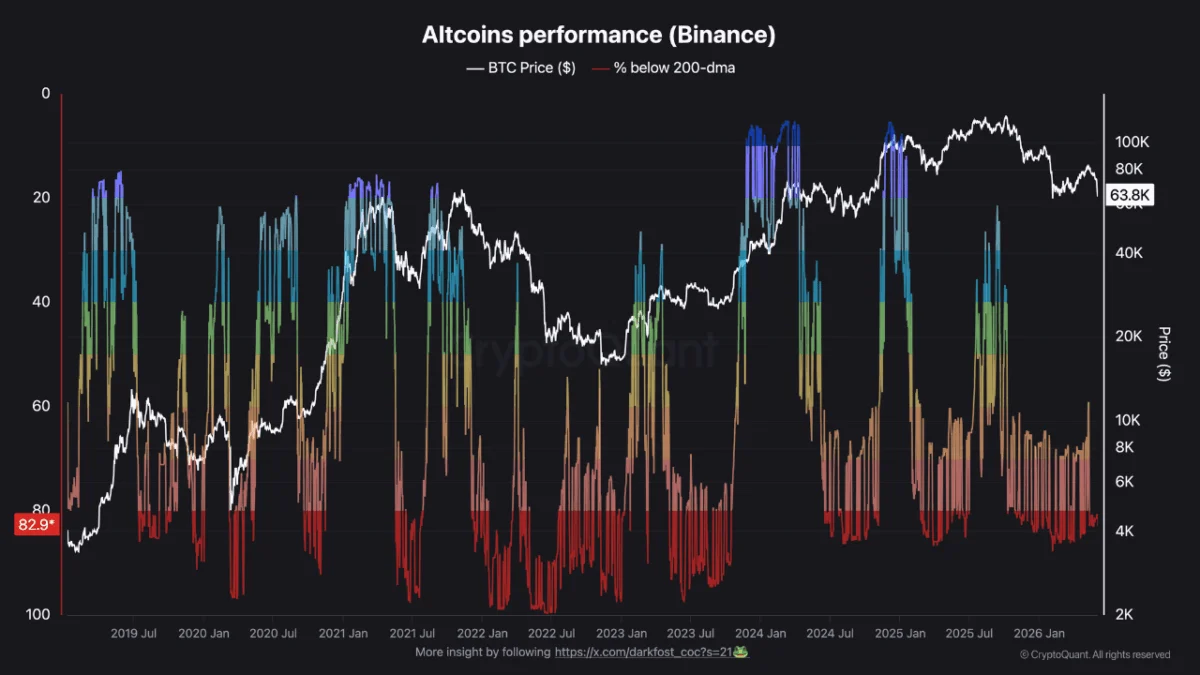
The cryptocurrency market is currently navigating a period of intense structural weakness, with a vast majority of altcoins struggling to maintain upward momentum in the face of broader financial instability. According to a comprehensive analysis by seasoned market expert Darkfost, the altcoin sector has entered a precarious phase, characterized by a significant decoupling from Bitcoin’s price action and a widespread failure to reclaim critical technical support levels. This downturn is underscored by the staggering revelation that 83% of all alternative cryptocurrencies are now trading below their 200-day moving average (200DMA), a metric widely regarded by institutional and retail traders as the definitive "line in the sand" between bullish and bearish long-term trends.
This technical decay follows a volatile period in the global financial landscape. On a recent Friday, US financial markets witnessed a massive deleveraging event, with over $1 trillion in market capitalization evaporated in a single trading session. This sell-off was primarily driven by cooling sentiment surrounding artificial intelligence (AI) and semiconductor stocks, which had previously served as the primary engines of equity growth. The ripples of this macro-economic contraction were felt acutely across all risk-on assets: the S&P 500 retreated by 2.6%, the Nasdaq Composite fell by 4.7%, and Bitcoin, the flagship digital asset, experienced a 4% decline. However, while Bitcoin has shown resilience in previous cycles, the altcoin market has failed to recover, instead sinking deeper into a prolonged period of underperformance.
The Technical Erosion of the Altcoin Sector
The 200-day moving average is a foundational tool in technical analysis, representing the average closing price of an asset over the previous 200 trading days. When an asset trades above this line, it is generally considered to be in a macro uptrend; conversely, trading below it suggests systemic weakness and a lack of buying pressure. Darkfost’s report highlights that the current reading—where only 17% of altcoins remain above this threshold—is among the weakest recorded in the current market cycle.
This lack of "market breadth" is a significant concern for analysts. In a healthy bull market, a rising tide typically lifts all boats, leading to a high percentage of assets trading above their long-term averages. The current data suggests a "hollow" market where capital is not rotating into smaller-cap assets but is instead concentrating in Bitcoin or exiting the ecosystem entirely. Since 2022, the share of altcoins trading below the 200DMA has fluctuated between 60% and 90%, but the persistence of the current low suggests a structural shift in how investors perceive the risk-reward profile of non-Bitcoin assets.
Chronology of the Decline: From Peak to Retraction
The journey to the current market state began in late 2024. While Bitcoin reached new heights, fueled by the success of Spot Bitcoin Exchange-Traded Funds (ETFs) and institutional adoption, the broader altcoin market began to exhibit signs of fatigue as early as December 2024. Unlike previous cycles, such as the 2017 ICO boom or the 2021 DeFi summer, the "Altseason" that many retail investors anticipated failed to materialize with the same vigor.
The decline accelerated following the peak of the TOTAL3 index—a metric provided by TradingView that tracks the total market capitalization of all cryptocurrencies excluding Bitcoin and Ethereum. From its local high in late 2024, the TOTAL3 index has shed approximately $520 billion. This massive outflow of capital saw the index plummet from its peak to a current valuation of roughly $670 billion. This contraction has effectively erased nearly a year of gains, returning the altcoin market to valuation levels last seen in November 2024.
This timeline reveals a sobering reality: for many investors who entered the altcoin market in late 2024 or early 2025, their portfolios are likely in a state of significant drawdown. The rapid flight of $520 billion reflects a "risk-off" sentiment that has been compounded by the lack of new retail liquidity entering the space.
The Macro-Economic Catalyst: AI and Semiconductors
To understand the current state of altcoins, one must look toward Wall Street. The cryptocurrency market has become increasingly correlated with high-growth tech stocks, particularly those in the AI and semiconductor sectors. As Nvidia, AMD, and other tech giants faced a correction due to concerns over overvaluation and the sustainability of the AI boom, the liquidity that often trickles down into speculative assets like altcoins dried up.
When the Nasdaq drops nearly 5% in a single day, institutional "risk parity" funds and algorithmic traders often trigger automatic sell orders across all volatile asset classes. Altcoins, which typically possess lower liquidity than Bitcoin or large-cap equities, suffer disproportionately during these liquidations. The $1 trillion loss in US markets created a vacuum of liquidity, forcing investors to consolidate their positions into "safe-haven" assets or cash, leaving altcoins vulnerable to further slippage.

Investor Sentiment and Capital Concentration in Bitcoin
A defining characteristic of the current cycle is the overwhelming dominance of Bitcoin. Historically, Bitcoin leads the market, and once it stabilizes at high prices, investors move "down the risk curve" into Ethereum and then into smaller altcoins. However, this cycle has broken the mold. The introduction of Bitcoin ETFs in the United States has created a "walled garden" of liquidity. Institutional capital flowing into these ETFs stays within Bitcoin, as these products do not allow for easy rotation into speculative on-chain assets.
Consequently, Bitcoin’s market dominance remains high, while altcoins struggle to find a narrative that attracts similar levels of capital. The "Bitcoin-only" thesis has gained traction among institutional players who view BTC as "digital gold" but remain skeptical of the long-term utility or regulatory status of the thousands of smaller tokens that make up the altcoin market. This concentration of capital has left the altcoin sector starved for the "fresh blood" necessary to sustain a broad-based rally.
Historical Context: Is There a Silver Lining?
Despite the grim statistics, Darkfost points out that extreme pessimism has historically been a precursor to significant market opportunities. The analyst notes that periods where the vast majority of altcoins trade below their 200DMA are often the points of maximum financial opportunity for long-term contrarian investors.
By contrast, the periods of March and December 2024 saw nearly 90% of altcoins trading above their 200DMA. While these periods felt exuberant and profitable, they actually represented "overheated" market conditions where the upside potential was limited and the risk of a correction was at its highest. The breadth expansion seen during those months was the strongest since 2017, suggesting that the subsequent correction was a necessary, albeit painful, "cleansing" of market excesses.
Implications for the Future of the Ecosystem
The current "cleansing" of the altcoin market has several long-term implications:

- Survival of the Fittest: With 83% of assets in a technical downtrend, many "zombie projects"—cryptocurrencies with no active development or utility—may never recover. This could lead to a much-needed consolidation of the market, where only projects with genuine use cases and sustainable tokenomics survive.
- Regulatory Pressure: The ongoing scrutiny from global regulators, particularly the SEC in the United States, continues to cast a shadow over altcoins. Many assets are being evaluated under the Howey Test, and the uncertainty regarding their legal status prevents institutional "long-only" funds from providing the liquidity needed for a recovery.
- The Search for a New Narrative: For altcoins to reclaim their 200DMA, the market requires a new catalyst. Whether it is the advancement of Real World Asset (RWA) tokenization, breakthroughs in Layer-2 scaling, or a resurgence in Decentralized Finance (DeFi), the sector needs to move beyond mere speculation to attract sustained investment.
- Retail Fatigue: The "retail" investor, who traditionally drives altcoin manias, has been hampered by inflation and high interest rates. Without a significant shift in global monetary policy—such as a series of aggressive rate cuts by the Federal Reserve—the "excess" capital required to fuel a new altcoin season may remain sidelined.
Conclusion
The altcoin market is currently enduring a "stress test" of historic proportions. The combination of a $520 billion market cap loss and the fact that four out of five altcoins are trading in a macro downtrend paints a picture of a sector in crisis. While the correlation with struggling US tech stocks has exacerbated the decline, the internal dynamics of the crypto market—specifically the dominance of Bitcoin and the lack of new retail participants—suggest that a recovery may be slow and selective.
For the disciplined investor, this period of extreme bearishness serves as a reminder of the cyclical nature of digital assets. While the 200DMA currently acts as a ceiling for the majority of the market, historical data suggests that the foundation for the next major expansion is often built during these very moments of widespread underperformance and capital flight. As the market continues to process the shock of recent global financial losses, the focus remains on whether altcoins can find a bottom or if the "crypto winter" for alternative assets is set to settle in for a longer stay.